
Fassen Sie diesen Blogbeitrag wie folgt zusammen:
| Agentic AI in retail interprets data against goals, evaluates options, acts across service, inventory, pricing, merchandising, assortment and omnichannel operations within rules, thresholds and guardrails. |
TL;DR:
Agentic AI in retail moves AI from recommendation to action. AI agents in retail can interpret data, evaluate options and execute decisions across customer service, inventory, pricing, merchandising, assortment and fulfilment within defined guardrails. The strongest use cases are high-frequency, time-sensitive decisions where faster action creates measurable value. However, success depends on clean data, connected systems, clear ownership and human controls that define where agents can act autonomously and when they must escalate.
- What agentic AI in retail means, and where an AI agent stops being an assistant
- How AI agents in retail differ from traditional predictive and rules-based retail AI
- Six agentic AI use cases in retail with the clearest path to measurable value
- How agentic AI supports retail planning, merchandising and pricing decisions
- What has to be true in data and governance before agents act unsupervised
- Which agentic AI trends in retail matter for 2026, and which are still early
Agentic AI in retail involves developing systems that are able to understand retail data and the objectives of the business, evaluate the options and execute the decision within the broader system of interconnected retail business processes with minimal human intervention. This can include AI agents that handle retail order management, customer service, inventory, pricing, merchandising, and assortment planning, omnichannel fulfillment, and working within the constraints of business rules, budgets and people.
Agentic AI in the retail industry is a different category, and the distinction is operational. A retail AI agent is given a goal rather than a query. It deconstructs the goal into mini-steps, fetches what it requires from POS, inventory, pricing and supplier data sources, evaluates tradeoffs against rules of thumb and boundaries, then acts within a state-aware connected system. The output supplies the next opportunity for decision-making.
Four properties separate an autonomous AI agent from an assistant:
- Goal orientation. The instruction is an outcome, such as holding a category above 97 percent in stock inside a working capital ceiling, not a task.
- Multi-step reasoning. It plans a sequence and revises when conditions change mid-execution.
- Tool and system access. It writes back into the OMS, the pricing engine or the planogram rather than producing a recommendation for someone else to key in.
- Bounded autonomy. Every action sits inside thresholds, approval tiers and audit trails a human defined.
A retail AI agent runs a closed loop. The same six stages repeat whether the decision is a markdown, a transfer or a service resolution:
- Retail data. POS, on-hand and in-transit inventory, customer records, competitor pricing, supplier lead times, fulfilment capacity.
- Context. What has already been committed: open-to-buy, allocated stock, promotional calendar, margin targets.
- Reasoning. Options evaluated against the objective and the constraints, including second-order effects on adjacent categories.
- Decision. An action selected, or escalated when confidence or financial exposure crosses a threshold.
- Action. Executed inside a connected system, within guardrails.
- Feedback. The outcome measured and folded into the next cycle.
Stages one to four are where vendor demonstrations concentrate. Stage five is where pilots stall. Writing back into an ERP, OMS, PIM or pricing engine needs write permissions, transaction integrity, rollback paths and an audit record a controller will accept. That is a data engineering problem, not a model problem, and the most common reason a proof of concept never reaches production.
The two are complementary. Agents consume the forecasts and elasticity models a retailer already has. What changes is what happens after the model produces a number.
| Dimension |
Traditional retail AI |
Agentic AI in retail |
| Input |
A defined question or scoring task |
A business goal with constraints |
| Output |
A prediction or recommendation |
An executed action plus a record of why |
| Trigger |
Scheduled batch or user request |
Continuous monitoring of live signals |
| System access |
Read access, output to a dashboard |
Read and write across connected systems |
| Human role |
Interprets output, executes manually |
Sets objectives and guardrails, handles exceptions |
| Failure mode |
Model drift, stale assumptions |
Unbounded action, weak lineage and audit trail |
| Data dependency |
Tolerates gaps through aggregation |
Requires clean, current, governed source data |
These use cases are ordered by the strength of production evidence behind them, highlighting where agentic AI in retail is already showing the clearest path to measurable business value.
1. Kundenerlebnis und Service
A customer adds to cart at lunch, sees a delivery date of tomorrow, and later tries to check out only to find the date has changed. They contact support, and a chatbot asks for information the retailer already holds. Nearly half of shoppers, 49 percent, abandon purchases because of ordering friction.
Agentic AI will autonomously resolve 80 percent of common customer service issues without human intervention by 2029. Gartner
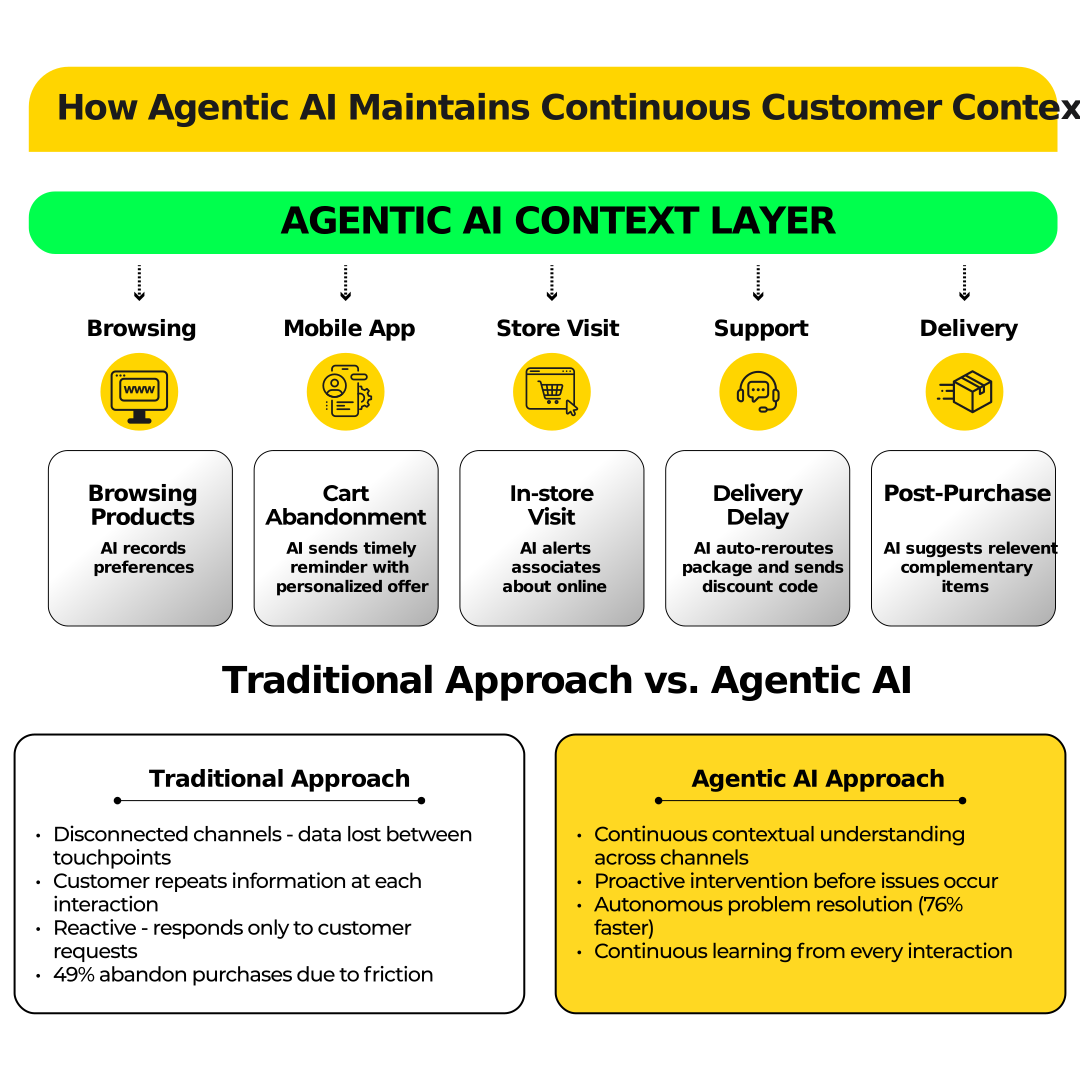 Wie agentenbasierte KI den Kundenkontext über alle Kontaktpunkte hinweg kontinuierlich aufrechterhält
- Continuous contextual understanding. The agent holds awareness across channels. When someone browses online then walks into a store, it already knows what they were looking at and briefs the associate.
- Proactive intervention. Where a product is out of stock online but available nearby, it offers a reservation for pickup rather than returning an out-of-stock message.
- Autonomous resolution. When a package is delayed, it reroutes, applies goodwill credit inside policy, and notifies the customer of the fix rather than apologising for the problem.
The caution is scope. Autonomous resolution works on high-frequency, low-ambiguity cases: delivery status, address changes, returns, size substitution. Escalation for fraud, pricing disputes or regulated categories should be non-negotiable from day one.
2. Inventory Management and Replenishment
Inventory carries the largest quantified prize and the most demanding prerequisites. IHL Group puts global inventory distortion, the combined cost of out-of-stocks and overstocks, at 1.7 trillion dollars a year, or 6.2 percent of retail sales in 2026. The trend is improving, down from 10.4 percent in 2021, but the residual is still roughly the GDP of South Korea written off annually.
The reason it stays stubborn is granularity. Each SKU-location combination carries its own decisions on buy quantity, reorder timing, allocation, lifecycle, markdown and substitution. Traditional systems force broad parameters across whole categories, while every SKU has its own demand pattern and elasticity. That mismatch drives much of the distortion.
This is the class of problem agentic systems handle well: high volume, repeatable, rule-bounded, too granular for a human at the required frequency. A stock tracking agent monitors velocity, an inventory flow agent shifts allocation priorities when a trend emerges, a pricing agent adjusts terms in response. The coordination produces the result, not any single agent.
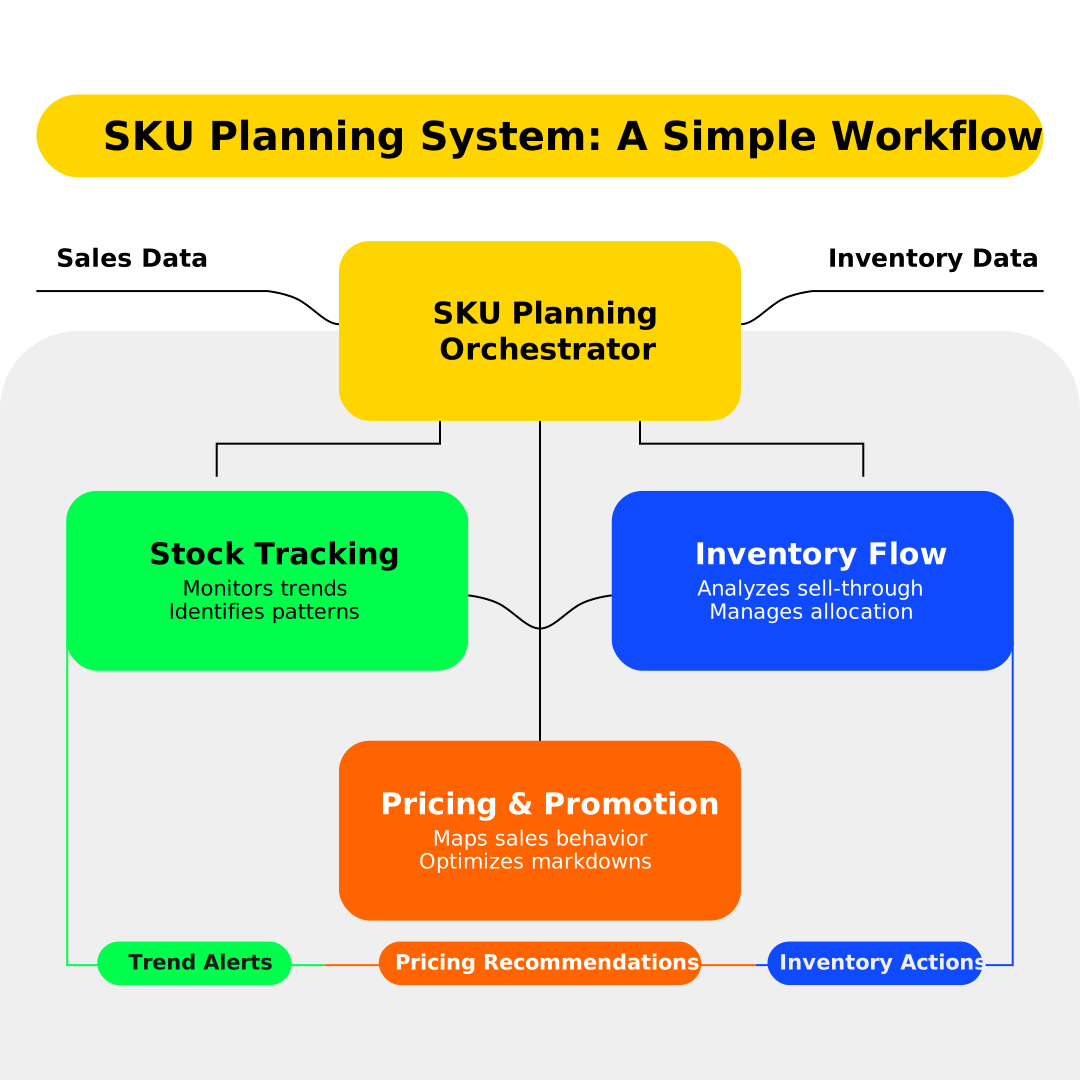 SKU planning bot’s easy to understand workflow
The prerequisite is unforgiving. Agents acting on inventory need accurate store-level perpetual inventory, and most retailers do not have it. IHL identifies data quality, integration, inventory visibility and store-level edge infrastructure as the four gaps that turn a 2026 commitment into a 2027 cancellation.
Gartner expects spend on supply chain software with agentic AI to reach 53 billion dollars by 2030.
3. Dynamic Pricing and Promotion Optimization
Pricing is the one that has the most immediate link between the decision of an agent, its effect on the P&L and which is why that needs the more precise limits.
Machine learning already generates price recommendations against predefined targets, which then pass through several review layers before execution. BCG identifies this as the core inefficiency in retail merchandising today: space planning, promotions, pricing and forecasting run as separate processes, and the merchant spends more time assembling inputs than judging outputs.
Agentic AI pricing optimization changes the review layer, not the model. The agent monitors competitor moves, elasticity, inventory cover and margin continuously, executing within a corridor: a maximum move per cycle, a floor margin, protected key-value items, escalation above a set exposure. Anything outside goes to a human with the reasoning attached. In promotions the value is less in finding a new discount than in killing underperforming mechanics quickly and catching cannibalisation before the period closes.
Two cautions practitioners will recognise. Agentic pricing inherits every weakness in the competitor feed, and scraping quality varies widely by category and geography. And an agent optimising one category in isolation makes locally rational decisions that damage adjacent ones, so cross-category constraints must be modelled explicitly.
Price the elasticity. Model the retaliation.
PricePulse simulates how the market answers a price change before it ships, so pricing teams set the corridor an agent executes inside instead of discovering it in the post-mortem.
Related: RGM Suite, AI Pulse Suite, and leading price optimization software companies.
4. Assortment and Merchandising Optimization
Most retailers still plan assortments on historical data, category heuristics and merchant intuition. It works, but it produces selections that are reactive to last year, slow to adapt, too uniform across markets, and prone to stockouts and overstocks at once.
The quarterly review is giving way to continuous monitoring. Assortment Observer agent alerts merchants within hours when an adjustment is warranted, surfaces product relationships category-level analysis misses, and returns planogram recommendations based on current conditions.
McKinsey sizes the prize at up to 40 percent of a merchant’s time reclaimed from repetitive work and redirected into vendor negotiation and strategy. That prize is conditional, and the barrier is rarely the model. A merchandising agent that cannot see committed open-to-buy or the margin target finance holds the category to will produce recommendations that are technically valid and commercially incomplete, and the merchant goes back to reconciling by hand.
Warning: may cause excessive clarity in your product mix.
See how smart retailers are boosting sales and cutting costs with better product placement.
5. Omnichannel and Fulfillment Optimization
Omnichannel in most retail organisations is not a symphony. E-commerce promotions cannibalise store sales, store teams hold inventory that would sell faster online, and marketplace strategy undercuts direct-to-consumer margin. By the time teams align, the market has moved. The instinct is to call it a technology problem. It is usually a decision velocity problem wearing a technology costume.
Agentic AI for retail operations orchestrates channels as a single business:
- When store traffic drops in a region because of weather, the agent shifts promotional emphasis to mobile channels there
- When a marketplace undercuts a key product, it adjusts online pricing while holding in-store margin where the competitive set differs
- When inventory builds in specific stores, it redirects to fulfilment nodes serving higher e-commerce demand
- Instead of batching weekly, it makes thousands of micro-adjustments daily
The caveat is latency. Fulfilment orchestration has to resolve in the time it takes a customer to reach checkout, and store-level network and edge infrastructure is a real constraint in a large estate. A routing agent that resolves in eight seconds is a worse experience than the static rule it replaced.
6. Personalized Shopping and Agentic Commerce
The five use cases above are agents working for the retailer. This one is agents working for the shopper, and it inverts the relationship. McKinsey estimates that by 2030 the US B2C retail market alone could see up to 1 trillion dollars in orchestrated revenue from agentic commerce, with a global range of 3 to 5 trillion. That covers both agent-completed transactions and human purchases shaped by AI recommendation, which is the more realistic near-term category.
Agentic commerce dominated NRF 2026, where Google announced a protocol governing agentic commerce on its platform, following the Agentic Commerce Protocol from Stripe and OpenAI. Whether these settle into an interoperable standard or fragment into competing rails is the open infrastructure question.
The implication is unglamorous: product data becomes the interface. Adobe found AI traffic arriving in volume while retail pages stay inconsistently machine-readable, product detail pages worst of all. Structured, real-time product, price and availability data decides whether an agent can transact on an assortment. Keep it in proportion though: agent-completed checkout is still a small share of transactions, and the investment holds up on discovery economics alone.
The value of agentic AI in retail extends beyond automating tasks. This is the real prize: narrowing the time lag between the point at which a challenge is spotted, and the point at which decisions are made and executed by linked-up retail operations.
1. Faster decisions from signal to action
In the traditional retail process analysis and execution are often disconnected. AI agents in retail can monitor constantly evolving situations, assess alternatives, and take actions within specified boundaries. This enables retailers to respond to demand changes, stock challenges or service issues more rapidly than the next planning or review cycle.
The benefit is not simply faster analysis. It is reducing the time between recognising a change and taking the appropriate action.
2. More merchant time for higher-value decisions
Agentic systems can take over repetitive analysis, monitoring and reconciliation that consume merchant capacity. This gives teams more time for assortment strategy, vendor negotiations and category decisions.
For example, Walmart says its agentic merchant tools automate time-intensive tasks such as data entry and analysis. Its Trend-to-Product capability has also shortened traditional fashion production timelines by as much as 18 weeks, showing how AI can reduce operational effort while helping merchants respond faster to changing trends.
3. More responsive inventory and replenishment
Agentic AI inventory management allows retailers to respond continuously to demand velocity, stock availability, supplier lead times and fulfilment constraints. Instead of identifying an imbalance after it occurs, agents can adjust replenishment or allocation as conditions change.
The benefit, however, depends on accurate store-level inventory and current supply data. Giving an agent faster decision-making capability adds little if the inventory position it sees is incomplete or outdated.
4. Faster pricing decisions without giving up control
The other benefit of agentic AI pricing optimisation is that it can track the competition, elasticity, cover and margin from competitors at the same time and modify prices along highly defined corridors.
Using human teams still establishes the divisions, like margin floors, defended items, maximum price changes and escalation points. The benefit is therefore not simply making more price changes. It is responding earlier while keeping pricing and promotion decisions inside commercial constraints.
You might also like:
AI Price Optimization in Action: Retaining Customers and Amplifying Profits
5. Faster and more consistent customer resolution
Automating high-volume, rule-based enquiries with agentic AI customer service and escalating exceptions for additional judgement can take care of much of your AVE and allow human agents to focus on more complex situations.
L'Oréal provides a real-world example. After introducing agentic AI into its consumer-care workflows, the company reported a 64% reduction in average case handling time, from around seven minutes to about 2.5 minutes. The system supports tasks including case summarisation, response drafting, intent validation and promotional-code generation.
6. Better coordination across retail decisions
The longer-term value comes when agents stop operating as isolated tools. Agentic AI retail planning can connect decisions across inventory, pricing, merchandising and fulfilment, allowing an action in one area to account for its impact elsewhere.
For example, a pricing agent optimizing margin and an inventory agent reducing excess stock could make individually sound decisions that conflict with each other. Coordinated agents can evaluate those trade-offs against a shared commercial objective before acting.
This is where agentic AI for retail moves beyond task automation towards orchestrating connected decisions across the retail value chain.
| Benefit |
In practice |
| Decision velocity |
Signal to action compresses to intraday |
| Merchant capacity |
Up to 40 percent of time redirected to strategy |
| Inventory efficiency |
Fewer simultaneous stockouts and overstocks |
| Margin protection |
Continuous price adjustment inside a corridor |
| Service quality |
Autonomous resolution of routine cases |
| Auditability |
Every action carries its reasoning and lineage |
A forecast that is wrong produces a bad number. An agent that is wrong produces a bad number and acts on it, at machine speed, across a store estate.
- Unbounded action. Maximum exposure per decision and per period, protected items and categories, and a kill switch a business user can operate without an engineering ticket.
- Data lineage. When an agent reprices a category, the retailer must reconstruct which inputs drove it. Regulatory in some categories, commercially necessary in all.
- Compounding error. Agents acting on other agents’ outputs propagate upstream data problems faster than review cycles catch them. Circuit breakers on anomalous volumes are cheap insurance.
- Accountability. Every AI agent should have a clearly identified business owner responsible for its actions, outcomes and escalation. Weak risk controls, rather than model performance alone, are a major reason agentic AI projects are expected to fail.
- Agent washing. Some tools are positioned as agentic even when they only generate recommendations. A simple procurement test for agentic platforms/tools is whether the system can take autonomous action within connected systems. If it cannot, it is closer to an assistant than an autonomous agent.
- Diagnose the foundation first. Inventory accuracy, integration, governance and edge infrastructure determine what is feasible. Unglamorous, and the step most often skipped.
- Select on decision latency, not visibility. Best candidates are high-frequency, rule-bounded and slow, with a measurable cost of delay. Service resolution and replenishment qualify. Strategic assortment does not.
- Define the action envelope before building. Thresholds, escalation tiers and rollback paths are design inputs, not a review to be passed later.
- Instrument the baseline. Capture decision latency, error rates and financial outcomes before go-live. Skipping this is a leading cause of cancellation.
- Scale horizontally and orchestrate. Value comes from coordination across adjacent decisions, not deeper autonomy in one. An inventory agent and a pricing agent that cannot see each other will work against each other.
Stop planning and start implementing.
Check out the 5-step implementation blueprint that helps you get actual business results.
- Agentic commerce and AI shopping agents. Protocol competition resolves or fragments, and product data readiness becomes a commercial priority rather than a technical one.
- Autonomous merchandising. Category manager tasks shift to specialised agents, with the merchant supervising outputs. Adoption trails the hype, given the 71 percent satisfaction gap.
- AI-driven pricing and promotion decisions. Execution moves inside corridors, and human review shifts from approving every move to setting and auditing the corridor.
- Real-time inventory and fulfilment orchestration. Store-level data and edge capability decide this, not the agent layer.
- Multi-agent workflows with human guardrails. Coordination becomes the design problem, alongside tooling to supervise systems that act faster than they can be reviewed.
Retail is an early instance of a broader shift. The same principles are moving into CPG, pharmaceuticals and adjacent sectors, for the same reason: data-dense environments where the cost of decision latency is measurable.
The separation between retailers who capture value and those who do not will not come down to model access, which is commoditising fast. It comes down to whether the data foundation supports an agent acting on it and whether the governance design lets that action be trusted. Organisations working with Polestar Analytics build that foundation alongside the agents rather than after them.
- Agentic AI in retail creates the most value where decisions are frequent, repeatable and time-sensitive, particularly across inventory, pricing, service and fulfilment.
- AI agents in retail work best when they can act across connected systems, not just generate recommendations for teams to execute manually.
- Use cases such as agentic AI inventory management and agentic AI pricing optimization depend as much on clean, current data and system integration as they do on the intelligence of the agent.
- Human control does not disappear with greater autonomy. Business teams still need to define thresholds, escalation rules, financial limits and accountability before agents act independently.
- The next stage of agentic AI for retail is likely to be less about isolated agents and more about coordinated workflows spanning merchandising, inventory, pricing and omnichannel execution.
Repetitive, high-frequency operational decisions such as price adjustments, stock reallocation and issue resolution. Strategic decisions stay human-led, supported by real-time simulation. Guardrails keep autonomy inside business constraints and financial thresholds.
A shift from siloed decision-making to cross-functional orchestration. Teams align around outcomes rather than functions, data is shared across boundaries, and roles move toward supervising agents. Governance is essential for accountability.
Timelines depend far more on data readiness than on the agent build. Where inventory accuracy and system integration are already sound, a single agentic AI use case moves quickly. Where they are not, that groundwork sits on the critical path and dominates the schedule. Sequencing is set out in the agentic AI implementation guide.
Agentic AI in retail describes agents working for the retailer inside its operations. Agentic commerce describes agents working for the shopper, discovering, comparing and sometimes transacting across retailers. The first is an operating model change, the second a discoverability change requiring machine-readable product data.