
Summarize this blog post with:
✔ How Agentic AI and Generative AI are changing the landscape of Pharma!
✔ Discuss the architecture and framework of Top 3 Agentic AI Use cases in Pharma: Rare Disease Identification & Sales Mapping Agent, Patient Care personalization agent, and Anomaly detection agent.
✔ Pre-requisites of getting started with Agentic AI for pharma
From even 3D printing drugs to developing drugs with the help of generative AI, pharma and life sciences industry has come a long way.
It is estimated that by 2025, over 180 zettabytes of data will be generated globally, with healthcare contributing more than one-third. We’ve moved away from talking about big data in pharma to talking about building AI applications is more important than ever because the potential is now unlimited—especially when exploring agentic AI use cases in pharmaceutical industry, from drug discovery to patient engagement.
Generative AI itself was expected to produce $60 billion to $110 billion in annual value across the pharmaceutical value chain. Now think about the value that the combination of Agents, Generative AI, and Statistical modelling techniques can bring!
Do you know?
47% of the data is underutilised in business decisions for pharma industry.
With agentic AI in pharma and life sciences, that untapped data can finally be understood. With intelligent systems that can reason, plan and execute while keeping human-in-the-loop!
Before exploring agentic AI pharma use cases, pharmaceutical organizations must establish three critical foundations:
1. Quality Data – Is your data infrastructure ready for agentic AI
Though the emphasis of good data has always been there, now is high time to increase focus on data representation and storage. Cloud infrastructure is not just a ‘should-have’ but a ‘must-have’, and there’s a need to take it a step further with choosing the right format of storage like Lakehouse, One Lake, etc.
Let the numbers nudge you a bit more-
AI in Pharma could generate $60 billion to $110 billion a year in economic value for the pharma and medical-product industries reflecting productivity, cost, and revenue impact!
Modern data architecture for agentic AI requires:
- Cloud-native storage solutions like Databricks Lakehouse or Microsoft's OneLake that enable real-time data access across siloed systems
- Unified data models that connect clinical trials, manufacturing sensors, sales data, and patient outcomes
- API-first infrastructure allowing agentic AI systems to query multiple data sources autonomously
2. Integration with tools- Why it matters for agentic AI use cases in pharma?
For instance, consider a data-related question, about annual sales. Instead of having the same model perform every task right from querying data, formatting results, and generating responses, with Agentic AI you can have:
- A specialized SQL agent queries structured sales databases using source-specific syntax
- An LLM-powered natural language agent interprets physician notes and prescribing patterns from unstructured CRM data
- A rules-based calculation agent applies regional pricing adjustments and formulary constraints.
- An orchestrator agent synthesizes results and generates insights in natural language
3. Change Management & Governance- What pharma leaders should expect?
Agentic AI in Pharmaceuticals is not static; it needs to be monitored regularly to validate results as conditions evolve. Not only does this require a lot of time and effort technically, but it also demands significant education and time from a change POV. It is important to educate the leaders and users about model drift, latency, and other challenges/benefits of AI Agents.
By 2027, non-technology-related reasons, such as high costs, poor culture integration, lack of proper governance and misaligned processes, will cause 40% of GenAI project failures in life sciences.
Gartner
There are many possible agentic AI use cases in life sciences, especially within the pharma industry—ranging across drug discovery, clinical trials, manufacturing, commercial sales, marketing, and compliance. These intelligent systems are redefining how life sciences organizations innovate, operate, and scale.
| Use Case |
Generative AI |
Agentic AI |
| Drug Discovery and Development |
In silico compound screening
Large molecule design
Knowledge extraction |
Autonomous research agents
Personalized medicine design |
| Clinical Trials |
Synthetic data generation
Patient recruitment |
Trial optimization
Real-world data analysis |
| Manufacturing & Supply Chain |
Process optimization
Predictive maintenance |
Autonomous supply chain management
Quality control automation |
| Commercial & Marketing |
Personalized content creation
Chatbots and virtual assistants |
Sales force automation
Market analysis and forecasting |
| Regulatory & Compliance |
Document generation
Compliance monitoring |
Automated regulatory submissions
Auditing and risk management |
But for the sake of better understanding, well talk about 3 of them.
Not every doctor is Dr. House. It’ll be practically impossible to identify rare diseases based on the patient test data.
What if an AI agent could identify rare disease patterns in real time and automatically connect patients with right HCP??
Let’s take the example of a Dr. Daniel & Patient: Erika who has a rare disease ‘ABC’. We’re trying to help improve her QoL by promptly identifying the patterns in the test and bring attention to Dr. Daniel with the right treatment course.
 Sample Agentic Framework for a Rare Disease Identification & Sales Improvement agent
- Patient Identification Agent looks at the patients’ test database to identify patterns based on the quantity, types, and frequency of tests.
- Pattern Match Agent looks at pre-existing patient data to match to the identified patterns. Eg: Erika is matched as a patient with ‘ABC’ and the doctor is identified as Dr. Daniel.
- Rep Mapping Agent checks the available representative for Dr. Daniel based on expertise, location and other parameters (as defined).
- Planning agent uses Dr. Daniel’s past communication history, remembering that he values clear, data-focused conversations and is interested in tracking patient progress – and proposes a communication strategy.
- Scheduling agent validates the proposed engagement strategy and sets up the email/chat/call/meet timeline.
- Activity tracking agent ensures all systems/communication are in sync with the timeline and provides a complete view of every interaction.
With an orchestrator agent managing the entirety of all sub-agents, you can not only plan subsequent activities with your sales team and track follow-ups, but also leverage the best agentic analytics platforms for pharma sales analytics to drive smarter, real-time decisions across the commercial function.
Looking to kick start your Agentic AI for Pharma journey?
Get a free demo of our Agentic AI bots!
Talk to AI Experts
Wearables are now bringing us healthcare data that can improve patient data like never before. The sample Agentic Framework (below) for patient care represents a next-generation approach to personalized healthcare delivery, integrating multiple data streams through a real-time hub.
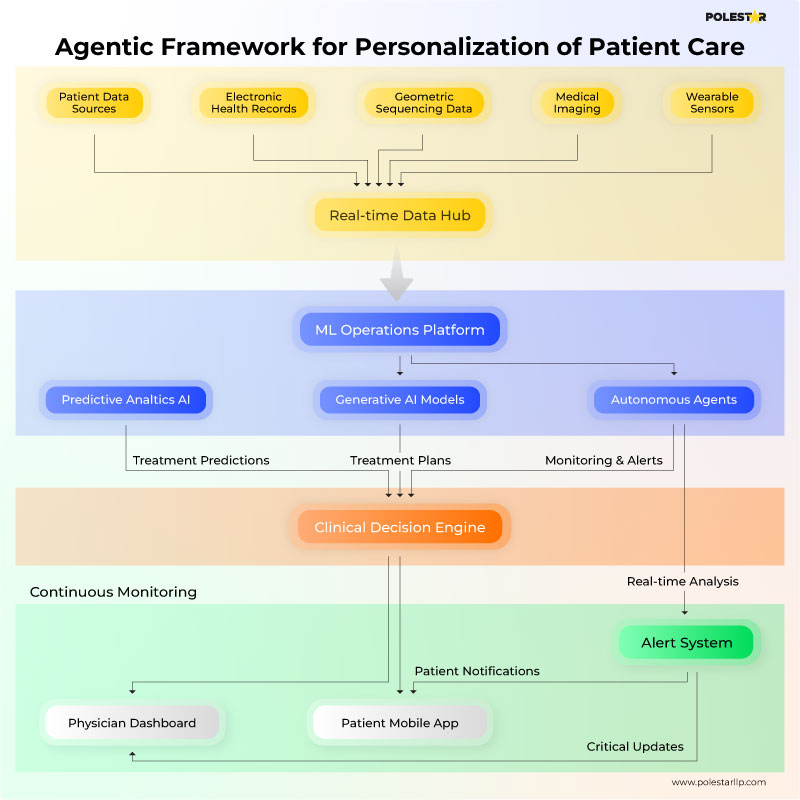 Sample Agentic Framework for Personalization of Patient Care
At its core, the framework leverages three key AI components: Predictive Analytics AI for treatment forecasting, Generative AI Models for treatment planning, and Autonomous Agents for continuous monitoring and real-time analysis.
This specialized agent can:
- Flag unusual prescription patterns that may indicate medication errors
- Detect potential adverse drug reactions before they become severe
- Identify unexpected therapeutic responses that might require dosage adjustments
You might also like:
Another type of agent we’re working on is the Anomaly detection agent which monitors production processes in real-time and identify potential issues before they lead to equipment failure or quality problems. It ingests data from a network of IoT sensors across the production floor, monitoring variables such as:
- Equipment vibration patterns
- Temperature fluctuations
- Power consumption
- Production speed
- Quality metrics
- Acoustic signatures

The agent pre-processes the data for signal filtering and monitoring. Through multiple detection methods including statistical analysis, machine learning models, and pattern recognition algorithms it identifies three types of anomalies: Point Anomalies, Contextual Anomalies, and Collective Anomalies.
The intelligent decision system can identify the root cause analysis to give priority-based alerts & generate automated response protocols.
This model also highlights the need for continuous monitoring and feedback loops to check for model drifts and accuracy at regular intervals while keeping in compliance with the industry standard.
Agentic AI is redefining clinical operations
See how adaptive, autonomous AI is reshaping the pharma landscape across clinical data and operations.
Download the Pharma AI e-book
The era where you’re still thinking about whether or not you need AI is long gone.
You need to get started with it. Pronto.
 AI Roadmap at a glance
If you are stuck anywhere on this journey of getting started with Agentic AI use cases for pharmaceutical industry, don’t worry we’re here to help!
Our pharma and tech experts will guide you to accelerate your Agentic AI journey sooner. Just drop us a message and we’ll get back to you.
Agentic AI framework for patient care personalisation represents next-gen approach to pharma and life sciences industry. It’s core components for architecture are:
- Real time data integration- Ingestion from continuous data streams, connecting to EHR systems for medication history and lab results etc.
- Predictive analytics- forecasts disease progression based on biomarker trends, identifies treatment timing windows etc.
- Gen AI treatment planning- personalised treatment protocols, natural language for treatment recommendations etc.
- Autonomous monitoring- prescription anomalies, adverse reaction precursors or therapeutic response variations etc.
Unlike manual monitoring systems, multi-agents system analyses patients data points while flagging issues immediately.
Most pharmaceutical companies successfully deploy agentic AI in pharma industry using hybrid approaches that work with existing on-premises systems.
Common starting strategies are:
Begin with single-source use cases that don't require extensive integration (like manufacturing sensor monitoring)
Use middleware layers to connect agents to legacy systems without full migration
Implement data lakehouse architecture that sits alongside existing systems
Deploy agents that read from on-premises systems but operate in cloud environments
Practical approach: Start with one constrained pilot while upgrading infrastructure in parallel. Many pharma analytics companies in USA specialize in designing agentic AI architectures that work with legacy pharmaceutical systems, allowing gradual modernization without disruptive "big bang" replacements.
The key is selecting initial agentic AI use cases in pharmaceutical industry that match your current infrastructure maturity, then expanding as systems evolve!