
Summarize this blog post with:
Editor's Note: Global Capability Centers are no longer measured only by operational efficiency or cost arbitrage. As AI, analytics, and enterprise transformation reshape business priorities, GCCs are increasingly expected to drive measurable business outcomes, influence revenue and margin, and operate as strategic value creators. This blog explores the shift from traditional cost-center models to outcome-driven GCC operating models, highlighting the capabilities, leadership priorities, and AI-led foundations defining the next generation of enterprise GCCs.
For two decades, the business case for a Global Capability Center (GCCs) wrote itself: take a process, move it to a lower-cost geography, and book the arbitrage. The CFO understood it, the board approved it, and the GCC delivered against a single, comfortable metric - cost per FTE saved. That model built an industry. It is also the reason so many GCCs are now stuck.
Because the question on the table in 2026 is no longer how much did the GCC save? It is how much value did the GCC create? And for most enterprises, the honest answer is that they don't actually know — which is itself the most important finding of all.
The macro story is unambiguous. India alone now hosts 2,117 Global Capability Centers across 3728 units, a market approaching USD 98 billion and on track for USD 99–105 billion by 2030 (FY26E, Zinnov Report). More than 500 Forbes Global 2000 companies run a center here, joined by nearly 600 mid-market and 500 PE-backed GCCs - a clear signal that the model is now size-agnostic, not a Fortune 500 privilege.
By the most recent benchmarking report, only about 27% of GCCs reach "Portfolio Hub" status within five years, the stage at which a center owns end-to-end products, platforms, and outcomes rather than executing handed-down tasks. The rest plateau. They scale headcount without scaling mandate. They grow the cost base faster than they grow the value they're trusted to own.
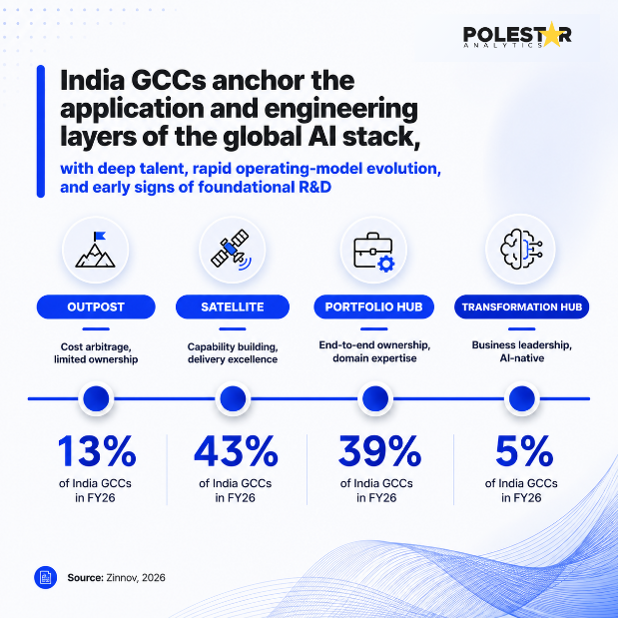
That gap between the centers that became value multipliers and the ones that simply became larger cost centers is the real subject of this blog.
The cost-center framing was never wrong; it was just incomplete, and it quietly shaped behavior in ways that are now expensive to unwind.
When a GCC is measured purely on cost, every decision optimizes for cheaper rather than better. Talent is hired against rate cards, not capability ladders. Work is scoped to be transferable, not transformative. And critically, the center never builds the muscle to make a business case for itself in the language the enterprise actually rewards — revenue protected, decisions accelerated, risk avoided.
There is also a structural accountability problem that cost-center thinking papers over. In most enterprises, finance owns the budget, IT controls the infrastructure, and the business drives the demand - but no one owns the outcome. When ownership is fragmented like that, a GCC can run flawlessly on its own SLAs and still fail to move a single number the C-suite cares about. The center looks efficient on paper and invisible in the boardroom.
This is why the smartest GCC operators have stopped arguing about cost savings and started talking about cost avoidance and value creation — two fundamentally different financial frameworks. Savings are a one-time arbitrage you can only book once. Avoidance and creation compound: a defect caught upstream, a forecast that prevents a stock-out, a pricing model that protects margin under competitive pressure. These don't show up cleanly in a cost-per-FTE line, which is precisely why centers stuck in cost-center logic systematically under-report their own worth.
Having worked with GCCs across industries, the centers that break through share five characteristics:
#1 Own business outcomes, not activities.
A team that compresses time-to-decision from three days to two hours, and can prove the P&L impact of that compression, owns an outcome.
One global healthcare manufacturer we worked with moved from reports taking three-plus days to generate to reports generated in seconds, with a 50% efficiency gain. But the bigger shift was strategic, the GCC stopped owning reports and started owning decision velocity for the regional business.
#2 Direct Influence on Revenue and Margin
A sign that a GCC creates value rather than saves it is the moment it starts touching the top line and Revenue Growth Management (RGM) is the archetype. A GCC that owns pricing, promotion, trade-spend, and assortment decisions stops being a back office and becomes a margin engine for the enterprise.
When those decisions are driven by elasticity modeling and explainable ML rather than spreadsheets and instinct, the impact lands directly in the P&L: data-backed AI-powered RGM delivers a 4–6% profit uplift, with tighter control over the trade dollars that quietly erode margin.
#3 AI Embedded into the Core Operating Model
This is the defining line between mature and emerging GCCs in 2026. The fastest-growing GCC mandates today sit around data, analytics, and AI. But the centers winning strategic charters are not treating AI as a side initiative or innovation pilot. They are embedding it into how work happens. That includes:
- Private LLMs trained on enterprise data
- Agentic workflows across functions
- Predictive operational models
- AI-driven decision support systems
In these organizations, AI is not sitting in a lab. It is integrated into the operating model itself.
#4 Financial discipline built into technology scale
Do you know that roughly 29% of cloud spend is wasted. A GCC that consumes ever-larger cloud and AI budgets without correlating that spend to business value is, definitionally, a cost center wearing a strategic badge.
The mature centers run FinOps as a discipline - informing, optimizing, governing, and scaling cloud and data spend with the same rigor finance applies to any capital.
One pharmaceutical client running 150,000+ datasets and 40,000+ pipelines on Azure Databricks turned a USD 10M annual spend with no granular visibility into 17% annual savings through FinOps dashboards, lineage tracking, and governance — while increasing the work the platform supported.
They build leaders, not just teams. The most strategic GCCs have become leadership factories — environments where global product portfolios and enterprise transformation programs are owned, and where India-based leaders increasingly carry global remits. Several global CXOs are now alumni of their own India GCCs. A center that exports leadership is, by definition, no longer peripheral.
The transition from cost center to value multiplier is not a single decision; it is a maturity journey, and it helps to name the stages. Most enterprises move through Setup and Initiation (tool selection, foundational data strategy), to Stabilization (scalable processes, governance, visibility), to Optimization (efficiency, intelligence, FinOps-driven control), and finally to Transformation (scaled innovation, AI use-case deployment, and the ability to incubate and prove value continuously).
What changes across these stages is not the headcount — it's the ownership. Early-stage centers consume strategy; mature centers generate it. And the accelerant through every stage is a unified data, analytics, and AI foundation. Centers that try to scale on fragmented tooling, vendor sprawl, and tribal knowledge stall at Stabilization. Centers that unify their data estate — collapsing the gap between raw data and intelligent action - compress the journey dramatically, onboarding new data sources 60–80% faster and freeing scarce engineering talent for genuinely differentiated work.
This is also where the engagement model matters more than most leaders admit. The choice between project-based delivery, managed services and co-owned CoEs, outcome-based engagements, and staff augmentation is not procurement trivia — it determines whether the center accumulates capability or rents it. Outcome-based and co-managed models tie a partner's success to your measurable results: one telecom firm achieved 20%+ cloud cost savings through an outcome-led engagement precisely because the incentive was the outcome, not the hours.
So here is the test. If your CEO asked tomorrow, "What would the enterprise lose if this GCC disappeared?" Could you answer in the currency of business value, not the currency of cost saved?
If the answer is a number with a dollar sign that finance booked years ago, you are running a cost center, however large. If the answer is a list of decisions that would slow, products that would stall, margins that would erode, and innovation that would never ship, you are running a value multiplier.
The centers that will define the next decade aren't waiting to be asked. They are embedding AI into how they operate, running financial discipline as a core competency, owning outcomes end-to-end, and proving — in numbers the board already trusts — that they don't cost the enterprise money. They make it.
The cost-center era built the GCC. The value-multiplier era will decide which ones survive it.
Polestar Analytics partners with GCCs across every stage of the maturity journey — from foundational data-estate setup to AI-powered transformation - combining FinOps discipline, the 1Platform unified data ecosystem, and proprietary accelerators to turn capability centers into enterprise value multipliers.