MLOps services
MLOps Services for AI-Ready Machine Learning
Enterprise MLOps on the cloud you already run, with AI-built pipelines your engineers approve.
MLOps services
Enterprise MLOps on the cloud you already run, with AI-built pipelines your engineers approve.
Trusted by consumer brands









The production gap
of AI projects make it into production
of ML practitioners name monitoring model performance as their top production challenge
take 1 to 3 months to deploy a model, 10 points more than in 2024
Sources: 1 and 2. Gartner survey, May 2024. 3. Gartner prediction, July 2024.
Use cases
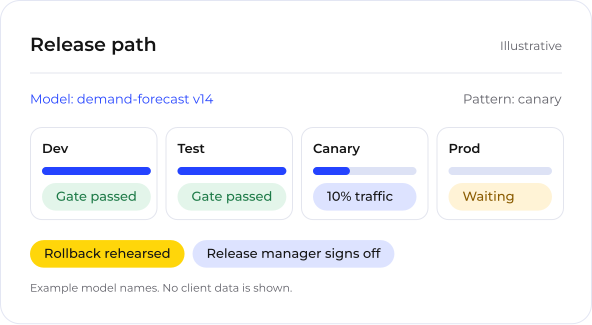
Shadow, canary and blue-green releases, with the rollback rehearsed outside production before go-live.
MLOpsAI foundationsRollback rehearsed
See how a global retail GCC ships models with MLflow rollback →
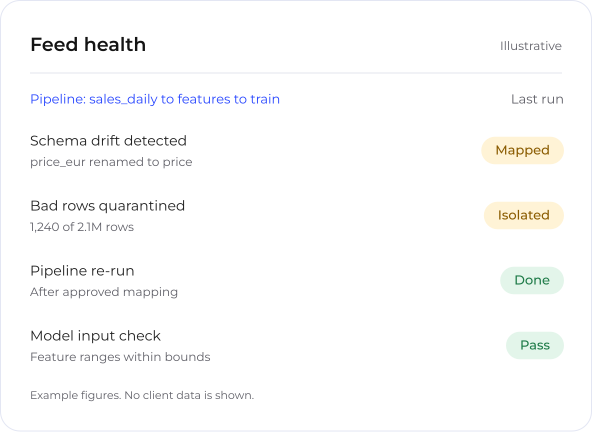
Machine learning pipeline automation from data to release, versioned and reused. Schema drift and broken feeds get fixed upstream, before the model sees them.
Foundation StudioDataOpsVersioned
See how a global alcoholic beverage GCC runs governed pipelines →
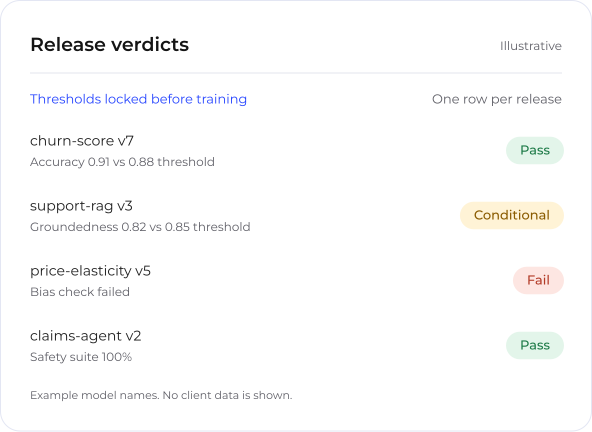
Thresholds agreed before training. Custom evaluations for quality, safety and accuracy, including LLMs and agents.
MLOpsAI & Data GovernanceThresholds locked
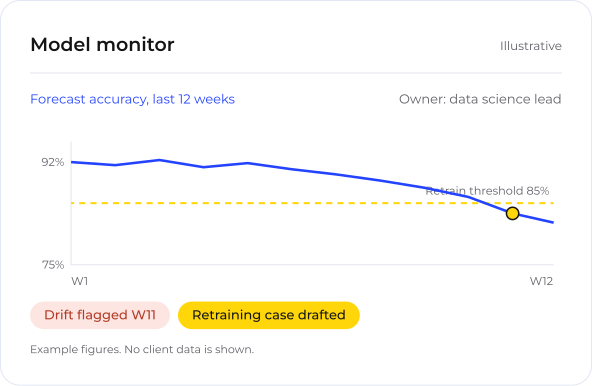
Accuracy, drift and value tracked against today’s baseline. Retraining runs on triggers you agree up front.
MLOpsModelingDrift triggers
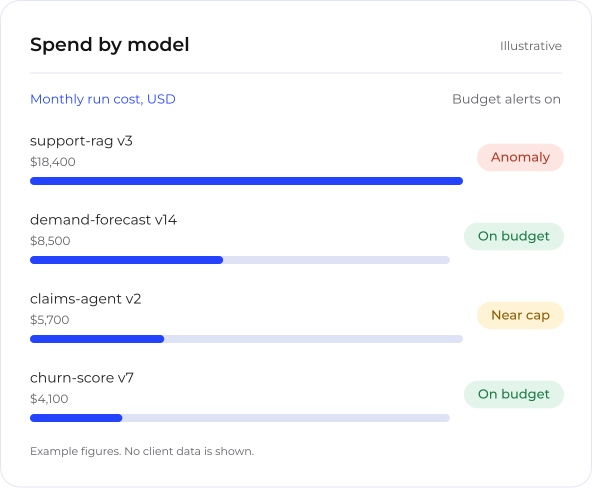
Token, model and compute spend attributed per model and owner, with budgets and alerts.
FinOps StudioPlatform & FinOpsPer model
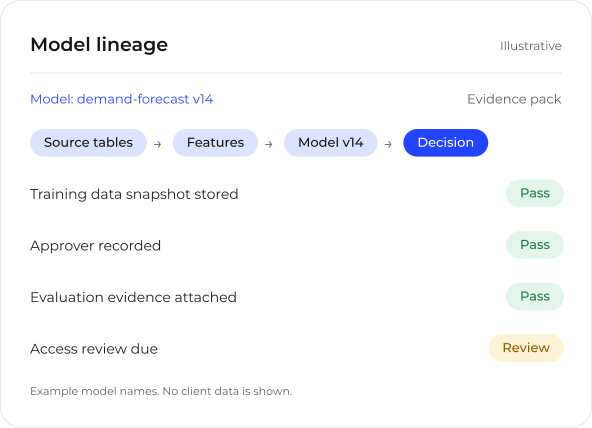
Lineage from source data through the model to the decision, plus an evidence pack for each release.
AI & Data GovernanceEvidence pack
The process
Data modeling on 1Platform
Our MLOps solutions take models from first release to retraining, with Polestar Analytics IP accelerators and services, and every model connected to the rest of your data and AI estate.
1PlatformFoundation StudioFinOps StudioAI foundation
MLOps and LLMOps
 Governance
MLOps keeps your models running in production. These Polestar Analytics services handle what comes before it and what runs alongside it, on Azure, AWS, GCP or Databricks.

Before deployment
Forecasting, pricing, customer and supply models, backtested against today’s method before they enter your release pipeline.
Best when:the model isn’t built yet, or it can’t beat what you use today.

Alongside MLOps
Evaluation, tracing, guardrails and rollback for the LLMs and AI agents running next to your ML models.
Best when:GenAI or agent workloads are going live on the same platform.

Controls and evidence
Lineage, model risk controls and audit trails that hold up when risk or compliance asks for evidence.
Best when:a model needs risk or compliance sign-off before it ships.

Models now ship with MLflow versioning, rollback and an audit trail, through GitHub CI/CD.
Global retail enterprise GCC, with Polestar Analytics as its embedded analytics partner
MLOps and data engineering | Databricks
Read the case study →
Quick Quack now plans 90 days ahead with ML forecasts that read the weather.
Quick Quack Car Wash, 200+ stores across the West Coast and Central US
ML model deployment services | ML in Anaplan
Read the case study →
One governed lakehouse, with quality checks and monitoring that reduce data drift, now feeds one forecasting model.
GCC of a global alcoholic beverage enterprise
DataOps and governance | Databricks and Anaplan
Read the case study →Polestar Analytics live sessions
Polestar Analytics product and technology leaders on agent readiness, AI-ready data and the work that starts after a model goes live.
Every model gets an owner, a threshold, a retrain trigger and a runbook.
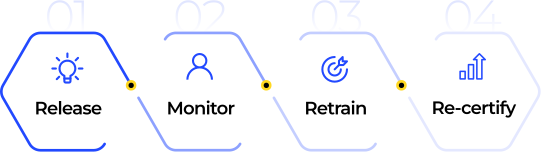

The same stages, gates and rollback steps for every model and agent, written down once.

AI drafts the pipelines, tests and runbooks. A named person on your team approves each step.

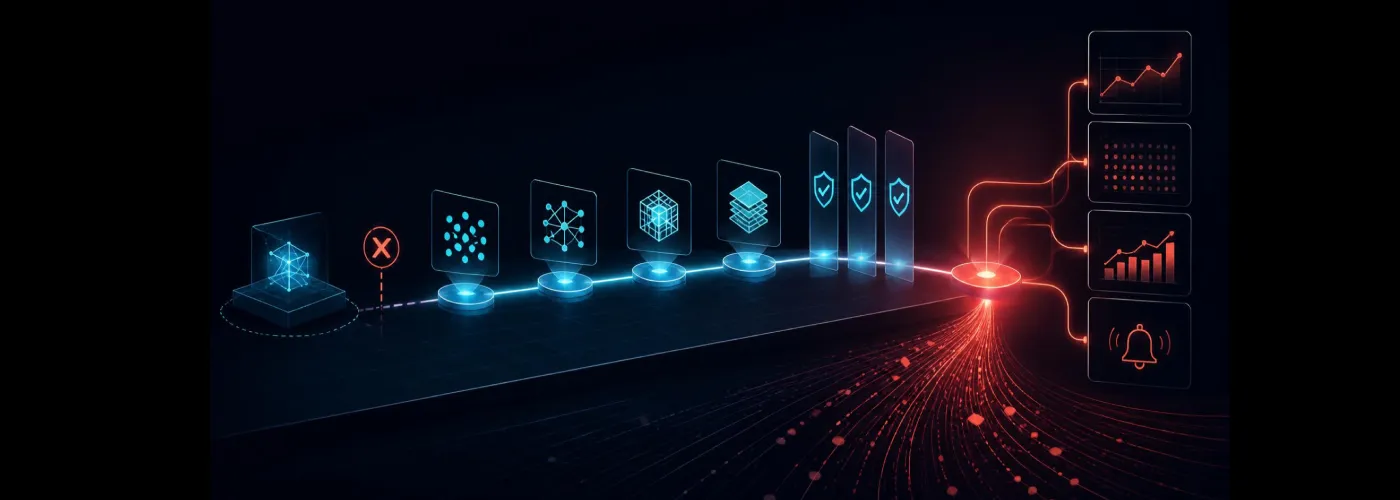
Every release is rehearsed outside production first, and a dry run without a rollback doesn’t pass.

Agents run in your tenancy with read-only access and call the LLMs you’ve already approved.

 Partner
 Partner
 Partner


FAQ
We compare your CI/CD, environments and repos against our reference pipelines, then keep your tools and fill the gaps. If MLflow already tracks your experiments, it stays. For a global retail GCC, we added MLflow versioning and rollback plus GitHub CI/CD to the team's existing setup, and cloud cost on their offer-model pipelines fell 75%.
Four things, all on one of your real systems: a gap map scored stage by stage, an adopt, adapt or replace plan per stage, generated pipeline and runbook drafts for your stack, and a release plus rollback rehearsed outside production. Your engineers review every generated file before anything merges.
Every release follows a shadow, canary or blue-green pattern with written rollback steps. We rehearse the rollback outside production before go-live, and a dry run without one doesn't pass. On-call runbooks cover common AI incidents, so whoever is on call can roll back without paging the model's author.
Thresholds are agreed before training and then locked. An agent builds starter test suites from sampled, masked traffic, and we add custom evaluations for quality, safety and accuracy. Each release gets a Pass, Conditional or Fail decision. When prompt and RAG fixes stop lifting scores, the fix belongs in the model itself, through fine-tuning.
You agree the triggers up front: accuracy dropping, drift past a threshold, or value falling below the baseline. When one fires, the drift monitor flags it and drafts the retraining case for your data science lead to approve. The runbook names each trigger, its owner and the retrain steps, so anyone on the team can run it.
No. Agents deploy into your own tenancy on Azure, AWS, GCP or Databricks with read-only access. They read configs, logs and schemas in place, sample raw records only with your written approval, and call only the LLM endpoints you've approved, with logging you can audit.
Yes. In the managed model, we re-run the path-to-production check on a set schedule, keep pipelines and runbooks current as your stack changes, and review the scores with you each quarter.
We’ll check its path to production and show you the gaps, stage by stage.

Senior Vice President


Assistant Vice President