Data modeling services
Data Modeling Services for Reliable Enterprise Analytics
Predictive models for forecasting, pricing, customers and supply, proven against today’s method before you build.
Data modeling services
Predictive models for forecasting, pricing, customers and supply, proven against today’s method before you build.
Trusted by consumer brands









The DECISION GAP
Of AI projects fail by some estimates, twice the rate of IT projects without AI
Of companies see no material value of AI value at scale.
Stat on models built but never used in a decision
Use cases
Demand, volume and revenue forecasts at the level planners need, backtested against today's method before anyone relies on them.
ForecastingPer forecast hierarchyBacktested first
Analytical data modeling of price and promotion elasticity, with scenario tools for pricing teams who've been working from rules of thumb or last year's numbers.
PricingPer category or brandNeeds price history
Data modeling solutions for propensity, churn and next-best-action, so sales and marketing target the customers most likely to respond.
Customer analyticsPer customer baseLinked to a campaign
Inventory, replenishment and anomaly detection across your supply chain, for networks where stock-outs and excess stock exist at the same time.
Supply chainPer network or nodePolicy changes agreed
The process
Data modeling on 1Platform
Our data modeling consulting covers enterprise data modeling from decision to live model. That’s six components, delivered with the ML Studio library on 1Platform, with every model feeding the rest of your AI stack.
1PlatformML Studio libraryAI foundation
Data science and advanced
analytics
 Monitoring

Best when you have a named decision to improve, with an owner. We start from that decision
and assess only the data that serves it.
Trade-off:Focused, but may miss better
use cases elsewhere.

Best when you have a rich data domain and want to know what it can support. We profile the
domain first, then shortlist decisions it can feed.
Trade-off:Broad view, but
more effort to land an owner.

Best when a forecast or score already exists and you want to know if it can be beaten. We run
baseline and challenger on today’s method.
Trade-off:Fast proof, limited to one
decision.
Pulse apps
14 weeksto measured pilot results
Studio apps
80–90%of your data foundation pre-built
Prism engine
Weeksnot quarters, to build a Pulse app
for a new domain
No app for your domain? Give Prism your docs. In a few weeks, you’ll have one.
1Platform

Quick Quack now plans 90 days ahead with ML forecasts that read the weather.
Quick Quack Car Wash, 200+ stores across the West Coast and Central US
Revenue forecasting | ML in Anaplan
Read the case study →
A 60-person forecasting team stopped fetching data and started steering the plan.

Long-tail spare parts demand, forecast at 95% accuracy.
CIO/CDO roundtable series
A roundtable series on turning models into decisions: which use cases are worth building, when to stop, and who owns a model after go-live. Hosted by Saurabh Singh, CPG and Telco Industry Head at Polestar Analytics, with data and technology leaders from global consumer and enterprise brands.
Featured experts from

















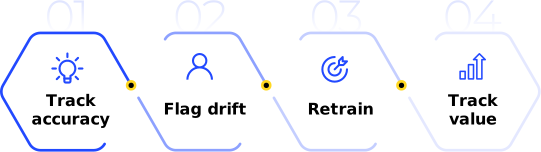
Every model gets an owner, drift triggers and a retraining runbook.

No decision owner, no build. A model nobody uses is a cost.

Acceptance thresholds are agreed before training, then every challenger is backtested on your data.

If the challenger can’t beat today’s method, we stop. That’s a good result.

Agents run in your tenancy and call the LLMs you’ve already approved.


 Partner
 Partner
 Partner



FAQ
Our data modeling (or data modelling) services take one decision from framing to a live model in six components: problem framing and value, data and feature readiness, model build, validation and backtesting, decision integration, and monitoring and retraining. We offer them as four sub-offerings: forecasting, pricing and elasticity, customer analytics, and supply optimization.
We only build a model if it beats today’s method on a decision someone owns. Every use case gets a named decision owner, kill criteria and a baseline before any build starts. Models are built with ML Studio library components on 1Platform, and each one is placed where the decision is made, whether that’s a plan, a price list, a campaign or an alert.
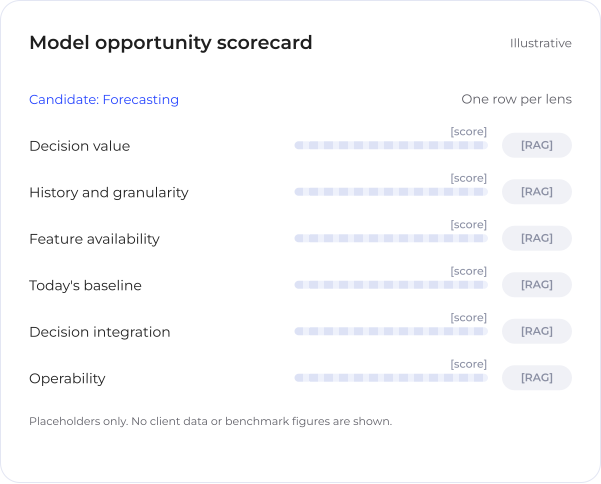
We score every candidate use case on six lenses before any model is built: decision value, history and granularity, feature availability, today’s baseline, decision integration, and operability. You get a scored shortlist with kill criteria and a named decision owner, plus a value case and build plan for the top use case.
We agree acceptance thresholds before training, not after seeing the results. We run naive and statistical baselines against today’s method, then AutoML challengers that are backtested against that baseline, all on your own data. An agent writes the comparison report, and your data science lead signs it off.
We stop, and that’s a good result. A model nobody uses is a cost, not an asset. Agreeing kill criteria up front means teams don’t keep tuning a model the data can’t support.
Enough history, at the right level and frequency, for the model to learn from. Pricing work, for example, needs price history. We profile an approved extract for history, gaps, granularity and outliers, and score its fitness before any build. If data history or quality is the blocker, we start with a Data & Analytics Maturity Assessment.
An agent does the first pass at every step. It profiles your data, runs baselines, proposes features, trains challenger models and drafts the value case. A named person checks and signs off each step before the next one starts: your data owner, data science lead, domain expert, and business owner with finance.
We track accuracy, drift and value, and retrain on triggers agreed with you. A drift monitor flags changes and drafts the case for retraining. You also get a monitoring and retraining runbook covering drift triggers, owners and retraining steps.
No. Agents run in your own cloud tenancy on Azure, AWS, GCP or Databricks. They read schemas, configs, logs and documents where they are, and sample raw records only with your written approval. They call only the LLM endpoints you’ve already approved, with logging you can audit.
Model work runs on your own ML platform, for example Databricks or Azure ML. Model output then feeds the rest of your AI stack. A forecast can feed a financial or demand plan, a prediction can become a tool for an agent, and business users can query model results in plain language.
Yes. You can choose onsite, hybrid (the default), AI-led remote, co-delivered or continuous managed delivery. In the co-delivered model, your team runs the method with our agents while Polestar Analytics coaches and checks quality. It suits a client building its own data science team.
Name one decision and its owner, share an extract, and see baseline and challenger side by side.

Senior Vice President


Assistant Vice President