
Fassen Sie diesen Blogbeitrag wie folgt zusammen:
Are traditional field-force strategies still enough for specialty pharma?
The pharmaceutical industry has evolved dramatically over the past decade. Specialty therapies have become more complex, healthcare professionals (HCPs) have less time for in-person engagement, and commercial expectations continue to rise.
Yet many pharmaceutical organisations continue to assign medical representatives based primarily on territory boundaries, physician lists, or historical call plans. The question is simple: is this still the most effective way to engage HCPs? For specialty drugs, the answer is increasingly no.
Success today depends not on the number of representatives in the field, but on ensuring that the right medical representative engages the right HCP at the right time with the right scientific conversation.
Key Takeaways
- Specialty pharma success now hinges on precision engagement, not field-force size.
- AI decides WHERE to focus commercial effort; Emotional Intelligence decides HOW to engage.
- Aligning rep strengths to HCP opportunity can lift productivity, ROI and Rx growth.
- Reps are amplified, not replaced, by better intelligence.
Unlike primary-care products, specialty medicines carry a fundamentally different commercial dynamic. Every interaction between a medical representative and an HCP has the potential to influence therapy adoption, patient outcomes, and commercial success, which makes intelligent resource alignment more important than ever.
- Complex clinical evidence and evolving treatment protocols
- Smaller, highly-specialised patient populations
- High-cost therapies with significant access scrutiny
- Longer treatment journeys and follow-up
- Multiple stakeholders involved in each treatment decision
- Deeper scientific discussions with specialists
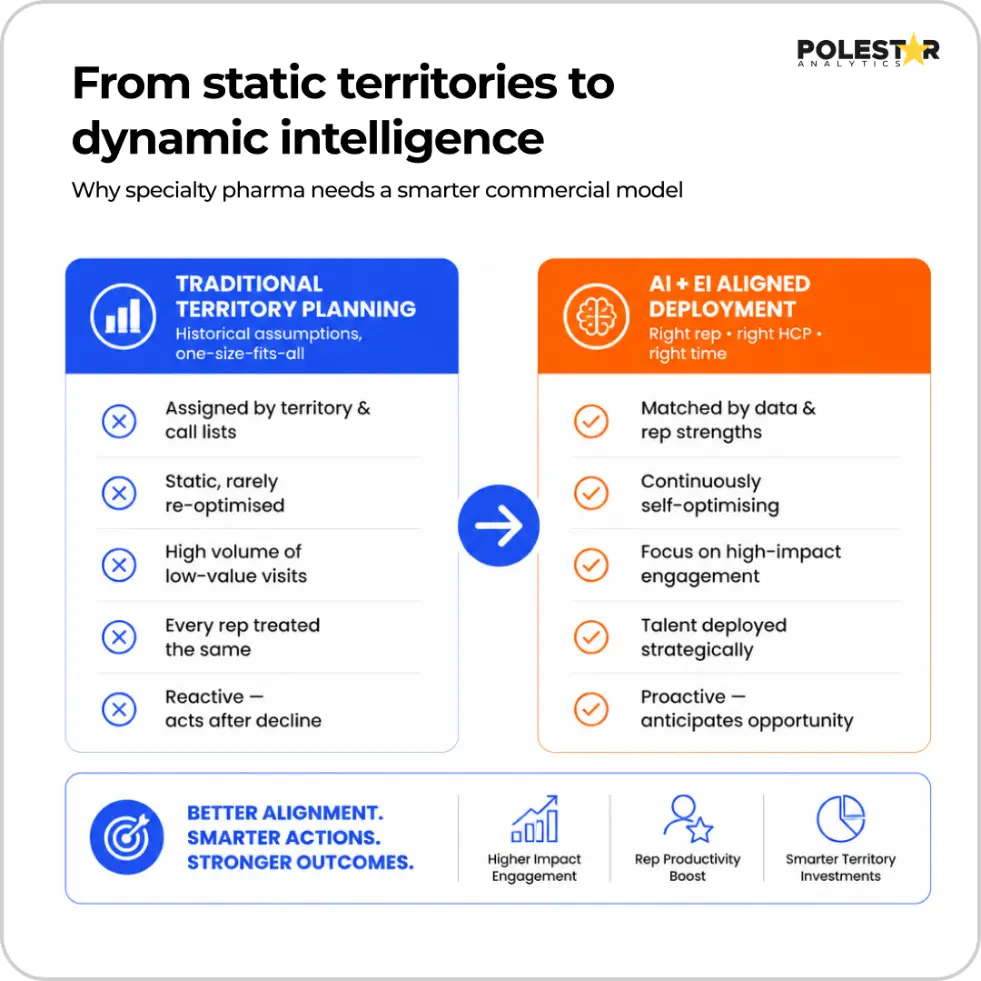 Figure 1 — Moving from static territory planning to dynamic, intelligence-led deployment.
Artificial Intelligence enables pharmaceutical organisations to move beyond static territory planning. Instead of relying on historical assumptions, AI continuously analyses many data signals at once and recommends where commercial effort can create the greatest impact. This is the shift from static HCP lists to living HCP intelligence that evolves in real time, producing a field force that adapts as market conditions change.
Data signals AI can weigh together include:
- Prescribing behaviour and trends
- Patient demographics & disease prevalence
- Referral networks and patient flow
- Treatment adoption trends
- Market-access challenges
- Previous HCP engagement history
- Digital interaction signals
- Competitive activity
- Account potential and whitespace
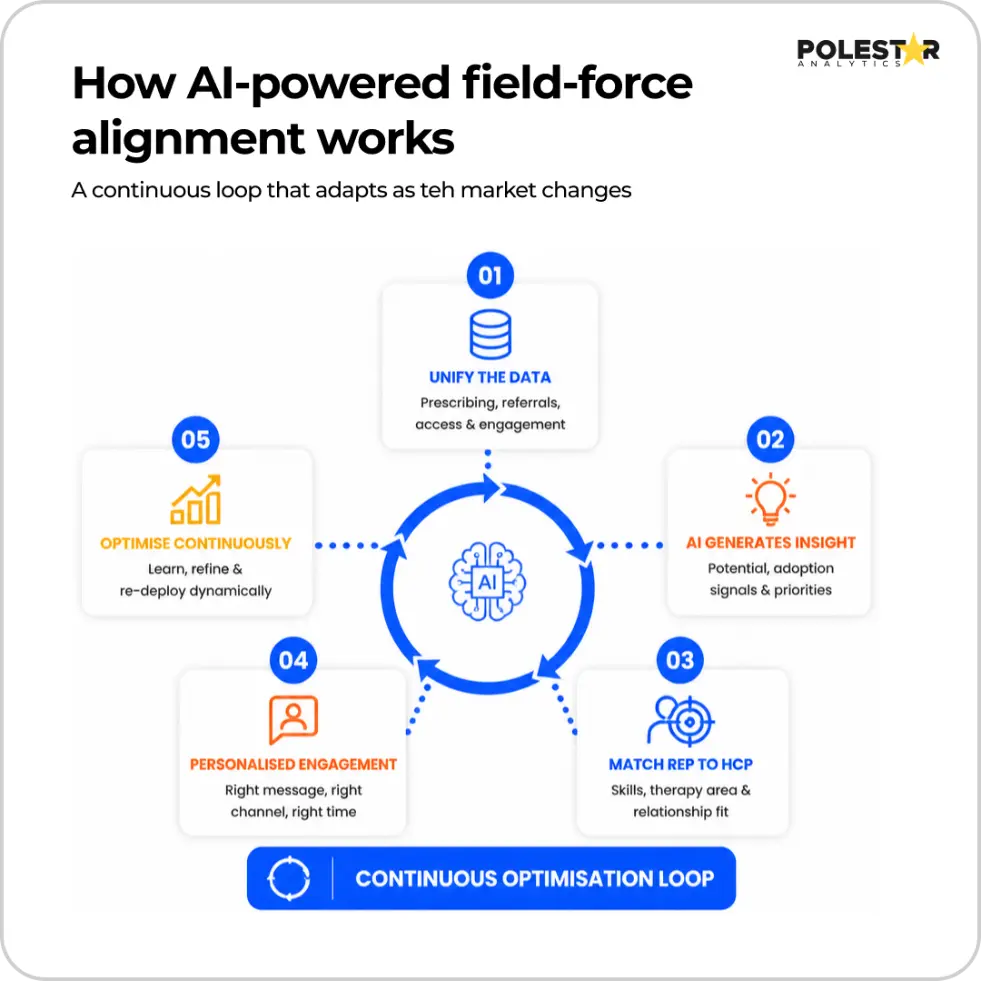 Figure 2 — AI-powered alignment as a continuous, self-optimising loop.
Whereas AI helps to identify the places where representatives should reach out to their counterparts, EI helps them know how to reach out. The best medical representatives are not those who make many phone calls but the ones who create trust and interpret the science with confidence.
- Build long-term trust with specialists and treatment centres
- Understand the real-world challenges physicians face
- Communicate complex scientific evidence with clarity
- Adapt each conversation to the HCP's preferences and style
- Show genuine empathy toward physicians managing complex patients
These human capabilities cannot be replaced by AI. Instead, AI amplifies them, ensuring representatives spend more time with the HCPs where their individual strengths will have the greatest influence. This is where technology and human expertise complement one another. The same logic applies to how field teams are measured: quotas built only on territory size overlook the relationship, agility and collaboration behaviours that actually move specialty prescriptions, a theme we unpack in our ebook on re-imagining incentive compensation in pharma.
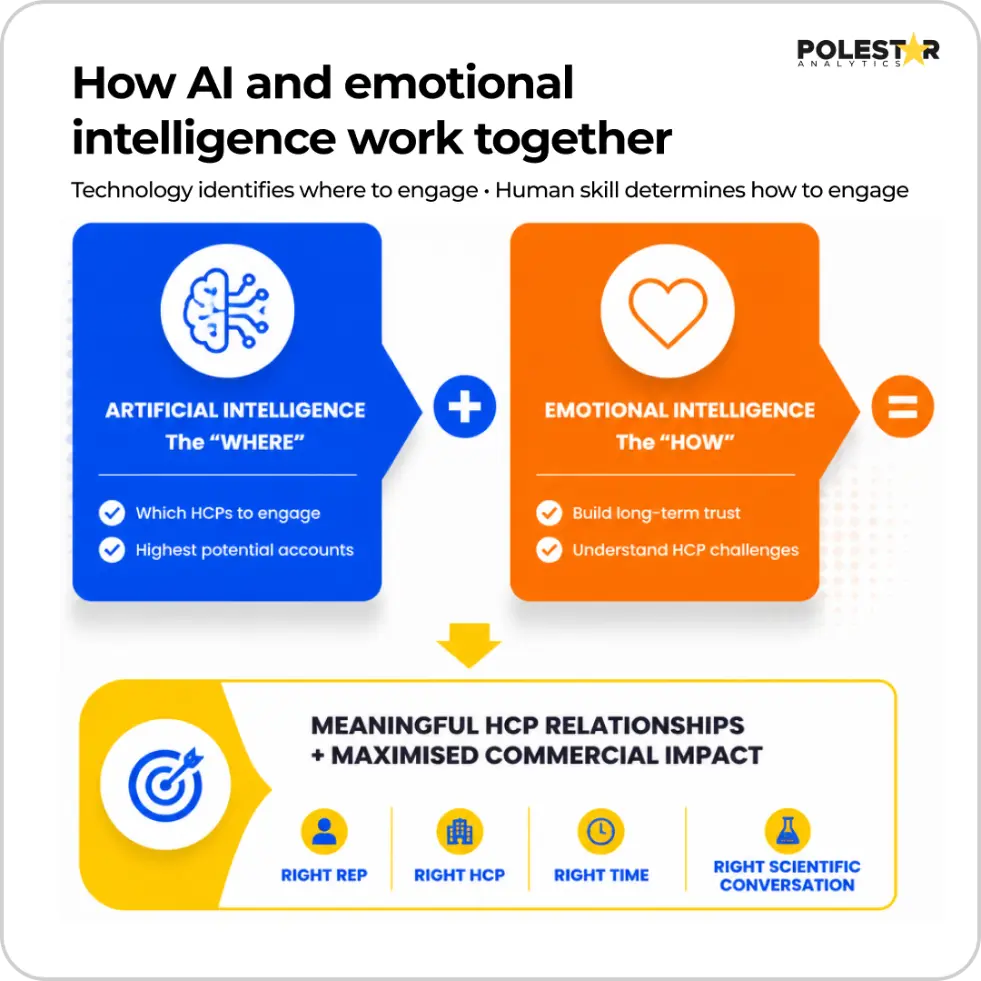 Figure 3 — AI determines the "where"; Emotional Intelligence determines the "how".
Imagine every medical representative equipped with a personalised commercial strategy. AI continuously surfaces the opportunities; each representative is then matched to them based on their individual strengths, so talent is deployed strategically rather than uniformly, and every interaction becomes more meaningful.
| AI identifies... |
Reps are matched by... |
| Which physicians need engagement |
Scientific & therapy-area expertise |
| Accounts with highest growth potential |
Communication and relationship style |
| Specialists likely to adopt new therapies |
Experience with complex accounts |
| Hospitals needing scientific depth |
Track record with similar HCP profiles |
| Territories that need more focus |
Relationship-building capability |
When representative capabilities are aligned intelligently with HCP opportunities, organisations can achieve measurable improvements in field-force effectiveness in pharma and overall commercial performance, without increasing field-force size. Rather than adding headcount, they maximise the effectiveness of the teams they already have.
Across our pharma engagements, AI-led targeting and guided field execution have supported roughly 40% higher rep productivity and markedly faster decision cycles, by maximising the teams already in place rather than adding headcount.
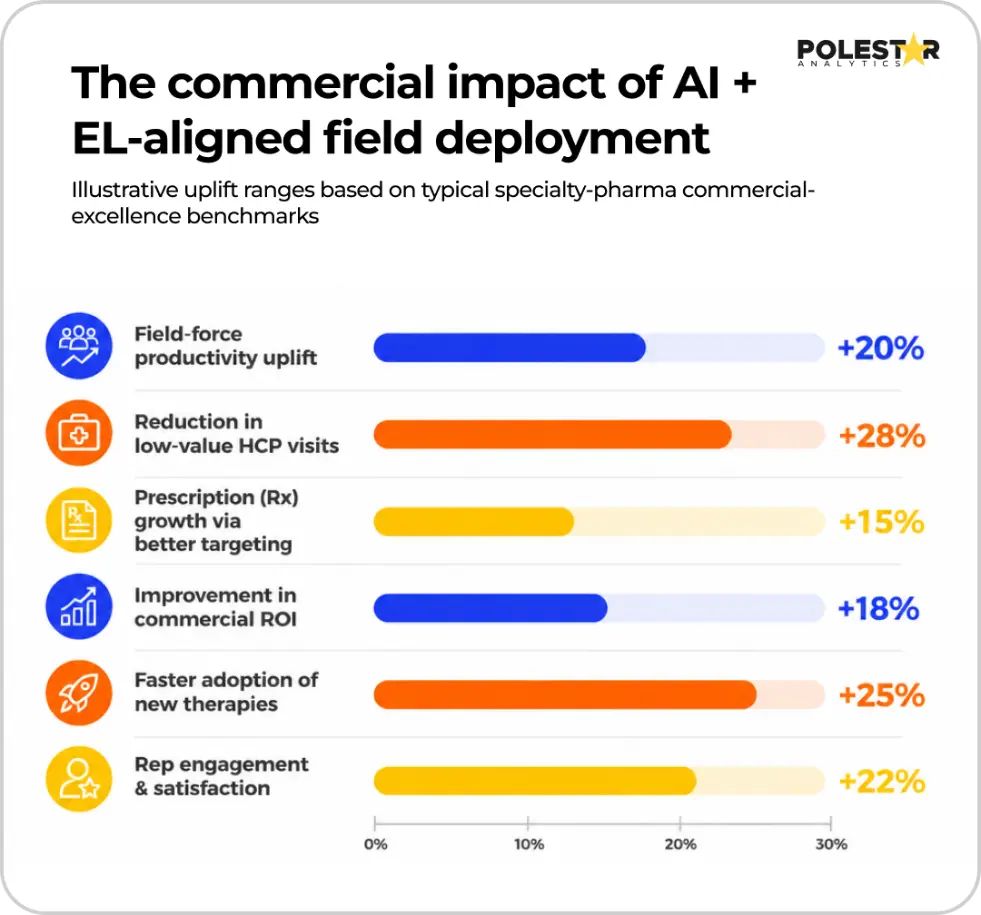 Figure 4 — Average uplift ranges drawn from typical specialty-pharma commercial-excellence benchmarks & use cases.
Potential outcomes across the commercial engine
- Higher-quality scientific engagement with healthcare professionals
- Faster adoption of new and innovative therapies
- Stronger relationships with key opinion leaders and treatment centres
- Better utilisation of existing field resources and reduced low-value visits
- Increased prescription growth through more relevant engagement
- Improved territory productivity and faster expansion into high-potential accounts
- Better return on commercial investment
- Increased motivation and satisfaction among medical representatives
Note: figures shown are illustrative industry-level benchmark ranges, not guarantees; actual impact depends on therapy area, data maturity and execution.
The future of specialty pharma belongs to organisations that combine AI-driven intelligence with the human empathy of medical representatives. Technology identifies where to engage, while Emotional Intelligence determines how to engage, creating meaningful HCP relationships and maximising commercial outcomes.
Absolutely not. AI does not replace the field team, on the contrary, it makes them work better. The medical reps continue to represent the company, they establish connections, explain the scientific evidence and assist physicians all the way through. What AI does is just provide better data for them to apply their knowledge.
The future belongs to AI-enabled medical representatives, not AI replacing medical representatives.
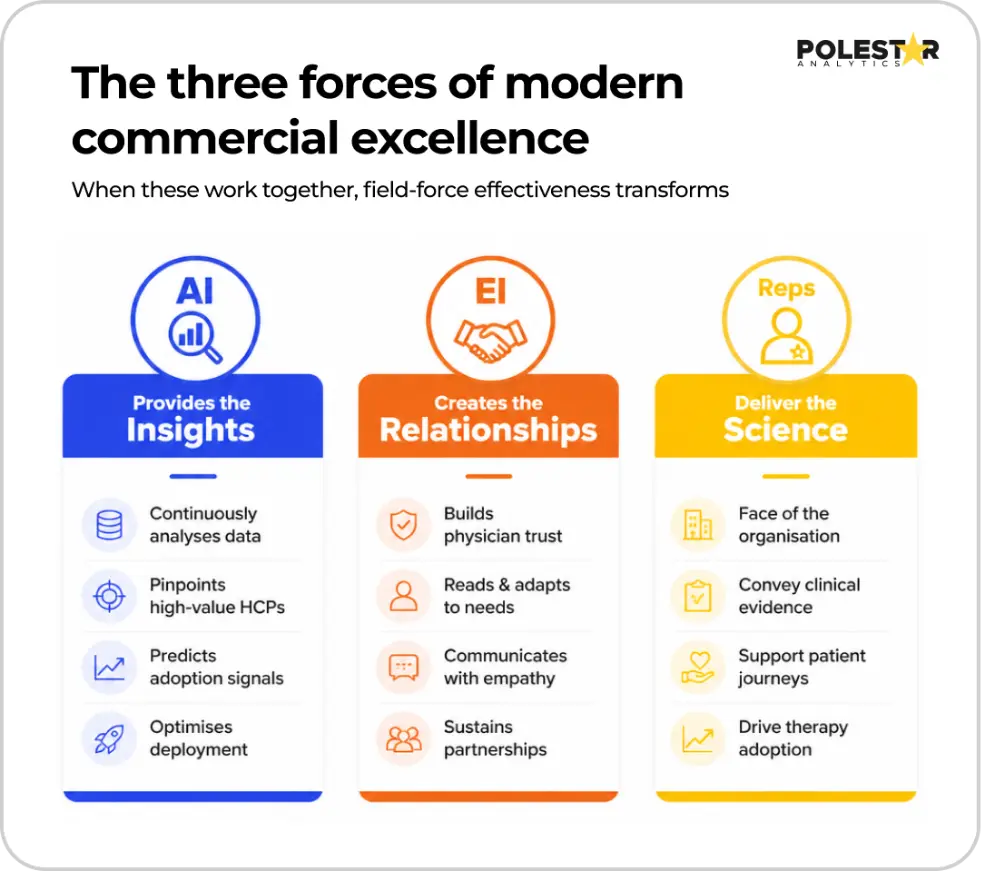 Figure 5 — Three complementary forces behind modern commercial excellence.
Imagine a commercial platform that lets leaders make proactive decisions instead of reacting after performance declines, the kind of agentic commercial workflow we detail in our guide to driving commercial excellence in pharma with Agentic AI. It could answer questions such as:
- Which representative is best suited to a particular specialist?
- Which HCP should receive priority this week?
- Which accounts are showing early adoption signals?
- Which territories require immediate intervention?
- Who has the strongest relationships in a therapy area?
- Where are commercial resources underutilised?
- Which hospitals are most likely to adopt next?
- Which engagement strategy is driving the most Rx growth?
The future is not about increasing sales headcount. It is about increasing the intelligence behind every commercial decision. The next generation of specialty pharma will bring these capabilities together into a single, self-improving system:
- Artificial Intelligence for decision support
- Emotional Intelligence for relationship building
- Data-driven commercial planning
- Personalised HCP engagement
- Continuous optimisation of field-force deployment
Together, these capabilities create a smarter, more agile commercial organisation, one capable of delivering stronger business outcomes while improving the experience of healthcare professionals.
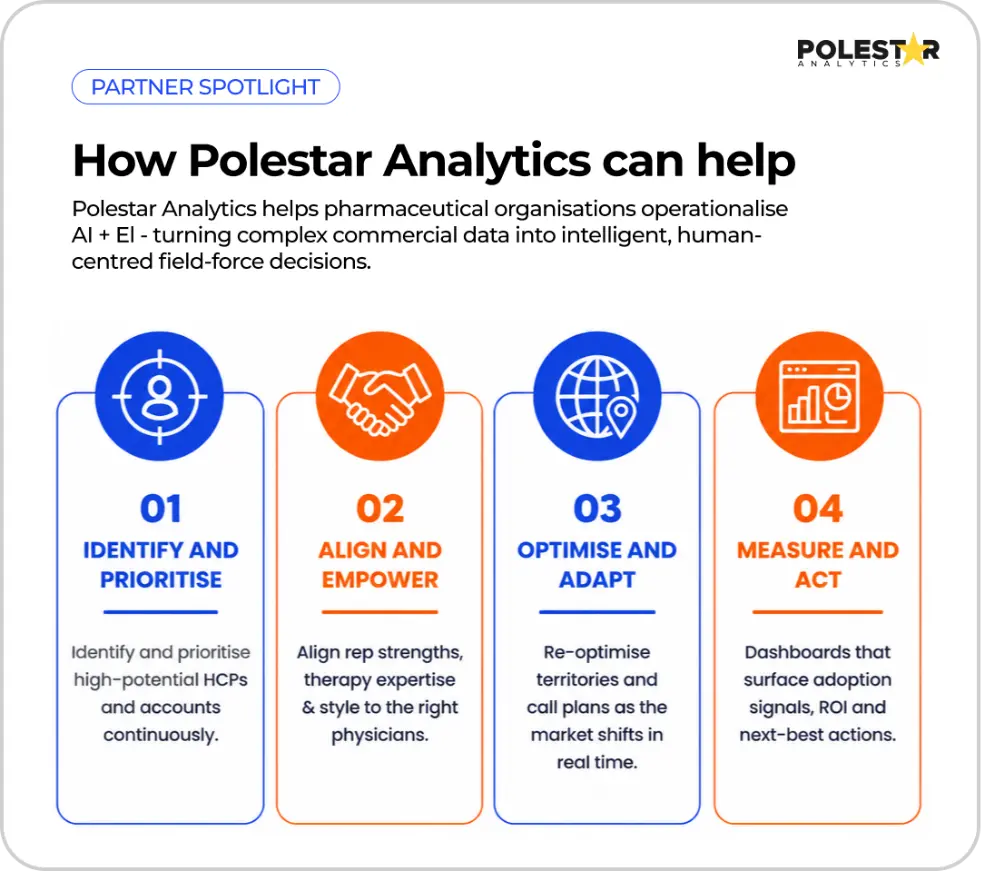
Polestar Analytics partners with pharmaceutical organisations to operationalise this vision, connecting fragmented commercial data, building AI models that enable AI-driven HCP segmentation in pharma, pinpoint high-value HCPs and accounts, and translating those insights into intelligent, human-centred field-force decisions. From AI-driven HCP targeting and rep-HCP matching to dynamic deployment and next-best-action dashboards, Polestar helps commercial teams engage the right HCP, at the right time, with the right representative, and measure the impact.
What Polestar Analytics helps you achieve
- Unify prescribing, referral, access and engagement data into one commercial view
- Prioritise HCPs and accounts using AI-driven potential and adoption signals
- Match representative strengths to the physicians where they add the most value
- Re-optimise territories and call plans dynamically as the market shifts
- Track ROI, Rx growth and next-best actions through intuitive dashboards
The pharmaceutical industry is entering a new era where commercial success depends on how effectively organisations combine technology with human capability. Artificial Intelligence provides the insights. Emotional Intelligence creates the relationships. Medical representatives deliver the scientific value.
When these three elements work together, pharmaceutical organisations can transform field-force effectiveness, accelerate specialty-drug adoption, optimise commercial investments, and build stronger partnerships with healthcare professionals.
The future of specialty pharma will not be defined by larger sales teams. It will be defined by the smarter deployment of people, powered by AI and strengthened by Emotional Intelligence.
Join the conversation
- Is your organisation still relying on traditional territory planning?
- How are you using AI to optimise field-force effectiveness?
- Do you see Emotional Intelligence becoming a measurable capability in commercial strategy?
We'd love to hear your perspective, and to explore how AI and EI together can reshape the future of specialty-pharma commercial excellence.
Traditional planning assigns representatives by territory boundaries, physician lists, or historical call plans, a static model that rarely gets re-optimised. AI-enabled alignment goes one step further in doing away with such assumptions by analysing continuous streams of signals such as prescribing behavior, referral network, adoption patterns, market access, and previous engagements in order to identify where commercial investments would make the most difference. The outcome is a flexible field force that adjusts itself according to the changing market dynamics.
No. AI is not replacing field teams, it makes them more effective. Representatives remain the face of the organisation: they build relationships, communicate scientific evidence, and support physicians throughout the patient journey. AI simply provides sharper intelligence so reps can focus their expertise where it matters most. The future belongs to AI-enabled medical representatives, not AI replacing them.
AI decides when to engage; Emotional Intelligence (EI) decides how. The most productive reps are not the reps who make the most calls; rather, they are the ones who gain the trust of the physician, understand their pain points, explain difficult science to them, are able to adjust to their personality, and are empathic toward them. AI amplifies them by ensuring reps spend more time with the HCPs where their individual strengths have the greatest influence.
When rep capabilities are matched intelligently to HCP opportunities, organisations can improve performance without adding headcount. Typical industry benchmark ranges point to higher field-force productivity, fewer low-value visits, stronger prescription growth through more relevant engagement, better commercial ROI, faster adoption of new therapies, and improved rep motivation. Actual results vary by therapy area, data maturity, and execution, so these are directional benchmarks rather than guarantees.
With Polestar Analytics, pharmaceutical companies can leverage their ability to operationalize AI + EI, by bringing together disparate commercial data, creating models that identify highly valuable HCPs and customer segments, and making that actionable with intelligent and human-centered field decisions. The capabilities include HCP targeting through AI, HCP-rep pairing, smart deployment, and next best action dashboards measuring ROI and Rx growth. A good way to get started would be to implement it as a pilot in one specific therapy area or region.