
Summarize this blog post with:
Three industries, one recurring leak, and it is rarely a storage problem. In consumer goods, trade spend is the second-largest line on the P&L after cost of goods, roughly a fifth of gross sales, yet more than half of it never turns a profit. In retail, inventory distortion still drains about $1.73 trillion a year, around 6.5% of global retail sales. In the area of life sciences, it takes around 10 to 15 years for a new drug and approximately $1.3 billion which also includes money for unsuccessful research. Funds are wasted as the data necessary to fix the problems are imprisoned in unrelated systems.
That gap is where Polestar Analytics works. Polestar Analytics is a certified Databricks consulting partner that builds production-grade AI and agentic Revenue Growth Management (RGM) solutions for CPG and retail brands. A Databricks Brickbuilder Silver partner with certified AI data architects and engineers, they have delivered 1,000+ successful implementations for 350+ clients across 20+ geographies, with 87% repeat business spanning sectors such as consumer goods, CPG, beverages, retail, and manufacturing. As a Databricks launch partner for Genie and Lakebase and a recognized Migrate and Modernize specialty partner, they often help clients get access to the latest platform functionalities before they even become commercially available, often providing them with a zero-cost Genie trial to lower their entry barriers.
Polestar Analytics splits its platform work three ways:
- Data engineering — tuning pipelines and ETL, optimizing performance, and cutting cost through serverless compute.
- Migration and modernization — moving legacy Hadoop, Teradata, and Netezza systems onto Databricks, with governance established in Unity Catalog from the start.
- AI and machine learning — running the full ML lifecycle with MLflow and Feature Store, tuning generative AI, and putting inference models into production.
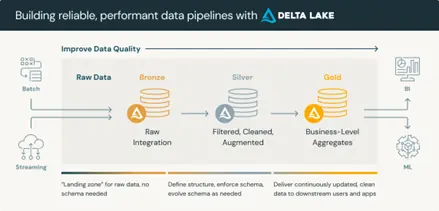
Most engagements start with a medallion architecture, moving raw data through Bronze, Silver, and Gold layers with automated quality checks on Delta Lake, while Unity Catalog governs lineage and access.
On top sit Polestar Analytics' own Databricks-native products: the Pulse suite, PromoPulse for trade promotion, PricePulse for pricing, and CapitalPulse for finance, alongside the Data Nexus modelling accelerator and Agenthood AI for persona-centric agents. As a launch partner for Genie and Lakebase, the firm often puts these capabilities into a client's stack while they're still new to the market.
For consumer goods clients, including the alcoholic beverage makers Polestar Analytics serves, the highest-value work sits around trade spend and demand. US trade spending tops $200 billion a year, and around 75% of CPG firms struggle to align promotions with retail execution, so small accuracy gains compound fast.
Polestar Analytics builds the Databricks data foundation that lets consumer goods teams:
- Forecast demand in real time across channels
- Analyse promotion effectiveness as campaigns run, not after
- Understand shoppers and brands through unified data
- Optimize pricing strategy across multiple channels
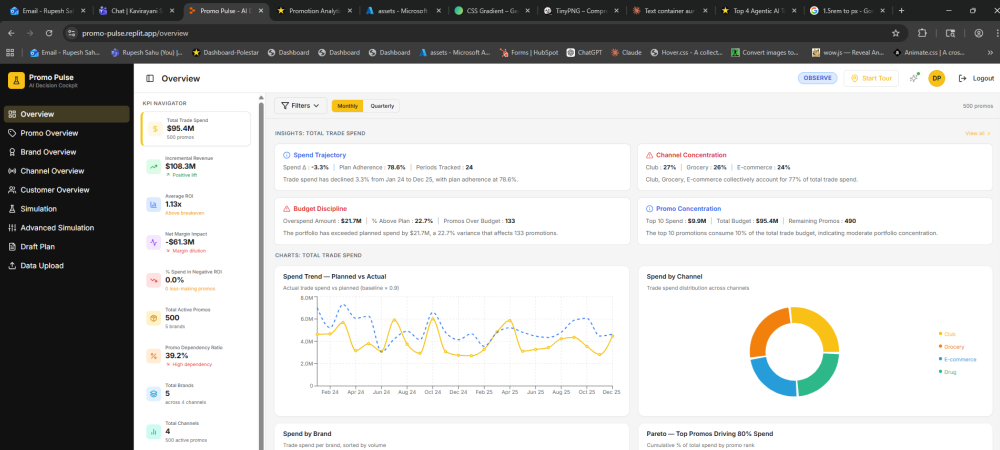
On top of that foundation sits PromoPulse, their trade promotion product. It targets a 2-5% revenue increase and roughly 10% better promotion ROI than the competition. The edge comes from working with predictive and prescriptive trade budgets, rather than analysing data only after campaigns finish. The difference is timing. Instead of waiting weeks or months after a campaign's completion to analyse its effectiveness, marketers can measure incremental lift using a reliable statistical benchmark during the live campaign stage and at the same time adjust the budget.
An Alcobev engagement shows the same pattern at a great scale. A global alcoholic beverage leader operating across major world was plagued with data residing in more than 150 distinct source systems. The finance, marketing, HR, and supply chain departments of the multinational organization were functioning independently without any unified PII and GDPR framework across markets, while the users of the company's data were experiencing long waiting periods for insights due to legacy systems. Polestar Analytics migrated the estate to a Databricks-based harmonized mesh platform built on three pillars: engineering automation, governance, and organizational enablement.
In reality, this implied automating data ingestion by all four departments, implementing Bronze-Silver-Gold-Platinum quality levels, establishing PII controls and controls based on a role of the user, providing ML-ready platform, and making self-service analytics available. The result was 150+ systems running as one platform, reporting turnaround twice as fast, insights reaching business users three times faster, 99% data availability for critical operations, more than 50,000 R&D documents processed by custom AI tools, and over 50 change programs rolled out with adoption above 90%.
Retail shares the CPG forecasting challenge but adds the pressure of real time. Inventory distortion drains about $1.73 trillion a year, and stockouts alone cost retailers roughly $1.2 trillion globally, usually because marketing, merchandising, and inventory read from different systems.
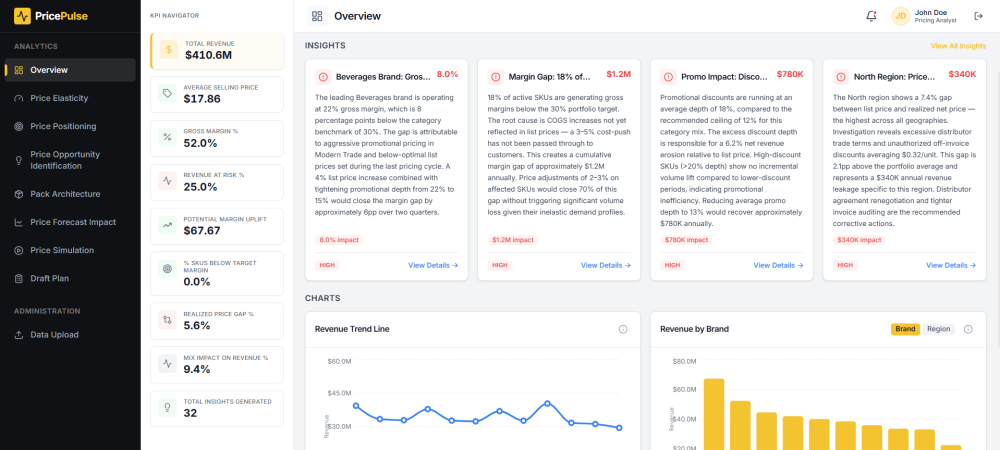
Polestar Analytics' answer is to unify the channels that normally sit apart, pulling point-of-sale, e-commerce, inventory, loyalty, and supply chain data into one Lakehouse. From that base it enables non-linear demand forecasting, personalized product and shopping recommendations, dynamic pricing through PricePulse, retail media measurement, and customer intelligence that treats online and in-store as one shopper rather than two.
Its Data Nexus accelerator is built to reach that unified state faster, and their team cites roughly 50% faster time to value from cutting unused pipelines, inefficient notebooks, and wasteful workflows.
That unification shows up in a global retail GCC engagement. The client's analytics ran on legacy Hive-based data with weak governance, ML models had no versioning or audit trails, and pipelines were costly and slow to run. Working as an embedded analytics partner, Polestar Analytics migrated the estate to Databricks Unity Catalog, introduced MLflow for model versioning, set up CI/CD to reduce engineer dependency, and right-sized clusters to cut cost and runtime. On top of that foundation it built A2K customer intelligence to surface high-value loyalty targets and a unified pre-versus-post promotion dashboard. The results were concrete: 75% lower cloud cost on offer-model pipelines, 40% faster runtime, and 90% savings on the customer-lifetime-value pipeline. That governed, cost-controlled foundation is what lets loyalty and promotion analytics run on numbers merchandising teams actually trust.
Life sciences is where Polestar Analytics' governance-first approach earns its keep. It is known that more than 90% of clinical trials fail and the cost of a single drug is well over a billion dollars, therefore any action that helps either shorten the cycle or earlier identify the signal has an immediate impact.
Polestar Analytics is using Databricks Data Intelligence platform, which incorporates clinical information and can provide real-world evidence analytics, along with bringing supply chain visibility and producing regulatory-ready reports on a secure foundation. Unity Catalog takes care of data lineage and access control needed for audits. This is becoming urgent as the volumes of data are increasing. A single late-stage trial generates much more data than it used to a decade ago; however, that data has no value if it remains in different clinical, operational, and laboratory systems.
Unity Catalog makes or breaks your migration. See the patterns that decide.
A leading Fortune 500 healthcare organization serving millions of members highlights the cost of fragmented data and legacy systems. It was spending about $2.59 million a quarter on Databricks with little visibility across more than 4,500 jobs. There was no unified lineage from source systems through Azure Data Factory and Databricks into Power BI, datasets and pipelines proliferated with heavy duplication, monitoring was fragmented across teams, governance around dataset reuse and cluster configuration was inconsistent.
Polestar Analytics put in a centralized FinOps and governance framework with granular spend dashboards, real-time consumption monitoring, end-to-end lineage, standardized deployment and cluster practices, optimized autoscaling, and enablement workshops to build cost-aware habits in the teams themselves. As a result, there was a 17% spending reduction in Azure Databricks, there was 100% visibility in expenses across all domains and workload types, more than 150,000 datasets were rationalized, over 40,000 pipelines were governed in a standardized manner, and customers were enabled to make a transition from reactive cloud cost management towards proactive management of cloud expenses.
Across all three industries, Polestar Analytics ties its Databricks use cases to a consistent set of outcomes:
- Supply chain resilience
- Personalized and monetized customer experience
- Employee productivity
- Profitable volume growth
- Sharper market intelligence
These trace back to concrete objectives the industry already recognizes, dynamic pricing, portfolio innovation, demand and inventory optimization, supplier collaboration, and long-range planning. Timelines are specific, and usually run between six weeks and ten months depending on data complexity. Simple migrations wrap up early in that range, while the most involved work, a full advanced-analytics solution with model deployment, sits at the longer end.
What is more telling than the technology itself, though, is how valued is the way clients engage with the consultants; they follow their own approach instead of waiting to be told what to do, make several proof-of-concept iterations, and see risk mitigation as a key part of engagement rather than as an afterthought.
The through-line is the sequence, not any single tool. Migrate the estate, govern it with Unity Catalog, then build the promotion, pricing, and clinical use cases that move the P&L, with native products and accelerators shortening each step. A spirits company got one version of the truth, an FMCG leader got a supply foundation ahead of schedule, and a health insurer got its cloud bill back under control. Fragmentation is the shared problem across CPG, retail, and life sciences, and fixing the foundation is what turns the rest from mystery into leverage.
Weighing a Databricks migration? Our experts map the sequence for your data estate
Implementing Databricks goes beyond setting up infrastructure. An experienced consulting partner helps build a governed data foundation, accelerates migration and modernization, and ensures AI use cases deliver measurable business outcomes instead of remaining pilot projects.
Promo-Pulse handles trade promotion optimization, Price-Pulse covers pricing and elasticity, and Capital-Pulse focuses on working capital intelligence for finance. All share the same Databricks-native foundation.
No. Products like PromoPulse and PricePulse are built as no-code interfaces for commercial teams, taking users from data to a finalized plan in a single session without SQL or model-building.
Polestar Analytics goes beyond implementation. With 1,000+ deployments, 87% repeat business, and launch-partner access to capabilities like Genie, Pulse Suite and Lakebase, they migrate your estate, govern it with Unity Catalog, and build the promotion, pricing, and clinical use cases that actually move your P&L, turning fragmented data from a cost centre into leverage.