
Summarize this blog post with:
Editor's Note: Trade promotions remain one of the largest and least optimized—investments for CPG organizations. As market volatility, retailer complexity, and margin pressure increase, traditional spreadsheet-driven approaches are no longer sufficient. This blog explores why trade promotion planning is fundamentally broken, the risks of maintaining the status quo, and how modern, AI planning platforms like Pigment enable finance, sales, and marketing teams to plan, execute, and optimize promotions with confidence. Explore now.
Do you know that trade promotions represent 15–25% of revenue for many CPG companies, making them one of the largest and most strategic investments a company makes. Yet nearly 85% of CPG brands still struggle with overspending and ineffective trade management, according to Strategy&—often because leaders still don’t understand how to maximise their ROI.
What happens when the approach changes? A leading alcoholic beverage manufacturer and distributor analyzed 500+ promotional activities across 30 markets, they achieved a 15% improvement in promotion effectiveness, unlocking nearly $50M in annual revenue growth. The difference wasn’t bigger budgets—it was data-driven planning replacing gut instinct.
Today, decision-makers still come across questions in their everyday life:
What was the retailer’s product-level performance across California, Texas, and New York over a defined time period?
How are competitors planning and optimising their promotions? What does their promotion calendar look like?
What is the effectiveness of my past trade promotion? Will it work again for a different product or a scenario?
What would my sales look like if I kept Brand A at base price for six months, while running a BOGO on Brand B for one month?
The issue isn’t that these questions exist — they always will, because the way trade promotions are planned and managed is fundamentally broken. Excel-based workflows, disconnected data sources, and siloed teams make it difficult to answer even basic questions with confidence, allowing margin leakage to become normalized over time. For finance, sales, and marketing leaders looking to turn trade spend from a necessary cost into a true strategic lever, the solution isn’t asking fewer questions — it’s rethinking the entire approach to promotion planning.
In this blog, we’ll explore the most critical gaps in traditional trade promotion planning and show how Pigment planning platform can deliver meaningful impact across teams. Dive in.
Learn about the comprehensive framework for managing trade promotions effectively, from planning and execution to analysis and optimization.
Modern trade promotion planning must address eight fundamental capabilities that conventional approaches cannot deliver:
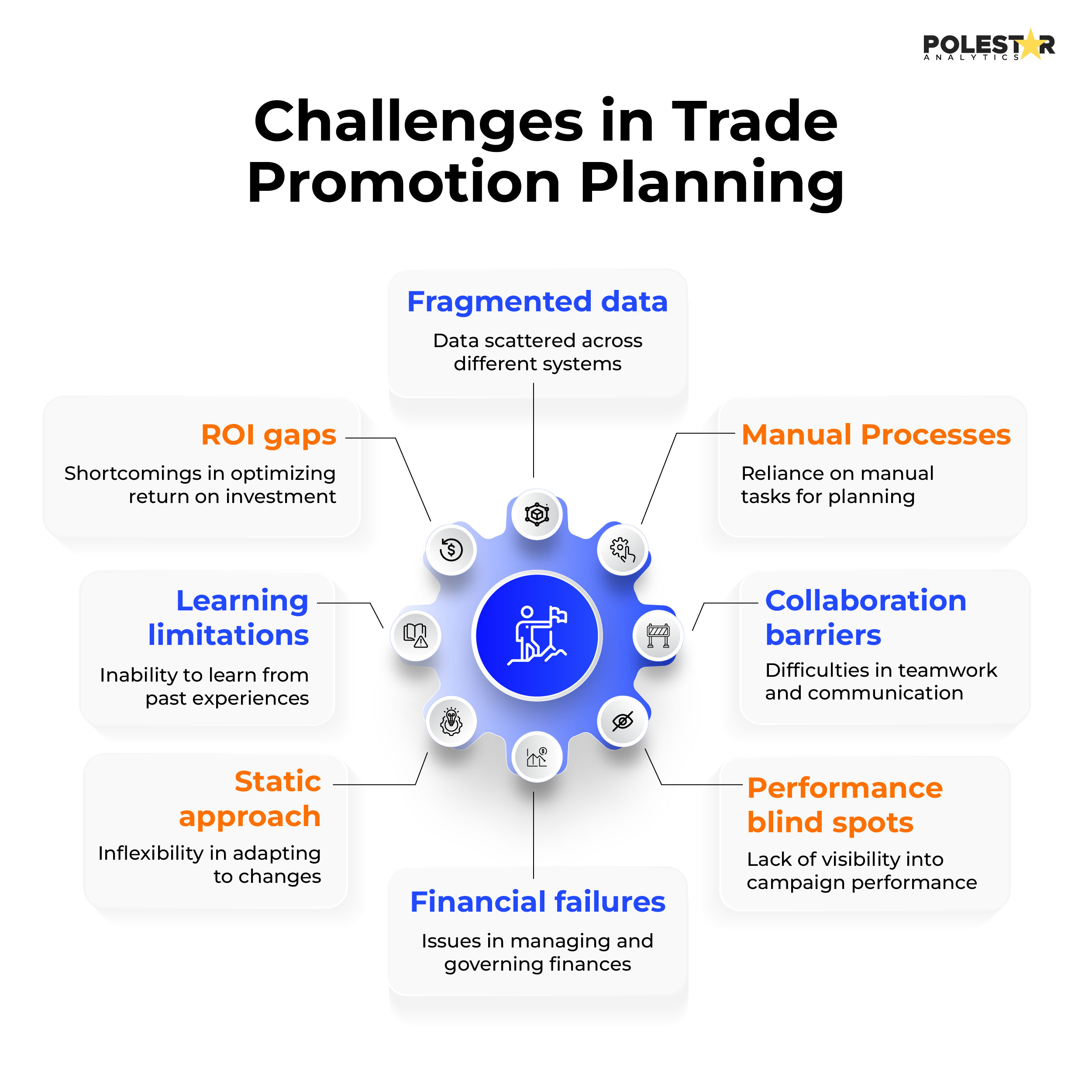
Fragmented data foundation: Promotion data scattered across ERP, CRM, Excel, and retail execution systems creates a planning issues. Without a unified data model that centralizes master data, historical performance, and real-time actuals, teams waste weeks on manual consolidation. The result? Planning cycles that should take days stretch into weeks, and forecasts nobody trusts.
Manual planning processes: Excel-driven workflows may work for isolated plans, but it breaks at enterprise scale. Broken formulas, copy-paste errors, and version control issues, consume teams time. So, when your team spends more time maintaining spreadsheets than analyzing promotional effectiveness, you've the game.
Collaboration Barriers: Trade promotion demands tight coordination between finance, sales, and marketing—but fragmented tools make this impossible. Without shared workspaces, approval workflows, and audit trails, teams operate in silos. The result is confusion, rework, and promotions end up not meeting anyone’s goals.
Performance Blind Spots: A BOGO driving 35% volume uplift sounds impressive, until you realize it destroyed category margin by 12%. Without granular tracking of cannibalization, tactic-level ROI, basket halo effects, and competitive response patterns, teams cannot optimize what they can't measure.
Financial Governance Failures: Real-time budget tracking should not be aspirational—it should be on high priority. Many organizations still realise that they have overspent, at the end of the month. Without things like approval workflows, automated budget limits, and variance alerts, trade budgets can rapidly get out of hand instead of being managed as an intelligent investment.
Static Planning Approach: Markets change. Competitors launch counter-promotions. Inventory situations evolve. Retail traffic patterns change. Your promotion plans should flex accordingly—but manual processes can't keep pace. Without swift what-if modeling capabilities (testing discount depths, timing shifts, channel mix), you're locked into plans that were obsolete before execution began.
Learning limitations: Post-promotion analysis is where competitive advantage compounds. Which tactics worked? Which retailers drove the best sell-through? What were the early warning signs that signals underperformance? However, when evaluation happens late, insights get siloed, and learnings never systematically improve future plans. You're repeating mistakes, not building institutional knowledge.
ROI Optimization Gaps: There’s no clear, structured way to allocate trade spend by brand, region, or channel. Promotions are often chosen based on intuition instead of price elasticity curves or historical ROI rankings. Because performance isn't systematically compared across tactics, channels, and periods, high-potential strategies stay under-invested while low-performers drain budgets.
Therefore, the solution to these complexities lies in the adoption of a modern platform that brings financial logic, strategic planning, predictive modeling, and operational execution together—so that finance, sales, and marketing can co-own promotional results instead of operating in silos.
How do you decide your next move?
Dive into Pigment’s core strengths, use cases, advanced AI features, and what sets it apart from other planning tools
Explore Pigment
Pigment for trade promotion planning delivers precisely what is needed. It brings control, clarity, and connected decision-making to the complete trade promotion lifecycle, replacing spreadsheet-heavy manual processes with a collaborative platform that auto-suggests promotions and seamlessly integrates historical plans.
Built on a natively sparse engine, Pigment's workspaces aren't limited by storage capacity constraints. Data flows freely across business functions—from sales to finance to supply chain—without requiring manual imports between models or reconciliation headaches. This architectural foundation means your trade promotion data, customer insights, and P&L impacts exist in a single source of truth that every team can access simultaneously.
With one-click ML forecasts generated directly within Pigment Boards, users can project promotional lift, baseline volumes, and incremental revenue from any business metric without switching tools or waiting on data science teams. Comprehensive P&L visibility and unified cost management make every stage of promotion planning intelligent, faster, and more accurate.
Pigment Agents can continuously monitor promotion performance against benchmarks, automatically flag underperforming campaigns, and surface optimization opportunities in real-time. These intelligent assistants work alongside your planning teams to identify patterns in historical data, suggest promotional calendars based on seasonality and competitive dynamics, and even recommend budget reallocations mid-quarter.
The platform maps halo effects and cannibalization to reveal the real impact of each promotion, while scenario planning and AI-powered insights convert raw data into decisive action. With multi-team workflows and executive dashboards, Pigment closes the loop on trade spend, replacing manual spreadsheets with a connected, profitable planning engine.
As a trusted Pigment partner, we leverage AI-powered analytics and proven planning frameworks to build solutions that fit both your current needs and future vision. Our approach enhances integration and modeling capabilities to drive more innovative and more scalable outcomes.
In this short demo below, you’ll see how Pigment-powered trade promotion planning enables auto-suggested promotions, one-click forecasting, integrated cost management, and impact analysis, bringing planning, execution, and performance together.
Still struggling to justify your planning investment?
See how teams are achieving up to 306% ROI on their planning investments.
Explore Pigment
With this approach at hand, the strategic impact extends well beyond operational efficiency. Organizations can now change the way they understand and manage their spending areas. Here's how:
Pigment’s advantage for finance teams is that - governance, variance, and margin protection is happening inside the same live, shared model that teams are actively planning in. Teams can gain a clear picture of what’s working across regions and brands, allowing them to allocate expense more confidently. Now finance teams can:
- Monitor margin impact as promotions are planned
- Validate ROI assumptions before approvals
- Reallocate spend dynamically across brands, regions, and time periods
Sales teams get the tools to drive performance with data rather than gut feel. They can clearly see which retailers drive the best promotional results. Which tactics work in different channels? And where should co-op budgets go for the biggest impact? The data gives answers to all these questions. Moreover, Field teams also get advantages from real-time feedback and clear performance metrics, making execution more accountable and clearer.
Marketing teams move beyond execution and become a strategic engine for impact and optimization. To understand a promotion's true effect teams can leverage automatically suggested promotions based on historical data and testing different mechanics, messages, and timing, brands can rapidly see what actually works.
With comprehensive visibility across the entire product portfolio through cannibalization and halo Effect mapping, leaders make SKU-level planning more effective and informed. The platform's Scenario Planning feature helps explore all the "what if" scenarios, allowing teams to proactively adjust strategy for optimal results. Robust AI insights instantly analyze the data, telling you exactly what the numbers mean.
The shift from "let's try this" to "the data shows this will work" changes organizational credibility and influence.
For the CFO and executive team, intelligent trade promotion planning delivers what legacy approaches cannot:
- Confidence that trade spend is driving profitable growth, not just volume.
- The ability to model strategies and see trade-offs before setting budgets.
- Continuous learning that improves decisions over time.
- A shift from seeing promotions as a cost to treating them as a strategic advantage.
Trade promotions don’t have to be a source of guesswork, overspend, or disconnected decisions. With Pigment for trade promotion planning, CPG organizations can eventually replace disconnected workflows with an intelligent, unified planning engine that brings accuracy, transparency, and real accountability to all critical decision.
By connecting finance, sales, and marketing on a unified platform, teams can predict outcomes, optimize spend, and constantly improve performance. The outcome is simple: your trade spend actually supports profitable growth instead of draining margins. With Pigment, promotions become an intelligent investment, not just another cost. Get in touch to plan smarter.