If you are here, you already know that problems don't exist in isolation; they are deeply connected. And when observing top-performing companies, they found out that
58% of profitable growers focused on mix of assortment, pricing, and promotion analytics for CPG growth.
58%
of profitable growers focus on the mix of assortment, pricing, and promotion analytics — not any single lever in isolation.
Source: Deloitte, Consumer Products Industry Outlook 2025
For decades, CPG Revenue Growth Management (RGM) teams have wrestled with challenges in assortment, pricing, and promotion — but these levers don't operate independently. Decisions in one area ripple through the others, creating complex trade-offs that mature teams must navigate.
Over forty-year RGM maturity arc , we've seen decision making evolve in clear stages:
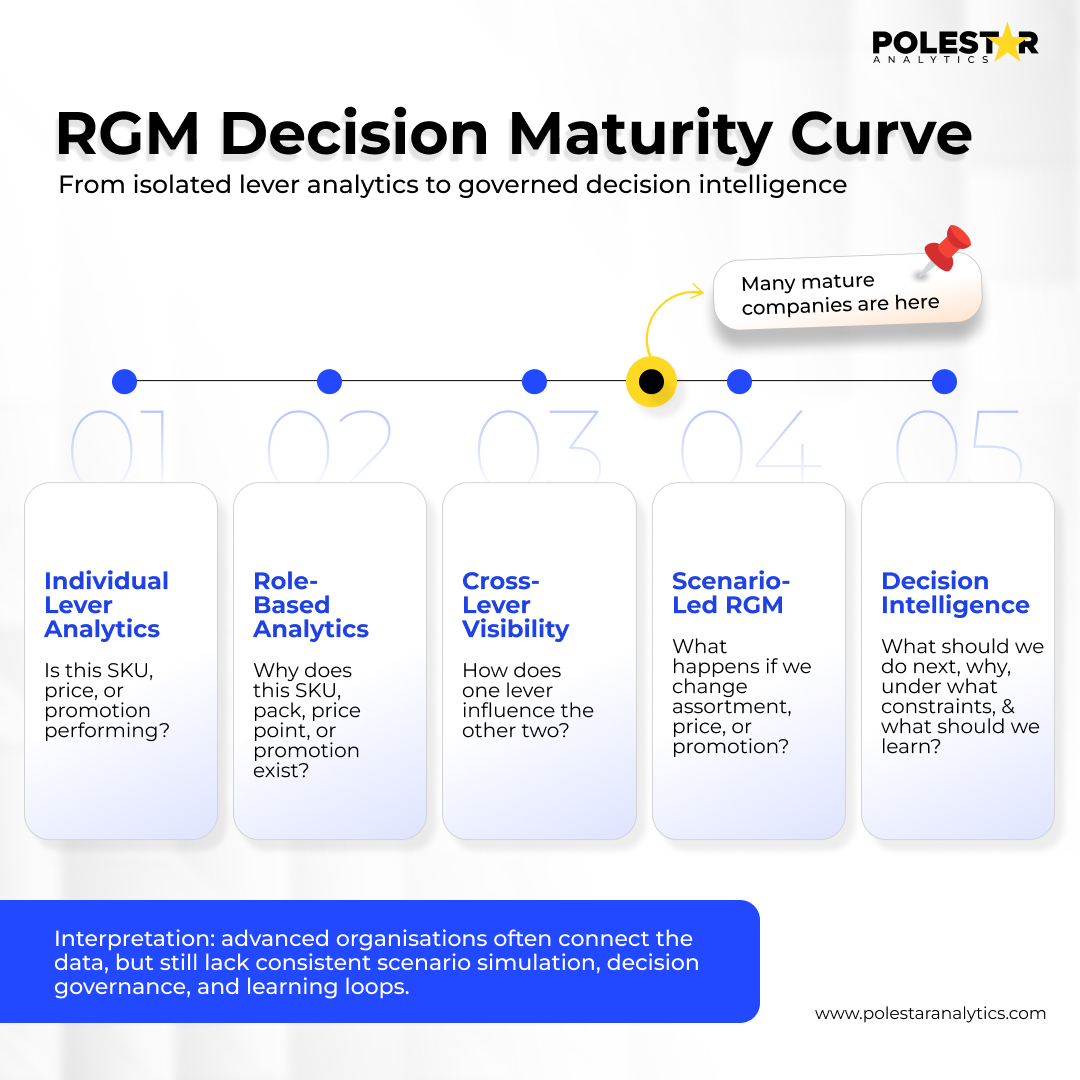
The difficulty is that assortment, promotion, and pricing don't often happen in a vacuum. A decision in one area usually creates opportunity or pressure in the others. Most organizations can now see these links, but acting on them remains difficult. Teams often understand that a price change can affect promotion performance or that an assortment move can shift demand across packs, but they usually don't have an easy way to test those trade-offs before committing.
That's where Revenue Growth Management is headed: moving beyond siloed reports and disconnected analysis, and towards a more connected planning approach — where teams can compare scenarios, understand commercial trade-offs, and make better decisions across all growth levers.
“RGM is evolving from just being a silo function into orchestrating the end to end of the equation — moving from looking backward to predicting forward and acting with agility.”
Lauren, Head of Data & Analytics, Diageo
How the levers interlock
When it comes to decision-making across assortment, pricing, and promotion, every major RGM decision starts with one primary lever, but the final outcome is shaped by the other two:
| If the decision starts with... |
Pressure-test with... |
Final decision should optimize |
| Assortment |
Price role, promotion dependency, substitution path |
Portfolio health, shelf productivity, margin mix |
| Pricing |
SKU role, pack ladder, promotion pressure |
Revenue, margin, affordability, premiumization |
| Promotion |
SKU role, regular price, inventory, cannibalization |
Incremental margin, trade ROI, demand quality |
Here's the blueprint: don't think of assortment, pricing, and promotion as disconnected analytics silos, but as interconnected decision lenses. Start with one lever, then pressure-test and optimize through the others.
This interconnected approach is the reality that mature CPG RGM teams must master to unlock hidden value.
TL;DR
The three-pillar blueprint for CPG Revenue Growth Management
PILLAR 01 · SHELF FOUNDATION
Assortment analytics
The shelf foundation — with key controls, individual metrics, interconnective views, plus common misreads.
PILLAR 02 · VALUE ARCHITECTURE
Pricing analytics
What it controls, how to track it individually and across levers, and interpretation pitfalls.
2.1 Assortment-led decisions: which SKUs deserve space, support, or simplification?
As a decision maker in mature CPG Revenue Growth Management, you know that assortment decisions are no longer just about "which SKUs sell?" The question is: how does each assortment decision impact shoppers, pricing, promotions, and the value of your whole product portfolio?
Having the right product mix can really pay off. According to NielsenIQ, when retailers trimmed their assortment by 10% while keeping the top performers they saw sales and gross profit jump by up to 7%. On top of that, swapping out underperformers can boost sales by 1-3% and raise profits by 2-4% every year. All this proves that assortment decisions aren't usually simple — and their impact is often bigger than you'd expect.
A slow-moving SKU might still protect trial and introduce new shoppers. A value pack can support affordability but inadvertently weaken the core pack's sales. A premium SKU may not drive volume but can anchor trade-up behavior and defend margin mix. Similarly, a promoted SKU might appear successful by sales lift alone — until pricing and promotion analytics reveal that growth is funded, not earned.
Assortment decisions cannot rely on velocity, margin, or distribution metrics alone. They must be interpreted through the lens of price and promotion simultaneously.
Assortment: commercial architecture, not just range decisions
An SKU rarely underperforms in isolation. Its performance is shaped by:
- The role it plays in the portfolio
- The price point it occupies
- The shopper mission it serves
- The channel where it appears
- The promotional support it receives
Mature assortment analytics move beyond simple rationalization. The real question isn't just "which SKUs should we drop?" It's "which products really deserve their spot when you weigh up price, promotion, substitution, shopper behaviour, and retailer economics all at once?
Many assortment errors arise from interpreting metrics too literally. For example:
- A slow-moving SKU might protect an entry price point essential for affordability.
- A premium SKU might carry brand equity more than volume.
- A regional SKU might appear weak nationally but drive loyalty in specific clusters.
- A high-growth SKU might be overpromoted or underpriced, cannibalizing more profitable packs.
The goal is explicit role definition for every SKU — not just complexity reduction.
Fundamentals matter
Before you can measure impact, it's key to understand how assortment planning, finding retail whitespace, and leveraging AI for optimization all shape your relevance to shoppers and the overall health of your product portfolio.
Assortment-led decision matrix
| Assortment assortment |
Shopper behaviour affected |
Pricing signal to test |
Promotion signal to test |
Connected RGM assortment |
| Keep a low-volume SKU |
Trial, affordability, regional preference, basket completion |
Does it protect an entry price point, premium anchor, or local price role? |
Does it need support, or is it valuable without heavy promotion? |
Protect if the SKU supports a role that keeps shoppers in the brand or retailer range |
| Push a high-growth SKU |
Basket expansion, repeat purchase, trade-up or trade-down |
Is growth coming from the right price gap, or from underpricing? |
Is growth organic, or dependent on frequent deals? |
Expand only if growth is incremental, profitable, and not cannibalising better-margin SKUs |
| Prune a tail-end SKU |
Switching, mission loss, competitor leakage |
Will removing it break the pack ladder or remove an important price point? |
Is the SKU genuinely weak, or only weak because it was never properly activated? |
Prune only when demand transfer, margin impact, and shopper-role loss are understood |
| Substitute one SKU with another |
Pack switching, convenience, value seeking, stock-up |
Does the replacement improve price-per-unit logic and reduce pack overlap? |
Can trade support shift to the better-fit SKU without losing incrementality? |
Substitute if the new SKU serves the same mission with stronger margin, velocity, and shelf productivity |
| Localise by channel or region |
Local relevance, channel-specific missions, retailer loyalty |
Does the SKU need a different channel price corridor or regional price role? |
Does activation need to vary by retailer, region, or format? |
Localise when national averages hide pockets of profitable demand |
| Protect a premium or strategic SKU |
Trade-up, brand perception, category credibility |
Does it maintain the premium ladder even with lower velocity? |
Should it get visibility-led support instead of discount-led support? |
Protect if it strengthens margin mix, brand hierarchy, or retailer category story |
This nuanced approach to assortment analytics anchored in AI-powered CPG analytics and cross lever decision intelligence is critical to unlocking portfolio value and shopper loyalty.
As specialists, we understand that assortment choices aren't just about squeezing out more revenue. They have a deeper impact — shaping how shoppers behave, influencing how price pack architecture are built, and affecting how well promotions perform. Nailing your assortment strategy means seeing its role in boosting the value of your entire portfolio, not just looking at how single SKUs perform.
With this mindset, let's now turn to the next critical pillar pricing-led decisions — where protecting margin without breaking demand requires strategic alignment with assortment and promotion levers.
Turn assortment insight into retailer-ready recommendations
Explore how Polestar Analytics' retail analytics services help CPG and retail teams connect SKU role, shelf productivity, and portfolio health into one decision layer.
2.2 Pricing-led decisions: how do you protect margin without breaking demand?
Pricing is the bridge where assortment strategy meets market impact. In a permanently stressed system, the challenge is architecting value signals that resonate at the shopper's moment of choice and not just finding a "magic price".
To win, experts acknowledge the need of AI-enabled elasticity to synchronize Price Pack Architecture (PPA) across channels because the price you set on a SKU impacts not only its standalone profitability but also the effectiveness of promotions on that SKU and others, and the overall health of the product portfolio.
Key complexities include the following:
- Price-pack architecture: your pricing needs to make sense across pack sizes, encouraging premium options without undercutting your entry-level products or confusing shoppers.
- Promotion pressure: relying on frequent, aggressive promotions can pull down your base prices, making it tougher to protect your margins and sometimes just shifting sales around, rather than driving real growth.
- Assortment interplay: the price you set for a SKU can change its entire role — whether it's the entry-level option, your premium flagship, or a unique regional pick.
“Gut feelings never lead to good decisions. On a significant pricing bet you have to be able to say, the elasticity is X, and it makes sense because of what I know about my products, my categories, my customers. And if we are wrong, here is the range of outcomes.”
Sara Schillio, Director of Integrated Analytics, Kellanova , RGM Roundtable 1
That range of outcomes is the unlock. Mature teams take a CPG Price Optimization Strategy to market when the downside is bounded, not when the model is loudest. The guardrail is internal, not external, echoing Harry Ergan's warning about pricing governance:
“If you do not define your pricing architecture internally, the market will define it for you through retailer pressure or competitive retaliation.”
Harry Ergan · RGM Roundtable 6
AI for CPG Pricing that ignores the price pack ladder it sits inside is just a faster way to lose the architecture.
This is the core work that AI in CPG Pricing performs when fully connected. As Harry (Ajinomoto) explains, when people trust the numbers, they trust the recommendations. This moves RGM from a "reporting function" to "Commercial Decision Intelligence."
To get these interdependencies correct, we need combined analytics that can model how changes in pricing impact promotion success, product variety, and overall profitability in different competitive and shopper situations.
View the pricing interdependency
Before the market reacts, let pricing decide
See how PricePulse uses advanced simulation, auto risk classification, and pricing agents to help CPG teams move before margin, demand, or competition shifts.
2.3 Promotion-led decisions: which promotions generate genuine incremental value versus merely providing a temporary boost?
Even with a well-defined assortment strategy and a coherent pricing ladder, promotion remains the most dynamic lever capable of reshaping or disrupting the entire commercial equilibrium. Traditional Trade Promotion Management (TPM) systems often fall short by treating promotions as isolated, retrospective events rather than as interconnected elements of your commercial strategy, missing their real-time impact on pricing, assortment, margin, and shopper behaviour.
Here's the challenge: you can have your pricing perfectly tuned for both margin and demand, but aggressive promotion-driven discounts can erode your base prices, eat into premium SKUs, or train shoppers to wait for deals — weakening your pricing power in the long run. Likewise, a SKU you've positioned as a premium anchor or entry point can lose its role if promotions shift demand elsewhere or cause shoppers to stock up, making inventory management trickier than ever.
Point being, promotions can also mask assortment weaknesses — a SKU sustained on shelf by promotional support may seem successful, but without that support, it could be a margin drain. Because of this complex interplay, promotion decisions must be evaluated as live forces interacting with assortment roles and pricing corridors (sometimes correcting course, sometimes creating new challenges).
The key is separating volume lift from incremental value. Volume spikes alone are insufficient; the real focus must be on incremental margin, trade ROI, demand quality, and brand credibility.
How promotion decisions impact pricing and assortment
| Promotion decision impact |
On pricing |
On assortment |
| Deep discounting |
Can erode base prices, weaken price ladder integrity, and drive deal-trained shopper behaviour |
May cannibalize premium or core SKUs, distorting SKU roles and portfolio balance |
| Visibility or bundling |
Supports premiumization without margin erosion |
Reinforces SKU role as brand anchor or trial driver |
| Discount depth misaligned with elasticity |
Overuses trade spending, reducing net margin |
Masks SKU underperformance, delaying rationalization decisions |
| Misaligned timing or channel |
Disrupts shopper price expectations and regular price integrity |
Undermines localized assortment strategies and retailer partnerships |
| Cannibalization within portfolio |
Compresses margins across SKUs, complicates price optimization |
Obscures true SKU contribution and assortment health |
Promotion decisions ripple through pricing and assortment in complex ways. The ability to simulate promotional scenarios before committing spend is essential to understanding true incremental impact — forecasting uplift, margin erosion, cannibalization, and inventory constraints simultaneously.
Watch: promotion simulation in practice
Such simulation uncovers hidden trade-offs early, enabling mid-cycle adjustments rather than retrospective fixes. This is where platforms like PromoPulse provide this capability, helping ensure promotions support, rather than disrupt, established price architecture and SKU roles. This integrated approach is foundational to precise, agile promotional analytics decisions.
The era of connected decision planning: a practical framework for CPG leaders
Connect assortment, pricing, and promotion in one loop and the whole operating model shifts. Analysis sharpens, trade-offs surface and get resolved before spend, and every cycle compounds on the last. The value is not in the connection; it is in running the diagnose-to-learn cycle continuously, so priorities refine each pass and commercial bets are judged before the dollars move, not reconciled after.
That is the line between visibility and decision intelligence: teams that can see the trade-off versus teams that resolve it, portfolio-wide, every cycle, under clear governance.
ProfitPulse runs that loop in production. It removes the analyst bottleneck and puts diagnosis, simulation, and activation directly in commercial teams' hands through Pulse AI and plain-language queries, so the person who owns the number stops waiting on someone else to pull it.
Watch the ProfitPulse video
For RGM and CPG leaders, the framework comes down to four disciplines:
01
One demand truth
Own-price elasticity, cross-elasticities, cannibalization, and substitution estimated in a single model, so pricing, trade, and category argue from the same reality instead of three versions of it.
02
Role before number
Every SKU, price, and promotion carries an explicit role, volume, margin, equity, or retailer, fixed before optimization runs. Anchors get protected and the category does not erode by accident.
03
Primary lever, optimized through the other two
Each call starts with its main lever, then optimizes against the pack ladder, promo dependency, and substitution path as live constraints. Trade-offs are managed up front, not discovered in variance.
04
Simulate, commit, learn
Test the combined move before the spend, push it into execution, feed the outcome back so the next forecast is sharper.
The single-lever era rewarded the teams with the best analysts. The connected era rewards the teams with the best decisions, and those are no longer the same teams. So, the next time the question lands, how do pricing, promotion, and assortment work together in Revenue Growth Management, you will not reach for a framework. You will know they move as one decision, because every business runs on a pulse. The edge belongs to the teams that can feel it. That is the capability on which the next decade of CPG share is built.
Frequently Asked Questions
We already run pricing and promotion dashboards. What does a connected RGM setup give us that reporting does not?
Reporting tells you what a price or a promotion did. A connected setup tells you what to do next, and what that move will cost you elsewhere in the portfolio. For connected RGM, the working test is whether your team can pressure-test one lever through the other two before spend is committed: a price move against the pack ladder, a promotion against SKU role and cannibalization, an assortment cut against demand transfer. PricePulse and PromoPulse exist to make that test routine rather than a quarterly exercise. Most teams can already see the trade-off. Far fewer resolve it before the money moves.
How do we know price optimization will add revenue rather than move volume around?
Because elasticity is modelled at SKU, geography, and channel level, not as a portfolio average. For AI price optimization, PricePulse identifies which SKUs, packs, channels, or regions can absorb a change without damaging demand, margin, or the retailer relationship, then models the competitive response before you commit. What you should ask for in evaluation is the granularity of the elasticity and the bounded range of outcomes, not a single recommended number. If a model answers at portfolio average, the recommendation is directionally interesting and little more.
What proof should we see before committing next year's trade budget?
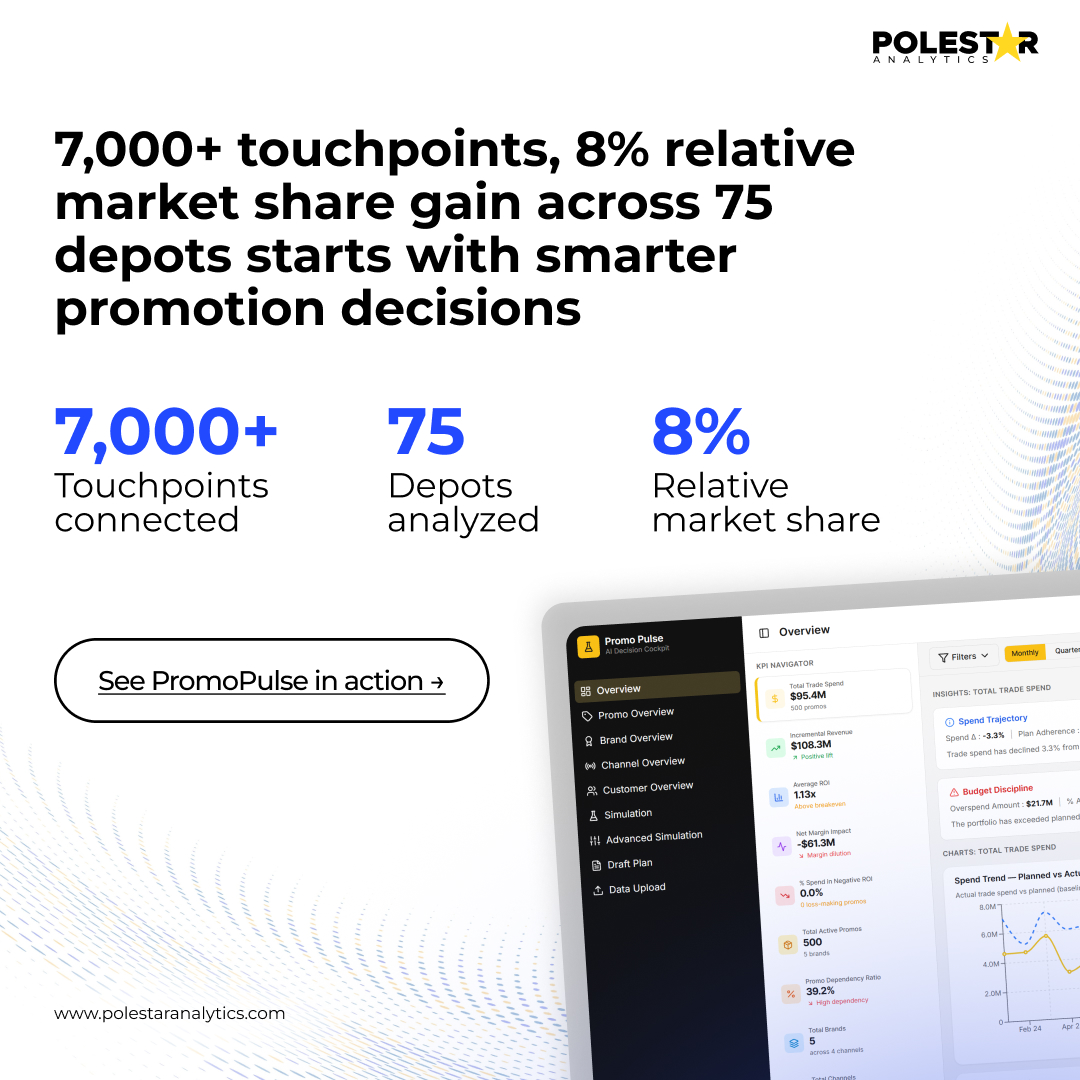
A pilot on one or two brands and channels, measured against a control set, before anything scales. For trade promotion optimization, PromoPulse separates genuine incremental value from temporary lift by measuring uplift net of baseline, alongside cannibalization, pull-forward, discount depth, and ROI. The usual shape is six weeks to align definitions and pipelines, eight weeks of measured pilot, then scale. Industry research consistently puts 50 to 70 percent of CPG promotions below break-even, so a pilot is typically funded by what it stops rather than by what it starts. For a worked example, see the 8 percent relative market share gain across 75 depots.
Do we need to fix our data foundation before any of this works?
You need a cleansed, governed gold layer. You do not need a multi-year modernization programme before the first decision improves. If that data product already exists, the apps land on it. If it does not, it is built alongside the pilot rather than ahead of it. Databricks is one route to that foundation, and the same holds on Microsoft Fabric, Snowflake, or Azure. For conversational analytics in RGM, natural-language querying only earns trust when it runs on governed data, which is why pricing logic, KPI definitions, and source-to-metric lineage ship pre-built instead of becoming a six-month definitional exercise.
What does a connected Revenue Growth Management operating model look like in practice?
ProfitPulse by Polestar Analytics connects pricing, promotions, trade spend, assortment, and sales planning into a single decision loop for CPG and retail brands. For connected RGM, the loop matters more than the connection: diagnose, simulate the combined move, commit, then feed the outcome back so the next forecast is sharper. Decisions are evaluated through margin, volume, ROI, cannibalization, and portfolio impact before execution, and plain-language queries put diagnosis in commercial hands, so the person who owns the number stops waiting on an analyst to pull it.