
Summarize this blog post with:
TL;DR: Your traditional TPM systems are execution and settlement engines, not optimization platforms. With PromoPulse as your Trade Promotion Analytics platform, you can have an AI-powered Revenue Growth Management (RGM) Decision Cockpit. It automates promotion classification, unifies disparate data sources, enables predictive scenario simulation, seamlessly connects financial planning with commercial execution, and provides an embedded conversational AI assistant for instant, data-grounded insights.
There is a quiet assumption baked into every SAP TPM and Exceedra deployment: that if you plan carefully enough upfront, execution will take care of itself.
But is it true for implementation?
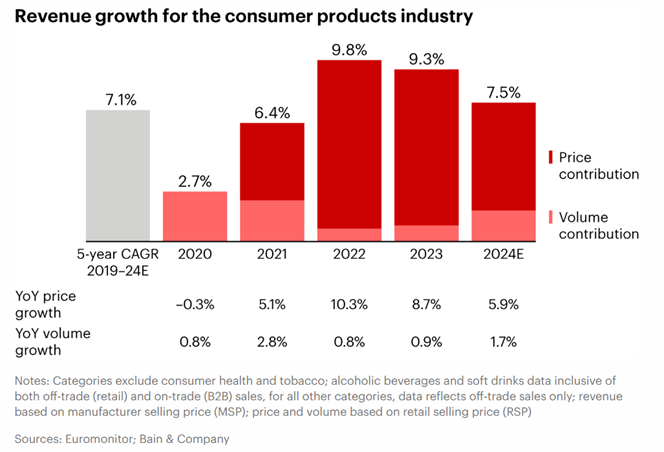 Source: Bain
What this clearly shows is that about three-quarters of 2024’s sales growth is likely to have come from price increases rather than volume gains. That is a strong sign that the old playbook is running out of room. At the same time, the cost of trade promotion remains enormous (second-highest cost item), with CPG companies typically spending 16% to 24% of gross sales revenue.
The issue is not that commercial teams lack discipline. The issue is that the industry is plagued by a clerical culture. We treat trade spend as an unavoidable "cost of doing business" rather than a precision growth engine. This is a strategic failure. If your team is stuck in a cycle of fragmented data and reactive spending, you aren't managing a portfolio. You are documenting a slow-motion margin dilution.
In many CPG companies, budget allocation is driven by historical precedent or intense pressure from retail customers, rather than actual evidence of Return on Investment (ROI). This leads to an inability to prioritize which promotions actually drive value.
The Promo Pulse Solution: Automated Quadrant Classification for Trade Promotion Management Promo Pulse introduces a dedicated Promo Intelligence layer that automatically categorizes every single promotion into four clear strategic buckets based on ROI and volume contribution:
- Scale,
- Optimize,
- Experiment, or
- Stop
Instead of guessing, RGM Managers and Trade Marketing Managers can instantly see which campaigns to prioritize, while the Strategic Portfolio Overview provides dynamic KPI panels detailing average ROI, net margin impact, and the percentage of spend wasted on negative ROI
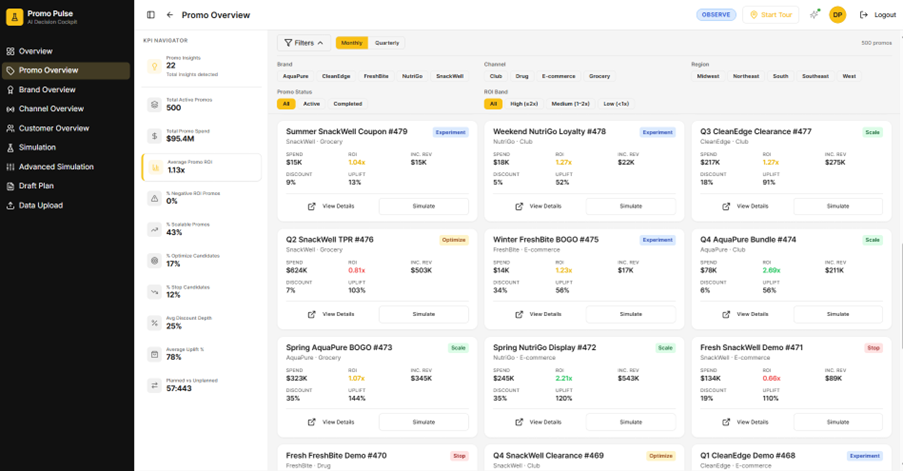 PromoPulse application showing each promotion with Experiment – Stop- Scale – Optimize tags
Trade Promotion for a Winning ROI Strategy
Struggling to maximize trade promotion ROI? Discover data-driven strategies to optimize spend, improve visibility, and drive profitable growth with Polestar Analytics.
Drive Smarter Promotions
One of the biggest weaknesses in TPM is that it answers questions slowly. A commercial leader asks what is driving ROI, where margin is leaking, or which promotions are underperforming, and the answer often has to be assembled from multiple reports.
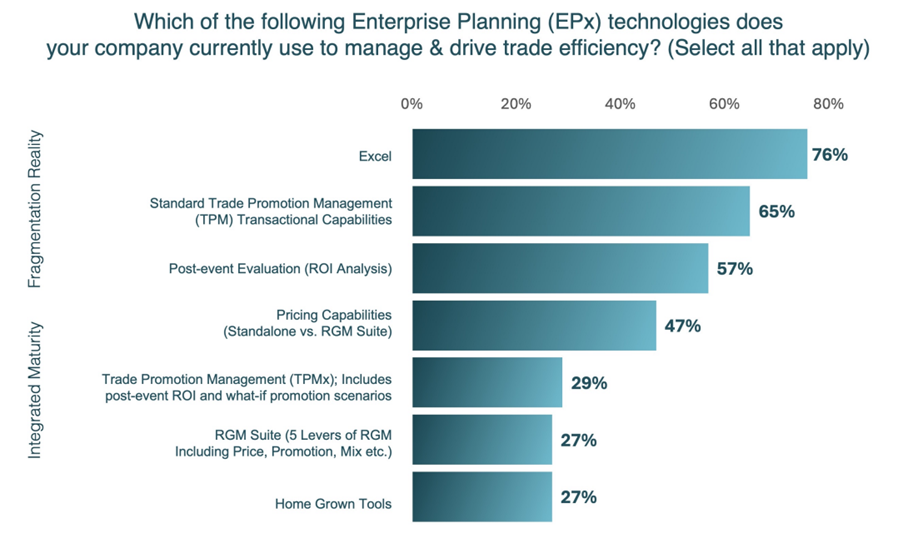
Excel (with 76% usage, source: POI State of Industry Report, 2026) still stands as the leading technology for managing trade efficiency leading to disconnected post analysis.
Through built-in data ingestion pipelines, including automated CSV uploads and derived metric computations, PromoPulse instantly calculates ROI, incremental revenue, and uplift percentages. With it’s command centre you can easily:
- View 10 Live KPI Indicators: Total Trade Spend, Incremental Revenue, Average ROI, Net Margin Impact, % Spend in Negative ROI, Total Active Promotions, Promo Dependency Ratio, Total Brands, Total Channels, and Volume Sold.
- With dynamic KPI panels: Selecting any KPI instantly renders a dedicated analytical panel with trend charts, brand/channel breakdowns, scatter plots, waterfall charts, and Pareto distributions.
- With multi-dimensional filtering: Slice all views simultaneously by region, channel, and time period (monthly or quarterly).
Traditional TPM creates a clean approval path, but it does not make the plan smarter. Once the budget is set, the system is largely in execution mode, even if a better allocation would have delivered more value.
That matters in a market where the top 50 CPGs by revenue grew only 1.2% year over year in H1 2024, while insurgent brands captured about 40% of overall U.S. consumer products growth.
The centerpiece of Promo Pulse is its Advanced Simulation Engine. Users can utilize a multi-step simulation wizard to define target geographies, brands, channels, and a total budget envelope.
Using historical performance data, the platform provides AI-powered recommendations on where to increase or reduce spend to maximize projected ROI. As users pull different budget levers, the incremental revenue and ROI recalculate dynamically, allowing teams to compare multiple scenarios side-by-side before committing a single dollar.
When teams plan their enterprise financials in one system but execute promotions in another, it creates a painful "Excel middle layer". This disconnect inevitably leads to reconciliation errors and lost business context.
With PromoPulse you can natively eliminate this disconnect through a structured workflow. Teams move seamlessly from analyzing historical data (Observe), to simulating budgets (Adjust), to committing to a draft plan (Finalise).
For companies using enterprise platforms like Anaplan, Promo Pulse offers two-way plan synchronization. Anaplan can hold the top-down financial constraints, while Promo Pulse handles the bottom-up promotion optimization, writing the finalized plans back into Anaplan as actuals or committed forecasts.
Data scientists might build brilliant demand forecasting and price elasticity models, but business users cannot easily access them because traditional data platforms require SQL or coding knowledge. Manual analysis in older TPMs can take days.
So, Promo Pulse is explicitly built as a no-code interface for commercial teams. It features -
- A built-in rules engine that automatically surfaces the four most critical business insights
- AI-Powered Recommendations, to suggest optimal budget allocations, identifying where spend should be increased, reduced, or reallocated
- Uses PulseAI, an embedded assistant, where users can simply ask natural language questions like, "What is driving margin dilution for Brand X?"
PromoPulse is an AI-powered promotion intelligence layer that helps commercial teams move from post-event reporting to real-time diagnosis. It surfaces what is driving ROI, where margin is leaking, and which promotions need attention, without waiting for multiple reports to be stitched together.
Traditional TPM reporting tells you what happened after the fact. PromoPulse is designed to help teams understand what is happening now, so they can spot underperforming promotions faster and act before losses compound.
PromoPulse is built for commercial leaders, revenue growth teams, trade promotion managers, and analytics teams that need faster visibility into promotion performance. It is especially useful for organizations that want to improve promo ROI, reduce margin leakage, and make decisions with less manual analysis.