Introduction
Across CPG enterprises today, Revenue Growth Management is already producing measurable returns:
3-7%
Revenue uplift from channel optimisation
10-20%
Cost cuts from disciplined inventory & mix
2-4%
Top-line gain from mix & assortment programs
The returns are real but they're also uneven. The same investment can produce all three results in one market and almost none of them in another, sometimes inside the same company. That unevenness is what most CPG leaders are now trying to solve for, and it's why Modern Revenue Growth Management is moving toward an operating model rather than a tool stack.
The forty-year arc of how this function has matured shows the same pattern repeating. Each generation that solved a visibility problem also widened the connection problem the next generation has to fix. If you are a leader ready to enter the next generation of Revenue Growth Management — you are at the right place. This guide is for you.
Chapter 1
Why Revenue Growth Management Needs a Connected Operating Model
Pricing analysts run elasticity. Trade marketing builds the Q3 calendar. Category planners rebuild PPA for convenience. Finance closes margin variance. Four teams, four spreadsheets, four versions of the same week.
Across all RGM Roundtable sessions with RGM leaders at PepsiCo, Mondelez, BIC, BAT, Albertsons, McCain, Church & Dwight, Ajinomoto, and others, one diagnostic surfaced in nearly every session:
The levers of Revenue Growth Management are still being managed in parallel, not together. The technology stack has matured. The connection between teams hasn't.
Kelly Rolader, Global VP of Revenue Growth & Development at BIC, describes the structural integration required to close this gap:
"By bringing pricing strategy, data science, and anti-counterfeit into the RGM center of excellence, we're able to then think about: How do we offset that disruption? How do we think about the pricing strategy that we're putting in place? It allows us to forecast better, to have an upfront conversation with our customers, and to really bring a holistic RGM approach and strategy to life with fact-based decision making."
— RGM Roundtable 3
Where the Old Model Came From
The disconnection didn't appear by accident. The Revenue Growth Management Framework that most CPG companies still operate on was built across four decades:
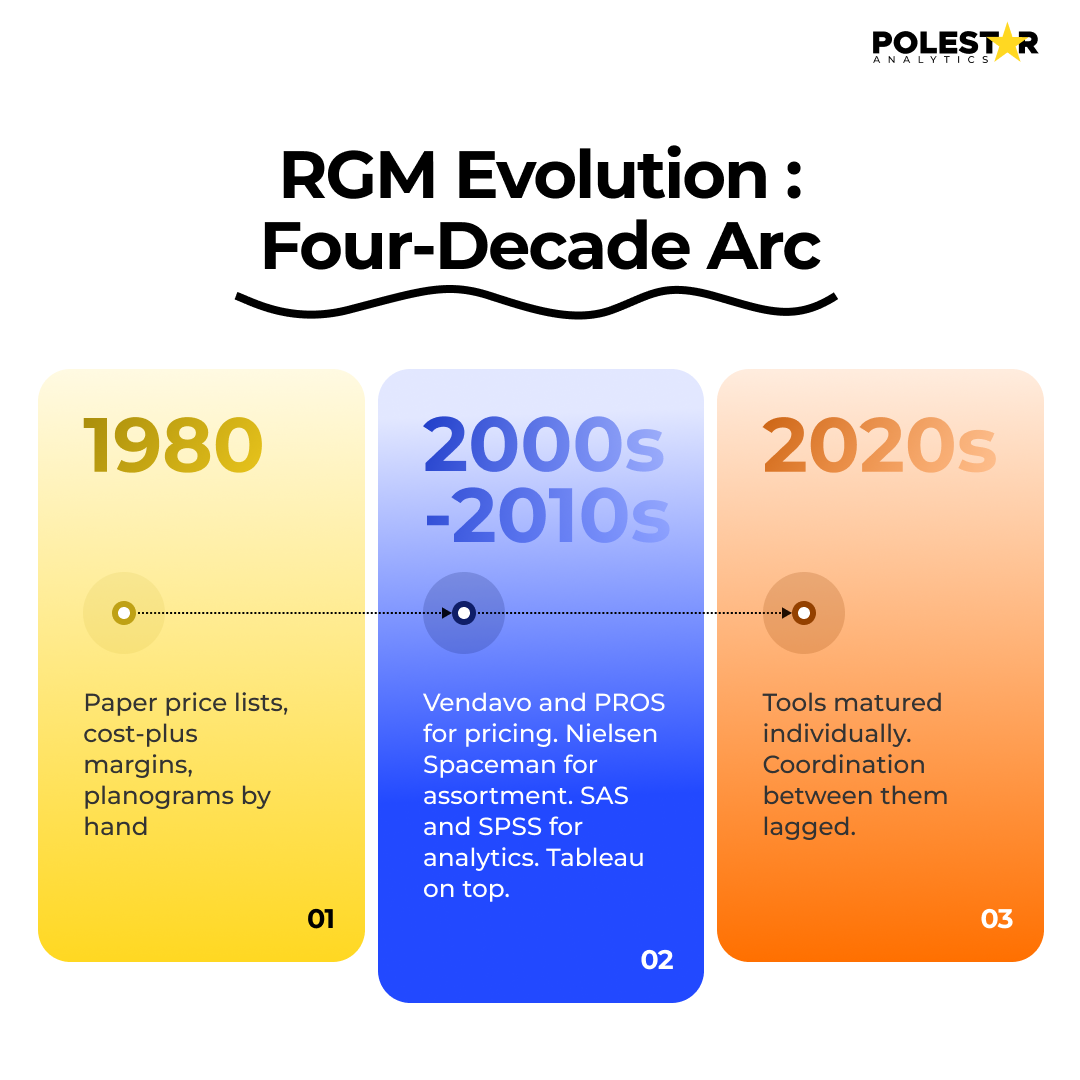
Each generation that solved a real visibility problem also created the next coordination problem. By the time the lakehouse era arrived, the Revenue Growth Management Operating Model had become harder to coordinate the more capable each individual piece became.
The RGM POV
The connected operating model isn't a replacement for specialist depth. and the strongest voices in the field are clear about that. Sabina Kay at Raise Beverage Group has described AI and connected systems as "another vantage point," a way to challenge assumptions and pressure-test existing decisions rather than dilute the expertise each function brings.
"Use AI to challenge yourself and challenge your assumptions. Use it as another vantage point."
— RGM Roundtable 2
What does it mean? For RGM, specialist depth will always be important. The connected operating model isn't about flattening expertise; it's about ensuring the specialists are looking at the same data, the same scenario, and the same outcome metric when their decisions interact.
A connected operating model needs a profile the function wasn't originally built to hire for.
It is the single biggest hiring constraint we see in Revenue Growth Management Transformation programs today, and the operating model only works when this profile is the spine of the team.
See how connected RGM works in practice.
Test cross-lever scenarios across price, pack, promotion, mix, and channel inside one Revenue Intelligence Platform.
Explore ProfitPulse
Chapter 2
Moving RGM Upstream: From Price Control to Value Strategy
A connected operating model only delivers if the function itself moves upstream. Connecting backward-facing work just gives you coordinated backward-facing work.
Harry Ergan, VP Revenue Management at Ajinomoto, captured the risk of staying in the price-control seat:
"Try not to become the pricing police. You need to make the commercial logic explicit. If you don't define your pricing architecture internally, the market will actually define it for you through retailer pressure or competitive retaliation. These guardrails aren't about being rigid; they are about maintaining commercial discipline under pressure."
— Harry Ergan, VP Revenue Management, Ajinomoto · RGM Roundtable 6
Moving upstream means the RGM team is in the room when the portfolio is being designed, not just when the price needs defending. The work shifts from monthly variance review into quarterly category planning, and eventually into the annual Revenue Growth Management Strategy conversation.
The RGM Frameworks That Anchor Upstream Work
Historically, RGM was viewed narrowly as a downstream pricing department. The framework has since evolved into a much broader discipline that integrates pricing, promotion management, portfolio optimization, and channel strategy to drive sustainable growth. As Kelly Rolader (BIC) explains, this evolution moves the function from a posture of "control" to one of "proactive value creation"Several Revenue Growth Management Frameworks have tried to organise this upstream move.
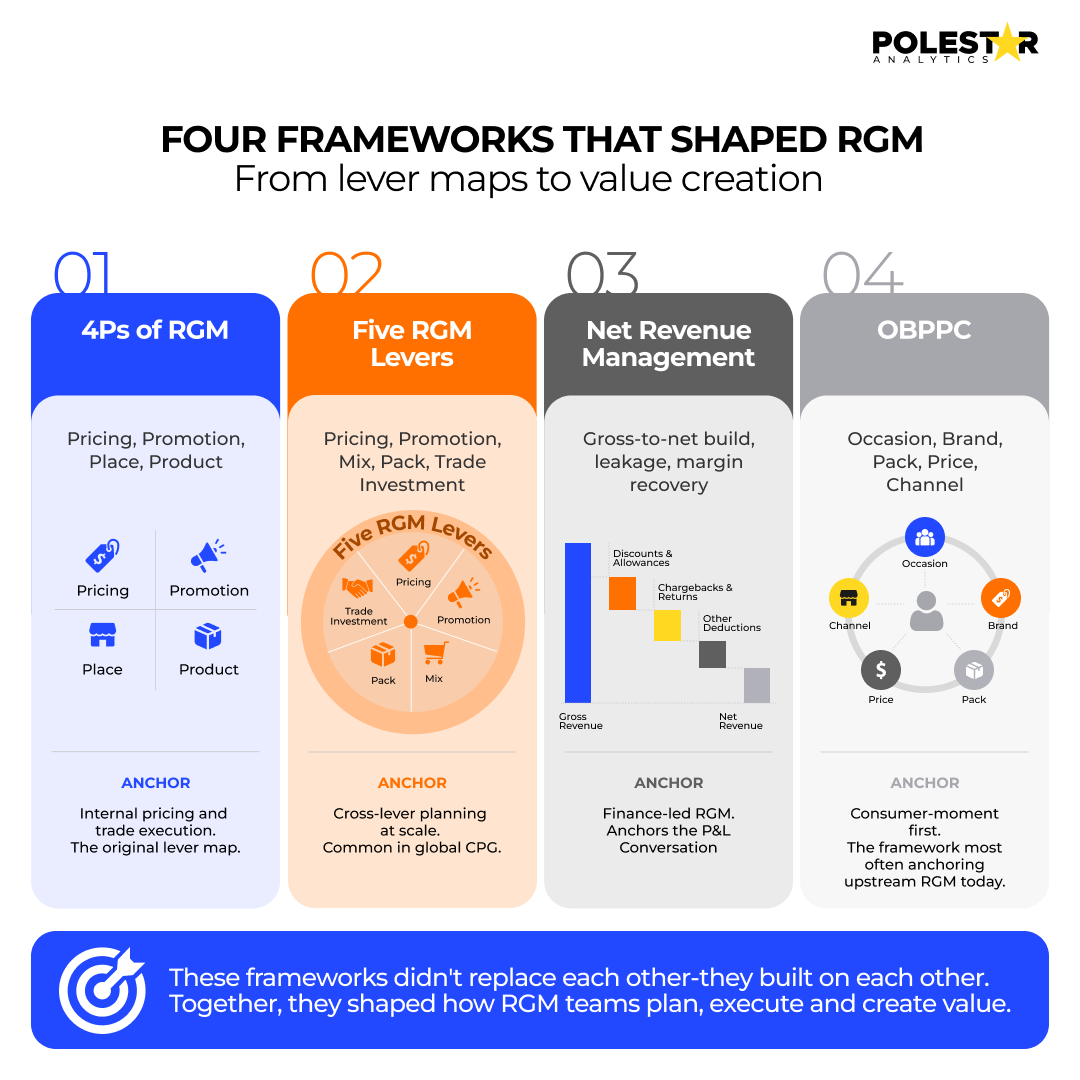
The framework that most often anchors the upstream conversation in CPG today is OBPPC. Its power lies in reversing the traditional "factory-first" logic, instead starting with the consumer's demand moment.
Price Pack Architecture (PPA): Translating Occasion into Portfolio
Inside the OBPPC framework, Price Pack Architecture (PPA) serves as the mechanical engine. It is the discipline that translates those abstract "occasions" into physical products on a shelf. Victor Arias, who leads RGM for Mondelez Mexico, describes the discipline as a framework with intentional freedom:
"You want to give guidance regarding how pack design links to consumption location and demand moment. Then markets adapt to the local reality and the channel. Set the framework. Show the intent. Then give markets freedom inside it."
— RGM Roundtable 2
Done well, PPA gives a brand a portfolio that captures every demand moment without cannibalising itself. Before optimisation begins, the first test is simple: each pack should have a clear role, a clear occasion, and a clear reason to exist in the portfolio.
Two Pricing Details That Determine Whether a PPA Holds
| Detail |
Why It Matters |
| Coinage Logic |
In emerging markets and convenience occasions, hitting a memorable coin point can make or break a pack. A few cents on the wrong side of a psychological threshold flattens a launch. |
| Localised Elasticity |
A national elasticity curve is a useful starting point and a misleading endpoint. The same SKU behaves differently across channels, regions, and promoted weeks. Move from one curve to many. |
The upstream work above is where PricePulse — the price elasticity cockpit — does its job. The elasticity work, the corridor design, the competitive index tracking, the localised pricing scenarios are exactly the kind of cross-channel, cross-region modelling that the connected pricing layer is built to run.
Close the pricing intelligence gap.
PricePulse brings elasticity, price corridors, and competitive indexes into one layer so pricing decisions move upstream, run faster, and hold up at the shelf.
Explore PricePulse
Chapter 3
Scaling Connected RGM Across Markets
This is where most Revenue Growth Management Transformation programs hit their hardest wall. And answer is simple rollouts fail when the central team is seen as a "reductive function." To succeed, the global team must provide the infrastructure while the markets drive the final 30% of the answer:
Why the Global Rollout Instinct Fails
The mistake is not centralising RGM capability. The mistake is assuming a central model can travel unchanged. A global team can define the framework, the guardrails, and the common language. But the moment that model enters a market, it runs into local channel structure, retailer power, pack economics, promotion habits, and uneven data quality.
What centre and market each own
Without a hard mandate, local markets drift, fragment, and lose the benefit of scale. The risk is genuine. The fix isn't choosing one extreme over the other. It's structuring the relationship between centre and market deliberately.
Gurkan Munsuz, Head of Global Revenue Growth Management at McCain Foods, describes the anchor required:
"[Success involves] embedding RGM checkpoints into the planning calendar and building learnings and outputs on existing commercial routines so that we speak the language of the front line."
— RGM Roundtable 4
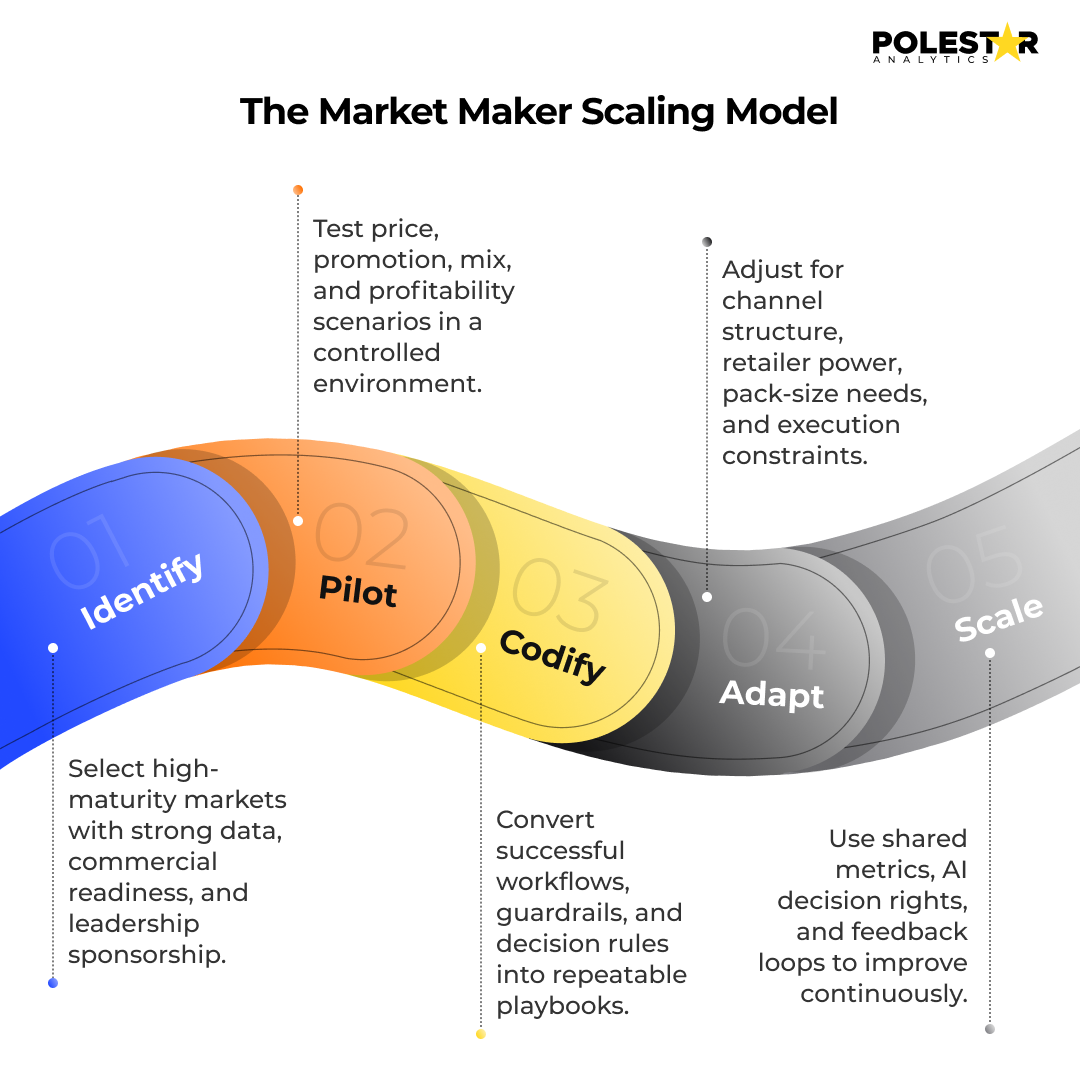
The Market Maker Scaling Model
That balance usually starts with a simple question: which markets are ready enough to prove the model for everyone else? In large CPG organisations, these become the Market Makers — the few high-readiness markets with enough data maturity, commercial sponsorship, and local execution muscle to test the operating model before it travels.
Proof Points from Real Deployments
Simulate trade promotions before the spend goes out.
PromoPulse runs TPO, scenario simulation, and real promotion ROI measurement so the trade calendar is designed to break even and built to win.
Explore PromoPulse
Chapter 4
The New RGM: Agentic AI as the Engine of the Connected Operating Model
Most RGM leaders aren't waiting to be sold on AI in Revenue Growth Management. They've already deployed it across pricing engines, promotion models, and demand forecasts. The frustration isn't with the technology. It's with what the technology is producing.
80%+
of CEOs are dissatisfied with their current RGM results. Only about 1 in 10 brands systematically achieves growth in share, category leadership, and profit at the same time.
— Bain & Company
The AI isn't bad. It's been built around the old operating model. Each pricing engine, promotion model, and forecasting tool runs in its own loop, sees its own slice of data, and ships its own recommendation to its own team. The connected operating model needs an architecture built for it, not the disconnected one stitched together after the fact.
That's the shift Agentic AI in Revenue Growth Management represents. Traditional AI gives you recommendations. Agentic AI gives you an ecosystem of specialised agents that plan, reason, and act across pricing, promotion, mix, pack, and channel together.
Three Agentic AI Use Cases Already Shipping in CPG
01
Reasoning-Agent MMM — reallocates budget continuously rather than re-running quarterly models
02
Agentic Price Pack Architecture — compresses the 12-16 week PPA cycle into days by removing cross-team handoffs
03
Agentic Trade Spend Optimisation — simulates retailer negotiations and reallocates promotion budgets inside pre-approved guardrails
ProfitPulse is the connected layer where these agents live and run as one system. The agents work through the night across pricing, promotion, mix, and channel. The translator running connected RGM walks in to a briefing that classifies what changed, what it means, and what to act on.
The Governance Conversation Around Revenue Growth Management
The question of what agents are allowed to decide on their own is where most agentic AI deployments either earn trust or lose it. Ivana Markovic, Vice President-RGM at Church & Dwight, captures the core governance principle clearly:
"AI still struggles with that context. It doesn't understand retailer politics. It doesn't understand competitive retaliation. Field reality, threats of delisting. Those aren't embedded into fully autonomous decision-making execution."
— Ivana Markovic, VP-RGM, Church & Dwight · RGM Round Table 5
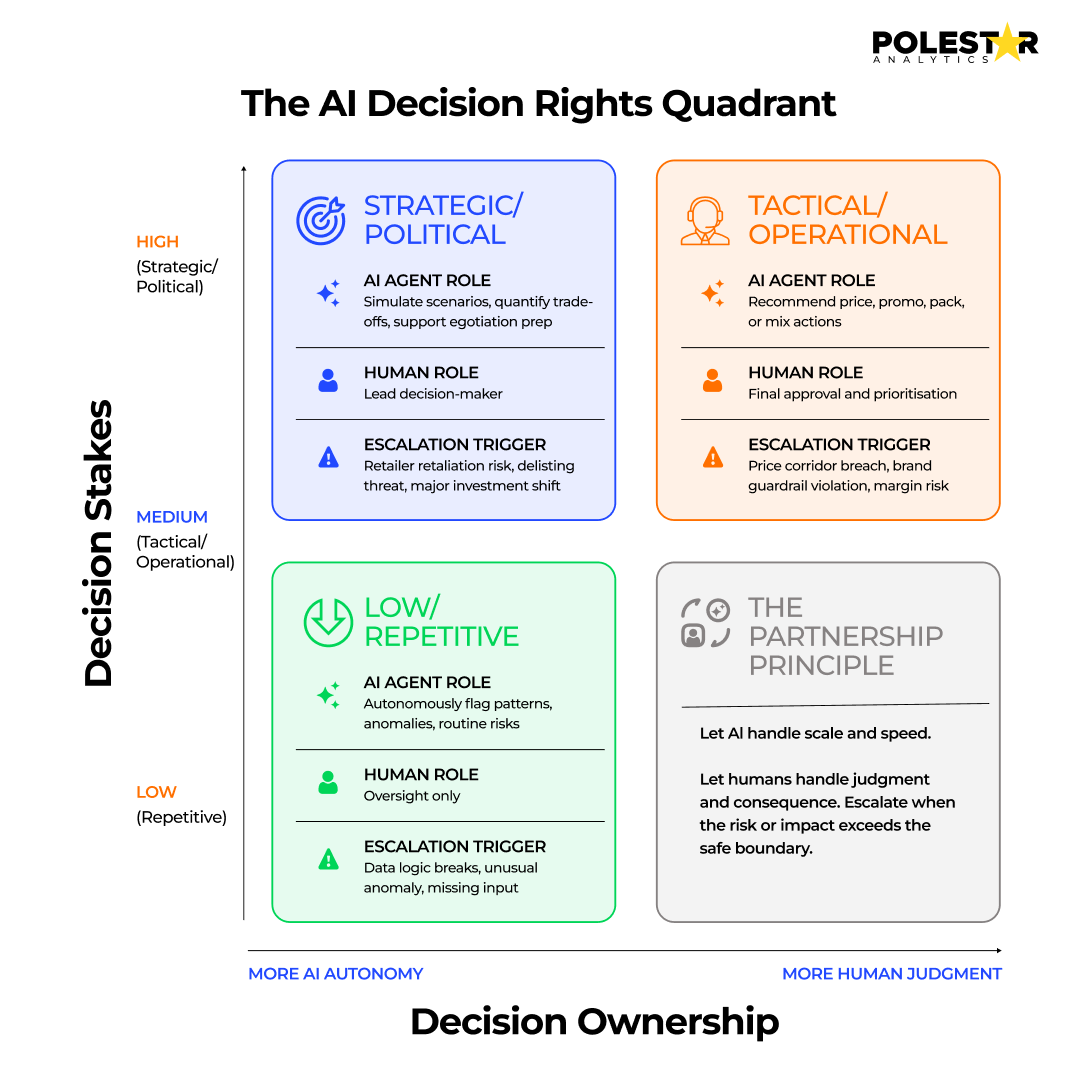
AI runs the bottom row. AI advises on the middle row. Humans run the top row, with AI as the simulation engine behind them.
72%
The industry average — trade promotions that don't break even.
That number isn't a measurement problem. It's an operating-model problem — the same one the connected layer is built to fix.
Chapter 5
Proof, the Last Few Feet, and Permanent Beta
A transformation isn't done when the platform goes live. It's done when the decision survives the journey to the shelf. The pricing corridor has to hold against the buyer's counter-offer. The promotion mechanic has to clear the planogram review. The mix shift has to read in the consumer's basket six months later.
The First Proof Is in the Numbers
A global alcoholic beverage subsidiary brought PromoPulse in to fix exactly the problem the connected model was built to solve. Trade promotion planning was happening on top-down targets that didn't read at outlet level. The team needed store-level uplift, not regional averages.
Customer and retail touchpoints optimised
Depots analysed through uplift modelling
Market share gain in pilot stores
The Second Proof Is Harder to Measure But Harder to Fake
Whether the pricing team and the trade team reach the same answer when they run the same scenario. Whether the regional GM defends the elasticity model in a steering committee under pressure. Whether the category buyer responds to a simulation on the substance rather than the politics.
The focus she's pointing at is what the connected operating model produces when it's working. Not more data. Less fragmentation. Not more dashboards. Fewer disconnections between the people whose decisions interact.
Why Connected Revenue Growth Management Must Stay in Permanent Beta
The discipline that holds the model together is what we call Permanent Beta. The model that works this quarter is a hypothesis next quarter. Markets shift, retailers consolidate, consumers move occasions, and the operating model has to be the thing under continuous improvement, not just the outputs it ships.
The Connected Revenue Growth Management Operating Model is not a product. ProfitPulse, PricePulse, and PromoPulse are how it gets operationalised. The work is to organise the function, so the levers move together, the translators run the decisions, and the decisions reach the shelf intact.
The leaders building this right now are the ones the next decade of CPG growth will belong to.
See the connected layer in action.
The clearest way to understand how the connected decision layer works is to watch it. See how ProfitPulse runs cross-lever scenarios across pricing, promotion, mix, pack, and profitability inside a single operating environment.
Explore ProfitPulse
FAQ
Frequently Asked Questions
Which Revenue Growth Management solutions analyse promotion, pricing, and product mix together?
ProfitPulse is a Revenue Growth Management Platform built to simulate price, promotion, pack, mix, and channel together on a shared data layer. Most platforms score each lever separately. Connected ones don't. The difference shows up in the daily work: when the pricing team models a corridor shift, they see the immediate impact on promotion lift, mix, and channel margin in the same scenario. That's what distinguishes a connected AI-Powered Revenue Growth Management solution from a tool stack.
How do AI-powered RGM platforms improve pricing and promotions?
PricePulse and PromoPulse improve pricing and promotions by running elasticity at scale and simulating trade spend before it commits. They classify daily signals into actionable risks and opportunities. Both sit inside an AI Decision Rights Matrix so recommendations respect retailer politics and margin guardrails. The result: faster decisions and measurably higher trade promotion ROI.
Which AI platforms help optimise pricing, assortment, and promotions together?
The PulseSuite treats pricing, assortment, and promotion as one Revenue Intelligence Platform, not three separate modules. ProfitPulse orchestrates PricePulse, PromoPulse, and MediaMixPulse so elasticity models, assortment scenarios, and trade calendars run in the same environment. That integration closes the gap between what the model recommends and what moves the P&L.