
Summarize this blog post with:
51% of CPG executives no longer believe price increases can reliably drive revenue growth. And it's not an outlier position — it's the consensus.
The pressure is coming from every direction at once. Consumers have recalibrated their price sensitivity in ways that weren't visible two years ago. Retailers are pushing back harder. Private label sits at record share in most developed markets. Tariff-driven cost volatility is reshuffling margin structures faster than annual pricing cycles can respond.
None of this is happening because organizations haven't invested in RGM (or pricing to be specific) capabilities. TPM platforms, AI-driven demand forecasting, SKU-level margin visibility, syndicated data from NielsenIQ and Circana embedded directly into planning cycles. Organizations have invested seriously. The data exists. The muscle has been built. And honestly it has never been better.
And yet 72% of promotions across CPG portfolios still miss their ROI target — because the pricing decision underneath every trade investment isn't grounded in real elasticity data.
The era of passing cost pressure through to the shelf and absorbing the volume consequence later is over.
What replaces it is harder. Pricing decisions now require simultaneous precision on elasticity, competitive position, pack architecture, and margin — across hundreds of SKUs, multiple channels, and markets that don't behave uniformly. Most organizations have the analytical tools to examine pieces of this. Far fewer have the decision architecture to act on all of it, at the speed the market now demands.
So where exactly does that architecture break down even in organizations that have invested seriously in RGM?
After working across enough pricing transformations, the failure modes become familiar — even in organizations with serious tooling investment.
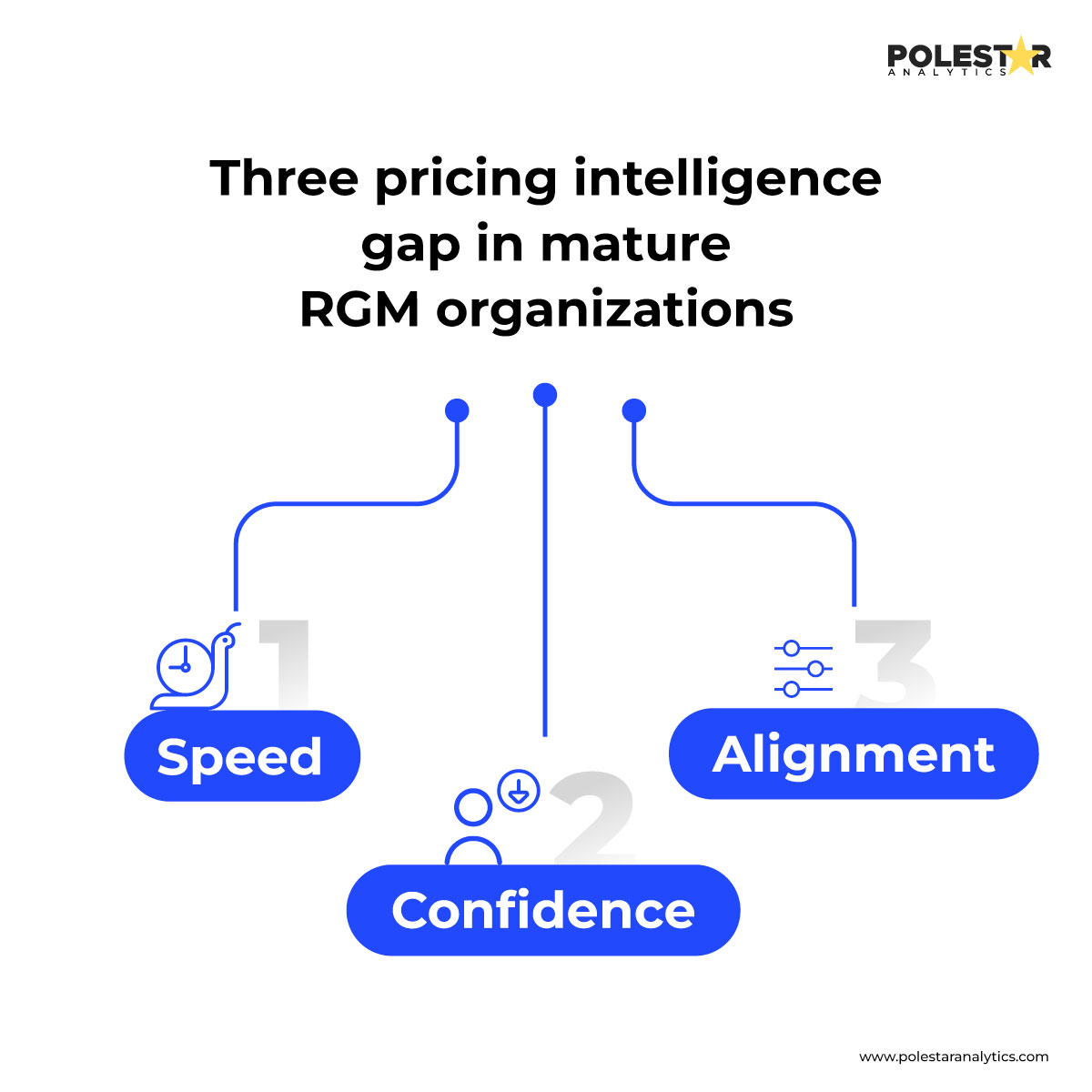 Three pricing intelligence gap in mature RGM organizations - Speed , Confidence, Alignment
- The speed gap: data exists across the system landscape, but by the time it is pulled, reconciled, and surfaced in a commercial review, the competitive window has already closed. A competitor moves on Tuesday. The validated response is ready the following week.
- The confidence gap: significant price calls are being made without a reliable way to model downstream impact before committing. Elasticity estimates sit in one system. Margin thresholds in another. Competitive position is a separate workstream entirely. The decision gets made in the gap between them.
- The alignment gap: commercial, finance, and supply chain work off different versions of pricing reality. Even well-reasoned decisions get executed inconsistently when the source of truth is fragmented.
These are not tool failures. They are integration and workflow failures — and they are expensive.
52% of CPG organisations report that HQ support teams lack the capabilities to guide pricing, trade allocation, and go-to-market strategy
The tools exist. The connected workflow does not.
Closing these gaps doesn't require another data source or a smarter model in isolation. It requires a single workflow that connects intelligence to decision — without breaking stride. That's exactly what PricePulse was built to deliver.
Closing these gaps requires more than better analytics. It requires a workflow that runs from diagnosis to an approved, plan-ready decision — without breaking into a separate system, model, or meeting.
That is the architecture behind PricePulse — the pricing intelligence module within Polestar Analytics' ProfitPulse which is the Intelligent RGM suite.
TL;DR
- The Pricing Command Centre answers the visibility problem.
Real-time revenue, average selling price, gross margin percentage, and a forward-looking Revenue at Risk signal — filterable by brand, channel, and region in a single view. AI insight cards surface what changed and what it means. Not a passive dashboard. An active signal system.
- The Elasticity Engine answers the confidence gap.
Built on hierarchical Bayesian regression and gradient boosting, trained on CPG commercial domain data, it produces SKU-level demand response curves that are channel-specific and cross-elasticity aware — meaning portfolio cannibalization is visible before it happens. It tells you exactly where pricing headroom exists and where the ceiling has already been reached.
- Competitive Price Positioning answers the speed gap on market intelligence.
A live Price Index per brand and SKU against the competitive set, with regional variation visible in real time. Not a quarterly benchmarking report — a live signal that moves when the market moves.
- Pack-Price Architecture catches the margin leakage most pricing reviews never reach. Price inversions where a smaller pack is cheaper per unit than a larger one. Cannibalization risk between adjacent pack sizes. Whitespace that competitor data confirms exists but internal reporting has never surfaced.
- The Simulation Workspace closes the confidence gap entirely.
Select SKUs, apply a pricing strategy, model competitor response scenarios, see projected revenue, gross margin, and volume impact side by side — before anything is committed. The approved scenario pushes directly to Anaplan, SAP, or Pigment in one click. Pricing decision becomes plan-ready input without a spreadsheet in between.
- Pulse AI sits across all of it. It does not wait to be queried. It monitors live pricing data continuously — flagging when a SKU crosses an elasticity threshold, when a competitor move shifts your Price Index in a key market, when pack-price inversion creates new cannibalization risk. Ask it — "Which brands have pricing headroom in the Northeast this quarter?" — and it returns an answer grounded in live elasticity models and competitive position in seconds. Pricing moves from a periodic review function to an always-on commercial capability.
The result isn't just faster decisions — it's better ones. Here's what that looks like in practice.
| €38M incremental net profit |
70% reduction in unprofitable price moves |
| 2.1pp improvement in Net Profit Margin |
3–5% net revenue improvement through pack-price architecture realignment |
These outcomes share a single source: replacing the gap between pricing analysis and pricing decision with one connected, governed workflow. Pricing intelligence at this level tends to prompt the same questions from RGM leaders. Here's where we address them directly.
So, before your next commercial review, take sixty seconds with these.
- How fast can your team model a competitor price move — in hours or in days?
- Can you simulate the P&L impact of repricing your top 20 SKUs before the meeting starts?
- Do you know which SKUs have pricing headroom right now — and which are one move away from a volume cliff?
These are not trick questions. Any pricing leader running a mature RGM function should be able to answer all three — with data, not instinct, and in hours, not days.
If the honest answer to any of them involves an analyst, a few systems, and a few days — you don't have a data problem. You have a decision architecture problem.
And that is exactly what PricePulse was built to solve. It's time to get a Pulse on it.
Revenue at Risk is a forward-looking signal identifying SKUs under active pricing pressure — from elasticity ceilings, competitive encroachment, or promotional dependency eroding net realized price. Unlike lagging P&L metrics, it surfaces the exposure before it hits the numbers. In PricePulse, Revenue at Risk appears live on the Pricing Command Centre, filterable by brand, channel, and region — giving commercial teams a prioritized view of where pricing action is needed before the window closes.
Price inversion occurs when a smaller pack size becomes cheaper per unit than a larger one — creating unintended consumer arbitrage. It typically happens when pack sizes are priced independently across channels over time, without a system monitoring the structural relationship between them. Consumers trade down to the smaller format, volume shifts away from the higher-margin pack, and the brand loses margin it never intended to give away. PricePulse's Pack-Price Architecture module detects inversion automatically across the portfolio as a live signal, not a periodic audit.
Pricing, trade, and media are interdependent — you cannot optimize a promotion without knowing the base price elasticity beneath it, and media efficiency is itself price-sensitive. PricePulse provides the shared pricing intelligence foundation within Polestar Analytics’ Profit Pulse RGM Suite, sitting alongside PromoPulse and MediaMixPulse. Validated elasticity coefficients and approved price moves flow across all three modules — ensuring trade and media decisions are optimized against a pricing reality that is itself grounded in data.
A pricing alert system is rules-based and reactive — you define a threshold, it fires when crossed, you decide what to do. Pricing Agents on the other hand are proactive and contextual. While agents monitor elasticity signals, competitive Price Index shifts, and pack-price exposure simultaneously — without predefined triggers. When it surfaces a risk, the agent recommendation which already carries the context occurs. The user as the full decision authority. Once the feasible recommendation is chosen it shifts it from notification to intelligence taking actions accordingly.