Introduction
The AI Revolution Didn't Just Evolve - It Accelerated
AI's growth curve looked predictable for a long time. RPA, then machine learning, then deep learning - each wave moving at a pace organizations could absorb. Then LLMs arrived, GenAI arrived, and the curve stopped being a curve. It became a wall.
Here's what changed: for the first time, AI systems could actually make use of the unstructured enterprise data had been sitting on for years - emails, call notes, physician interactions, trade reports, production logs. That data wasn't useless before. It just had no engine that could process it at scale. Now it does.
Rule-based bots and traditional ML models had their moment. They still do, in the right contexts. But they operate in neat, structured environments - and most real business problems don't look neat. They're messy, contextual, and full of edge cases. That's where Agentic AI enters, and why every boardroom conversation now somehow circles back to it.
Agentic AI didn't just layer on top of what GenAI started. It addressed the piece GenAI left unsolved: governance, security guardrails, and the ability to act - not just respond. Early LLM deployments made organizations nervous. Rightly so. Agentic frameworks answered those concerns with structured memory, role-based access, and auditability. Enterprise Deployment timelines that used to stretch to 18 months are now running in weeks.
Quantum computing will eventually change this again. But not yet - not for practical business workloads. So the real question sitting on every CTO's desk right now isn't whether to invest in agents. It's where to start, and how to avoid the mistakes that have already tripped up early movers.
📌 What This Guide Actually Covers
No buzzwords without substance here. We get into what Agentic AI means (and why the definition is genuinely contested), where we sit in the evolution timeline, and how it's being deployed right now in Pharma, CPG, Manufacturing, & Supply Chain - with real agent architectures, honest failure patterns, and starting points that don't require you to rebuild your data stack from scratch.
Chapter 1
What is Agentic AI?
Ask ten people in the industry what an "AI Agent" means, and you'll get ten different answers. That's not because anyone is wrong - it's because the technology genuinely operates at different levels depending on the context, the stack, and what a given team is trying to accomplish.
Some of the variation comes from vendors stretching the term. Some of it is legitimate. A workflow automation tool that calls an LLM to classify an incoming email is technically an agent. So is a fully autonomous system that plans a procurement strategy, executes RFQs, evaluates vendor responses, and escalates only when it needs a human call. Both qualify. The gap between them is enormous.
Definition 1
LLMs with Instructions & Tools
A language model given a system prompt plus access to external tools - APIs, search, code runners, databases. The model decides when and how to use those tools to get a task done. Simple concept; surprisingly deep in practice.
Definition 2
Prescriptive Workflow Systems
Deterministic, pre-scripted systems - closer to advanced RPA than true intelligence - with AI decision nodes embedded at specific branch points. Predictable. Auditable. A good starting point for risk-averse organizations.
Definition 3
Autonomous Customer Systems
Systems that handle customer queries end-to-end - without a human in the loop for standard scenarios. They manage context switches, infer intent, and escalate only the genuinely complex cases. Most customer service AI today lives here.
Definition 4
Task-Completing Automated Systems
The broadest definition. An agent that receives a goal, breaks it into sub-tasks, executes them in sequence, monitors its own outputs, and revises when something doesn't land right - all without being told what to do at each step.
Strip away the variation and a consistent pattern holds: LLMs + Workflows + Automation. When those three things come together in a well-designed system, you stop talking about cost savings in percentages and start talking about whole categories of work being restructured.
"AI agents aren't just a productivity tool - they're a rethinking of how work actually gets done."
- Microsoft
What's Actually Running Under the Hood
Whatever definition applies to your context, well-built agentic systems share the same skeleton. A planning layer - the LLM itself - handles reasoning. A memory system (short-term context plus longer-term retrieval) gives the agent continuity. A toolset of APIs, functions, or external systems gives it the ability to act. And a feedback loop lets it catch and correct its own mistakes before they compound.
It's that last piece - the feedback loop - that distinguishes a genuinely agentic system from a glorified chatbot. Without it, you're not building an agent. You're building a faster autocomplete. This is one trait you can see now with Claude or LLMs itself.
Chapter 2
Where Are We in the AI Evolution Journey?
RPA bots have been around since the mid-2000s. Microsoft launched Power Automate (workflow automation between apps) in 2016. So why does it feel like "agents" only just arrived? Because the word meant something much smaller before reasoning models entered the picture.
The earliest agents were basically glorified if-then scripts with a user-friendly interface. Useful, but brittle. They broke the moment conditions fell outside what the programmer anticipated. Real business processes - with all their exceptions, context switches, and missing data - don't fit neatly inside a flowchart.
LLM-based agents changed the equation. Not because they're faster. Because they can reason about ambiguity. They handle the grey zones. And that's where most operational problems actually live.
RPA
Robotic Process Automation
Rule-based bots
ML / RL
Traditional ML & RL
Experience-based agents
LLM
LLM-based Agents
We are here
LLVM
Multi-Modal Agents
Vision + reasoning
Self-Rep
Self-Replicating Agents
Autonomous swarms
Two Things That Weren't Possible Before
LLM-based agents unlock capabilities that previous approaches couldn't reliably deliver - and it's worth being specific about what those are, because the hype tends to blur this:
Capability 1
Reasoning Through Complexity
Real processes are unpredictable. A good agent doesn't just execute instructions - it adapts mid-task when circumstances shift. That's not something rule-based systems could do. It's something an experienced analyst does instinctively, and now agents can replicate it at scale.
Capability 2
Working With Imperfect Data
Traditional ML needed clean, structured input. If the data was missing a field, the model either failed or hallucinated. Modern agentic systems reason through incomplete data - they flag the gap, infer what they can, and ask for clarification only when it genuinely matters.
Chapter 3
The Five Stages of Agentic AI
Agentic AI isn't a light switch. Organizations that treat it as one - jumping straight to enterprise-wide autonomous systems - are the ones you'll read about in post-mortem case studies. The technology operates on a spectrum. Where you enter that spectrum should depend on your data readiness, your risk tolerance, and honestly, how much internal appetite exists for change.
Most organizations are somewhere between Stage 1 and Stage 3 right now. Stage 4 and 5 aren't theoretical - but they require foundational work that most teams haven't completed yet. The value isn't in rushing to the top. It's in advancing systematically and building compounding returns at each level.
Stage 1
Basic
Single-Purpose Agent - One Task, Done Well
Narrow scope, tight feedback loops. These agents operate within a defined set of parameters and sharpen their own performance over time through internal correction. Don't underestimate them. A well-designed Stage 1 agent monitoring inventory thresholds and triggering reorder alerts can generate ROI faster than a sprawling multi-agent system still in development.
Stage 2
Multi-Capability Agent - Versatile, Context-Aware
One agent, multiple task types. It doesn't need to be reset or re-prompted when the work shifts. AI contextual memory carries across different domains, and the agent prioritizes autonomously based on what it knows is urgent. Think of it as a very capable generalist - someone who can draft a report, analyze a data pull, and follow up on an open ticket, all in one session.
Stage 3
Department-Level Team - Specialists That Actually Talk to Each Other
This is where the orchestrator-agent pattern becomes central. A master agent assigns work to specialist sub-agents, monitors their outputs, manages handoffs, and synthesizes results. Stage 3 is where organizations start seeing qualitatively different outcomes - not just faster execution, but decisions that incorporate dimensions that used to require separate meetings.
Stage 4
Cross-Functional Network - No More Silos
Supply chain sees what marketing is doing. Pricing factors in procurement constraints. Trade spend decisions account for logistics capacity. Stage 4 agents share signals across departmental boundaries in real time - which sounds straightforward until you remember that getting human teams to do this reliably has been the defining management challenge of the last 30 years.
Stage 5
Advanced
Enterprise Agent Swarm - The A2B2A Era
Agent-to-Business-to-Agent. A self-organizing system where agents don't just respond to instructions - they interact with each other, adapt to changing conditions, and continuously refine the intelligence they generate. This is the A2B2A era taking shape. It exists in early deployments at a handful of large enterprises. For most organizations, it's 3-5 years away. But the architectural decisions you make today determine whether you can get there.
Chapter 4
Agentic AI Use Cases Across Industries
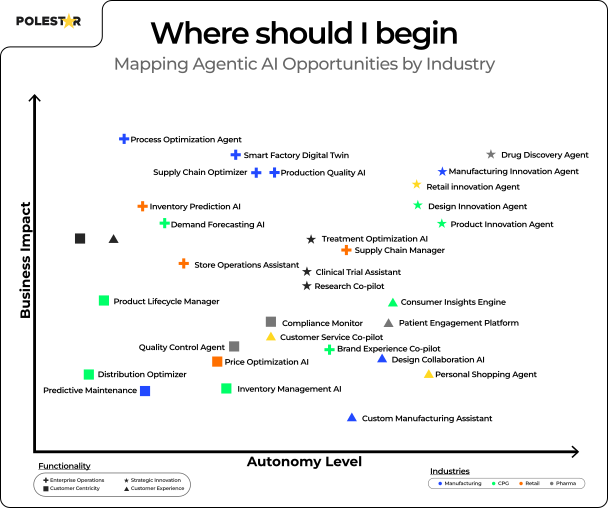
The use case landscape for Agentic AI is wide enough that "where do we start?" is a genuinely difficult question. Digital twin systems in manufacturing. Drug discovery agents in life sciences. Personal shopping assistants in retail. Supply chain risk monitors. Every function has a credible entry point — which paradoxically makes prioritization harder, not easier.
The mistake most organizations make at this stage is leading with technology. They hear about a use case at a conference, someone in the C-suite gets excited, and suddenly there's a pilot running in a function that doesn't have clean data, doesn't have stakeholder buy-in, and doesn't have a defined success metric. The technology works fine. The pilot fails anyway.
Start with the business problem. Then work backward to the agent architecture that solves it.
Three Questions That Should Drive Your Prioritization
Before selecting a use case, get honest answers to these. They're uncomfortable questions for a reason.
📊
Data Management
Is your data fragmented across seven different systems with inconsistent naming conventions? Because that's the reality for most organizations, and no agent architecture fixes bad data — it just fails faster with it. Unified taxonomies, accessible historical records, and cross-functional data access are the actual prerequisites.
⚠️ Garbage In = Garbage Out
🔄
Adaptability to Change
What happened the last time your organization tried to change how a team works? If the answer involves a year of resistance and a pilot that quietly died, that's your adoption risk profile — and it matters more than your model selection. Senior executive sponsorship and genuine change appetite aren't nice-to-haves. They're make-or-break.
⚠️ 80% of AI Projects Fail
🧠
Current AI Skills
Do you have people who can maintain, monitor, and improve an agentic system after go-live? Not build it from scratch — that's what partners are for — but own it operationally? Skills gaps and cost overruns are the two most cited reasons AI implementations underdeliver. Neither is a technology problem.
⚠️ Skill & Cost Are Top Barriers
How to Actually Prioritize
Have your leadership team answer one question honestly: which of these four outcomes would genuinely move the needle for us right now — Customer Centricity, AI-powered customer experience, Enterprise Operations, or Strategic Innovation? Whichever one gets the most energy in the room, that's your starting category. Find the highest-confidence use case within it, with the cleanest data and the clearest success metric. Start there.
Free Consultation
Not Sure Where to Start Your Agentic AI Journey?
Our experts can map your organizational readiness against the opportunity landscape and recommend a prioritized implementation roadmap — aligned to your specific industry and business goals.
Use Case 1
Agentic AI in Pharma
Rare disease identification is one of the most consequential - and most broken - workflows in pharmaceutical commercialization. Patients who should be diagnosed in months wait years. Sales teams work off incomplete, outdated data. And the connection between patient signal and physician engagement is almost entirely manual.
Agentic AI in Pharma doesn't just automate this process. It transforms the speed at which the right patient reaches the right physician and the right rep reaches the right doctor with the right information. That's a meaningful distinction.
🧬 Featured Workflow
Rare Disease Identification & Sales Enablement Agent
Orchestrator-Led Multi-Agent Architecture
An Orchestrator Agent sits at the center of this architecture - not executing tasks itself, but directing specialized sub-agents to handle each distinct piece of the pipeline. The sub-agents work in parallel, not sequence. That parallel structure is what makes the speed possible. And the Orchestrator ensures governance and model drift monitoring throughout - so the system doesn't quietly degrade over time without anyone noticing.
Agent Architecture Overview
Pattern Identification Agent
Analyzes patient data and ICD codes to identify diagnostic patterns with strong overlap indicators
Pattern Match Agent
Scores identified patients as High, Low, or Medium probability match for the rare disease
Rep Mapping Agent
Maps prescribing doctors to the right sales representative based on territory and specialty data
Planning Agent
Generates personalized engagement journeys for each doctor using historical interaction data
Scheduling Agent
Plans follow-ups and schedules live interactions for the sales rep to execute
Activity Tracking Agent
Monitors status, checks on live interactions, and feeds outcomes back into the loop
Orchestrator Agent - Command & Governance Layer
Manages all sub-agents, monitors model drift, enforces governance rules, and maintains continuous learning feedback loop
The downstream effects hit three groups at once. Patients get connected to appropriate treatment pathways earlier - before the disease has progressed further. Physicians get context-specific insights before a rep walks through the door, not after. And sales teams stop winging it - every interaction is backed by real prescribing behavior, engagement history, and territory intelligence.
What You Actually Need Before You Start
The technology conversation in pharma AI implementations almost always starts too early. Before you think about which LLM or which agentic framework, three things need to be in place:
- One clean source of truth for patient and prescriber data - ICD codes, prescribing history, territory maps, and interaction logs all need to live somewhere accessible. Most pharma companies have this data. Few have it in one place with consistent formatting.
- Working API infrastructure - connecting CRM, EMR, and analytics systems has gotten dramatically more feasible in the past few years. But "feasible" still requires dedicated integration work. Don't assume your systems talk to each other until you've tested it.
- Stakeholder alignment across medical affairs, compliance, and commercial - this is the actual bottleneck. Getting three functions with different risk tolerances and different definitions of success to agree on an implementation approach takes longer than building the system. Plan accordingly.
40%
Gartner projects that by 2027, 40% of GenAI project failures in life sciences will be caused by high costs, poor cultural integration, absent governance, and misaligned processes. Not model quality. Not data science. The organization is the variable that fails.
Source: Gartner
Use Case 2
Agentic AI in CPG
Somewhere between $500 billion and $1 trillion flows through CPG trade promotion budgets every year. A meaningful chunk of that generates no measurable lift. That's not a new problem - it's been a known problem for over two decades. What's changed is that AI finally offers a structural fix, not just a better spreadsheet.
$1T
Annual global CPG trade promotion spend sits between $500B and $1 trillion - and the primary reason so much of it underperforms isn't analytical capability. It's architecture. Separate systems for pricing, promotions, and distribution that were never designed to talk to each other.
Industry Estimates
Here's the structural problem with how most CPG companies run trade optimization: it's handled by specialists who don't talk to each other. A pricing team runs their analysis. A trade promotions team runs theirs. Distribution planning happens in a third tool entirely. Each produces an output that's technically correct in isolation - and collectively creates a mess. The pricing decision didn't account for the promotion that just launched in the same region. The promotion didn't factor in the distribution gap that will limit actual shelf availability.
With CPG companies expected to pour over $2.5 billion into AI and machine learning over the next few years, the bar has moved. "Which promotion to run in which store" is table stakes. The actual question is how all the variables across pricing, trade, distribution, and sales targets fit together into a coherent commercial strategy - and how to keep that strategy current as conditions change week to week.
🛒 Featured Workflow
Trade Spend Optimization System
Agent-Focused Multi-Dimensional Architecture
Think of it less as a system and more as the cross-functional team you always wanted - one where the pricing lead, trade manager, and distribution planner actually share a Slack channel and respond to each other in real time. Except the system never calls in sick, never protects its turf, and updates its outputs the moment new data arrives.
Agent Architecture Overview
Data Connector Agent
Maps relationships across variables - targets, products, distribution, incentive schemes, routes, externals - for cross-dimensional views
Strategy Agent
Performs integrated, cross-dimensional optimization analysis - sees the full picture
Execution Agent
Uplift assessment to optimize trade schemes for retailers and sales team targets
Analyst Agent
Tracks trade and sales targets and incentive performance in real time
Trade Spend Optimization Orchestrator
Tracks implementation progress, creates retailer-specific plans, and works in a continuous learning feedback loop
Why This Hits Differently Than Regular AI
The key shift isn't computational - it's coordination. Traditional trade optimization generates separate outputs that a human then has to reconcile manually (usually in a PowerPoint deck, usually the night before a planning meeting). The multi-agent architecture eliminates that reconciliation step entirely. A pricing signal automatically flows into the promotion strategy. A detected distribution constraint immediately updates sales territory targets. The outputs aren't separate documents to be compared - they're a single, coherent commercial plan.
Blog
Go Deeper: Agentic AI for CPG & RGM
Our detailed blog covers Agentic AI applications in Revenue Growth Management - with architecture blueprints, ROI frameworks, and implementation playbooks specifically for CPG organizations.
Use Case 3
Agentic AI in Manufacturing
A large, disruptive order lands. It's 40% above standard fulfillment capacity. In most manufacturing
operations, the response kicks off days of back-and-forth — inventory checks, production scheduling
conversations, procurement calls, logistics coordination. By the time you have an answer for the customer, the
moment has passed.
Agentic AI in manufacturing doesn't just speed up operational analysis. It replaces fragmented manual workflows entirely — compressing hours of plant, supply chain, and production analysis into 30 minutes while delivering insights far more comprehensive than traditional manufacturing processes could produce on their own.
62%
62% of companies expect Agentic AI to deliver ROI of more than
100%. That expectation tracks directly with what GenAI already demonstrated — but the business process
impact of agentic systems is substantially broader.
Source: PagerDuty
🏭 Featured Workflow
Large Order Management System
Orchestrator-Led Inventory, Production & Procurement Coordination
What makes this system valuable isn't just the speed — it's that the system doesn't stop at "can we fulfill
this?" It goes further: locating nearby warehouse inventory, modeling revised timelines, calculating the
financial impact of a contract renegotiation, and presenting the customer with alternative offers that the
business can actually honor. That's four things that would normally require four separate conversations
across three departments.
Agent Architecture Overview
Inventory Agent
Checks whether current stock levels are sufficient for the incoming
order volume
Transportation Agent
Evaluates nearby warehouse levels and logistics options if primary
location is insufficient
Production Agent
Reviews production schedule capacity and calculates overtime feasibility
if gaps exist
Timeline Bot
AI-powered timeline modeling - calculates realistic delivery scenarios
given all constraints
Scenario Bot
Generates alternative pitches with revised timelines and budgets for
customer negotiation
Orchestrator Agent
Coordinates all sub-agents simultaneously, synthesizes outputs, and
presents an optimized response to the large disruptive order within 30 minutes
The Timeline Bot and Scenario Bot at the second layer are often underappreciated in presentations of this
architecture. They're the piece that turns an operational answer ("we can fulfill 70% of this order") into a
commercial one ("here are three alternative offers with different timelines and cost structures that the
customer can actually respond to").
What's worth noting: the sub-agents here don't retire after the order is closed. The Inventory Agent feeds the
AI-driven predictive maintenance workflow. The Procurement Agent plugs into AI-powered supplier risk monitoring. That's one of the
structural advantages of building agentic systems properly - the infrastructure compounds. Organizations that
understand this from the start scale their capabilities much faster than those treating each use case as a
standalone project.
Use Case 4
Agentic AI in Supply Chain
Only 13% of business leaders have formalized intelligent supplier management processes. Think about that for a
moment. Supply chain is arguably the function where a single bad vendor decision - a quality failure, a late
delivery, a compliance breach - can halt production, damage a brand, and trigger a crisis that takes quarters to
recover from. And most organizations are running it on spreadsheets, institutional knowledge, and hope.
13%
Only 13% of business leaders have formal supplier management
processes in place - a Forrester and Ivalua study finding that is either surprising or depressing
depending on your perspective. Either way, it's a significant gap that intelligent procurement agents
are well-positioned to close.
Source: Forrester / Ivalua Study
Agentic AI in Supply Chain is reshaping how organizations manage supplier and sourcing decisions across increasingly volatile global networks. Supplier selection today involves balancing thousands of interconnected variables simultaneously — including pricing, lead times, supplier reliability, geopolitical exposure, compliance requirements, currency fluctuations, and contingency sourcing strategies when disruptions occur.
In many organizations, this decision-making intelligence exists primarily in the experience of senior procurement leaders, creating dependency risks when key individuals leave or become unavailable. Agentic vendor selection systems don't replace that expertise. They operationalize it — transforming human procurement judgment into continuously available, scalable intelligence that can support faster, smarter supply chain decisions across the enterprise.
🔗 Featured Workflow
Agentic Vendor Selection Bot System
Intelligent Procurement Orchestration
The cheapest vendor is rarely the best vendor. This architecture accounts for that - weighting delivery
reliability, quality history, and risk profile alongside price. Supplier relationships that get overlooked
in a purely cost-focused manual review sometimes turn out to be the most strategically valuable. The system
finds them.
Agent Architecture Overview
Inventory Monitoring Agent
Continuously monitors stock levels against thresholds and demand
forecasts; triggers procurement when needed
Vendor Database Agent
Maintains comprehensive vendor profiles including price data, quality
metrics, delivery stats, and reliability scores
RFQ Generator Agent
Automatically identifies suitable vendors for the specific requirement
and issues requests for quotes
Analysis Agent
Evaluates incoming quotes on price, quality, delivery timelines, and
vendor reliability scores
Recommendation Agent
Creates actionable reports with the optimal vendor selection, complete
with supporting rationale
Procurement Orchestrator
Manages approval workflow, facilitates user verification
checkpoints, executes order placement, and runs continuous learning feedback loop
The Human-in-the-Loop Is a Feature, Not a Limitation
Good agentic supply chain systems don't remove humans from high-stakes decisions - they make those decisions
dramatically faster and better-informed. The Procurement Orchestrator surfaces a recommendation with full
supporting rationale: vendor score breakdown, risk flags, delivery probability, cost comparison. A procurement
manager can review it in 10 minutes and approve with confidence, rather than spending two days assembling the
same information from scratch.
That's the right design. The goal isn't to automate the decision - it's to eliminate the grunt work around it.
When organizations approach it that way, adoption is substantially higher. When they try to take the human out
entirely, they get resistance, mistrust, and pilots that get shelved quietly after six months.
Use Case 5
From Hype to Reality - And What's Next
The organizations that have already been through a GenAI implementation cycle have something the
early Agentic AI adopters don't: a clear picture of what went wrong. And the pattern is consistent enough to be
useful.
It's rarely the model. It's almost never the data science. The failures cluster around planning, governance,
training, and budget management - none of which are technical problems. They're organizational ones. And yet
most Agentic AI conversations still spend 80% of the time on technology selection.
What Companies Wish They'd Done Differently
PagerDuty surveyed IT and business executives at organizations with $500M+ in revenue about their biggest GenAI
implementation regrets - and what they're determined to avoid with Agentic AI. The top answers don't make for
comfortable reading:
41%
Rushing / Insufficient Planning
40%
Spending Too Much, Too Fast
38%
Not Setting Up Guidelines & Governance
37%
Not Offering Sufficient Training
37%
Poor Data Infrastructure
36%
Ill-Defined Expectations & Success Metrics
35%
Spending Too Little on Foundational Work
33%
Poor Change Management
*Survey of 1,000 IT and business executives with minimum
director seniority at $500M+ revenue companies. Source: PagerDuty
What These Numbers Actually Tell You
Look at the list above. Not one of those failure modes is about AI model quality. Not one is about data science
methodology or agent framework selection. They're all about the human side - planning, budget discipline,
governance, training, expectation-setting. The technology largely worked. The organization didn't catch up fast
enough.
That's the honest story behind the 80% AI project failure rate. And it maps directly onto what Gartner is
projecting for life sciences - 40% of GenAI project failures caused by organizational factors, not technical
ones. Same industry, same pattern, different year.
🎯 The Right Starting Point Isn't a Technology Decision
Before you choose a framework, pick a vendor, or spin up a pilot - find the right AI implementation partner. Not
one that builds something for you and hands you a black box. One that builds with you, transfers knowledge,
and helps your team own the system after go-live. That partner selection is the most consequential decision
in the entire Agentic AI implementation process. Everything else is optimizable. A bad partner choice isn't.
Let's Build Together
Ready to Deploy Agentic AI in Your Organization?
Polestar Analytics doesn't hand clients a black box. We build agentic systems
alongside your team - from data foundation through deployment - and ensure your people can own and evolve
what we build together. CPG, Retail, Pharma, Manufacturing: the outcomes differ; the approach is the same.