
Summarize this blog post with:
Editor’s note: Most agentic AI guides stop at "what is an agent." This blog goes one level lower into the architecture: the four modules every agent actually needs, and how they show up in real systems like flight rebooking and inventory rebalancing
The Architecture Behind Agentic AI
In the simplest terms, Agentic AI is the layer above generative AI. Where a GenAI model produces output on demand, an agent decides what to do, calls the tools it needs, and learns from the result. That whole loop is built on four modules: perception, reasoning, action, and learning.
The rest of this piece walks through each one, with examples.
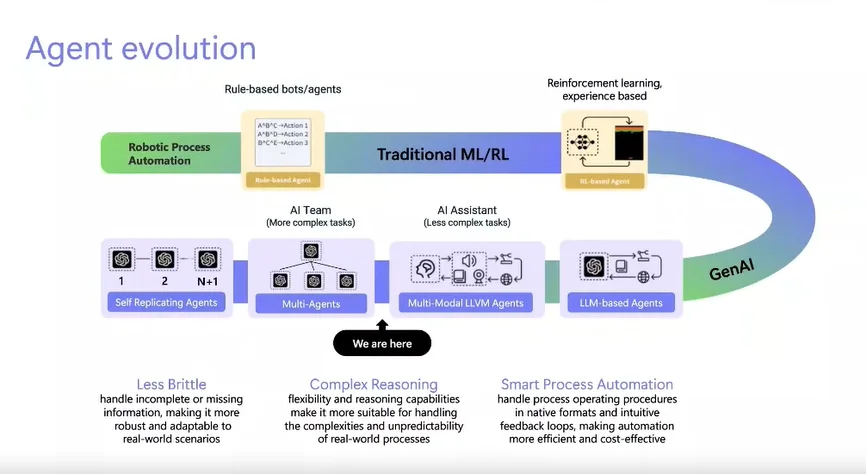 Discussion of Agentic Evolution in Microsoft AI horizon
To reach a level of autonomous decision-making and action, agents draw upon a combination of various technologies. These techs include machine learning, natural language processing, and automation. Now this intricate blend allows the AI to understand and respond to complex situations in a way that mimics human-like reasoning and adaptability.
For better understanding let’s divide the functioning into four steps.
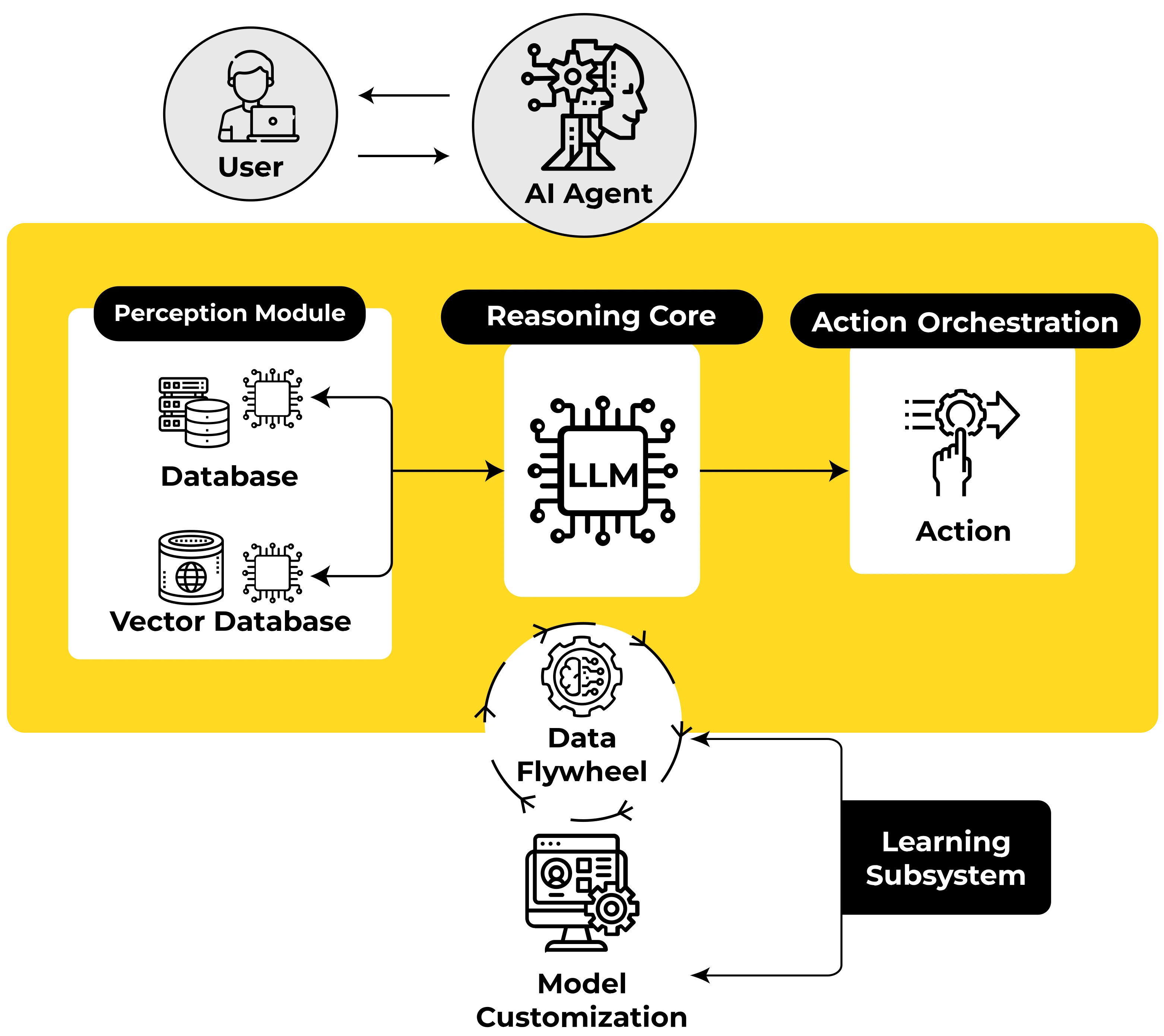 Agentic AI architecture
Unlike traditional AI systems or even LLMs that wait for human input, the perception engine actively combines and merges the information from multiple sources simultaneously. Think of it as the AI's sensory cortex with brings multi-modal processing to combine text, visual, and structured data through transformer-based architectures.
For example, with the Inventory agent mentioned above, the perception engine would about keep a track of the inventory levels with access to the warehouse inventory data & flag the system when it goes down.
Given the growing efficiency in the reasoning and planning capabilities of LLMs, they from the core of agents. It should be able to:
- Break down objectives into manageable sub-goals
- Identify potential roadblocks before they occur
- Formulate alternative approaches when initial strategies fail
Let’s go back to the example, formulating an action plan once the inventory levels have gone down, deciding on the suppliers, analyzing the possible timeline and shortlisting them etc. would fall under the purview of the reasoning agent
Traditional AI or even automations have a predefined workflow on which their systems work. But agents have the independence to take actions by being connected to multiple systems and tools. They maintain API connections with multiple systems simultaneously, implement sophisticated rollback mechanisms for failed actions, and take action based on the need.
Going back to the example, this is the part where the agent places an order with the supplier or creates an approval from the user for the order (based on what’s defined as the action plan).
This is where agentic AI truly distinguishes itself. It’s the feedback loop or the “data flywheel” where the data generated from its interactions is fed into the system to enhance models. Here’s how it works:
Experience Prioritization
Here algorithm identifies which experience are more valued for learning | Continuous Model Updates
Adapts behaviour based on success rates and changing conditions | | Cross-Task Learning
Applies insights from one domain to improve performance in others
|
Given that the frameworks and processes around Agentic AI are still new, these four processes form the basic structure of creating an agent. As complexity increases with business needs, this agentic AI implementation framework evolves to support more advanced, scalable use cases—let’s dive into the evolution now.
The four-module architecture above is the building block. What changes as agentic systems mature is how many of those blocks you stitch together, and across what boundaries. Our Agentic AI Maturity Stages in the knowledge hub walks through the full five-stage model. Three of those stages are worth showing with examples here, because they map directly to architectural decisions.
Single-task agents for quality control on a production line
A computer vision agent that monitors a production line is the simplest deployable shape. It runs on event-driven pipelines, hits a REST API when it detects a defect, and learns from the patterns it catches. One perception module, one reasoning core, one action endpoint.
Multi-domain orchestrator for flight rebooking
When a passenger needs to rebook, no single agent owns the workflow. An orchestrator coordinates separate agents for flight, seating, meals, and baggage. Each one runs the full four-module loop. The orchestrator decides whose answer wins. This is also what reduces hallucinations: each specialist agent only handles what it's good at.
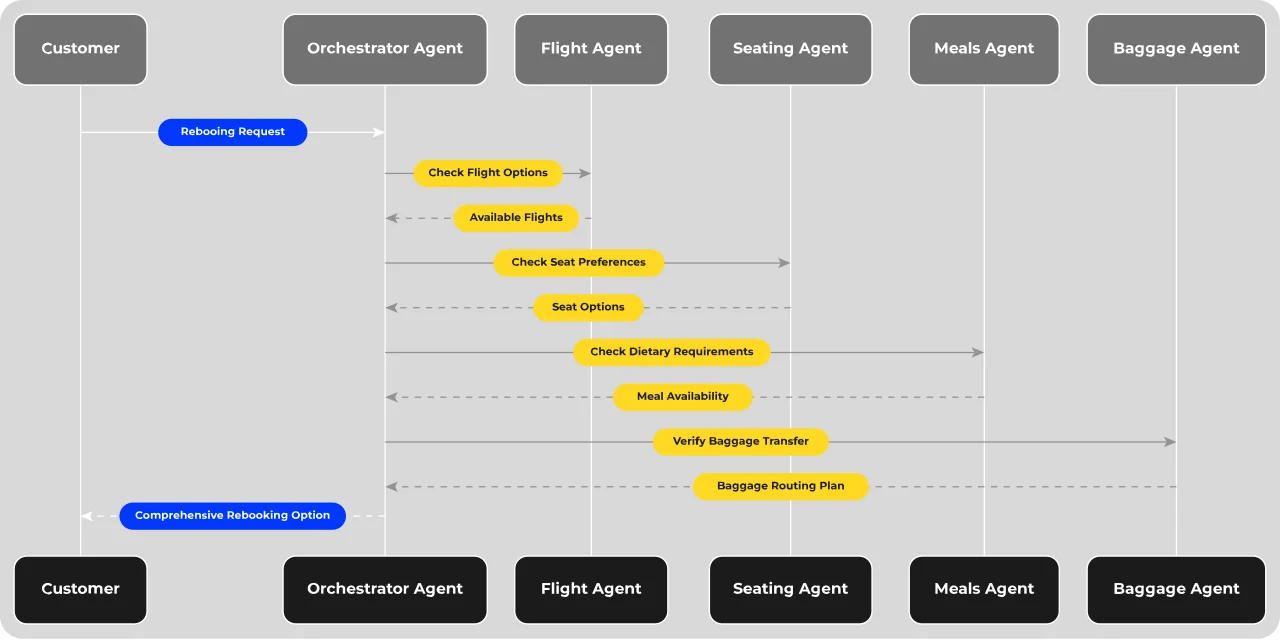 Example of Agentic AI system as a flight book agent
Cross-organization ecosystem when agents talking to other agents
The most advanced shape is when your agents stop talking only to your data and start talking to other companies' agents. Procurement agents negotiate with supplier agents. Customer service agents talk to logistics agents. This is the "agent-to-agent" layer, and it changes what an enterprise system looks like.
For where this fits in the full five-stage maturity model, see Agentic AI Maturity Stages.
We are seeing the history in making. While we are still at a nascent stage, things are advancing quickly. Its anticipated that by 2028, nearly a third of businesses will be integrating these AI agents into their daily operations. That’s just around the corner!
Think of it this way: we're moving from having digital assistants to having digital colleagues. While it might sound a little farfetched at the point, organizations that wait too long to adapt might find themselves playing catch-up. So, whether you're just curious about what a task-specific agent could do for your customer service, or you're ready to dive into complex multi-domain solutions, now's the time to start exploring.
And that's where we at Polestar Analytics come in. We're not just implementing technology; we're working on building such agents to help organizations navigate this new landscape with confidence and purpose. So, seize this opportunity to take action now before the chance slips away and your competitors gain the upper hand.