
Summarize this blog post with:
A single drug launch costs an average of $2.23 billion in R&D. Yet despite that investment, pharmaceutical companies collectively lose over $150 billion annually to inefficient commercial operations — misallocated sales effort, misdirected marketing spend, and delayed market access decisions that competitors exploit. The data to prevent most of this waste already exists inside these organisations. The problem is that it sits fragmented, unreconciled, and too slow to act on.
Commercial analytics in the pharma industry has evolved significantly — from monthly sales dashboards to predictive models that anticipate prescriber behaviour weeks in advance. But for most organisations, analytics still stops at the insight. The translation from intelligence to execution remains manual, delayed, and inconsistent. That gap is where commercial performance is lost.
This guide explores how a structured approach to commercial pharma analytics — built on unified data, the right analytical frameworks, and embedded decision workflows — closes that gap and delivers measurable outcomes across field, marketing, and access functions.
- Why fragmented data is a bigger problem than missing data — and how leading organisations resolve it
- Which analytical capabilities move prescriptions, not just populate dashboards
- How to build decision-ready analytics in a structured, time-bound framework
- What the benefits of commercial analytics to pharmaceutical companies look like in practice
The challenge in commercial analytics in pharma is rarely a shortage of data. It is a surplus of disconnected data arriving through incompatible systems, on incompatible timelines, with no unified layer to reconcile it.
Consider the typical working environment of a pharmaceutical brand manager. Sales activity lives in CRM, prescription trends and patient journey data sits arrives from another source.
Digital engagement metrics are distributed across multiple marketing automation platforms. Pharma commercial teams access an average of 11 different data sources to support a single strategic decision. It consumes 40% of their analytical capacity on reconciliation rather than insight generation
Do You Know?
73% of pharma commercial leaders report difficulty extracting actionable insights from their data ecosystem.
It is not because the data is missing, but because it cannot be assembled fast enough to influence decisions before market conditions shift!
The second layer of the problem is the insight-to-action gap.
By the time the analysis reaches the decision-maker through email, a slide deck, or a scheduled review meeting, the window has often already closed. This is not a data quality problem. It is a structural one — analytics built to inform rather than to act.
The organisations closing this gap are not necessarily investing more in data. They are investing differently — in unified infrastructure, decision-led frameworks, and custom commercial pharma solutions that connect insight directly to execution.
Leading pharmaceutical organisations do not build analytics capabilities as isolated tools. They build them as interconnected layers, each enabling the next.
# The Unified Data Foundation
Everything downstream depends on this layer. The goal is not to have one system — it is to have one version of the truth, regardless of how many source systems feed it. That means unified prescriber identity resolution across CRM, prescription data, and claims sources, master geography hierarchies that align sales territories with external data cuts, and real-time or near-real-time data feeds rather than monthly extracts that arrive after decisions have already been made.
Organisations with unified commercial data platforms reduce insight generation time by 65% compared to those operating fragmented systems. The technical architecture — cloud data lakes, API integrations, master data management — is not glamorous, but it is the substrate on which every analytical capability above it depends. Without it, even the most sophisticated models produce outputs that nobody trusts.
Do You Know?
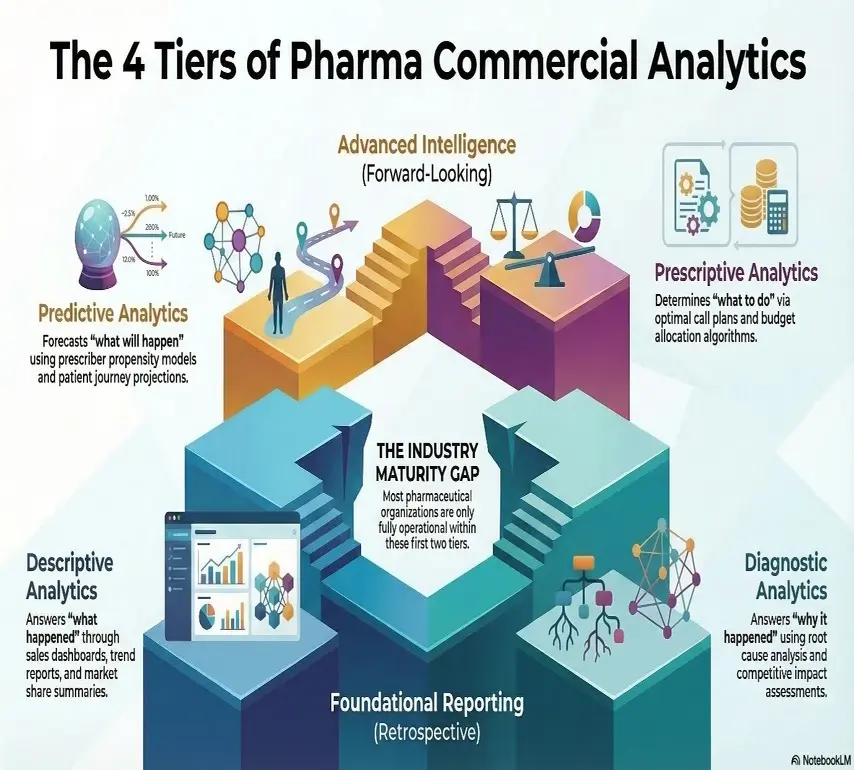
A 2024 Genpact study found that pharma companies with mature commercial analytics capabilities achieve 23% faster market penetration for new launches and reduce sales force costs by 18% while maintaining revenue growth The gap between descriptive and prescriptive analytics is not a technical gap — it is a strategic one.
| Dimension |
Key Performance Indicators (KPIs) |
| Commercial Impact |
- Incremental prescriptions
- Market share movement
- Launch velocity
|
| Efficiency |
- Promotion ROI improvement
- Cost per prescription reduction
- Field force productivity
|
| Decision Speed |
- Time from data refresh to action
- Insight adoption rate (Field & Marketing)
|
The most common failure in commercial analytics in pharma is not technical. It is sequencing: organisations invest in sophisticated platforms before they have the data foundation to support them, or they build analytical models without the workflow integrations to act on them. The result is analytics that sits between insight and execution, never reaching either destination effectively.
A structured framework resolves this in four stages:
Stage 1: Establish the Data Foundation
Identify the five highest-value data sources for your commercial context — typically internal CRM data, IQVIA NPA prescriptions, claims data from another source, master data reference files, and omnichannel engagement signals. Establish automated feeds rather than manual extracts. Build unified prescriber and geography master data that reconciles naming variations across sources.
Stage 2: Deliver Priority Use Cases with Visible Impact
Select two high-impact, low-complexity use cases that demonstrate value to commercial stakeholders quickly. Territory performance dashboards showing real-time prescription trends by representative and geography, combined with prescriber targeting models that identify high-potential HCPs based on specialty and prescribing patterns, are the typical starting point. Deploy minimum viable analytics first. Early wins create the organisational momentum that funds subsequent phases.
Stage 3: Embed Insights into Commercial Workflows
This is the stage most analytics programmes skip — and the reason most of them underdeliver. Analytics that require commercial teams to remember to log into a separate portal, interpret a statistical output, and manually translate it into a field action will not be used. Insights must arrive inside the tools commercial teams already use, now decisions are being made:
next-best-action recommendations in the CRM
automated call plan adjustments in weekly territory reviews
patient journey intervention triggers that alert patient services teams when prescribed patients do not initiate therapy within a defined window.
The benefits of commercial analytics for pharmaceutical companies are realised at this stage — not at the model-building stage. Decision velocity is the metric that matters analytics that takes three weeks to influence a field decision is already outdated in a market where competitive dynamics shift weekly.
Stage 4: Measure, Scale, and Layer in Advanced Capabilities
Track leading indicators — adoption rates, data quality scores, insight implementation rates — alongside lagging indicators — sales productivity, marketing ROI, forecast accuracy. Identify next wave use cases from demonstrated value.
As the foundation matures, layer in advanced capabilities: predictive prescriber models using machine learning across 50 or more variables, natural language query interfaces that allow commercial teams to ask complex analytical questions without SQL or data science support, and automated anomaly detection that surfaces opportunities and threats five to seven weeks earlier than traditional reporting cycles.
The short answer is yes — and the evidence is increasingly clear. Organisations that implement commercial pharma analytics with the right sequencing and the right use case prioritisation consistently achieve 15 to 25% sales productivity improvements, 30% marketing ROI gains, and six to eight months faster market access.
These outcomes are not exclusive to large pharma. Mid-sized and emerging biopharma organisations accessing custom commercial pharma solutions through specialist partners — rather than building internal capability from scratch — are achieving comparable results at a fraction of the infrastructure investment.
The distinction that separates organisations that capture these benefits from those that do not is rarely about data volume or analytical sophistication. It is about whether analytics is embedded into the commercial decision workflow — or whether it sits beside it, waiting to be consulted.
Commercial analytics in pharma has moved past the point where generating insights is the differentiator. The differentiator now is the speed and consistency with which those insights reach the people making commercial decisions — and the structural integrity of the infrastructure that makes that possible.
The organisations winning on commercial execution in 2026 are not the ones with the most data. They are the ones that built the right foundation, sequenced their capabilities deliberately, and treated analytics as a decision engine rather than a reporting function.
If your organisation is still navigating the gap between analytical output and commercial action — whether in targeting, promotional mix, market access, or field execution — that gap is addressable. It starts with an honest assessment of where your data infrastructure, analytical maturity, and workflow integration currently stand.
Commercial pharma analytics experts who understand both the data and the commercial context are the difference between a programme that generates insights and one that generates outcomes.
Commercial analytics in pharma unifies sales, prescription, claims, and engagement data to drive faster decisions across field, marketing, and market access. It matters now because pharma loses over $150 billion annually to fragmented data and delayed insights — not missing information.
Traditional reporting tells teams what already happened, often after the prescribing window has closed. Commercial analytics in pharma predicts prescriber behaviour and embeds next-best-actions directly into CRM and field workflows — shifting from informing decisions to driving them.
The biggest failure is sequencing, not technology — teams build advanced models on fragmented data nobody trusts. The right order: unify data first, deliver two high-impact use cases, embed insights into workflows, then layer in predictive and AI capabilities.
Commercial pharma analytics delivers 15–25% sales productivity gains, 30% marketing ROI improvement, and six to eight months faster market access. These outcomes are equally achievable for mid-sized and emerging biopharma through specialist partners — without enterprise-scale infrastructure investment.