
Summarize this blog post with:
Editor’s Note: If you've read our Agentic AI Framework guide, you already know what agentic AI is and how it evolved. This blog is the workflow companion. It covers what's running under the hood (the LLMs), how to pick the right reasoning model, and how to find your first use case.
Under every agentic system sit four design choices that decide whether it works at scale:
- Model Specialization - More targeted value with a shift from general-purpose models to specialized ones.
- Cognitive Processing - Integration of both rapid responses and considered human input while decision-making, inspired by the “fast and slow thinking" approach.
- Agent Architecture - By breaking down tasks and distributing them across multiple agents we see enhanced collaboration in the agentic LLM ecosystem.
- System Design - Shifting to a modular architecture that dynamically manages AI capabilities, making systems more adaptable and scalable.
Now the fact is that the speed with which these LLMs have grown, especially over past five years, have opened so many avenues for the AI assistances which we are working with. And each stage of this evolution has a role to play in present and future of Agentic AI workflows. So, let’s take a trip down the ‘memory’ lane to see how we reached here.
Though we’ve explained the workflow very briefly in our agentic AI guide, here we cover the journey of traditional AI to agentic AI workflows in detail.
 Evolution of AI over years Source: Microsoft
The genesis of Agentic workflows traces back to RPA, which automated repetitive tasks through rule-based programming. Now for a technology whose value proposition heavily lies on its capabilities to draw insights from various data types of data sources, it’s natural to have various APIs combining the data at one place. Now if you see at scale, not having a proper workflow for the same will affect your data stewardship.
| Capability |
Description |
| API Orchestration |
RESTful and SOAP API integration with error handling and retry mechanisms |
| UI Automation |
Advanced screen scraping with optical character recognition (OCR) |
| Process Mining |
Automated discovery of workflow patterns through system logs |
| Event-Driven Architecture |
Webhook integration for real-time process triggering |
While effective for structured processes, these systems lacked adaptability and required explicit programming for each task.
As AI evolved, it built on Robotic Process Automation (RPA) by incorporating Reinforcement Learning (RL) and machine learning. This gave AI systems the ability to recognize patterns and make smarter decisions, allowing them to handle more than just repetitive tasks. Instead of following a predefined set of rules, these bots became more adaptable and capable of automating increasingly complex processes and repetitive tasks.
Enterprise Implementation
| Component |
Key Capabilities |
| Model Management Systems |
- Version control for model artifacts
- Training pipeline orchestration
- Model performance monitoring
|
| Data Processing Pipeline |
- ETL workflow automation
- Data quality validation
- Schema evolution management
|
However, while these systems introduced learning capabilities, they still operated within confined domains and required extensive human oversight for adaptation to new scenarios.
The emergence of generative AI literally marked a paradigm shift, in AI architecture and capabilities. Transformer-based models revolutionized natural language processing. These models excel at creating content, understanding context, and generating human-like responses.
Key Capabilities
LLM Integration Framework
| Area |
Key Components |
| Foundation Model Architecture |
- Encoder-decoder implementations
- Prompt engineering systems
- Context window management
- Token optimization
|
| Enterprise Deployment |
- Model quantization for efficiency
- Inference optimization
- Caching strategies
- Load balancing mechanisms
|
This phase brought us foundational LLMs (which work as the reasoning core of Agentic AI architecture) and tools like Copilot, fundamentally changing how AI systems interact with human users.
Now with Agentic AI We’re now entering the 'post-LLM era,' where AI moves from task-focused tools to agents that can handle complex, interconnected processes. Agentic AI pushes beyond traditional automation, combining earlier AI advancements into more autonomous systems. Systems don't just generate content – they act with agency, making decisions and executing tasks with greater autonomy.
Its capabilities range from doing simple to complex task.
 Agents can vary in levels of complexity and capabilities depending on your needs
Now as soon as we talk about the range of capabilities of agentic AI we are often asked – what is the difference between Bots, Copilot and Agents.
Is your Agent strategy a hit or a miss?
Find the Agent type that'll bullseye your goals.
Guide to Agentic AI
Now for better understanding, let’s flip the switch to see how a bot, copilot and an agent react to the simple act of turning a light. Let’s see which one of them illuminate the situation best.
| Aspect |
Bot |
Copilot |
Autonomous Agents |
| Behaviour in given scenario |
Only turns on light when "on" button is pressed |
Suggests turning on light when room gets dark, waits for approval |
Automatically manages lighting based on time, occupancy, activities, and lumens |
Now that we've explored the evolution from simple bots to sophisticated AI Agents, understanding their distinct capabilities, the natural question is: Where should I begin mapping Agentic Workflow Opportunities?
Now that you see how Agentic AI capabilities range from a simple bot into a fully autonomous agent (now It's on you how you built on it). So, the million-dollar question is: looking at that matrix, what gets you most excited? "Customer Centricity," "Customer Focus," "Enterprise Operations," or "Strategic Innovation"?
Customize using pre-built multi-agent networks that reduce development time and risk.
 Agentic AI Use Case Matrix
Each direction on the map represents a different kind of opportunity. But unlocking their full potential depends on two key factors:
- Your company’s AI maturity—How ready is your organization to integrate autonomous decision-making?
- Your reasoning model—Which AI model will serve as the best "brain" for your workflows?
Q1. How to Prioritize Agentic AI Use Cases?
The X-axis might represent autonomy levels (e.g., from assistive AI to fully autonomous AI).
The Y-axis might represent impact or feasibility (e.g., from experimental use cases to high-value, scalable applications).Prioritization Framework:
Q2. Which reasoning model will work best for my agentic AI workflows?
Given that the model landscape also shifts fast with new releases land every few months, especially with Anthropic's Claude Opus line, OpenAI's GPT-5.x line, and Google's Gemini Pro line. The most important thing are to check current benchmarks like τ²-bench (Sierra Research / Princeton), not generic chat leaderboards.
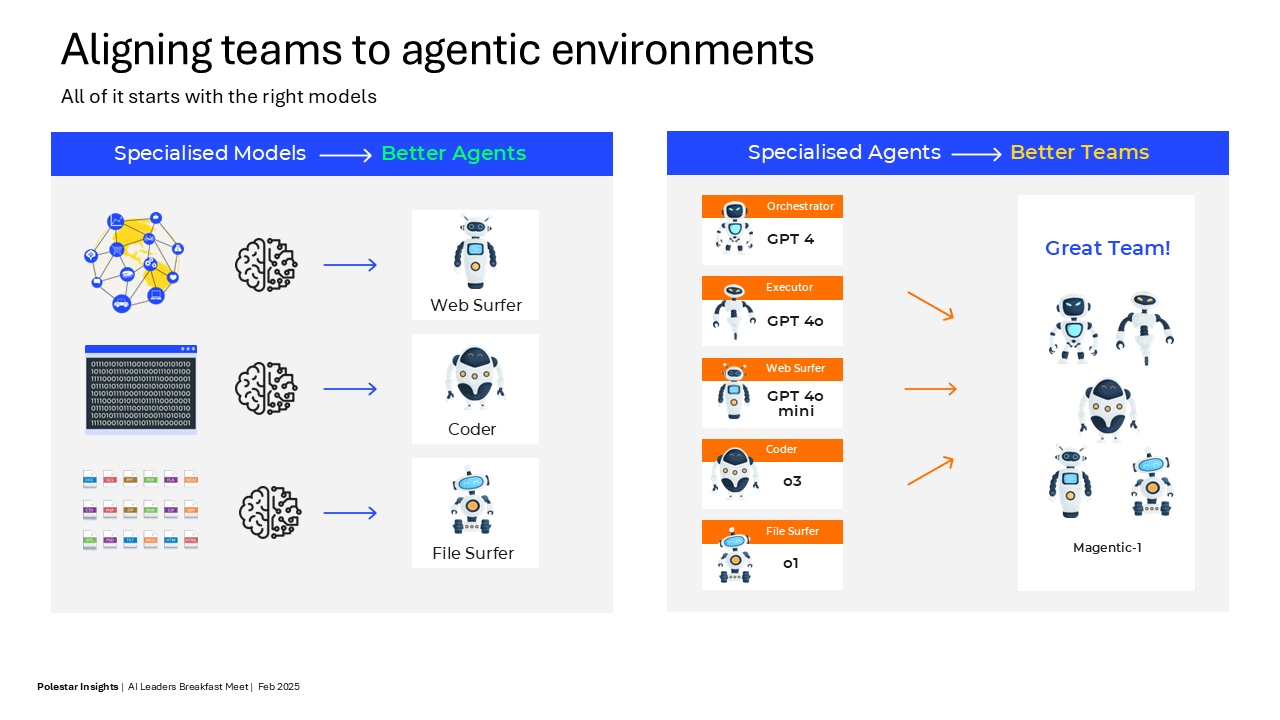 An example of agentic ai systems
Your Agentic AI Journey starts here
The journey from RPA to Agentic AI marks a shift from automation to autonomy. But success won’t come from simply adopting it—it’s about strategically integrating it into your ecosystem in a way that enhances efficiency, decision-making, and innovation.
- Start Small, Think Big – Begin with focused applications in areas like customer service or process automation, but always plan for long-term transformation.
- Embrace Hybrid Models – Use GPT-4o for fast decision-making and O3 for deep reasoning to get the best of both worlds.
- Promote a Culture of AI Literacy – The more your teams understand AI’s strengths and limitations, the better they can leverage its potential.
- Prioritize Ethical AI – As AI gains more autonomy, setting clear ethical guidelines is critical to ensuring responsible deployment.
- Stay Agile – AI is moving fast. The winners will be those who build flexible, future-ready systems.
At the end of the day, Agentic AI isn’t about replacing human intelligence—it’s about amplifying it. The businesses that thrive will be those that find the perfect balance between human creativity and AI capability.
So, the real question is: Where will you start your Agentic AI journey?
PS- In the upcoming blog you are going to see Agentic AI in action. Stay tuned for more!