Aishwarya SaranInformation Alchemist

Melden Sie sich an, um die neuesten Einblicke und Updates zu Technologie, KI & Datenanalyse, Data Science und Innovationen von Polestar Analytics zu erhalten.
 Fassen Sie diesen Blogbeitrag wie folgt zusammen:
RIA data integration in 2027: single household identity, data reconciled across custodian, CRM and billing, and governed definitions that make AI trustworthy. |
TL;DR
New pricing models for custody are emerging, RIAs are increasingly using multiple custodians, and AI has made its way into advisors' daily tasks. Each of these puts pressure on the same weak point in the RIA tech stack: client and revenue data that carries a different meaning in every system. The firms that get real value from AI in 2027 are likely to be those that settle what a household is before they add another tool. That makes RIA data integration, built on an AI-ready data architecture, the starting point.
For years the RIA tech stack was a vendor decision. This is now a question of portability: how much of your data can be moved or reconstructed elsewhere without losing its context? As custodial arrangements, data access frameworks, and AI in wealth management converge at the same time, new factors must be considered in how registered investment advisers deploy technology.
Repricing and AI ambition ran into a single barrier: custodians didn't normalize the data. The leadership team must revisit how and where to make investments. Custodians or vendors will come and go as often as every three to five years, but the client and revenue data layer is still owned by the firm.
Most RIAs are already transferring and moving data between custodians, portfolio management, CRM and billing.
Custodians provide positions, transactions, and cost basis information using their unique file formats and transaction codes. The portfolio management system organizes accounts for performance analysis, the CRM focuses on individuals and relationships, while billing organizes accounts based on fee agreements. Although none of these approaches is incorrect, a straightforward inquiry like a household's total assets under management (AUM) can yield four different answers depending on which system is consulted.
Regulators see the result. Across about 130 adviser exams in 2021, SEC staff found fee problems in most, and incorrect householding was among the most common causes.
A change in custodians highlights all these differences within just a few months. Account identifiers, transaction histories, CRM connections, and billing configurations must all be reconstructed. Typically, operations staff at many firms find themselves manually matching records during the conversion process. Additionally, a central data layer needs to be remapped to align with the new custodian, although the underlying business logic is defined only once, allowing the team to plan the conversion ahead of time.
Access is shifting as well. Since 2023, Fidelity has required third-party apps to use APIs in place of screen scraping. APIs deliver cleaner, faster data, which is a real improvement. Deciding what that data means, and which system's answer wins when they disagree, remains the firm's call.
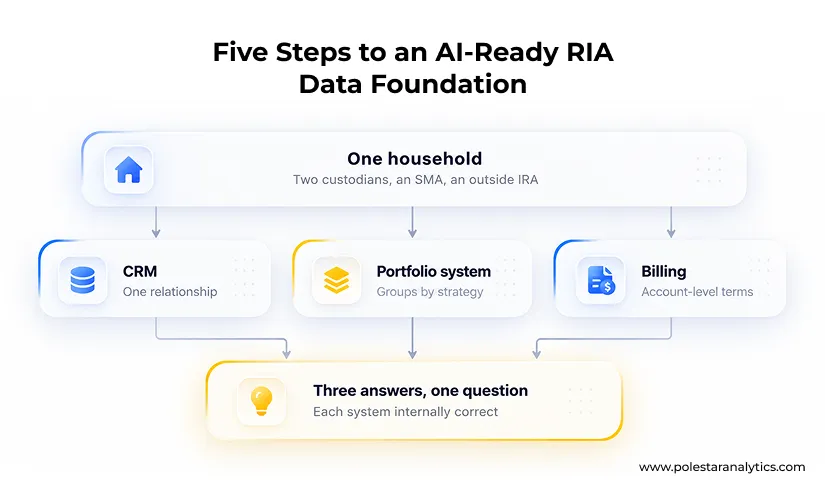
Any inherent uncertainty in the source data will be replicated by the AI (garbage in, garbage out). If two people at a firm use different methodologies for measuring the AUM of a household or an advisor's revenue, the model will choose one or the other without any warning of which was used.
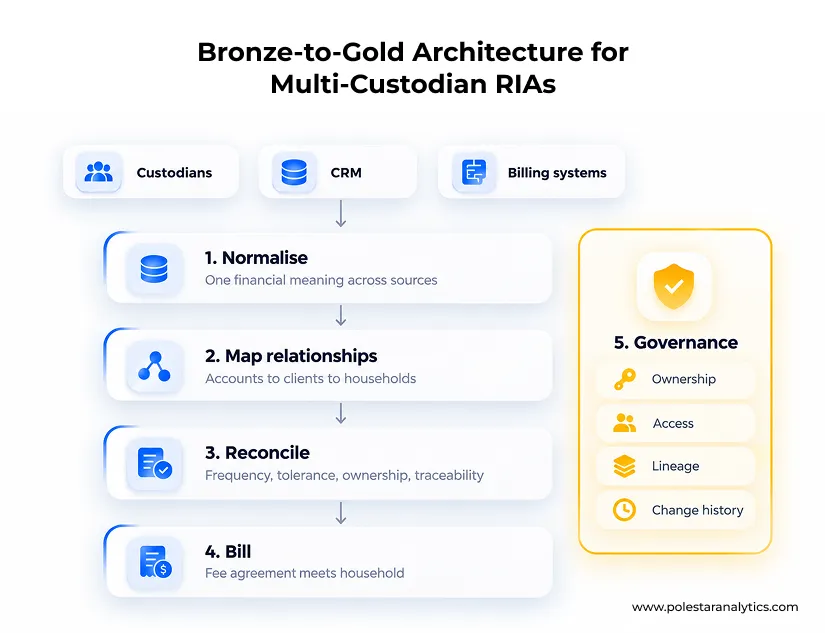
Custodian-based data integration brings account structures, transaction codes, and valuation timing from multiple custodians into a common model. A bronze-to-gold architecture provides one way to manage this:
Proper data lineage makes it possible for companies to go back to their source data whenever they report any figures, which simplifies audit and financial review processes.
RIA CRM integration links custodian accounts to standardized client, household, and advisor IDs, which have defined methods for handling conflicts. It is important that these relationships remain up to date even if the account switches custodians or is changed to a new advisor.
The 2025 Kitces AdvisorTech research found integration quality to be the strongest driver of satisfaction with advisor technology. For RIAs, getting these connections right is central to reliable household reporting.
Effective RIA data management reconciles positions, balances, and transactions with custodian information despite timing issues between trades and settlements. Every exception requires an owner and traceability back to its origin before impacting clients' reporting and billing.
Initial reconciliation runs may uncover older discrepancies. Operations teams should distinguish these from new exceptions to understand where controls need attention.
Household-level billing reconciliation requires each account's fee schedule, exclusions, discounts, and billing period to be checked against the client agreement. Reporting households and billing groups may differ, particularly where tiered pricing and household discounts apply.
The 2025 Raymond James RIA Benchmarking Survey found that 41% of responding RIAs used tiered pricing. The SEC's June 2026 risk alert also highlighted incorrect fee rates, missed householding benefits, and charges on excluded assets. Those in charge of RIA operations can use billing controls to improve revenue capture and reduce the risk of overbilling clients as well as compliance risk.
Most RIAs know what they need. The order is the hard part, and it depends on the trigger. A firm changing custodians needs portability first. A firm merging practices needs one definition of a household first.
| Priority | Start here if |
|---|---|
| 1. Client and household identity | You're changing custodians or absorbing acquired books |
| 2. Custodian normalization | You run two or more custodians |
| 3. Reconciliation and exceptions | Month-end close relies on manual checks |
| 4. Billing and revenue validation | Billing runs on spreadsheets or exports |
| 5. Governance for AI | You're piloting AI on client data |
Smaller RIAs usually start with identity and portability. Larger firms often need enterprise definitions and lineage first. Contained AI uses, like meeting notes, can run in parallel if they don't depend on unreconciled data. Governance belongs in the plan early, since AI and its data sources sit in the SEC's 2026 exam priorities.
One piece of advice from the field: sequence the roadmap by the decision leadership most needs to trust next quarter, whether that is revenue by advisor, household AUM for a transition or the data an AI pilot will read. Technology choices fall out of that far more cleanly than the other way round.
Build or buy comes down to engineering capacity and time. A firm with an in-house data team and one or two custodians can reasonably build this layer. Firms on several custodians tend to find that connector maintenance and KPI logic become a permanent cost center, and that is where a pre-built layer earns its place.
WealthPulse by Polestar Analytics is a best wealth management intelligence platform for RIAs. It maps data from custodians such as Pershing, Fidelity, Schwab, BNY Mellon and Apex, along with billing, CRM and market data, into one canonical model built around the firm-defined household. It includes 20 to 30 standard wealth KPIs, shows which metrics a firm's connected sources can support, and adds agents for attrition risk, household risk and meeting prep. It runs on Databricks or Microsoft Fabric.
The true measure of a resilient technology stack is what remains when one component changes. If a custodian is re-priced or one of your vendors is replaced, a resilient stack preserves the firm's view of clients and revenue.
Custodians will stay central to safekeeping and settlement, and their move to APIs helps everyone. The weak point sits above them. Household definitions, fee arrangements and operating logic span several providers, and none of them owns the full picture. That job falls to the firm, and in most stacks it still lives in spreadsheets.
A two-minute resilience test. Follow one household across custodians, CRM, reporting and billing, and ask:
Where the trace breaks is your 2027 priority. Whether the layer is built in-house or with a platform like WealthPulse, the firm should own the household definition and the metric catalog. Get those right and the next custodian or vendor change becomes a remapping job operations can plan for.
RIA data management maps custodian data to account, household, and advisor constructs defined by the firm. Different reconciliation rules and grouping rules are maintained for reporting and billing. Reconciliation and data lineage methods are used for transfers, advisor changes, and custodian changes.
A number of factors add considerable operational risk to a migration, such as account IDs, prior activity, the CRM mappings, the billing configurations and downstream reporting logic. If custodians have bespoke formats, this will typically require considerable remapping and reconciliation. The canonical data model alleviates some of those dependencies, but not account transfer processes, client authority, etc.
Before AI agents run on a common data platform, an RIA will need access controls, a record of source data, checksums or other verification, provenance of data, and explicit ownership of data and calculations. When adding AI, the additional requirements are logging of activities, limited access and capabilities for agents, escalation of exceptions, and human review.
Über den Autor
Information Alchemist
Without data you are just another person, with an opinion.
Verwandter Blog