
Fassen Sie diesen Blogbeitrag wie folgt zusammen:
| Databricks AI agents move from pilot to production when teams build on the Mosaic AI Agent Framework and Agent Bricks, treating governance and evaluation as foundations. |
TL;DR
The majority of AI agent pilots fail not due to inadequate AI models but due to neglecting evaluation and governance. Databricks can close the gap using agents founded on governed enterprise data and establishing an easy route for teams to move from prototype to production. The Mosaic AI Agent Framework provides the governed stack comprised of Vector Search, MLflow, Model Serving, Unity Catalog, while Agent Bricks carries out automation of synthetic data generation, benchmarks and tuning. Databricks telemetry shows multi-agent workflows grew 327% in four months, and teams using governance ship 12x more projects to production. Build for multi-model, multi-agent architecture from day one.
One number puts the pace of this in perspective. Use of multi-agent workflows on the Databricks platform shot up 327% between June and October 2025 (Databricks, 2026 State of AI Agents report). Four months, not four years. And it isn't some fringe reading, it comes off telemetry covering more than 20,000 organizations, including over 60% of the Fortune 500. Something shifted in how enterprises build Databricks AI agents, and much of it comes back to the tooling underneath finally growing up.
If you manage a data or platform team and you are considering creating AI agents on Databricks, this manual provides complete information on what causes pilot projects to fail, details about the Databricks agent stack, steps to move from the prototype to production, and how to acknowledge governance and whether it is worth investing in, at the end of the whole process.
Let's start with the awkward truth. Most AI agent projects don't collapse because the model blurted out one wrong answer. They collapse in the space between a demo that wows a room and a system somebody trusts to run on its own.
Databricks calls out the two culprits directly: quality and cost are what keep most agentic experiments from reaching production. Skip real evaluation and teams fall back on judging agents by feel, which breeds uneven quality and experiments too pricey to scale. Throw in a new model dropping every few weeks and you get pilots that dazzled in April and never see a production release.
The proof that this is fixable, rather than a hard ceiling, is written into the adoption curve. Retail by itself leads every industry in multi-model AI adoption, with 83% of companies running two or more LLM families so they can send each task to whichever model wins on cost and performance (Databricks, 2026 State of AI Agents report). The teams out front didn't stumble onto a miracle model. They sorted out the plumbing around it.
The base layer is the Mosaic AI Agent Framework, the built-in Databricks platform for building, evaluating, and deploying AI agents on Databricks in production. Here's the distinction that counts: it isn't a library you bolt onto what you already have, the way you would with LangChain. It links your enterprise data in Delta Lake to LLMs through a governed, auditable stack, Vector Search, MLflow tracing, Model Serving, and Unity Catalog all included. Once you're past the prototype stage, that difference stops being a talking point and becomes the reason projects live through security review.
Want to see the Mosaic AI stack applied to a real vertical?
Explore enterprise use cases and business benefits in Databricks Mosaic AI for Retail.
Databricks Mosaic AI for Retail
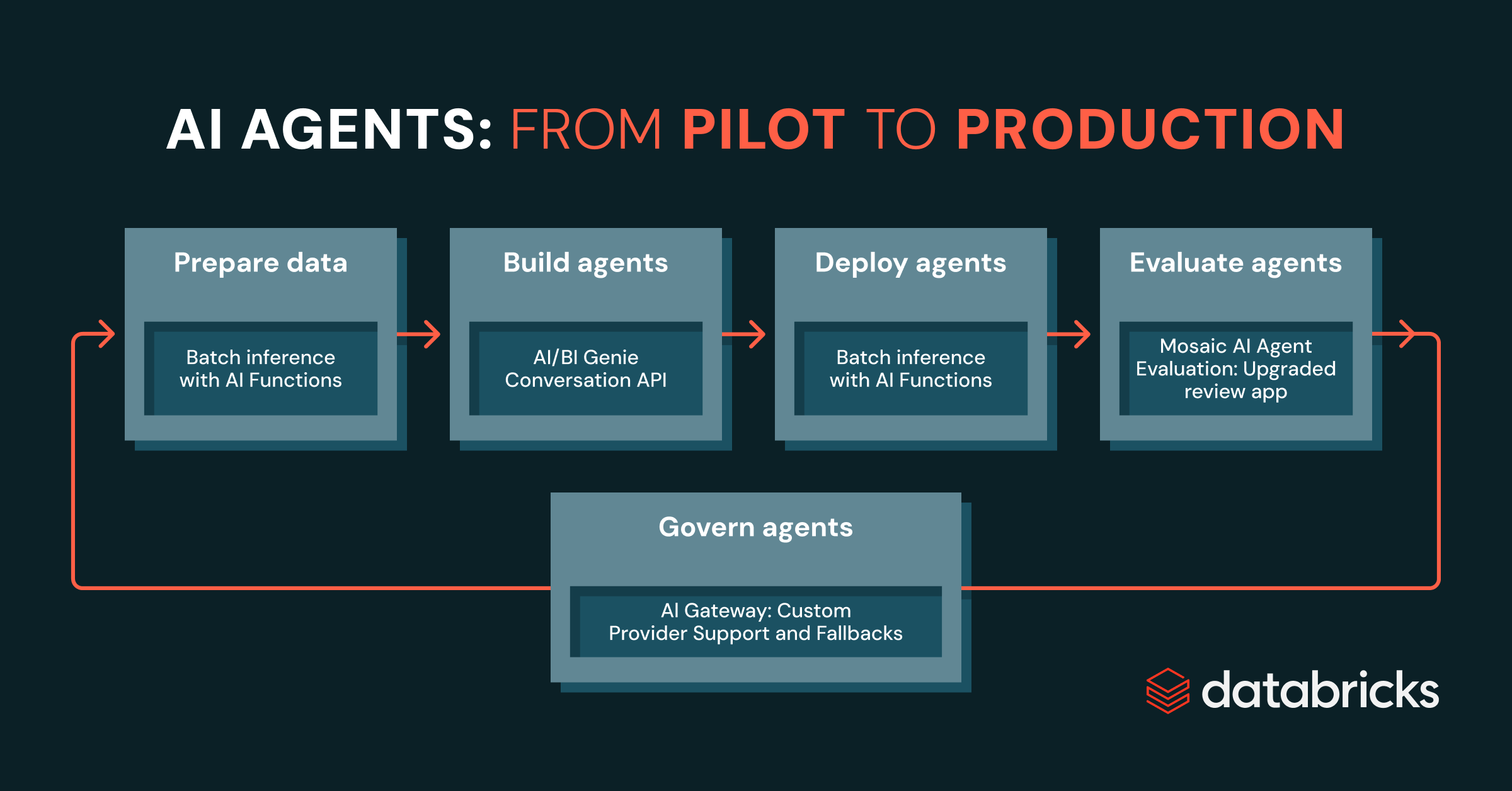
Sitting on top is Databricks Agent Bricks, which Databricks rolled out in Beta on June 11, 2025 at the Data + AI Summit (Databricks newsroom). The pitch is intentionally plain: describe the agent's task at a high level, wire up your enterprise data, and Agent Bricks takes it from there. It's tuned for the patterns enterprises actually run, structured information extraction, reliable knowledge assistance, custom text transformation, and orchestrated multi-agent systems, which covers the bulk of real Databricks AI agents use cases in the field today.
Understanding the Databricks Agent Bricks architecture matters because of how it sidesteps the trial-and-error grind. Agent Bricks borrows techniques from Mosaic AI Research to automatically generate domain-specific synthetic data and task-aware benchmarks, then tunes for cost and quality against them. So instead of guessing whether your agent improved, you've got a benchmark to hold it to from day one.
 Source: Databricks
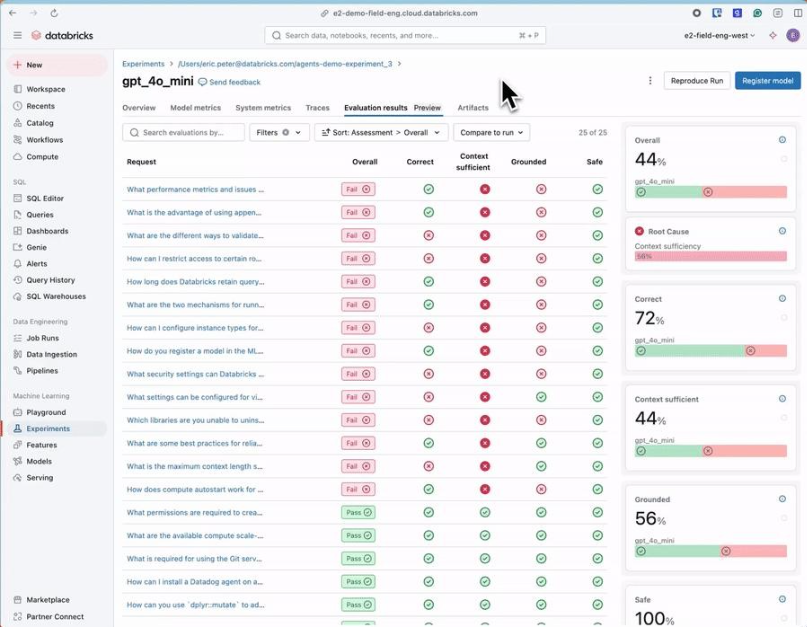
Evaluation is where the framework pays for itself, because "does this thing actually work" is the question that buries most gut-check deployments. Agent Evaluation runs AI-assisted assessments of output quality and pairs them with a UI where human stakeholders weigh in, keeping subject-matter experts in the loop instead of shutting them out.
Databricks took this further late in the year. In November 2025, it introduced three MLflow-powered evaluation capabilities in Agent Bricks that really matter for domain-heavy work (Databricks Blog, Building Custom LLM Judges). Agent-as-a-Judge automatically determines which parts of the agent's execution trace to evaluate, so developers stop hand-writing traversal logic for complex metrics. Tunable Judges let enterprises align domain-specific evaluators with their subject-matter experts, defining criteria for correctness, tone, or compliance through the make_judge SDK in MLflow 3.4.0. And Judge Builder gives those experts a visual interface to shape evaluation criteria without living inside the code.
 Source: Databricks
Why that trio earns its place: generic scoring tends to buckle on domain-specific workflows like clinical summaries or customer-service de-escalation, where "correct" carries a nuance no one-size rubric can hold. Letting a compliance lead define what "good" looks like, without opening a ticket with engineering, is how evaluation keeps up with the business.
If you want to get started with AI agents on Databricks, a workable build path runs like this. Ground the agent in governed enterprise data through Vector Search instead of shoving documents into a prompt. Trace every run with MLflow, which in its 3.0 release got rebuilt for GenAI and can watch agents deployed anywhere, even outside Databricks. Then iterate against real benchmarks well before anyone floats a launch date. That sequence is the shortest honest answer to how you create an AI agent on Databricks that survives contact with production.
This is the part people skim and really shouldn't. Governance isn't the compliance tax you pay to ship agents. In the Databricks numbers, it's the single best predictor of whether you ship them at all.
Organizations using AI governance tools deploy over 12 times more AI projects to production than those with none, and teams using evaluation tools land nearly 6 times more deployments (Databricks, 2026 State of AI Agents report). Read those the right way and the intuition flips on its head. Guardrails around data usage, compliance, and quality aren't the brake on releases. They're what gives stakeholders the nerve to sign off on a production push in the first place.
Unity Catalog is the layer carrying that load, applying data governance across every LLM and MCP in the enterprise from one spot. When you deploy AI agents on Databricks, Agent Bricks ships with built-in governance and enterprise controls for exactly this reason, so teams can go from concept to production without stitching separate tools together. That's not a bonus feature. It's the line between an agent that clears review and one that lives in a demo forever.
Here's a pattern worth designing around early: the one-model era is done. As of October 2025, 78% of companies on Databricks used two or more LLM families, and the slice running three or more climbed from 36% to 59% in a single three-month stretch (Databricks, 2026 State of AI Agents report). The driver is economics, not trend-chasing. You hand simple tasks to smaller, cheaper models and save the frontier models for the reasoning that genuinely calls for them.
The multi-agent move is the same plot one level up. That 327% jump in multi-agent workflows captures teams graduating past single chatbots toward systems that plan and execute end-to-end, specialized agents on specialized domains with a supervisor orchestrating the lot. Build for that from the start. An architecture that assumes one model and one agent will need reworking the second a new use case shows up, and a new use case always shows up.
The fair caveat: the surge is real, but it's growth off a base where fairly few organizations have agents genuinely humming in production. That gap is the opening. The building blocks aren't the hard part anymore, Agent Bricks, the Mosaic AI Agent Framework, MLflow 3.0, and Unity Catalog give you a governed route from idea to deployment. What splits the teams that ship from the ones stuck in pilots isn't a sharper model. It's treating evaluation and governance as the foundation instead of an afterthought, and grounding every agent in data you actually trust. Get the plumbing right and the agents follow.
Build Autonomous Revenue Managers with Databricks
See how AI agents can transform revenue growth management into autonomous, data-driven decision-making.
Explore RGM with Databricks
Start by connecting governed enterprise data, then use the Mosaic AI Agent Framework or Agent Bricks to define the task and wire in retrieval. The framework handles tracing, serving, and evaluation so you iterate against benchmarks rather than gut feel.
It takes a plain description of your task plus your data and auto-generates synthetic training data and benchmarks to tune against. That removes the trial-and-error guesswork that stalls most teams at the evaluation stage.
Agents sit on a governed stack spanning Delta Lake data, Vector Search retrieval, Model Serving, MLflow tracing, and Unity Catalog governance. Agent Bricks layers on top to automate tuning and evaluation across that foundation.