
Fassen Sie diesen Blogbeitrag wie folgt zusammen:
TL;DR
The case for forward deployment AI isn't that AI needs more engineering. It is the fact that enterprise AI reacts differently when exposed to unstructured data and unexpected user behavior not envisioned during the pilot stage. This piece explores when it is beneficial to invest in such proximity, how the interaction should take place, and when it is appropriate to return the system to your team.
Enterprise AI is heading into an important tipping point. According to Gartner's Hype Cycle for Agentic AI for 2026, agentic AI is already at the peak of inflated expectations, even though only 17 percent of organizations have embraced AI agents, while 60 percent intend to incorporate them in the next two years. As AI moves from experimentation to production use, the difference becomes clearer.
It's the practice of embedding engineers inside a client's day-to-day operations, close enough to watch an AI system meet real data and real users, and fix what breaks before trust erodes. We've covered the broader mechanics of forward deployed engineering before; this piece picks up where a buyer sits: not curious where the term came from, but deciding whether to write a check for it.
AI isn't just a feature here. Regular software behaves the same way every time. AI systems drift as they meet patterns nobody trained them on and degrade quietly instead of breaking loudly. The job of the AI engineer, therefore, is to spot this trend, identify its cause, and maintain reliability in an unpredictable environment. The inherent instability, then, explains why it is proximity, not a ticket queue, that forms the business model sought after by customers.
The real questions are practical: what does the engineer do, how does the engagement work and what happens once the system is live? A forward deployed AI solutions engineer's work generally falls into two phases:
Setup (first few weeks):
- Sits with the people who'll use the system to see how work really happens
- Traces why the "clean" data isn't clean
- Ships a first version small enough to break safely
Ongoing (the loop that follows):
- Watches the system in production for hesitation or overreach
- Fixes issues the same week, not the same quarter
- Trains the client's team on why a fix worked, not just that it did
That last point is what separates a genuine forward deployed AI engineer from a contractor billing hours against a spec sheet.
|
Standard AI Rollout |
Forward Deployed AI Engineering |
| Who catches problems |
End users, eventually, via a ticket |
The engineer, in real time, on-site |
| Fix turnaround |
Weeks to quarters |
Days |
| Feedback loop |
Passes through tickets, sprints, status decks |
Direct: the builder is the observer |
| Ownership after launch |
Often unclear |
Explicit, until handover |
McKinsey's State of AI report found that although AI use has become routine for most enterprises, almost two-thirds have not started scaling AI across the company. This is what McKinsey calls pilot purgatory: an AI use case works for the department it was developed for and for no other.
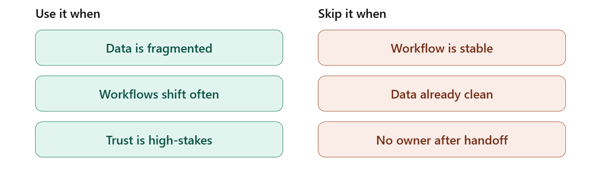
Smart buyers ask when to use it before they ask how, because it's not a fit for everything an enterprise does. It works well for some workflows and not others, so the real question is: which is this? Here's what settles it: when the system gets something wrong, do you notice right away, or not at all?
Some failures are obvious. Something breaks, someone notices right away, a ticket gets filed, and it gets fixed.
Other failures are invisible. Nothing breaks. The system just gives someone a wrong number that looks correct, that number gets used in a decision, and the mistake only shows up weeks later, by which point no one can trace where it went wrong. This is the kind proximity catches.
Timing matters too. Trouble doesn't spread evenly. It clusters in the first 60 to 90 days after go-live, when the system meets edge cases no pilot ever showed it. Scope embedment to that window, not as a permanent line item, and the cost question mostly answers itself.
Skipping this judgment call is expensive. Gartner predicts that more than 40% of agentic AI projects will be canceled by the end of 2027, citing escalating costs, unclear business value and weak risk controls, not model quality. Most, per Gartner, were misapplied from the start: agentic complexity thrown at a problem that never needed it.
Senior, embedded engineers cost more per hour than centralized delivery, and unlike offshore capacity, that cost doesn't compress much at scale. What justifies it shows up in a different number: McKinsey's research found that although most organizations use AI somewhere in the business, only about 6% see it contributing 5% or more to enterprise EBIT, the gap between using AI and getting paid for it. That gap closes when the workflow gets redesigned around the AI system, not the other way around. That redesign work is what forward deployed AI engineering services are built to deliver. The premium buys speed to it.
The comparison most buyers make is the wrong one. Comparing hourly rates only shows the cost of the labor. It doesn't account for what that labor can prevent:
- Rebuilding an integration because nobody caught a data issue
- Losing weeks of adoption before a problem is noticed
- Damaging credibility after a second failed rollout
Against those costs, the premium for forward deployment AI can be small.
It also shouldn't be permanent. The value is highest while the system is stabilising and your team is getting up to speed. By month nine, full embedded support starts to look more like outsourcing than forward deployment. Start with full embedment, then shift to advisory support as the system matures.
Whether to build internally or bring in forward deployed AI engineering services from outside depends on how central AI is to your competitive position. If it is core to how you compete, an internal function protects proprietary knowledge long-term. If it is supporting infrastructure, an external partner moves faster, provided the contract treats knowledge transfer as a deliverable.
Before signing, make sure the statement of work names:
- Documentation requirements, not left to memory
- A shadowing period for your internal team
- An explicit handover date, set on day one, not negotiated in the final week
Skip these and an embedded engineer who's the only one who understands the system isn't a capability you built. It's a dependency that walks out the door with them.
Three signals matter more than vanity metrics:
- Speed of fix: how fast a workflow issue gets caught and resolved after go-live
- Internal fluency: whether your own team can explain a decision without calling the vendor
- Usage that holds: whether adoption stays steady six weeks in; a quiet drop-off, not a dramatic failure, is usually the real warning sign
For a fuller view of what an enterprise AI strategy looks like when deployment isn't an afterthought, see our playbook on building a winning enterprise AI strategy.
The origin is the same: engineers embedded with clients instead of sitting on an internal product team; our glossary entry on the forward deployed engineer covers that base role in full. The difference is what drifts. Software behaves consistently once shipped, while AI systems can degrade as data and usage change, so an AI-focused FDE spends more time
Access to the live workflows and data the system touches, more than a typical offshore contractor gets. That's a legitimate governance question and belongs in security review from day one.
Knowledge transfer should be built into the engagement from the start. This includes documentation requirements, involving the internal team through shadowing, and defining a clear handover process so the client team can operate and evolve the system after the engagement ends.
Polestar Analytics looks beyond whether the AI system was deployed. Key measures include how quickly production issues are identified and resolved, whether the internal team develops the knowledge to operate the system independently, and whether usage remains consistent after deployment.
- Proximity is the product. The value isn't better models, it's that the person who built the system is close enough to catch it degrading before users lose trust in it.
- It's a fit for quiet failure, not all failure. Where wrong outputs look plausible and travel into decisions, embedment earns its premium. Where failures are loud and workflows are stable, it doesn't.
- Knowledge transfer belongs in the contract, not the relationship. Documentation, a shadowing period, and a handover date set on day one are what separate a capability you built from a dependency you rented.