
Fassen Sie diesen Blogbeitrag wie folgt zusammen:
TL;DR:AWS-zu-Databricks-Tauschdienste sind lose gekoppelt und bilden eine einheitliche Lakehouse-Plattform, die auf Delta Lake basiert.Unity-KatalogAWS Fabric ersetzt die bestehende Infrastruktur durch OneLake als gemeinsame Grundlage. Bei Snowflake Fabric, wo Sie sich bereits auf einer konsolidierten Plattform befinden, geht es im Wesentlichen darum, ob das Data Warehouse im Mittelpunkt bleibt oder ob die umfassendere, gemeinsam genutzte Infrastruktur von Fabric diese Rolle übernimmt.
Agentische KI-WorkloadsEine einzige Eingabeaufforderung löst Hunderte von Aktionen aus und erzeugt dadurch einen enormen Bedarf an Daten, Rechenleistung und Speicherplatz. Agenten fragen diese Daten kontinuierlich ab, analysieren sie und reagieren darauf, was neue Anforderungen an Rechenleistung, Speicherplatz, Integration, Governance und Datenzugriff stellt.
Das bedeutet, dass herkömmliche Datenarchitekturen Schwierigkeiten haben, diese Größenordnung effizient zu bewältigen, was zu höheren Infrastrukturkosten und betrieblicher Komplexität führt.Modernisierung und Migration des DatenbestandsDies ist unerlässlich, um skalierbare und kosteneffiziente KI-Workloads zu unterstützen, woran 83 % glauben. Andernfalls führen die veralteten Strukturen zu Latenz, Redundanz, Integrationsaufwand und steigenden Infrastrukturkosten.
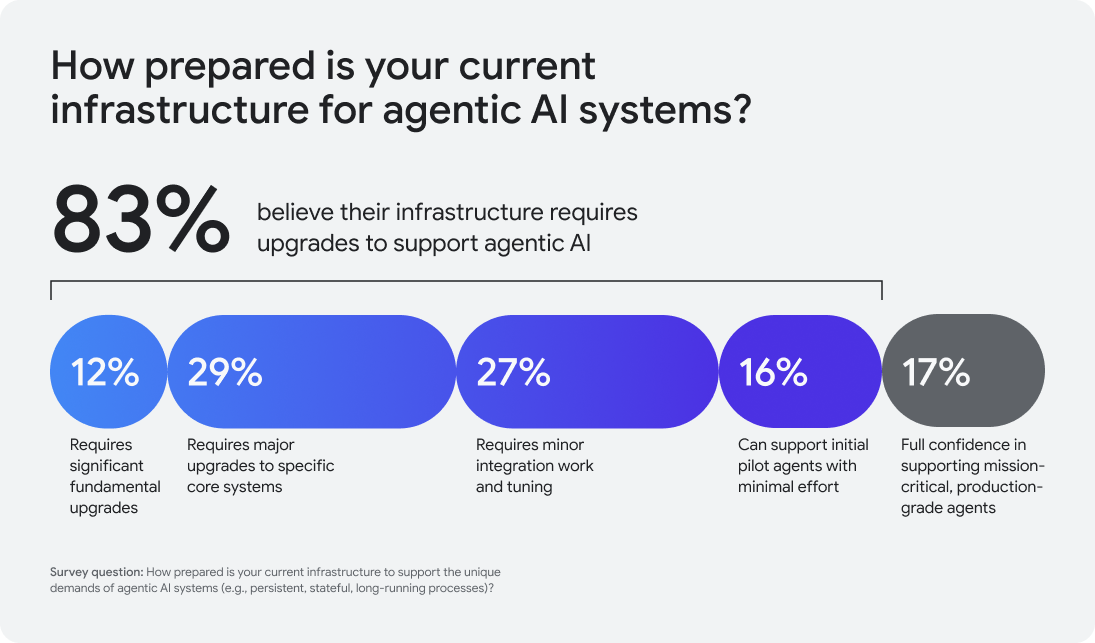 Quelle:Google, Bericht zum Stand der KI-Infrastruktur
Die Lösung für dieses Problem beginnt mit der Cloud-Migration oderDatenbestandsmigrationDie Übertragung von Daten von einer Plattform auf eine andere ist jedoch nicht einfach eine Frage des Kopierens von Tabellen und des Neuaufbaus von Datenpipelines.Die darunterliegende Architektur verändert sich.Speicherschichten, Rechenmodule, Datenformate, Orchestrierung, Sicherheit, Governance, semantische Modelle und Workloads müssen möglicherweise alle neu überdacht werden.
Wir versuchen also, damit die Migrationen von Datenplattformen eingehend zu untersuchen.AWS zu Databricks, AWS zu Microsoft Fabric oder Snowflake zu Fabric— um zu verstehen, was auf eine neue Plattform übertragen, was neu gestaltet und was weitergeführt werden kann.
Auf hohem Niveau:
| Ausgangspunkt |
Ziel |
Was sich am meisten ändert |
| AWS |
Databricks |
AWS-Dienste konsolidieren sich zu einer auf Seehäuser ausgerichteten Plattform |
| AWS |
Stoff |
AWS-Dienste bewegen sich in Richtung einer OneLake-zentrierten Analyseumgebung. |
| Schneeflocke |
Stoff |
Die auf Lagerhäuser ausgerichtete Analytik bewegt sich hin zu einer umfassenderen, gemeinsam genutzten Datenplattform. |
Ein ausgereiftes AWS-Ökosystem oder eine umfangreiche Dateninfrastruktur kann S3, Glue, EMR, Redshift, Lambda, Kinesis, Step Functions und externe Orchestrierung umfassen. Snowflake ist eine hochintegrierte Analyseplattform. Daher erfordert die Migration zu Fabric weniger Servicekonsolidierung, sondern vielmehr eine Neubewertung der optimalen Platzierung von Speicher, Rechenleistung, Engineering, Business Intelligence und Governance. Databricks und Fabric zielen beide auf die Reduzierung der Architekturfragmentierung ab, verfolgen dabei aber unterschiedliche Ansätze.
Das Verständnis der Anwendungsabhängigkeiten und die Beurteilung der technischen Machbarkeit sind daher zwei der wichtigsten Bereiche und gleichzeitig die beiden größten Herausforderungen bei der Migration im Allgemeinen.
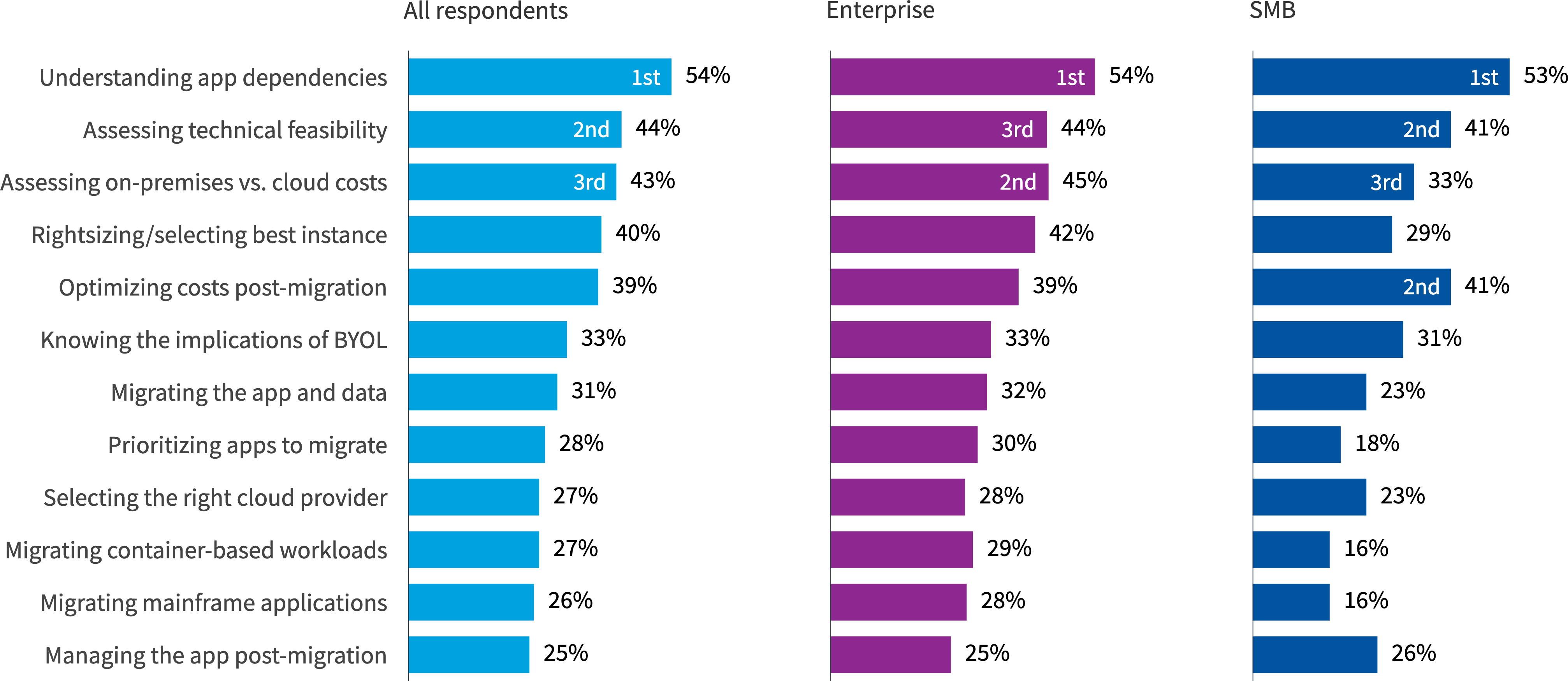 Quelle:Flexera 2026 State of the Cloud Report
Lasst uns jeden einzelnen Punkt genauer betrachten.
Eine Migration von AWS zu Databricks ersetzt die Service-Orchestrierung durch die Plattform-Orchestrierung. S3, Glue, EMR und Redshift haben jeweils ihre eigene Konfiguration, Berechtigungen und Fehlermodi. Databricks konsolidiert diese Komplexität in Delta Lake als Transaktionstabellenschicht, Spark/SQL als gemeinsam genutzter Rechen-Engine und Unity Catalog als Governance-Schicht. So ist dieselbe Funktionalität, die zuvor vier Dienste erforderte, nun auf einer einzigen Plattform verfügbar.
Das bedeutet, dass Sie zunächst Folgendes verstehen sollten:
- Klebearbeiten und Raupen
- Redshift-Schemas und -Prozeduren
- EMR-Arbeitslasten
- Stufenfunktionen
- Lambda-Funktionen
- S3-Pfade und Abhängigkeiten
- Streaming-Pipelines
- Externe Terminplaner
- Nachgelagerte Verbraucher
Die häufigsten Fragen zur Migration von AWS zu Databricks:
1. Was geschieht mit AWS Glue ETL-Aufträgen?
Glue-Jobs lassen sich zwar zu Databricks migrieren, erfordern aber häufig eine architektonische Neugestaltung anstelle einer einfachen Code-Anpassung. Glue-Workloads, die DynamicFrames, Crawler und Trigger nutzen, können mithilfe von Spark, Delta Lake und der nativen Databricks-Orchestrierung neu gestaltet werden.
Anstatt:Kleber → S3 → Rotverschiebung → Lambda
Die Architektur kann sich wie folgt gestalten:Datenaufnahme → Delta Lake → Spark/SQL → Workflows → BI/ML
Der Hauptvorteil besteht in weniger Schnittstellen zwischen Diensten und einer einheitlicheren Datenplattform.
2. Wie ändert sich das Streaming in Databricks?
Streaming wird Teil derselben Lakehouse-Architektur und nicht mehr als separate Pipeline-Schicht implementiert. Eine AWS-Pipeline mit Kinesis, Lambda, S3 und Redshift kann folgendermaßen vorgehen:
Auto Loader → Delta Lake → Lakeflow Declarative Pipelines
Dadurch können Batch- und Streaming-Verarbeitung gemeinsame Muster nutzen, die Datenqualität wird in die Pipelines integriert und BI, Analytics und ML können dieselbe verwaltete Datenebene verwenden.
Eine Migration von AWS zu Fabric ersetzt einen fragmentierten Service-Stack durch OneLake als gemeinsame Grundlage, und im Gegensatz zu Databricks müssen Sie die Daten nicht zuerst verschieben.Fabric unterstützt Verknüpfungen zu externen Quellen, einschließlich S3-kompatiblem Speicher, sodass Teams Verbindungen herstellen und validieren können, bevor sie auch nur ein einziges Byte physisch verschieben.
Der zentrale Wandel geht hin zu OneLake. Fabric basiert auf einer gemeinsamen Datengrundlage, auf der die verschiedenen Workloads mit denselben zugrunde liegenden Daten arbeiten können, anstatt dass jede Engine ihre eigene Kopie verwalten muss.
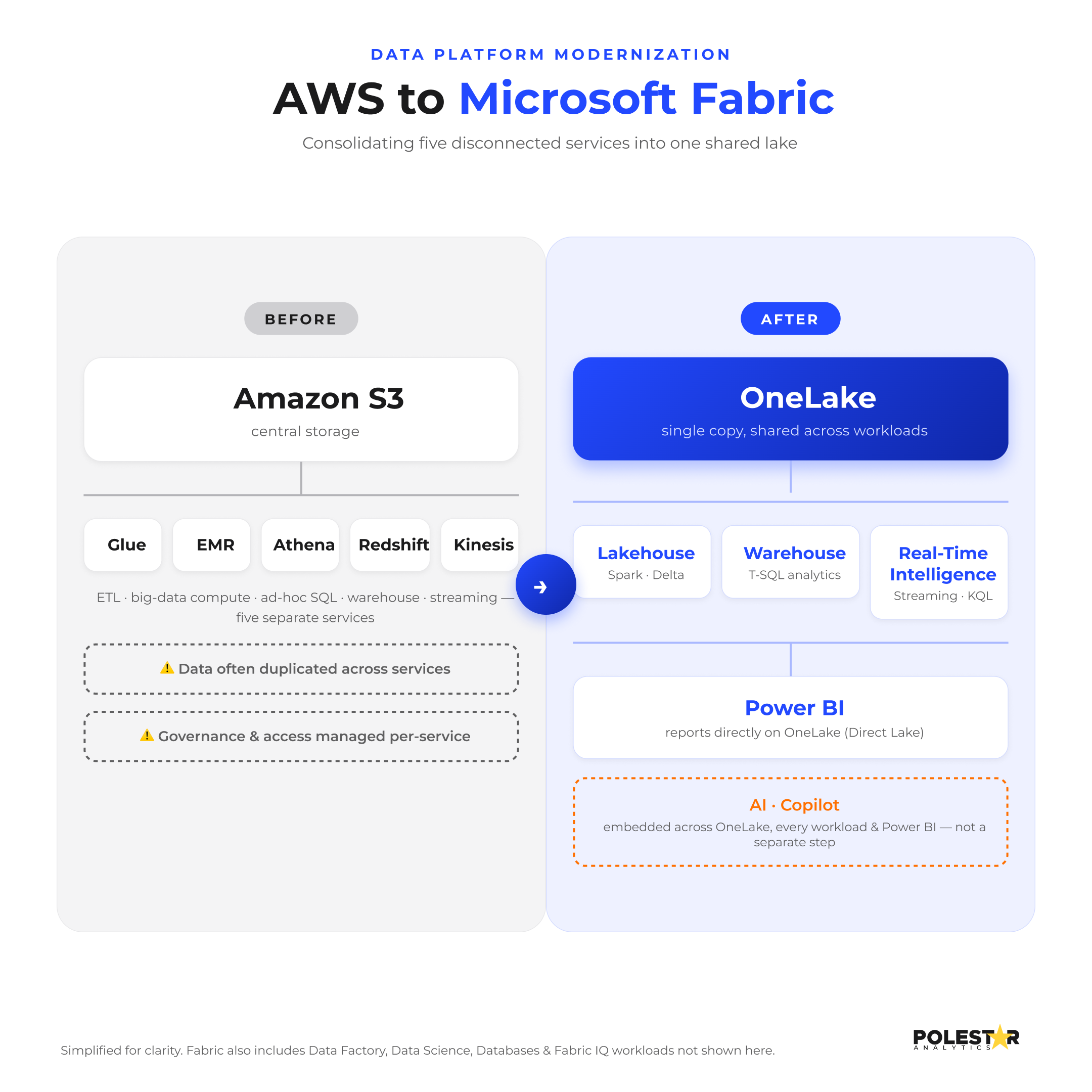
Die häufigsten Fragen zur Migration von AWS zu Fabric:
1. Warum sind Pipelines oft schwieriger zu migrieren als die Daten?
Denn das Verschieben von Daten verschiebt nicht die zugrunde liegende Logik.AWS-Workloads können Glue-Jobs, Step Functions, Lambda-Funktionen, IAM-Richtlinien, Datenqualitätsregeln, Zeitpläne und nachgelagerte Abhängigkeiten umfassen – die alle separat bewertet werden müssen.
Manche Arbeitslasten könntenFabric Data Factory-PipelinesAndere können ersetzt oder eliminiert werden, und einige bleiben möglicherweise außerhalb von Fabric.
Das Ziel ist nichtAWS innerhalb von Fabric nachbildenZiel ist es, die Workload-Architektur so umzugestalten, dass sie optimal auf die Stärken von Fabric abgestimmt ist.
2. Wie werden AWS Kinesis- und Lambda-Workloads auf Fabric abgebildet?
Kinesisströme können abgebildet werden aufFabric Eventstreams und Echtzeit-Intelligenzfür die Erfassung, Verarbeitung und Überwachung von Ereignissen, während Lambda-Funktionen ersetzt werden können durchFabric-Pipelines, Notebooks oder andere ereignisgesteuerte Verarbeitungsmusterabhängig vom Arbeitsaufkommen.
AWS: Kinesis → Lambda → S3/Redshift → nachgelagerte Anwendungen
Stoff: Eventstreams → Echtzeit-Intelligenz / OneLake → Analysen & nachgelagerte Workloads
Dies kann die Anzahl der involvierten Dienstleistungen reduzieren und gleichzeitigEchtzeit-Erfassung, -Transformation, -Speicherung und -Analyse auf einer einheitlicheren PlattformDie
Diese Migration basiert auf einer deutlich konsolidierteren Architektur als die beiden oben genannten AWS-Szenarien, was die Versuchung birgt, sie als reine SQL-Kompatibilitätsübung zu betrachten. Das greift jedoch zu kurz. Die entscheidende Frage ist, ob das Data Warehouse weiterhin im Mittelpunkt stehen sollte.
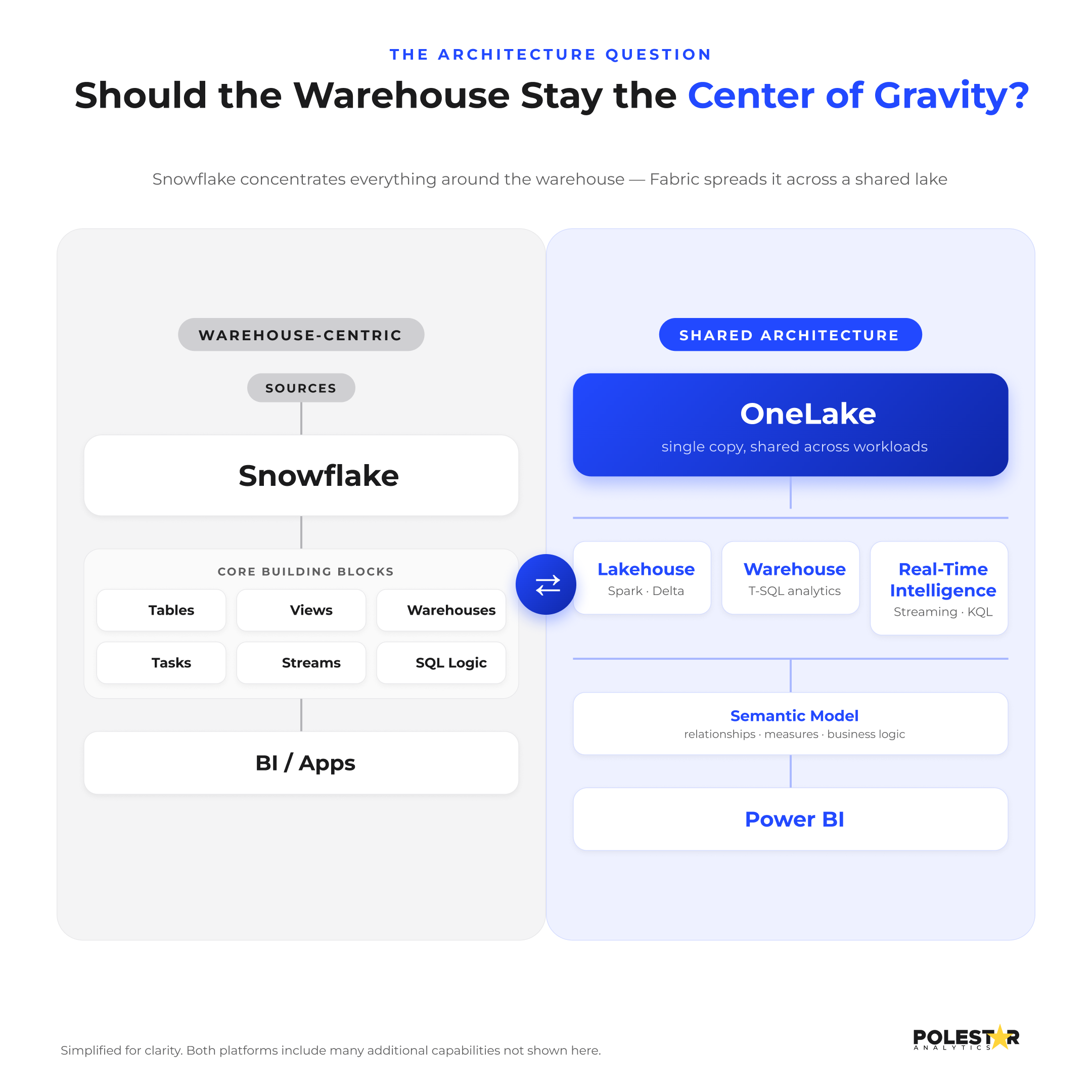
Der Vorteil dieser Data-Warehouse-Migration besteht darin, dass esMicrosofts Mirroring für Snowflake ist jetzt allgemein verfügbar(bestätigt von)Microsofts GA-Ankündigung), welches unterstützte Snowflake-Daten kontinuierlich in OneLake repliziert.Dadurch entsteht ein Koexistenzmodell, in dem bestehende Workloads weiterlaufen können, während neue Workloads schrittweise auf Fabric aufgebaut werden. Dies ist wertvoller als eine vollständige Migration, da es die Datenmigration von der Modernisierung der Workloads trennt.
Häufig gestellte Fragen zur Migration von Snowflake zu Microsoft Fabric:
1. Wie verändert sich die Trennung von Speicher und Rechenleistung bei Snowflake in Microsoft Fabric?
Die zugrundeliegende Architektur ändert sich grundlegend.Snowflake trennt Speicher und Rechenleistung durch sein virtuelles Warehouse-Modell, während Fabric Daten in OneLake integriert und workloadspezifische Rechenleistung über seine Dienste hinweg bereitstellt.
Dies bedeutet, dass bei einer Migration die Dimensionierung der Rechenkapazität, die Parallelität der Arbeitslast, die Datenübertragung, das Caching und die Leistungsmuster überprüft werden müssen, anstatt einfach nur Tabellen zu verschieben und die gleiche Architektur beizubehalten.
2. Was geschieht mit Snowflake Streams, Tasks und geplanten Workloads?
Sie müssen den Orchestrierungs- und Datenverarbeitungsfunktionen von Fabric zugeordnet werden.Snowflake Tasks und Streams können übersetzt werden inFabric Data FactoryPipelines, Notebooks oder andere inkrementelle Verarbeitungsmuster, je nach Arbeitslast.
Die Migration bietet daher die Möglichkeit, die Orchestrierung zu vereinfachen und doppelte Datenbewegungen zu reduzieren – und nicht einfach jede Snowflake-Aufgabe in Fabric nachzubilden.
Ein gängiger Ansatz für die Migration eines Data Warehouse sieht folgendermaßen aus:
| Alt |
Neu |
| S3 |
OneLake |
| Kleber |
Fabric Data Factory |
| Redshift |
Stofflager |
| Lambda |
Stoffäquivalent |
| Stufenfunktionen |
Textilleitungen |
Diese Tabelle ist zwar nützlich, stellt aber keine Architektur dar, da sie davon ausgeht, dass jede alte Komponente eine neue verdient. Ein besserer Ansatz stellt für jede Komponente eine andere Frage:
| Bestehende Arbeitsbelastung |
Frag das zuerst |
| S3-Daten |
Muss es verschoben werden oder kann man darauf verweisen? |
| Klebestelle |
Muss die Transformation weiterhin bestehen? |
| Redshift-Tabelle |
Werden Seedaten dupliziert? |
| Lambda |
Handelt es sich um Datenverarbeitung, Orchestrierung oder Anwendungslogik? |
| Stufenfunktion |
Welche Abhängigkeiten bestehen noch? |
| Snowflake-Lager |
Gehört die Arbeitslast in ein Lagerhaus, ein Ferienhaus am See oder beides? |
| BI-Extrakt |
Kann die semantische Schicht direkt auf die gemeinsam genutzten Daten zugreifen? |
Die Zielarchitektur sollte aus Geschäftsprozessen entworfen und nicht aus technischen Artefakten rekonstruiert werden.
MigrationStudio migriert Datenbestände von einer Plattform zur anderen: AWS zu Databricks, AWS zu Fabric, Snowflake zu Fabric, GCP zu Fabric, GCP zu Databricks – im Prinzip jede Plattform zu jeder. Es automatisiert die wiederholbaren 70 % dieser Arbeit: Ein agentengesteuerter Workflow scannt das Quellsystem, ermittelt, welche Jobs ausgeführt werden und welche verwaist sind, modelliert die Zielarchitektur, konvertiert und optimiert die Jobs und stellt das Ergebnis über Git bereit.
Der wichtigste Unterschied liegt in der semantischen Neuplattformierung anstelle der Transliteration. Die meisten Migrationstools bilden alte Syntax auf neue ab und liefern Code, der sich weiterhin wie das Quellsystem verhält – genau der Fehler der Eins-zu-eins-Abbildung, vor dem dieser Artikel immer wieder warnt. MigrationStudio hingegen ermittelt die eigentliche Funktion eines Jobs, schreibt dann idiomatischen Code für die Zielplattform und beseitigt dabei bestehende Altlasten, anstatt sie einfach zu kopieren.
Die Aussage bezieht sich auf eine beliebige Verbindung, die AWS mit Databricks, AWS mit Fabric, Snowflake mit Fabric, GCP mit Fabric und GCP mit Databricks umfasst.Wo dies anwendbar ist, bedeutet das eine Reduzierung des Zeit- und Kostenaufwands für die Migration um 35 % oder mehr im Vergleich zu einem manuellen Neuaufbau.
| Dimension |
AWS zu Databricks |
AWS zu Fabric |
Schneeflocke zu Stoff |
| Architektur beginnen |
Verteilte Dienste |
Verteilte Dienste |
Integrierte Lagerplattform |
| Kernverschiebung |
AWS-Dienste für Lakehouse |
AWS-Dienste für die OneLake-zentrierte Plattform |
Vom Warehouse-zentrierten zum gemeinsam genutzten Datenbestand |
| Lagerung |
S3 + Delta |
OneLake + externe Verknüpfungen/Aufnahme |
OneLake über Migrations-/Spiegelungs-/Speichermuster |
| Verarbeitung |
Spark + SQL |
Textilmotoren + Funken |
Stofflager/Lakehouse/Spark |
| ETL |
Refactoring in lakehouse-native pipelines |
Konsolidierung in Fabric-Pipelines/Workloads |
Überdenken Sie die ETL-Transformation von Lagerhäusern im Vergleich zur Transformation von Seehäusern. |
| Orchestrierung |
Databricks-Workflows / Pipelines |
Fabric Data Factory |
Stofforchestrierung |
| Governance |
Unity-Katalog |
Fabric/OneLake-Governance |
Fabric/OneLake-Governance |
| Größtes Migrationsrisiko |
Nachbildung der AWS-Architektur in Databricks |
Fabric als Zielarchitektur anstatt als Zielarchitektur behandeln |
Die Migration lediglich als SQL-Konvertierung behandeln |
| Größte Chance |
Daten- und KI-Workloads vereinheitlichen |
Plattformfragmentierung reduzieren |
Erweitern Sie die Analytik über die lagerzentrierte Architektur hinaus. |