
Sammanfatta detta blogginlägg med:
| Revenue Growth Management (RGM) in CPG is a data-driven approach to optimizing pricing, promotions, trade spend, and product mix to grow revenue profitably. |
TL;DR
Revenue growth management in CPG optimizes pricing, promotions, product mix and trade spend to grow revenue profitably. A revenue growth management framework covers six areas: pricing, promotions, trade spend, assortment, demand and profitability.
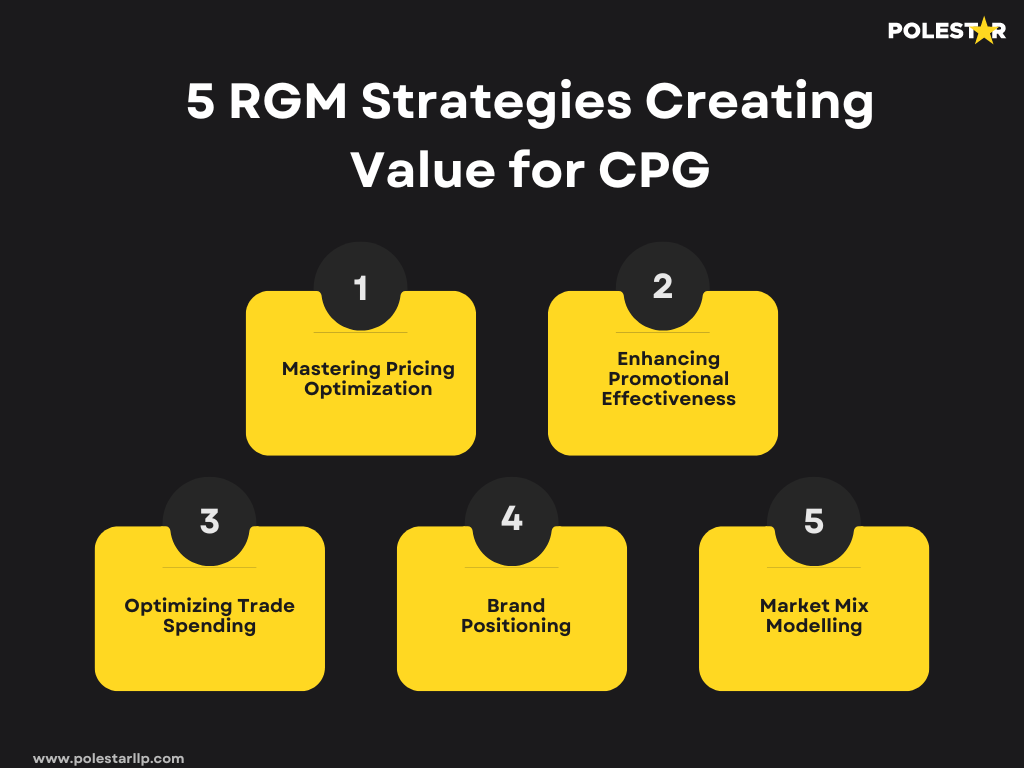
Most CPG companies have those defined, and most plan each one against its own elasticity read and its own baseline, which is where the numbers stop agreeing. Revenue growth management analytics puts a single demand model under all six, and ProfitPulse, an AI revenue growth management platform, is built to run it. The five strategies covered below are pricing optimization, promotional effectiveness, trade spend, brand positioning and marketing mix.
Revenue Growth Management (RGM) in CPG is a way of using data to systematically grow profitably through the management of pricing, trade spend, product mix, and promotional mix. RGM creates a single point of truth for consumer, sales, market, and financial data so that commercial teams can see the likely impact on profit of promotional lift and pack mix of a particular move before they make it.
It was introduced in the airline industry, where seats expire and prices must change daily.
RGM took that logic and made it work on a much harder problem: (literally) hundreds of thousands of SKUs and dozens of different accounts, and promotions that could either fund growth or quietly buy it. That's what a revenue growth management platform like Profit Pulse does, keeping those decisions in a single feedback loop instead of four.
Running those decisions in one loop has become necessary because each of them now carries more risk on its own. RGM is critical for CPG today because input costs, retailer terms and shopper behaviour are shifting within the same quarter, and a pricing, promotion or pack decision made on last year's data can take margin out of the business before the P&L shows it. RGM analytics gives commercial teams a way to see that effect before the decision is committed.
The answer becomes obvious when you see how the impact of issues such as cannibalization, improper trade spend management, and suboptimal pricing strategies, can significantly impact a company's bottom line.
Each of those issues sits with a different part of the commercial team, and each needs its own analytical read. - - Pricing analytics and price elasticity modelling show how far a price can move before volume shifts to a competitor or to private label.
- Promotion analytics separates the volume a promotion created from the volume it borrowed from future weeks or adjacent packs.
- Trade spend analytics tracks what each retailer and channel returns on the money invested with it.
- Product mix analysis shows which packs and SKUs carry the margin, and demand forecasting ties all of these to what the shelf will actually need.
- When these reads come from separate tools they seldom agree, and that gap is where most of the profit leakage begins.
Whether in category consumption, brand preference, channel selection, shopper frequency, or media engagement, the predictable consumer that existed before has vanished. But is this the only factor driving the need to rethink category growth strategies and Revenue Growth Management (RGM) practices?
While it's easy to call out the unpredictable consumer, let's keep it in mind it's not the only factor impacting Revenue growth management in the CPG industry.
Traditional Trade Promotion Management (TPM) and scenario-based Trade Promotion Optimization (TPO) were used in earlier Revenue Management (RM) strategies to improve promotion efficacy and daily pricing within a single retailer. It kind of worked, but to build comprehensive revenue growth management CPG solutions, businesses need to integrate them with other strategies and tools that address the broader aspects of pricing and promotion.
Hence, it’s not surprising to see more than 80% of CPG CEOs aren’t satisfied with their RGM results.
Rightly so, the industry leaders understand the importance of keeping pace with the changing market and how that’ll require more creativity and flexibility for retailers' promotions and pricing strategies across channels.
However, the question arises: what are the common barriers that are preventing managers from achieving this?
It's a Sign! Your RGM strategy needs a reality check
Get the playbook that reveals what's broken and how to fix it
Improve Your RGM Strategy
| Cause |
Factor |
Effect |
| Relying solely on historical customer data to inform decisions. |
Lack of granular view of data |
- Distorted understanding of customer behaviour
- Lack of real-time insights |
| Individual consumer account teams operate in isolation and utilize different revenue growth management platforms. |
Need for collaborative Demand Planning |
- Trade planning inconsistency |
| The use of traditional Business Intelligence (BI) tools designed primarily for visualizations and manual analysis. |
Lack of robust business intelligence |
- Manual Analysis
- Sales decline in specific categories |
| Many CPG organizations resort to quick-win strategies due to their high impact and low effort but struggling in aligning it with long-term goals. |
Unsustainable Quick-Win strategies |
- Lack of long-term scalability and sustainability
- Hindered consistent growth |
Each of those pitfalls are a result of analyzing a single lever, one at a time. RGM analytics is how CPG companies address the problem; it links pricing, promotion, trade and mix data together into one demand model, enabling a commercial team to understand the impact of a decision on volume and margin before they make it.
As we shift our focus to key strategies for driving revenue growth, let's explore how it works together to enhance overall business performance.
Revenue Growth Management Strategies for CPG
1. Mastering Pricing optimization:
Only 12% of shoppers say they will stick to their regular brands regardless of price, which proves that pricing pulls direct influence on customer behaviour. By introducing innovative methods for defining discounting strategies and pricing tactics, RGM has evolved beyond traditional data collection practices. Organizations can now easily collect and integrate various types of data for faster decision-making.
Hence, making the most out of that data, RGM managers can–
- Conduct Price Elasticity Analysis: To know how sensitive your customers are to price changes.
- Implement Dynamic Pricing: Utilize it to adjust prices in real-time based on market conditions.
- Experiment with Price Pack Architecture: Test different pack sizes and price points.
2. Enhancing promotional effectiveness:
Accounting for 20%-30% of sales, promotions for a fact are a significant investment for CPG companies. However, many promotions fail to deliver the expected ROI. As one of our client, a global alcoholic beverage subsidiary was planning trade promotions against top-down targets that never held at outlet level. Running uplift modelling across 75 depots with PromoPulse, the team gained 8% market share in pilot stores by moving spend onto the promotions that were already working.
Now how RGM helps in turning the tables in such situations is through:
- Utilize Promotion Response Modeling: Before launching a promotion, use predictive analytics to forecast its impact. For example, if you plan a "Buy One, Get One Free" offer, analyze past promotions to estimate potential sales uplift and ROI. This modeling helps in selecting the right promotional mechanics.
- Optimize Promotion Budgets: It helps in allocating the promotional budget strategically across channels. If social media ads have historically yielded higher ROI than traditional print ads, prioritize digital promotions. This targeted approach ensures that your marketing dollars are spent where they can generate the most impact.
- Track and Learn: After each promotional campaign, conduct a post-mortem analysis. What worked? What didn’t? Use these insights to refine future promotions. For instance, if a specific discount type drove significant sales, consider repeating it with variations. This iterative learning process fosters continuous improvement.
Plan, execute, repeat. Still missing the number?
The five failure points hiding inside traditional trade promotion management.
Explore the 5 TPM Failures
3. Optimizing Trade Spending:
An effectual trade spending strategy requires close coordination between manufacturers, retailers, and distributors to agree on a category profit pool. CPG marketers require a way to build performance indexes utilizing historical trade data, accounting for spend by category, retailer, and brand. Now with RGM place the organizations are:
- Optimize Promotional Allocations: Historical performance data as the decision foundation, strategically allocate the trade spend to most impactful promotional activities.
- Negotiate Smart Trade Terms: Insights help in establishing mutually beneficial terms.
- Measure trade effectiveness: Continuous measurement allows for informed decision-making and strategy refinement.
Through derive accurate insights from rapidly evolving sales and trade data. The results provide the information you need to make critical marketing decisions.
4. Brand Positioning:
Successful brand positioning is necessary for aligning with target consumers' needs as it establishes credibility, relevance, and meaning for the consumers. Hence, CPG brands focus more on differentiating their product proposition and product features and benefits to seem more at par with consumer wants. Now here how RGM helps CPG companies get an edge is through:
- Consumer Insights: By understanding what drives consumer choices, brands can tailor their messaging and product offerings to resonate more effectively with their target audience.
- Differentiation Strategies: RGM CPG enables companies to analyze competitive landscapes, allowing them to pinpoint unique selling propositions (USPs). By focusing on differentiating factors—such as innovative packaging or superior quality—brands can carve out a niche in the market.
- Continuous Adaptation: RGM is not a one-time initiative; it involves ongoing analysis and adjustment. By regularly assessing brand performance against market trends and consumer feedback, companies can refine their positioning strategies.
5. Marketing mix optimization:
To make sure that business growth is consistent and smooth, marketers use market mix optimization to evaluate and optimize marketing campaigns via statistical analysis. It is a complex process but as part of Revenue Growth Management (RGM) in cpg, it helps in interpreting results to arrive at actionable conclusions through:
- Budget Allocation: With insights gained from RGM, marketers can avoid overspending or under-investing in high-potential areas. This involves strategically distributing budgets across channels based on performance metrics and anticipated market trends.
- Campaign Effectiveness Tracking: By implementing robust tracking mechanisms, companies can evaluate the success of each campaign in real-time and make necessary adjustments. This iterative process allows for continuous improvement and maximizes the impact of marketing efforts.
The code has been cracked!
Track the campaign success effectively with commercial marketing KPIs and discover their role in achieving crucial business objectives.
Check out now!
- Scenario Planning: RGM supports scenario analysis to forecast potential outcomes based on different marketing strategies. This proactive approach enables companies to anticipate market shifts and prepare adaptive strategies ahead of time.
Want to Uplevel New Strategies for Your Revenue Growth Management?
Look no further! We've got the perfect strategies to help you boost your bottom line and stay ahead of the competition.
Talk to Our RGM Consultant
The Top Line is the revenue growth of RGM businesses defined after Trade Spend, Discounts and cost to Serve are accounted for. Two brands may show exactly the same revenue growth but one shows a significantly better bottom line, because they gained that revenue growth through a better Product Mix and price realisation versus volume. Revenue growth management analytics makes that difference visible at SKU, retailer and channel level. It shows which packs carry margin, which accounts return their trade investment, and where a discount moved volume without adding profit. That lets commercial teams plan growth that holds its margin through the year.
By now it has become clear that effective revenue growth management in CPG is not just a theoretical framework; it's a vital strategy especially when 74% of consumers say they would switch brands for lower regular prices.
With this in mind, let’s see some of the compelling use cases that can be realized when using these RGM solutions include:
1. Campaign Performance Measurement:
Campaign spend in CPG runs across in-store display and feature, shopper and trade activation, TV, digital, and retail media. Each is measured independently, against a different definition of a result, and the same weekly sales are allocated among more than one of them. The display was present, the feature appeared, the retail media was scheduled, and every report awards the volume it can measure.
Store-level sell-out is the only point where all of them come together.
RGM in CPG is measured against a modelled baseline, for each channel, retailer, and pack, thereby isolating the volume that would have sold without the activity from the incremental.
2. Forecasting demands of different brands and packs:
Retailers and e-tailers now have enhanced visibility into inventory availability across their stores and online channels. Supported by Demand forecasting within Revenue Growth Management (RGM), they can accurately predict future product demand across various sales channels and brands. This capability is crucial for improving supply chain efficiency and meeting delivery requirements, particularly the On-Time-In-Full (OTIF) mandate.
This helps them to make sure their products are available on the shelf to fulfill customers' demands.
3. Promotions and pricing:
Around 72% of trade promotions do not break even. The volume usually arrives, which is why the failure is easy to miss in a period total. What the total hides is where it came from: pull-forward moving purchases between weeks, cannibalisation of adjacent packs in the same portfolio, and discount depth set by precedent rather than by elasticity. RGM tests the right bundle, the right brands and packs at the right price against the price elasticity of each brand segment before the spend is committed, and measures uplift net of baseline afterwards so the three are visible separately.
4. Customer analytics:
Volume is buyers multiplied by frequency multiplied by basket size, and a two-point decline can come from any of the three. Each points somewhere different: fewer buyers is a recruitment problem, lower frequency usually traces to availability or a competitor's promotional calendar, smaller baskets often follow a pack decision the team made itself. Where the lost buyers went matters as much as the count, since a shopper moving to a smaller pack of the same brand stays in the franchise while one moving to private label does not. RGM in CPG keeps these separate so retention spend is directed at the specific loss.
Most RGM frameworks in CPG are a version of OBPPC: occasion, brand, pack, price, channel. It has held up for two decades because it starts from the demand moment rather than the factory. Where it breaks is one level down. Price pack architecture gets set against one elasticity read, the trade calendar against another, assortment against a third, and OBPPC stays coherent on the slide while the execution drifts. 58% of profitable growers work assortment, pricing and promotion as one mix rather than in sequence. Revenue growth management analytics is what makes that possible: one demand model, one baseline, one gross-to-net view feeding all six areas of the framework.
See it in action:
Revenue growth management (RGM) at scale is the latest and different approach to creating value. But its long-term real promise is perhaps in its potential to revolutionize how CPG companies operate. However, making that promise a reality requires more than just the right tools and the right approach. It requires a whole new way of thinking, a willingness to change, and a drive to learn and adapt as rapidly as the market does.
As companies address RGM's implementation, they will need to focus on collaboration and data optimization – all with an emphasis on consumer demand.
In doing so, CPG companies can better meet the realities of how consumers buy, and adapt to the constant changes in the marketplace. And having partners like Polestar Analytics along the way can make the journey a lot smoother. With our RGM Suite and other products, we can help CPG leaders transition from isolated, reactive decision making to unified, analytics-based actions. Ultimately, this focus on consumers can help CPG organizations reach new levels of sustained success.
By making the cost of a decision visible before it is taken. The profit leak in most CPG portfolios is not a bad price or a bad promotion, it is a good one funded by volume borrowed from elsewhere. RGM analytics prices that: uplift measured net of baseline, cannibalisation attributed to the SKUs that gave up the volume, pull-forward separated from genuine incremental demand. A promotion returning strong period sales and negative incremental margin looks identical to a successful one until the baseline is modelled. Around 72% of trade promotions do not break even, which is the size of the recoverable margin sitting inside most trade budgets.
Revenue management sets the price. Revenue growth management decides what the portfolio should earn and then uses price as one of five levers to get there. The distinction is not academic: revenue management came out of airlines and hotels, where inventory expires and price is the only variable. CPG has pack, mix, promotion, channel and trade spend, and none of them expire. That is why a CPG team running pure revenue management can hold price discipline perfectly and still lose margin to the pack ladder or the trade calendar.
AI in Revenue Growth Management now runs elasticity at SKU and channel level, and increasingly acts on it. Agentic use cases are already shipping in CPG: continuous MMM reallocation, PPA cycles compressed from weeks to days, trade spend simulated inside guardrails. Commercial judgment still sets the guardrails and approves the calls that carry risk. ProfitPulse runs the agents, the team keeps the decision rights.
The right revenue growth management strategy depends on your business maturity, market dynamics, and available data. For emerging markets, the focus is usually on building pricing discipline and establishing trade spend visibility. In contrast, mature markets often benefit from advanced RGM analytics, such as scenario modeling and elasticity-based pricing. A good starting point is conducting an RGM capability assessment, which benchmarks your current processes and highlights the biggest opportunities. Many companies use a revenue growth management platform like Polestar Analytics' ProfitPulse to bring structure and scalability to this process.
Many companies hesitate to adopt an RGM platform because of integration fears. Modern solutions like Polestar Analytics’ RGM Suite are designed to connect seamlessly with ERP, TPM, and BI systems. This enables a single source of truth for RGM analytics, improves speed-to-insight, and ensures decisions are grounded in accurate, consolidated data. Integration also makes change management easier, as teams can work with familiar tools enhanced by RGM intelligence.
- RGM in CPG is a data-driven approach to pricing, promotions, product mix and trade spend, not a pricing function with a wider remit.
- Conventional RGM stalls on four things: historical data alone, teams on separate systems, BI built for reporting, and quick wins that don't scale.
- A revenue growth management framework covers six areas. The differentiator is whether the RGM analytics underneath them read from the same demand model.
- Five strategies do the work: pricing optimization, promotional effectiveness, trade spend, brand positioning and marketing mix.
- The use cases are operational, not theoretical, attribution across online and offline campaigns, pack-level forecasting, promotion and pricing, and where churn actually concentrates.