Ali KidwaiContent Architect

Sign up to receive latest insights & updates in technology, AI & data analytics, data science, & innovations from Polestar Analytics.
 Summarize this blog post with:
Editor's Note: This blog explores why working capital management is becoming a strategic priority for CPG companies, how GCCs can act as intelligence hubs across AR, AP, inventory, and cash flow, and how CapitalPulse helps finance teams detect trapped cash, diagnose root causes, and prioritize action faster.
| CPG companies use GCC-led working capital management hubs to unify AR, AP, inventory, and cash flow visibility, helping release trapped cash faster across fragmented markets. |
The most recent PwC Working Capital Study — covering 19,000 listed companies — found €1.84 trillion in excess working capital sitting idle on global balance sheets.
In Europe alone, days inventory outstanding for cash-intensive sectors has hit a ten-year high, contributing to an estimated €300 billion of excess working capital. Global DSO has risen 5.7% over the last decade, tightening liquidity and making it harder for businesses to unlock available cash.
Retailer payment cycles are stretching. Promotion-led demand swings are creating inventory whiplash. Deduction backlogs are quietly tying up cash. Large companies have kept their headline numbers in check by leaning on suppliers and pushing DPO higher to hoard cash, offsetting deterioration in DSO and DIO, a strategy that masks the underlying problem rather than solving it.
That is why leading CPG companies are building working capital intelligence hubs inside their Global Capability Centers. These hubs are not designed to produce more dashboards, and they are not designed to replace the CFO, treasury, or regional finance teams. They are built to become the connective intelligence layer between them, detecting risk earlier, diagnosing the underlying business drivers, and helping business teams prioritize action before cash gets trapped.
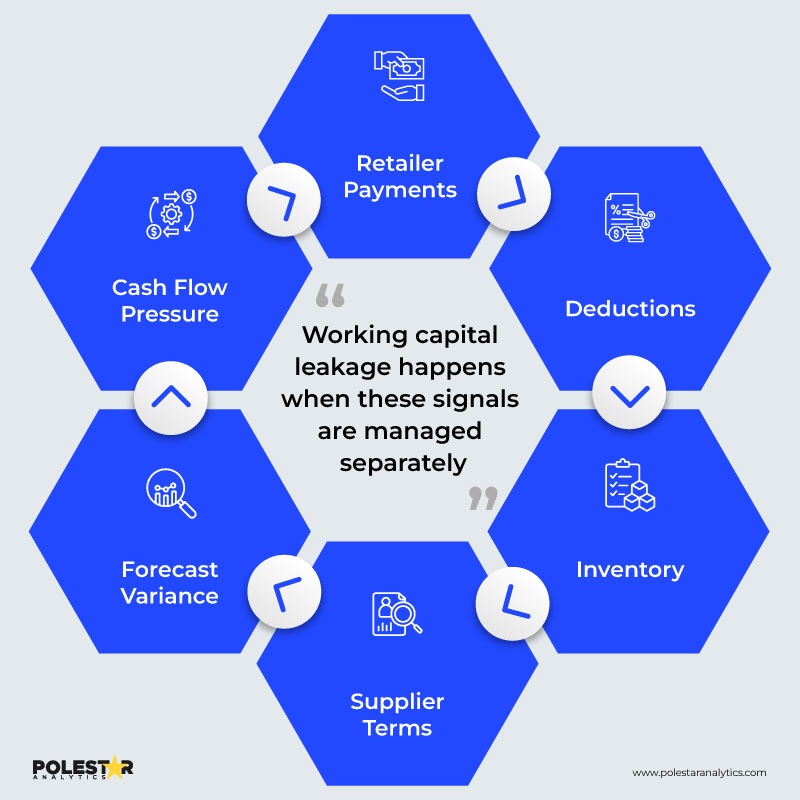
The issue is not that CPG companies lack working capital data. The issue is that data sits across ERP, AR, AP, inventory, sales, supply chain, treasury, and retailer systems without a shared decision layer. In CPG, working capital leakage is rarely caused by one big failure. It is caused by hundreds of small delays, mismatches, and disconnected decisions.
Regional teams are close to the market, and that proximity is genuinely valuable. But it pulls them toward local priorities: sales growth, distributor relationships, product availability, and short-term business targets.
Working capital, however, needs an enterprise-wide view.
A credit extension granted in one market can affect global cash flow. Excess inventory in one region may be invisible to another region facing demand. A supplier payment decision can create unnecessary cash pressure if it is not linked to treasury visibility. A deduction backlog may look like an operational nuisance, but its financial impact compounds across quarters.
| For example - Consider a global snacks manufacturer operating across a dozen markets, each negotiating its own distributor terms and managing its own deduction queue. No single region's numbers look alarming on their own. But when a GCC-based team consolidates the picture, a pattern emerges: three markets are extending credit terms beyond policy to protect volume, two are sitting on deduction backlogs untouched for over 90 days, and one is carrying six weeks of excess inventory from a missed promotional forecast. None of this shows up as a single failure. It shows up as a slow, compounding drag on enterprise cash that only becomes visible once the data is viewed together rather than market by market. |
Local teams see the market. Headquarters sees the financial outcome. The GCC, sitting between them, can become the intelligence layer that connects both. This is why many CPG companies are moving from region-led working capital follow-ups to GCC-supported working capital orchestration.
The scale of the GCC shift in CPG is now hard to ignore.
India is now a global hub for Retail and CPG GCCs, with over 70 companies employing more than 85,000 professionals. This number is expected to grow significantly, with over 25 new GCCs likely in the next two to three years.
What has changed is the mandate. India's role has evolved significantly from being a cost-efficient support base to becoming a strategic hub where global CPG companies are designing and deploying their AI operating models. Over 78% of newly established retail and CPG GCCs in India are prioritising AI, machine learning, and data engineering as core capabilities.
This matters for working capital optimization strategies for four reasons.
The GCC becomes more than a delivery center. It becomes the intelligence nerve center that supports cash, liquidity, and working capital decisions made by the CFO, treasury, and regional finance leaders.
This is where most thought leadership on GCCs glosses over reality. Building a working capital intelligence hub is not a platform decision. It is a multi-stage journey, and the early stages are harder than the later ones.
A practical sequence looks like this: consolidate the data, build reliable visibility, layer in diagnostics, then add predictive and prescriptive intelligence. Most CPG companies are somewhere between stage one and stage two. Pretending otherwise sets the wrong expectation internally.
The companies that have built this well treat the GCC as a long-term capability investment, not a quick-win automation project.
CapitalPulse is built for exactly this shift. It brings receivables, payables, inventory, and cash flow signals into a unified working capital view, giving GCC-led finance teams a single operating layer to monitor liquidity, detect trapped cash, diagnose root causes, and prioritize action.
Its capabilities include:
Moreover, CapitalPulse helps answer the questions traditional dashboards often miss: Where is cash getting trapped? Which accounts, SKUs, suppliers, or regions are driving the issue? What is the financial impact? What action should be prioritized first? How will a decision affect liquidity, service levels, and working capital performance?
For CPG companies building working capital hubs inside GCCs, CapitalPulse becomes the connective layer between data, intelligence, and execution. See it in action.
The signal from the broader market is clear. NWC days has deteriorated by 13.5% for small businesses and 19.8% for mid-size firms since 2015, while large companies have kept their numbers in check largely by stretching suppliers, a tactic with diminishing returns as payment-term regulations tighten in major markets. The companies that improve working capital performance over the next cycle will not be the ones with the most reports. They will be the ones that build the operating muscle to sense risk early, understand the drivers, and act before cash gets locked.
This is where GCCs can create disproportionate value, not by taking decisions away from finance leaders, but by giving them the connected intelligence those decisions have always needed.
Working capital pressure in CPG will keep rising. Retailers will get more demanding, supply chains will stay volatile, and finance leaders will face stronger liquidity expectations from boards and investors. Traditional reporting cannot solve this.
With $1.76 trillion of working capital opportunity still sitting on corporate balance sheets, the prize for getting this right is substantial.
For CPG companies, the GCC is not replacing the CFO, treasury, or regional finance teams. It is becoming the connective intelligence layer between them. Its role is to bring fragmented working capital signals together and help business teams prioritize action before cash gets trapped.
The future of working capital management in CPG will not be defined by who reports cash faster. It will be defined by who can release cash faster, and by how well finance, treasury, regional teams, and the GCC work as one connected system to make that happen.
Polestar Analytics helps CPG finance, and GCC leaders operationalize this shift through CapitalPulse, our AI-powered working capital management solution. Book a demo to see how CapitalPulse can help your GCC release trapped cash faster.
Start with the areas where cash is trapped but still controllable: overdue receivables, deduction backlogs, slow-moving inventory, and inconsistent supplier terms. The goal is not to launch a broad cash-cutting exercise. It is to identify which accounts, SKUs, suppliers, or markets are creating the biggest cash drag and prioritize action there first.
The answer is better segmentation, not blanket tightening. Some inventory buffers protect service levels. Some credit extensions protect strategic customer relationships. But others simply hide poor forecasting, weak deductions management, or outdated terms. CPG leaders need a shared view that separates necessary working capital from avoidable cash leakage.
The GCC should own visibility, diagnostics, prioritization, and follow-through tracking. It should not independently change payment terms, block customer credit, or release inventory. Its value is in giving CFOs, treasury, regional finance, sales, and supply chain leaders a clearer view of where action is needed and what the cash impact could be.
The first milestone is not predictive AI. It is a trusted working capital control tower that connects AR, AP, inventory, and cash flow signals across markets. Once leaders can see where cash is trapped, who owns the action, and what value is at stake, the GCC can move toward forecasting, scenario planning, and AI-assisted recommendations.
About Author
Content Architect
The goal is to turn data into information, and information into insights.
Related Blog
Ali Kidwai