Aishwarya SaranInformation Alchemist

Melden Sie sich an, um die neuesten Einblicke und Updates zu Technologie, KI & Datenanalyse, Data Science und Innovationen von Polestar Analytics zu erhalten.
 Fassen Sie diesen Blogbeitrag wie folgt zusammen:
| The updated Institutional Limited Partners Association (ILPA) Reporting Template adds fee and expense detail; fund teams need traceable classifications, reconciled offsets and reproducible allocations. |
TL;DR: The updated ILPA Reporting Template has applied since Q1 2026 to funds still investing and to new funds, with finer expense lines and separate internal chargebacks. The Performance Template applies only to funds launched on or after 1 January 2026. Supporting both reliably means capturing cost, offset, allocation and cash flow detail at source, and a closed-quarter replay is the fastest way to test whether your private equity fund data model holds.
The US Securities and Exchange Commission (SEC) adopted quarterly fee, expense and performance reporting rules for private funds in August 2023, and the Fifth Circuit vacated them in June 2024. ILPA carried the work forward voluntarily through its Quarterly Reporting Standards Initiative, which more than 300 organizations joined, and released the updated Reporting Template and a new Performance Template in January 2025.
Intent to adopt is high. In ILPA's 2025 consultation, nearly 70% of participants said they intended to adopt the updated Reporting Template, and in SS&C Intralinks' 2026 survey, 98% of limited partners (LPs) expected it to improve transparency. The harder part sits with general partners (GPs), 92% of whom rate their data as moderately organized or worse in Allvue's 2026 survey.
The updated disclosures require finer expense classifications and separate internal chargebacks. Supporting them reliably may require transaction-level attributes and links between fee receipts and offsets. That puts the problem squarely in the data architecture. And every quarter of spreadsheet workarounds makes it harder to unwind.
Two groups of funds are in scope: those still in their investment period during Q1 2026, and those that began operations on or after 1 January 2026, according to ILPA's combined template overview. Funds already past their investment period can stay on the 2016 version.
The Performance Template is narrower. It applies only to funds commencing operations on or after 1 January 2026, with first delivery four full fiscal quarters after operations begin, so the earliest reports cover data through 31 March 2027. Appetite is more uneven too: about 52% of consultation participants planned to adopt it, against every LP surveyed. And standardised reporting doesn't remove the need to assess strategy, vintage, cash-flow timing and valuation assumptions when comparing managers.
Keep three things apart: ILPA's recommendations, what your limited partnership agreement (LPA) and side letters require, and the practices a GP chooses. "ILPA reporting compliance" here means meeting whichever of those your LPs have made binding.
For a GP with funds on both sides of the cut-off, there is a choice. It may retain the 2016 template for eligible legacy funds or transition all funds to the updated format, using the transitional line ILPA provides for previously rolled-up amounts. Store the reporting version and effective period either way, so both approaches remain reproducible.
Exhibit 1: The 2016 template vs the updated ILPA Reporting Template
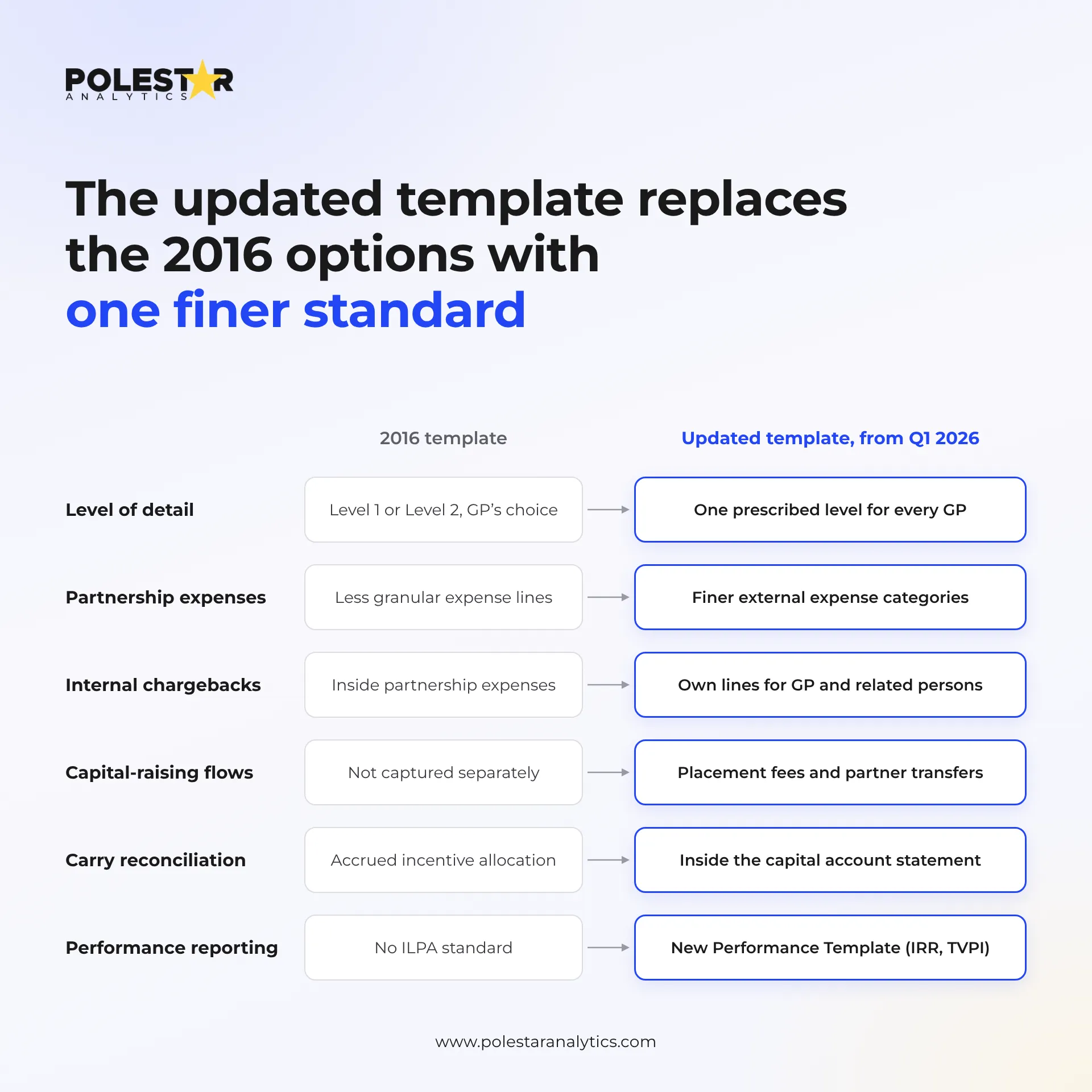
Exhibit 1 shows what moved. For a controller, the useful question is where each new detail comes from, because the ILPA Reporting Template changes draw on different source records:
Chargebacks are where mapping alone breaks down. Take a legal expense account. If it holds only third-party fees, it maps cleanly; if it also carries adviser chargebacks, it has to be classified from the invoice. Otherwise an LP who sees external legal costs fall has no way to tell whether the fund spent less or the work simply moved in-house. ILPA has also dropped its own related-person definitions, so apply the definitions under the accounting standards used in the fund's quarterly reporting, with classification judgments reviewed by finance and the auditor.
Exhibit 2: Where each expense gets its ILPA classification
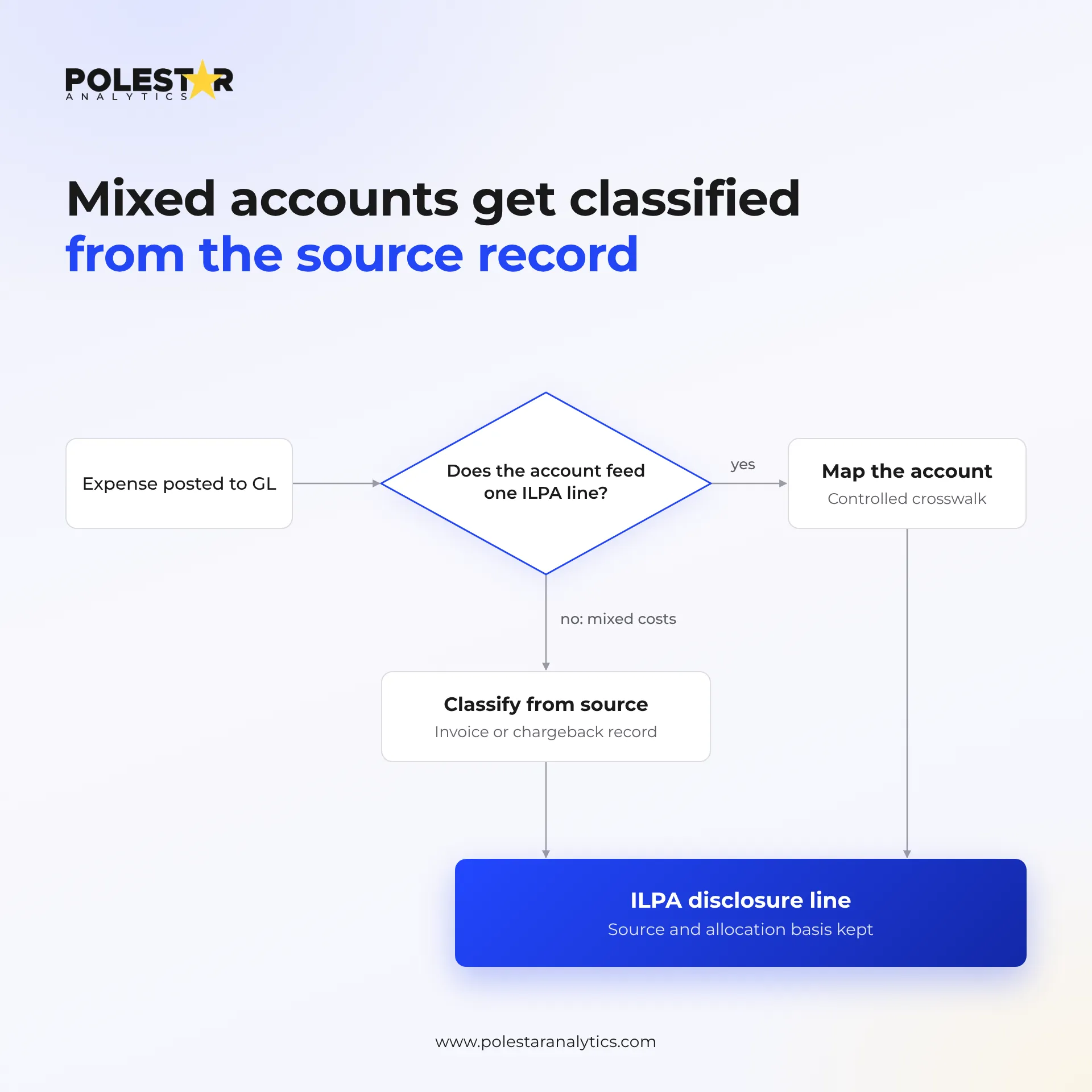
That decision repeats across every cost, receipt and cash flow, which is why the next question is which data to capture first.
Start with the elements below. They are priorities to assess rather than a complete reporting schema, and a model built around the chart of accounts usually holds only the first of them.
Methodology matters as much as the fields. Choose the one that matches how the GP calculates gross performance and calls capital: ILPA's Granular methodology suits GPs using fund-to-investor cash flows with itemised calls, while the Gross Up methodology accommodates fund-to-investment approaches and/or non-itemised calls. Settle the choice before tagging starts.<
On paper, these elements don't sound like much. Most fund data models still miss them because they were built to close the books, and three patterns explain most of the gap.
Some fixes need new tooling and some don't, depending on your systems, but the order is the same. Sort every template line from your last close into three groups (direct GL mappings, lines that need transaction attributes, and lines governed by fund-specific rules), then build as follows.
Exhibit 3: The ledger-to-LP readiness model
| Layer | What good looks like | Owner |
|---|---|---|
| Map | Controlled crosswalk wherever one account feeds one ILPA line | Fund accounting |
| Classify at source | Payee, related-party and facility attributes captured from invoices and schedules | Controller and administrator |
| Link and allocate | Receipts tied to offsets; allocations stored with basis, overrides and master-feeder source | Fund finance |
| Govern and automate | Named owner per field, tie-out validation, scheduled transfers | Chief financial officer (CFO), fund operations and IT |
In private equity data management, most of the cost sits in the first three layers and is finance time, because the hard calls are accounting judgments; fund reporting automation pays back in the fourth. Agree early who supplies each reconciliation, who reviews exceptions and who signs off the final disclosure, particularly where the administrator prepares the reporting.
In Polestar Analytics' work with fund finance teams, two lessons tend to hold across these layers. The first two are accounting work, and they move fastest when fund accounting and the administrator agree definitions before anyone builds. The last two are where tooling earns its place: a planning model that holds one fund hierarchy, a waterfall with a full audit trail and role-based close checklists makes ownership visible rather than assumed. That pattern is built into our Private Equity Planning App on Anaplan and Jedox.
Replay a closed quarter, and include at least one legacy fund. A plan only counts once it survives real numbers: the administrator should be able to trace an expense to its source record, the controller to reproduce the offset roll-forward, and IR to explain a material movement in one LP's statement without rebuilding a working paper.
Wherever the replay breaks, the fix is usually specific: better source capture for a missing payee type, a reproducible allocation for an unexplained LP amount, and private equity data integration for repeated file handling.
Integration gaps are often the slowest to close, especially where portfolio company data lacks consistent identifiers. On one private equity engagement, the fix was key-generation and mapping logic applied before data reached the planning model, which cut manual integration effort by 97%. The broader point holds whatever the tooling: fix identity and mapping upstream, and reconciliation downstream gets much lighter.
The numbers behind each disclosure. The template gives LPs far more detail, and that detail is only useful if someone tests it. For operational due diligence and reporting teams, four patterns are worth a follow-up question.
| What the LP sees | Useful follow-up question |
|---|---|
| External expenses fall while adviser chargebacks rise | Has total spend fallen, or has the delivery model moved in-house? |
| Fee receipts and offsets appear in different periods | Can the GP walk through the opening balance, eligible receipts, offsets applied and closing balance? |
| Managers report different gross-to-net spreads | Which methodology and cash-flow basis underpin the figures, and what else explains the gross-to-net difference? |
| An LP's allocation moves materially | Can the GP reproduce the allocation and show the basis applied? |
How far the Performance Template spreads is still open. It could become a fundraising default within a vintage or two, or remain a request from the largest LPs. The test underneath will hold either way: a completed template is only useful if the GP can reproduce every figure in it and the LP can understand and challenge them. GPs that can substantiate the costs allocated to investors, and explain how those costs affect reported returns, will spend far less time defending their numbers.
The Private Equity Planning App keeps fund hierarchies, waterfalls and carry in one auditable model.
See howFind out where your expense, offset and allocation data breaks before an LP finds it.
Book Your Data Readiness AssessmentUsually not. You may be able to meet the reporting needs through existing accounting systems and controlled schedules. A governed data layer can help where information is fragmented across systems, on Databricks, Microsoft Fabric, Snowflake or Azure, and where one is missing, Foundation Studio is the accelerator we use to build it.
Start with one fund and one closed quarter. A short discovery exercise should establish which template lines map directly, which need source attributes, and where reconciliations depend on people rather than records. Our discovery workshop covers this in one to two weeks and ends in a prioritised roadmap.
Yes, once the data is classified. Automation works best on governed data with validation on every tie-out, which is how the Private Equity Planning App handles fund economics.
If the fund launched on or after 1 January 2026, choose the methodology first and start tagging cash flows now. Granular or Gross Up determines how capital calls for fees and expenses are treated, and every call and distribution then needs an effective date and transaction type. History that isn't tagged at the time usually has to be rebuilt by hand.
Über den Autor
Information Alchemist
Without data you are just another person, with an opinion.
Verwandter Blog