
Fassen Sie diesen Blogbeitrag wie folgt zusammen:
| Databricks Mosaic AI is a governed platform layer for building, serving, and monitoring production AI agents, connecting your Delta Lake data to LLMs. |
TL;DR
Most enterprise AI fails not because the model is wrong, but because teams can't prove it's right. Mosaic AI packages the unglamorous production layer, retrieval, serving, evaluation, observability, and governance, into one platform that sits on your existing Databricks data. If your data already lives on Delta Lake and Unity Catalog and you're past the prototype stage, it gets you to production without stalling on the plumbing, with the trade-off being tighter coupling to the Databricks ecosystem.
The launch of the Data + AI Summit by Databricks in June 2026 was noteworthy for its success: over 30,000 people arrived in person at San Francisco's Moscone Center with representatives from more than 150 nations. But the number underneath that one matters more. Over 20,000 organizations now run on Databricks, including 70% of the Fortune 500.
Thus, this is not a niche application but rather an important technology used by many organizations. Many businesses are not merely testing AI but rather using it in operational mode and achieving practical results. And it is at this point that GenAI implementations often fail. Mosaic AI is Databricks' answer. If you've ever watched a promising prototype crumble the moment it hit messy enterprise data and an audit requirement, keep reading.
Mosaic AI is included in the Databricks Data Intelligence platform which would allow professionals to develop, create and keep the AI and machine learning solutions. Initially, Mosaic AI was introduced after the acquisition of the company MosaicML by Databricks in 2023 and then transformed into a larger component of the AI platform.
Mosaic AI is not regarded as a library that is installed simply. It represents a platform layer that connects enterprise data to Delta Lake and Unity Catalog in addition to LLMs and AI applications in an environment where governance is integrated into the entire operation. If your data is already on Databricks, that integration changes how you build.
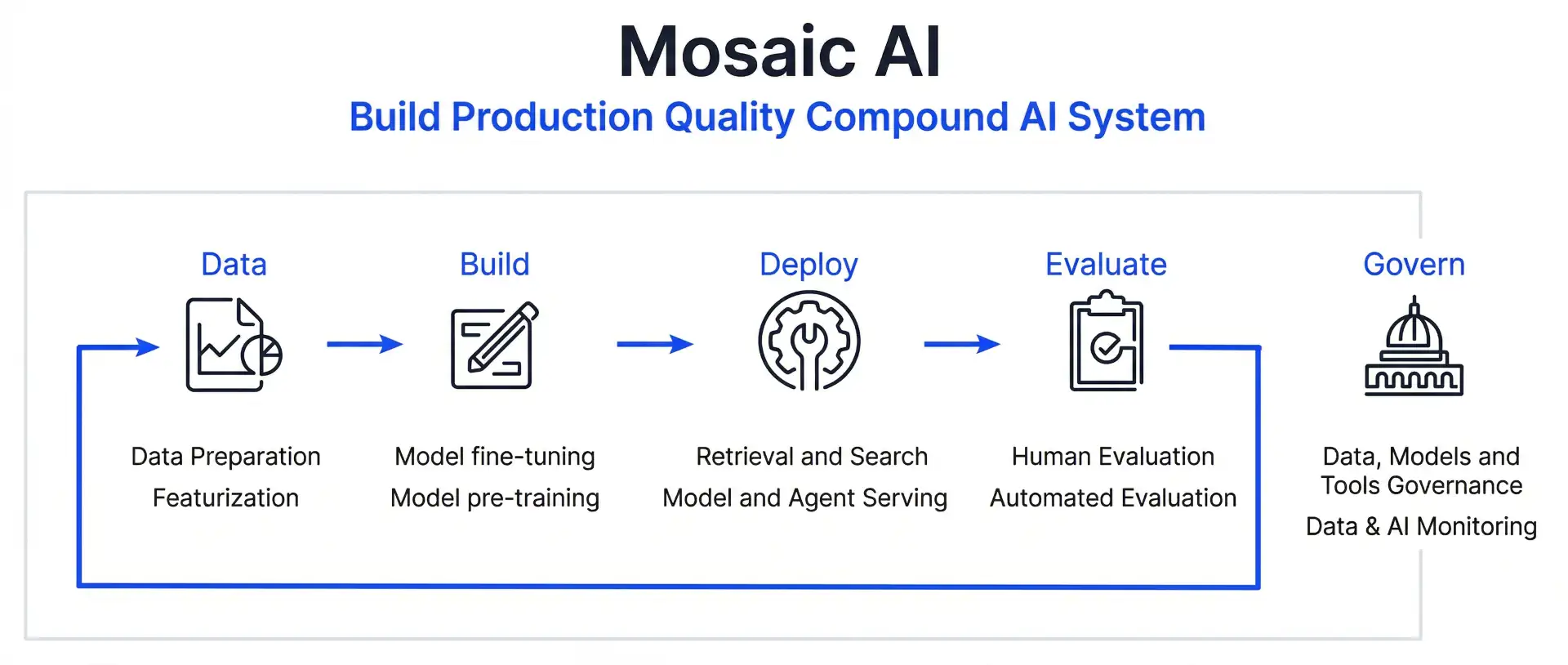
Once you get past the marketing, Mosaic AI is a handful of pieces that hand work back and forth as an agent does its job.
- Vector Search does the retrieval. It indexes and embeds your documents, structured stuff and the messy unstructured kind alike, so that when a query comes in the agent can pull the context that's actually relevant. Every RAG system lives or dies on this. Databricks rebuilt the whole thing at the 2025 summit, splitting compute from storage, and the Storage-Optimized AI Search that came out of it scales to billions of vectors at 7x lower cost. A drop like that is the difference between semantic search you run across your entire data estate and semantic search finance quietly kills next quarter.
- Model Serving is where the models actually run, whether you're using a prebuilt foundation model or something you fine-tuned yourself and registered in Unity Catalog. It now takes more than 250,000 queries per second, and Databricks built its own in-house inference engine that comes in up to 1.5x faster than a properly tuned vLLM-v1 on the workloads most people run.
- Then there's the AI Gateway, which acts as the control point every model call and tool call passes through. Rate limiting, payload logging, PII and safety guardrails, and automatic failover between providers all live here, so a single vendor going down doesn't surface as a broken response on some customer's screen.
- MLflow 3.0 handles the lifecycle and the watching-it-in-production side. It was rebuilt for generative AI, and one genuinely useful bit is that it can trace and monitor agents running outside Databricks entirely, whether that's AWS, GCP, or your own on-prem boxes. Its prompt registry also means your prompts get versioned like code rather than living as loose strings in somebody's notebook.
Individually, these pieces are useful. The harder question is how you get them working together without hand-wiring every connection yourself. That's the gap Databricks set out to close next.
 Source: Databricks
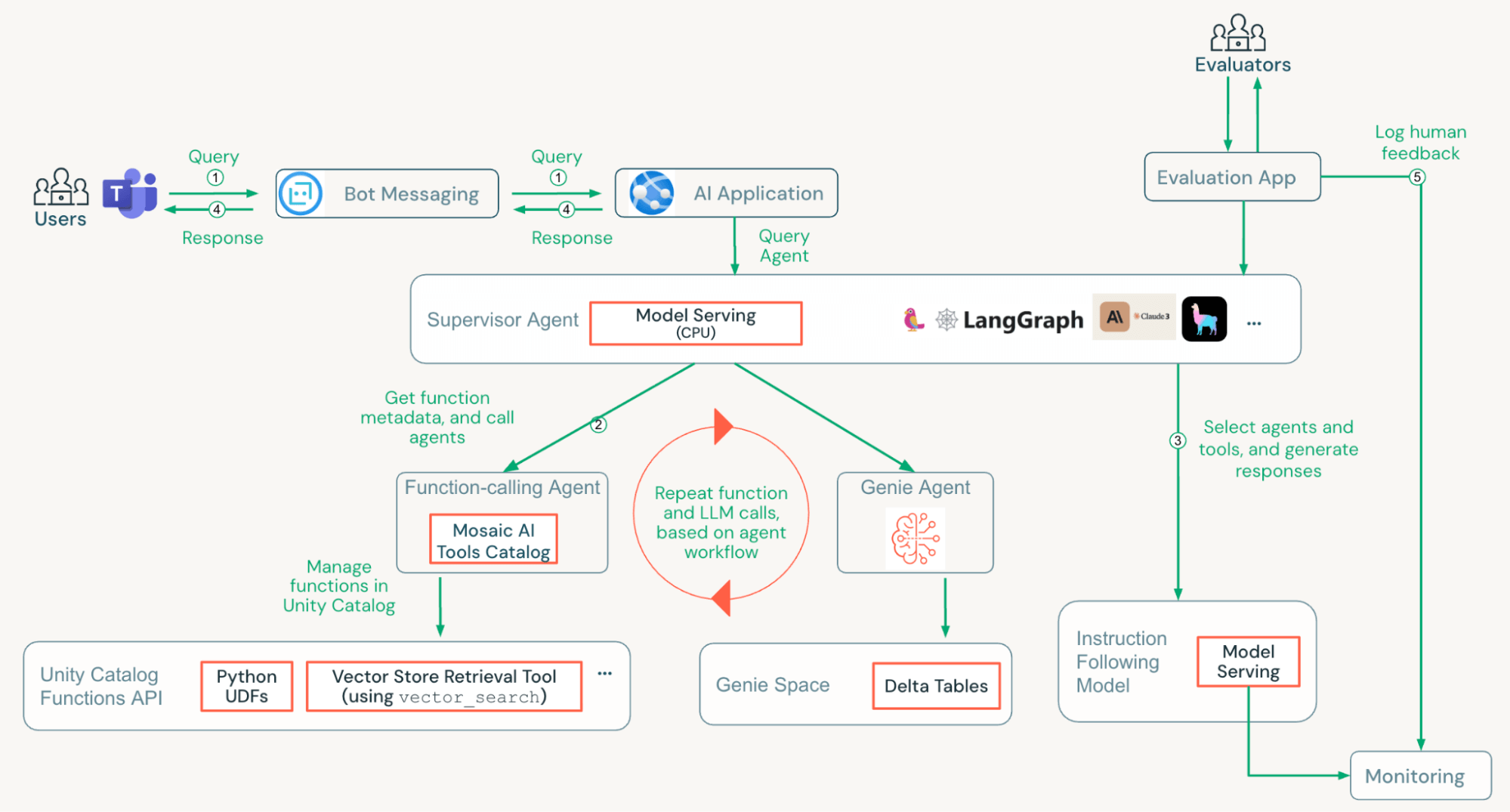
The product that received the biggest reaction is Agent Bricks, which became part of the foundation of Databricks' agent story by 2026. The concept is nearly playful: explain your intentions for the agent, connect your business data, and Agent Bricks does the rest.
There's real machinery under that sentence. Agent Bricks leans on Databricks' agentic research to auto-generate task-specific evaluations and LLM judges, then spins up synthetic data resembling your own to tune the thing. So the eternal headache of production agents, knowing whether it's genuinely good enough to ship, gets systematized instead of left to gut feel and expensive trial-and-error. It's tuned for common enterprise patterns: structured information extraction, reliable knowledge assistance, custom text transformation, and multi-agent systems.
 Source: Databricks
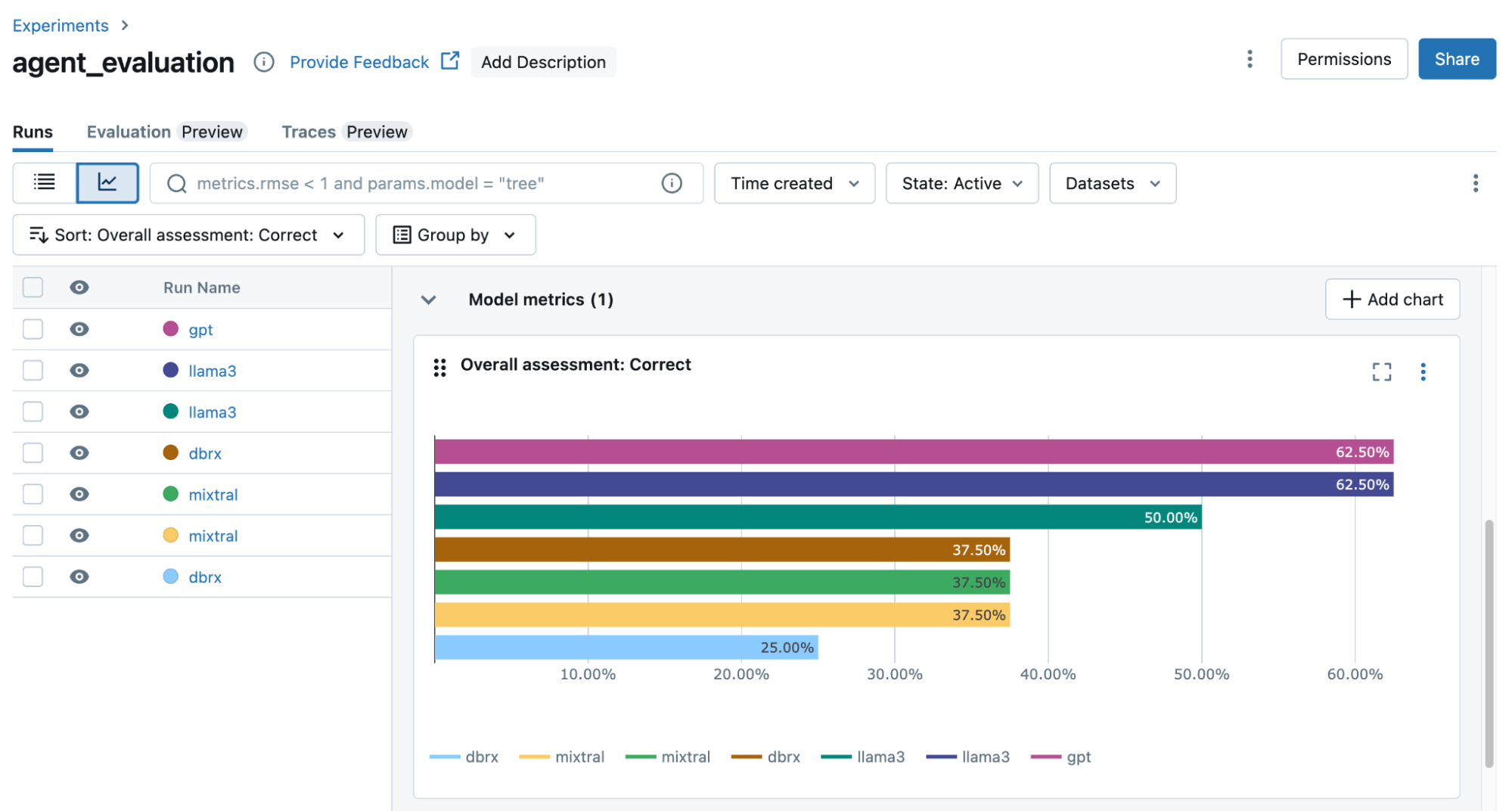
And here's the counterintuitive bit. Most enterprise AI failures aren't the model picking a wrong answer. They're evaluation problems, the plain absence of a trustworthy way to measure whether an agent is ready for production. Agent Bricks bets that automating that measurement matters more than squeezing one more point of accuracy out of the base model.
One thing worth flagging before governance: not everyone building with AI wants to open a Python file. AI Functions let analysts call generative AI straight from SQL, and in 2025 those functions became up to 3x faster and 4x lower cost than other vendors on large-scale workloads, with multi-modal functions like ai_parse_document pulling structured information out of messy files. It's a quiet change that widens who gets to build on the platform.
 Source: Databricks
Governance is the reason a lot of teams pick Mosaic AI over stitching open-source tools together. Back in March 2025 Databricks rolled out end-to-end governance across an agent's models, tools, and data, through AI Gateway paired with Unity Catalog, so everything an agent touches runs down an auditable path. And it went with open standards instead of walling things off: Anthropic's Model Context Protocol is baked in now, with Databricks-hosted MCP servers exposing Unity Catalog functions, Genie, and AI Search as governed tools an agent can safely call. That means the governance doesn't trap you in a proprietary tool-calling format you'll regret later.
Mosaic AI is the best option if your data base is already in Databricks, if you need a compliant governance that your compliance team can agree to and if you want to deploy the project without necessarily having to construct the operations layer on your own. Their integrated stack eliminates much of the infrastructure effort that could take you weeks to accomplish otherwise.
The honest trade-off is coupling. Plenty of teams start on a framework like LangChain for a fast prototype and move to Mosaic AI once they get serious about production. That migration is doable, but it costs time, so if you already know you're building for production on Databricks, starting on the platform stack usually pays off. The flip side: the tight integration creates dependencies that make mixing tools or switching platforms harder. That's a real consideration, not a footnote.
Curious how Mosaic AI plays out in a real industry setting? See how it powers governed, production-grade AI in retail.
Mosaic AI's real contribution isn't any single feature. It's that Databricks took the unglamorous production layer, retrieval, serving, evaluation, observability, governance, and put it in one place, so teams can spend their energy on the agent's actual job instead of on wiring. The releases through 2025 and into 2026 all point the same way, and if your data already lives in the Databricks ecosystem and you're past the demo stage, Mosaic AI is built to get you to production without stalling on the plumbing.
So here's the question worth putting to your own team. Is your AI stalling because the model is wrong, or because you can't prove it's right? Mosaic AI is built almost entirely for that second problem.
Key Takeaways
- Mosaic AI is a platform layer, not a library. It connects your governed Databricks data to LLMs through built-in workflows rather than bolting governance on at the end.
- Agent Bricks tackles the real failure point in enterprise AI, evaluation, by auto-generating task-specific evals, LLM judges, and synthetic tuning data, so production readiness is measured instead of guessed.
- Governance is the differentiator: end-to-end auditable paths through AI Gateway and Unity Catalog, plus open standards like Anthropic's MCP rather than proprietary lock-in.
It is used to build, train, deploy, and monitor production-grade AI models and agents. It connects enterprise data on Delta Lake and Unity Catalog to LLMs through governed, auditable workflows.
Mosaic AI is an integrated platform layer with governance built in, not a library you assemble yourself. Many teams prototype on LangChain, then move to Mosaic AI for production.
Governance runs through AI Gateway paired with Unity Catalog, giving every model, tool, and data source an agent touches an auditable path. It also uses open standards like Anthropic's MCP rather than proprietary lock-in.