


 Nitin KumarData Narrator
Melden Sie sich an, um die neuesten Einblicke und Updates zu Technologie, KI & Datenanalyse, Data Science und Innovationen von Polestar Analytics zu erhalten.
 Fassen Sie diesen Blogbeitrag wie folgt zusammen:
Agentic commerce in retail uses autonomous AI agents to discover, negotiate and execute purchases end-to-end, shifting shopping from human browsing to automated machine execution.
TL;DR
Agentic commerce shifts retail from human-driven UI browsing to machine-driven API execution. Bain & Company estimates this shift could generate $300-500 billion in US sales by 2030, 15-25% of all e-commerce. As consumers delegate buying decisions to autonomous AI agents, enterprise success depends on adapting to machine protocols (UCP, AP2), implementing Agent Engine Optimization (AEO) and ensuring operational resilience over visual persuasion.
Bain & Company projects that agentic commerce could reach $300 to $500 billion in US sales by 2030, 15% to 25% of all e-commerce. That number is the clearest sign yet that retail is heading into its next structural break.
In the mid-1990s, the first wave of e-commerce did something wonderfully basic: it took the printed paper catalog, put it on a glowing screen, and asked human beings to push virtual buttons. For thirty years, we perfected this ritual, sharper layouts, louder "Buy Now" buttons, but the same human eye doing the browsing.
Agentic commerce represents a structural inflection point. If e-commerce digitized the store, agentic commerce digitizes the shopper.
We are moving away from tool-based commerce, where humans actively filter, scroll, compare, and click through dozens of browser tabs, toward outcome-based execution. In this framework, the human consumer shifts from a tiny manager of shopping carts to a big-picture setter of personal needs. The consumer no longer searches for "nut-free low-sugar protein bars under $30." They simply state an outcome to the AI agent: "Keep my pantry stocked with healthy, allergen-safe snacks for the kids, within a $150 weekly budget."
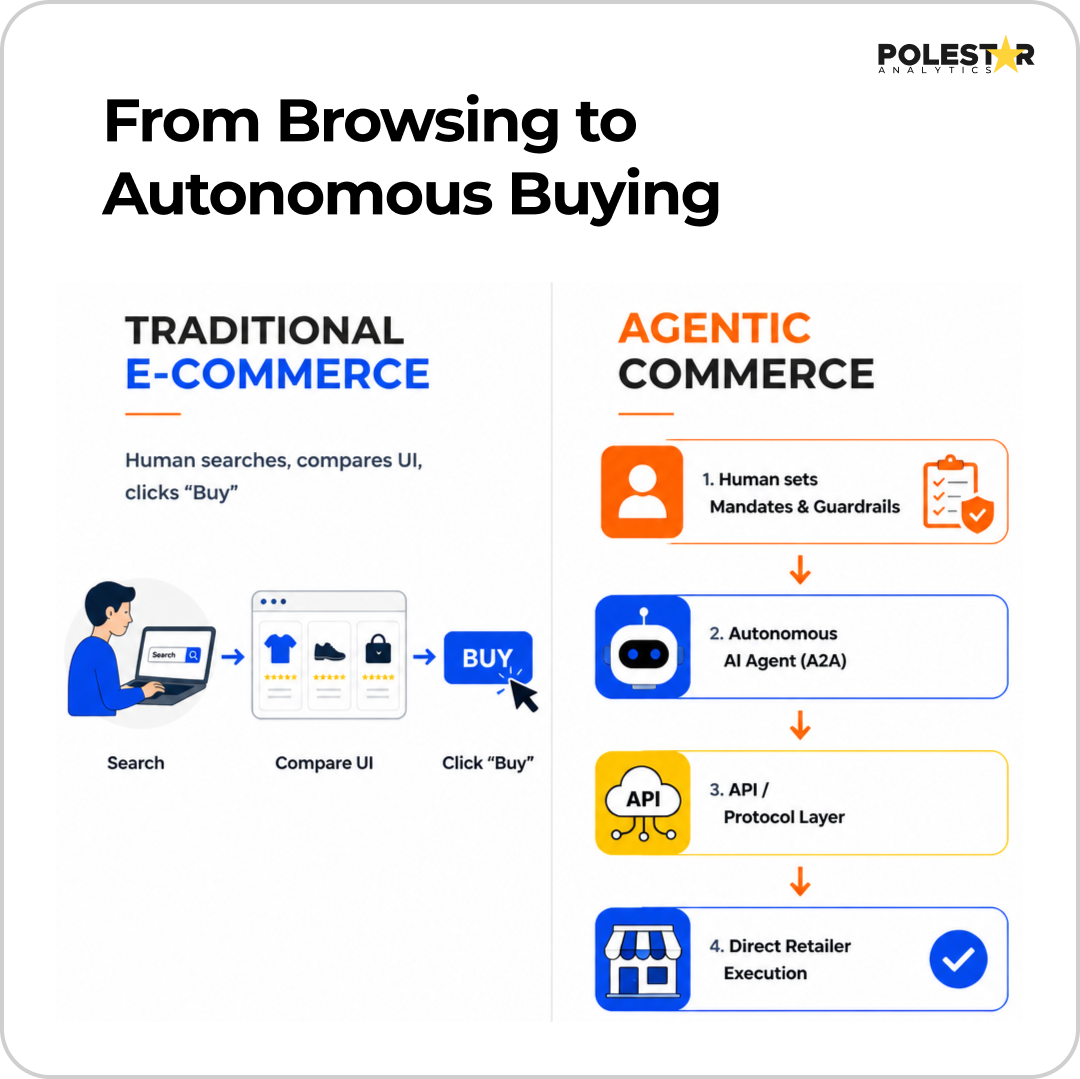
Gartner says that by 2026, 40% of enterprise applications will include task-specific AI agents, compared to less than 5% in 2025. Gartner also says that by 2028, one in three user experiences will move from applications to agentic front ends.
When software stops merely assisting and begins autonomously transacting, the fundamental rules of consumer engagement, brand equity, and technology stacks break down.
To understand how agentic commerce works in retail, the change from User Experience (UX) to Agent Experience (AX) should be looked at.
The beautiful high-res banners of a million-dollar website redesign are just noise for an AI agent. The agent doesn't care about the hero images and cool typography. It's only interested in things like schema, API latency, real-time stock checks, and policies.
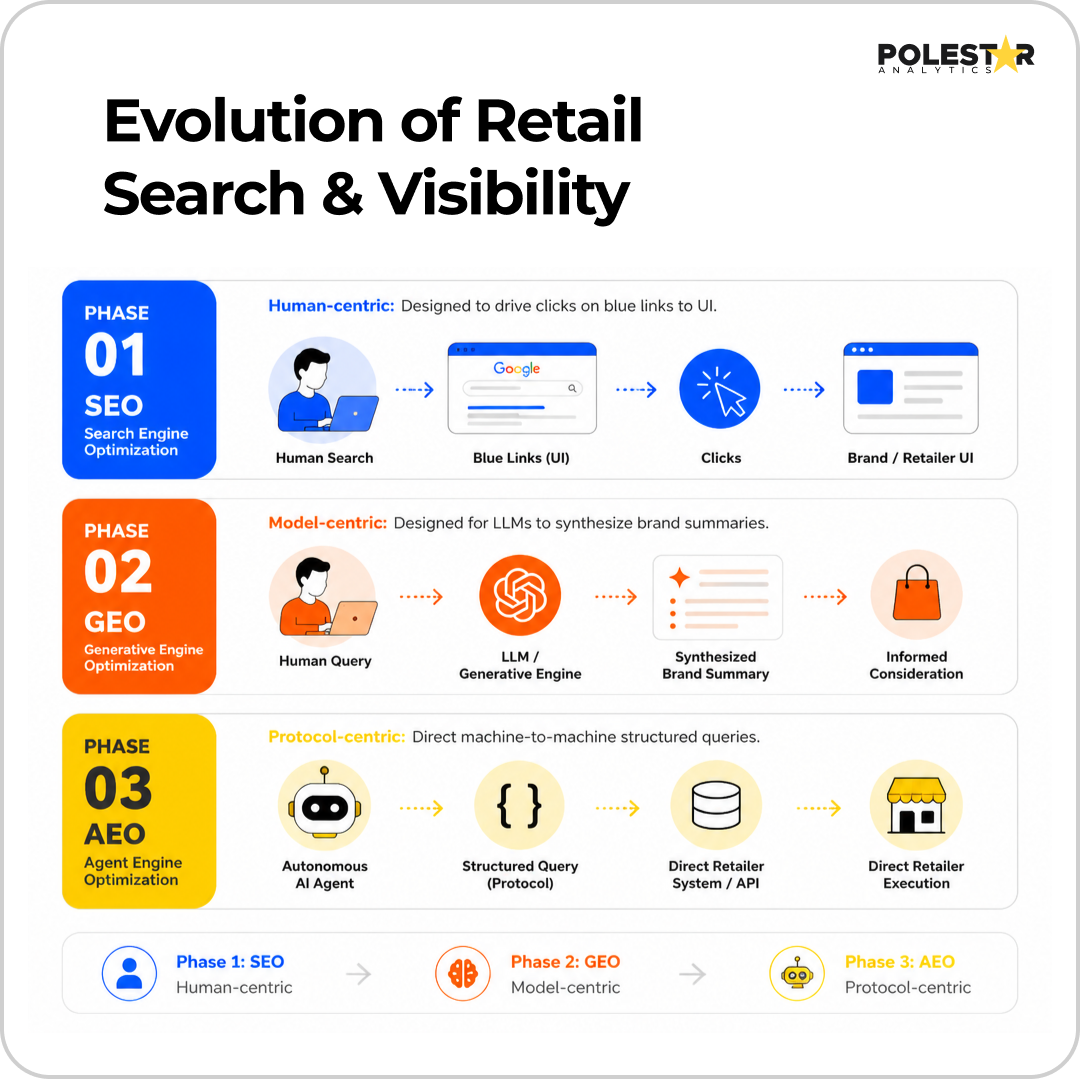
Autonomous commerce cannot function without standardized machine-to-machine communication protocols. Much like HTTP laid the open foundation for the World Wide Web, a new stack of open protocols is emerging to govern agentic transactions:
Deep-Dive Video Discussion
To explore how enterprise leaders view this paradigm shift, watch this Bodhi Session hosted by Polestar Analytics, featuring Indrajit Mitra (AI & Data Science Leader, Polestar Analytics) and Satya A. (Technology Evangelist and Enterprise Cloud Architect at Google).
Key takeaway from the discussion: Polestar Analytics highlights how the retail journey is unbundling, moving away from closed storefront domains toward open, machine-readable API ecosystems where speed, accuracy and data architecture dictate market survival.
A fundamental concern for CXOs is the threat of disintermediation. When an AI agent makes buying decisions in the background, does the merchant lose direct contact with the customer?
Bain & Company's research (cited above) also warns that full Agent-to-Agent (A2A) commerce may bypass or shortcut retail websites entirely. If shopping agents negotiate directly with merchant endpoints to secure pricing, delivery windows or return terms, then traditional multi-brand retailers risk being reduced to mere commoditized drop-shippers or fulfillment pipes.
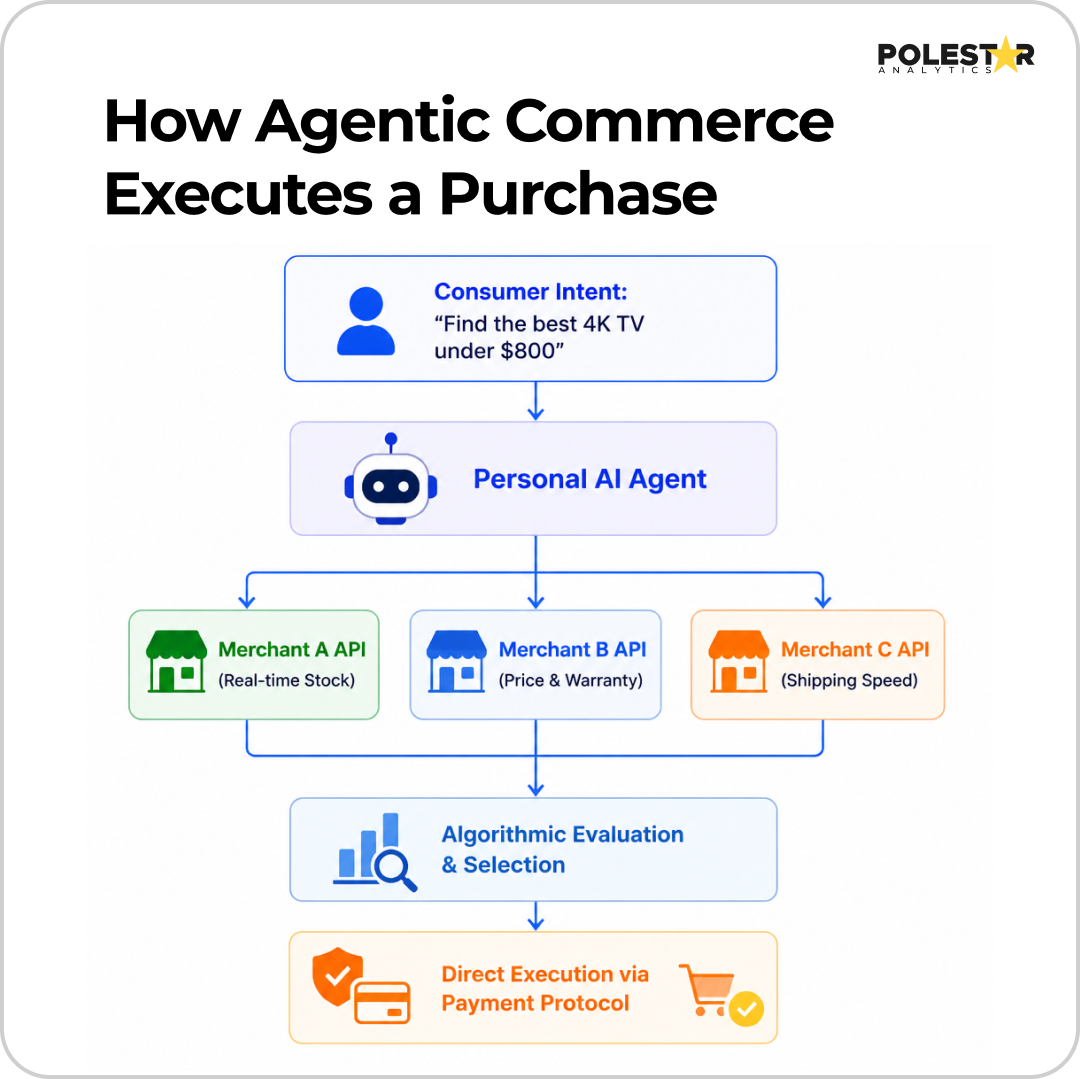
As BCG points out, shoppers who arrive via AI agents are already 10% more engaged, spend 32% more time on-site and bounce 27% less than traditional visitors, and retailer power in this ecosystem splits sharply based on business model:
Traditional performance marketing was designed to trigger emotional human responses: a flashing banner ad, a limited-time countdown timer, or a retargeted social media ad. But you cannot serve a retargeting ad banner to an AI agent.
Marketing in the age of agentic commerce in retail splits into two distinct, highly strategic disciplines:
| 1. Agent Engine Optimization (AEO) — Bottom of Funnel | 2. Top-of-Funnel Brand Equity |
|---|---|
| Clean, structured metadata and schema markup. | Deep emotional resonance with human consumers. |
| High-availability API infrastructure. | Storytelling that establishes brand mandates. |
| Algorithmic trust verification & stock feeds. | Example: "Buy me running shoes... but make sure they're Nike." |
As Gartner highlights in its Marketing Predictions, 60% of brands will use agentic AI to deliver streamlined one-to-one interactions by 2028, marking the end of traditional channel-based marketing. If a brand fails to build strong top-of-funnel equity with human beings, it becomes a generic commodity traded by algorithms strictly on price and delivery speed.
Allowing software to make financial transactions raises immediate risk concerns for C-suite executives: how do we trust an AI agent to spend money, and who is liable when an error occurs?
The industry is shifting from verifying user identity (e.g., passwords, SMS OTPs) to verifying agent authority and cryptographic mandates.
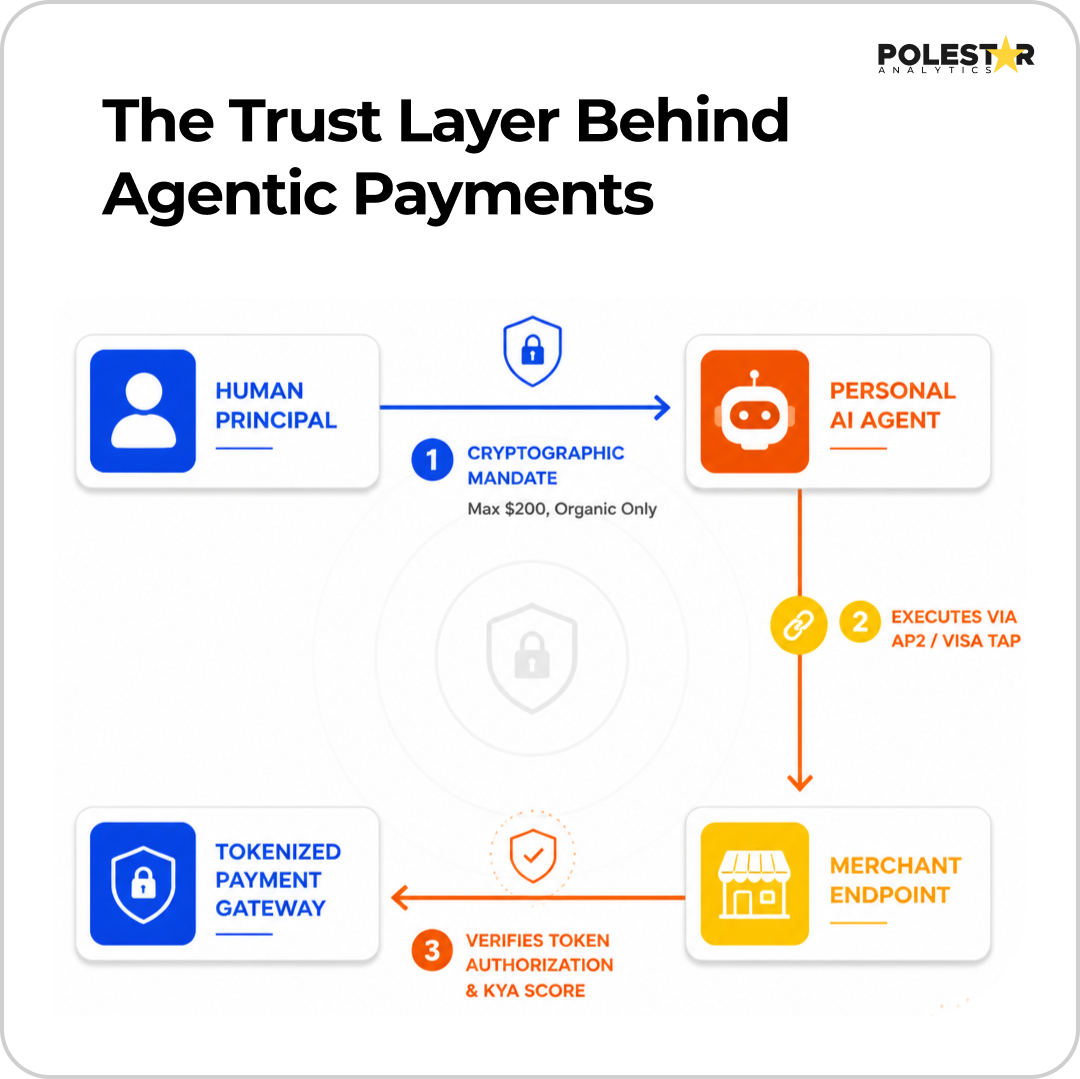
Just as financial institutions enforce Know Your Customer (KYC) standards, agentic ecosystems are instituting Know Your Agent (KYA) validation. AI agents earn cryptographic reputation scores based on transaction reliability, correct authorization and rule compliance:
If an agent operates within a signed cryptographic mandate, liability remains with the user or platform provider. If an agent strays beyond its mandate, real-time risk engines built into payment protocols automatically revoke transaction tokens.
To capture value in this evolving ecosystem, enterprise leaders must deploy modern agentic commerce services and transform legacy data architectures. Polestar Analytics recommends a phased approach:
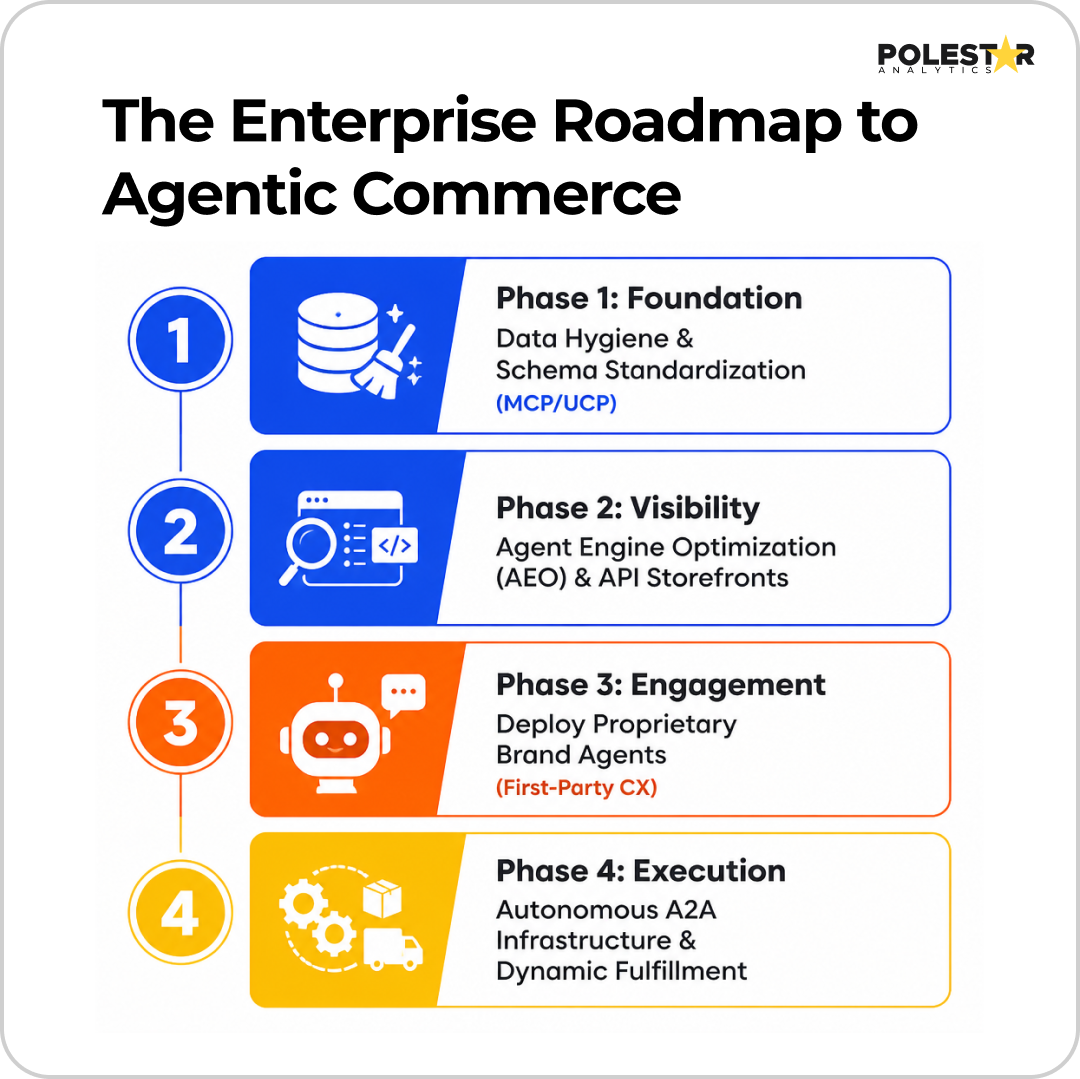
Before deploying agents, enterprise data must be organized and kept in sync at the same time. Systems must support standards such as the Model Context Protocol (MCP) so that third-party agents can instantly request product details, warranty conditions and stock numbers. Enterprise analytics partners such as Polestar Analytics help CPG brands and retailers build real-time data pipelines that feed these machine-readable channels.
To prevent complete disintermediation, brands must deploy their own specialized conversational agents across digital storefronts and kiosks. Utilizing enterprise frameworks such as Google's Gemini Enterprise for Customer Experience (GCX), retailers can provide deep reasoning capabilities that handle complex, long-tail consumer requests (e.g., "Help me select all materials, tools, and fixtures required to remodel a 50-sq-ft bathroom under $4,000").
Traditional metrics like Click-Through Rate (CTR) and bounce rate are irrelevant when interacting with autonomous agents. Modern retail dashboards must measure:
No, profitability shifts from impulse buys to algorithmic bundling, for example, an agent auto-adding a warranty when it purchases an appliance. This depends on retailers having clean, real-time product data in place ahead of agentic rollouts.
Liability follows the signed cryptographic mandate: transactions within the user's authorized limits are the user's responsibility, while violations of those limits shift liability to the payment platform under emerging TAP and AP2 standards.
Both. Retailers need APIs optimized for third-party ecosystems like Google and OpenAI, plus their own brand agents for high-touch service. Neither strategy works without a solid underlying data layer in place first.
Über den Autor
Data Narrator
The best ideas don't arrive. They wait for you to be ready.
Verwandter Blog
 Ali Kidwai
Nitin Kumar
Ali Kidwai
Nitin Kumar