
Summarize this blog post with:
One statistic illustrates just how significant the challenge has become. In 2025, enterprises spent roughly $684 billion on AI, and by year end more than $547 billion of it had produced no measurable business value according to research. The platforms were capable. The budgets were approved. What went missing was the groundwork.
That gap is exactly where a Databricks data platform implementation lives or dies. Technology has a low failure rate, but plans associated with technologies tend to have a high failure rate. Therefore, prior to spinning up clusters, one must treat the implementation process as a strategy issue first and a technology/engineering issue second.
The failure rates are not subtle. RAND's analysis of more than 2,400 enterprise AI initiatives found that around 80% never deliver their intended value, and Gartner has forecast that 60% of AI projects will be abandoned through 2026 because the underlying data simply is not ready. Poor data quality on its own costs the average organisation close to $12.9 million a year.
They are almost never about the model or the compute. There are three other foundational issues related to data that arise when implementing AI: (1) the presence of messy data, (2) weak data governance and (3) no existing data quality manager. As per a 2026 poll, the biggest hurdle to scaling AI continues to be Data Governance,62% of those polled agreed that Data Governance would be an impeding factor. If the original implementation plan of Databricks’ initial data platform does not include Data Governance and data quality as part of the plan at the outset, the platform's overall strategic objectives cannot be achieved.
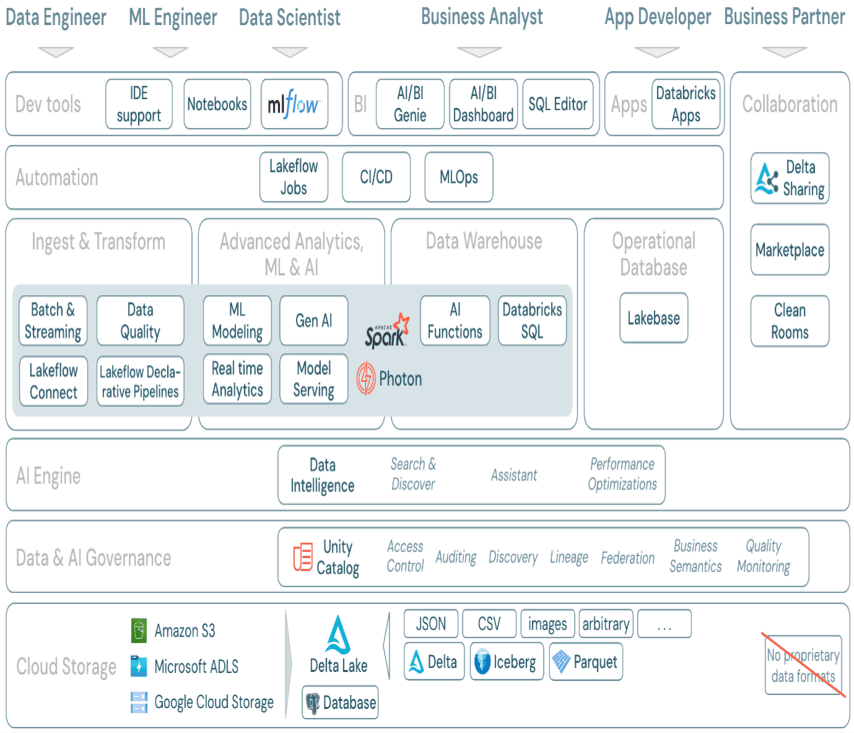
It helps to know what you are actually building on. The Databricks Data Intelligence Platform has been designed as a Databrick Lakehouse, i.e., a single layer designed to be used as both inexpensive, open storage (data lake) and providing the level of reliability and speed that users require to perform operational warehouse functions.
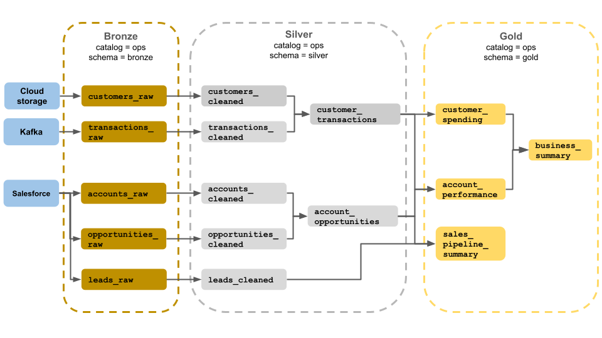
In practice, the Databricks data intelligence platform architecture rests on a few pillars. Delta Lake gives you reliable tables. Unity Catalog handles governance and lineage across every workspace. And a Medallion structure moves data through Bronze (raw), Silver (cleaned), and Gold (business-ready) layers so teams stop arguing about whose numbers are correct.
The architecture decisions made in an early stage are the ones that will impact you for many years to come Adoption demonstrates this strongly: Databricks has over 60% of Fortune 500 companies using Databricks. A 2026 BARC survey shows Databricks scored 8.6/10 on performance for production deployments. Analytics, BI and AI will all be leveraging the same trusted source of information if the architecture is correct.
 Source: Databricks
If you want a Databricks implementation step-by-step guide that survives contact with reality, keep it to a handful of disciplined phases instead of a sprawling checklist.
- Define the outcome first. Pick two or three business questions worth answering and write down what success looks like. The projects that succeed almost always nail this before touching the tooling.
- Assess and prepare your data. Audit sources, quality, and ownership before migrating anything. This is the step most teams skip and later regret.
- Lay the architecture and governance. Stand up Unity Catalog, naming conventions, and access controls on the first workspace, not the fifth.
- Migrate one workload, then iterate. Move a single high-value pipeline, prove it works, and carry the lessons into the next one.
- Operationalise and optimise. Add monitoring, cost controls, and automation so the platform stays healthy as it grows.
Treat this Databricks implementation guide as a loop, not a launch. The first workload teaches you more than any planning document, so the goal is to learn fast and repeat, not to boil the ocean in release one.
 Source: Databricks
Cost is where good intentions meet the monthly invoice. An important point that is not often mentioned during presentations is that the Databricks bill consists of two layers, the cloud infrastructure and the DBUs that run on top of it and there are continuous comments made by reviewers which indicate that the amount being spent by customers can be very unpredictable when the workloads are left unchecked. The most common and typically most costly error is to run regularly scheduled production jobs on All-Purpose compute, which can incur costs three to four times greater than Jobs Compute to run a similar job.
So Databricks implementation cost is less about the sticker price and more about discipline. Set auto-termination and autoscaling as defaults. Match each workload to the right data engineering compute type. Label everything to be able to identify where the money went. This activity is not an uncommon one but it will clearly define the difference between a platform that actually pays for itself and a platform that will continue leaking budget for three years without notice.
Plenty of teams can stand up a workspace. Far fewer can model a lakehouse, design governance, and dodge the traps that turn into painful migrations later. That is the real case for a Databricks data implementation partner: not extra hands, but the scar tissue of having done this before.
A good partner earns its keep in the unglamorous decisions, the data model, the security design, the cost guardrails set before sprawl begins. When you evaluate Databricks implementation services, push past certifications to specifics. Can they show a comparable build? Name the governance model they would use? Explain how they would control cost from week one? If the answers stay vague, keep looking. The point of bringing in help is to compress the learning curve, not to hand over ownership of your ai data strategy.
This is where Polestar Analytics fits. As a Databricks implementation partner, Polestar Analytics brings exactly the kind of hard-won judgment these questions are meant to surface: reference builds you can actually look at, a clear point of view on Unity Catalog and governance, and cost controls baked in from week one rather than bolted on after the bill arrives. The teams that work with Polestar keep ownership of their data strategy and gain a partner who has already walked the path they are about to take.
A concrete Databricks implementation example makes the payoff tangible. Bicycle maker Trek moved off a legacy warehouse onto the platform and reported an 80% acceleration in time-to-retail-analytics and a 65% cut in data refresh time. Utility operator AusNet went further on speed, migrating all of its production workloads from a legacy system within a couple of months before expanding into predictive maintenance.
The pattern is identical in both stories. Neither tried to do everything at once. They unified data first, proved value on a focused set of workloads, then scaled. That sequencing, foundation then proof then expansion, is the quiet engine behind the bigger headlines, including the 417% three-year ROI a Forrester study attributed to platform consolidation on Databricks.
The main point this article makes is that implementing Databricks requires choosing how to implement Databricks from a data/governance perspective, or to put it another way, making engineering style decisions in how you want to implement Databricks for your organization. The companies that excel in Databricks data intelligence in 2026 won’t be those with the most advanced models; they will be the companies that established their foundations on a solid Databricks data intelligence implementation strategy early on, then iteratively improve on it to achieve their results.
You can use this guide as a frame of reference to help define your goals for implementing Databricks data intelligence, how you want to structure the data you create, apply governance processes to those data sets from day one to continue improving. And if you would rather not navigate those early decisions alone, a partner like Polestar Analytics can help you set those foundations right the first time. They help organizations make those foundational data and governance decisions deliberately, structure their Lakehouse for what comes next, and put guardrails in place from the very first workload so the strategy holds up as it scales.
Want to go deeper on the architecture behind a strong implementation?
Explore how the Lakehouse reshapes data engineering from the ground up
Explore the Architecture
It depends on scope, but the smart approach is to start small rather than aiming for a full rollout at once. Teams that migrate one high-value workload first, prove it works, then expand tend to see results faster and with fewer costly mistakes.
The failures are rarely about the technology itself. They usually come down to messy data, weak governance, and no clear plan built in from the start. Around 80% of enterprise AI initiatives never deliver their intended value for exactly these reasons.
Not strictly, but a good partner helps you avoid expensive early mistakes in areas like data modelling, governance, and cost control. The value is compressing the learning curve, not handing over your data strategy.