
Summarize this blog post with:
Editor's note: Cloud and AI adoption have transformed how Global Capability Centers operate—but financial governance has struggled to keep pace. As cloud ecosystems grow and AI workloads expand, managing technology spend is no longer just a finance task. It requires collaboration across engineering, finance, and business teams. This blog explores how modern FinOps practices—combined with AI, automation, and unified data platforms—are helping GCCs bring visibility, accountability, and value-driven decision making to cloud and AI investments.
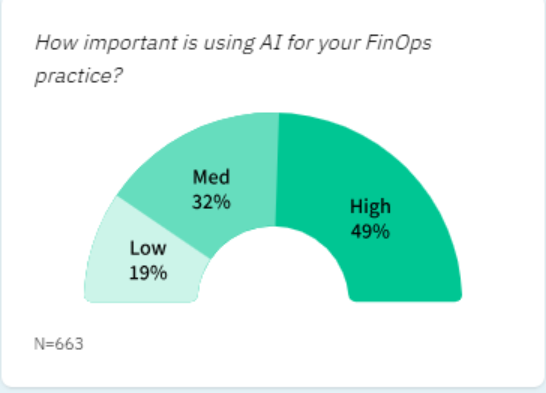
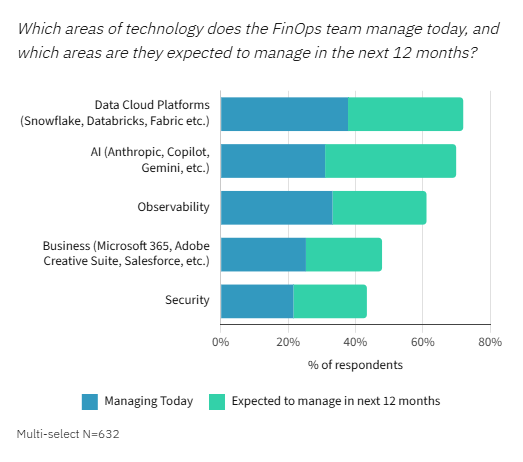
Two years ago, only 31% of organizations were managing AI spend within their FinOps practice. Today, that number sits at 98%. That single stat tells everything about how quickly the ground is shifting for FinOps leaders.
For GCC and Finance leaders Cloud was never the biggest challenge. The hard part has always been governance — knowing:
- What are you’re spending?
- Why are you’re spending it?
- Is it actually generating value?
And as AI workloads stack on top of already complex multi-cloud environments, the stakes are even higher.
The State of FinOps 2026 report confirms it: mature teams have moved on from optimization. Governing value is now the priority.
Today, Global Capability Centers (GCCs) sit at the center of global technology delivery — running data pipelines, AI models, and enterprise decision-making at scale. Without financial intelligence embedded at the execution layer, even the best-run GCC is flying blind.
That’s where modern FinOps makes a difference. In this blog, we unpack the real challenges GCCs face with cloud and AI spend and data estate, and what the future of AI-led FinOps looks like for GCC leaders who want to stay ahead. Dive in.
Today, 81% of companies report that managing cloud spend is a top business challenge, and nearly 27% of total cloud spend is wasted due to inefficiencies — a clear signal that growth in cloud adoption has outpaced financial governance maturity.
As AI workloads intensify and multi-cloud ecosystems expand, financial opacity, fragmented accountability, and unpredictable economics continue to erode the promised benefits of agility and innovation.
- Overspend is universal: Fragmented architectures, idle resources, and unmanaged experimentation create financial leakage that's baked into the operating model.
- Limited visibility: Cost data sits across vendors, subscriptions, and environments — making it nearly impossible to link consumption with business outcomes.
- Fragmented accountability: Finance sets budgets. IT provisions infrastructure. Business drives demand. No one owns cloud economics end-to-end.
- ROI remains unclear: Most organizations lack structured mechanisms to connect cloud spend with efficiency gains, revenue impact, or customer value.
In the present situation, FinOps is no longer a cost-reporting discipline. It is a structural response to systemic gaps in governance, collaboration, and optimization. For GCC-led enterprises managing complex, AI-driven data estates, the need is not incremental improvement—it is an operating model that embeds financial intelligence into every layer of cloud execution, enabling control, agility, and sustained business differentiation.
What separates high-performing GCCs from the rest in 2026? Learn how AI-native, business-first GCCs are shaping enterprise outcomes.
At present, leading GCCs are moving beyond spend visibility to AI-native FinOps models that measure:
Tokens per rupee to understand the true economics of AI consumption
Cost-to-serve per use case to link spend directly to business outcomes
GPU/NPU efficiency to maximize performance from high-cost compute
—while actively shutting down zombie workloads before they drain value.
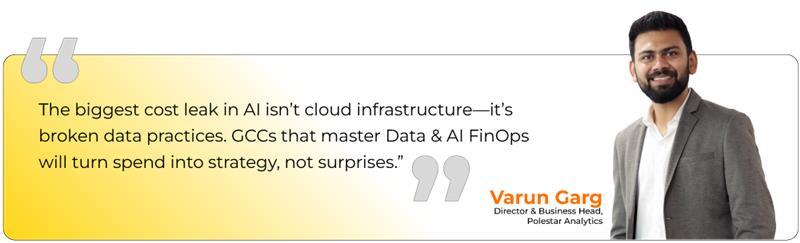
What’s driving this change is a clear realization: Most waste doesn't come from infrastructure. It comes from inefficient data practices — duplicate pipelines, unused datasets, broken lineage, poorly optimized jobs.
Modern GCCs are solving this through Data & AI FinOps model in place. It starts with strong data quality and observability—trusted lineage, anomaly detection, and consistent metadata. On top of this, FinOps becomes operational: linking performance, cost, and governance into daily decisions.
Polestar Analytics flagship product 1Platform is allowing this shift by unifying cost observability, real-time lineage, pipeline orchestration, predictive alerts, and business-level cost attribution into a unified operating system. With smart dashboards, rule-based controls, and actionable recommendations, FinOps becomes embedded across the GCC maturity curve—transforming cloud and data spend from reactive cost control into proactive value creation.
- Empower with Data: FinOps begins with visibility. Democratize cost, usage, and performance insights across finance, engineering, and business teams. Full attribution at the workload or user level eliminates ambiguity and allow informed decisions.
- Collaborate Cross-Functionally: Cloud economics cannot be managed in silos. Finance grasps budgets, engineering controls usage, and business defines value—but FinOps aligns all three around shared KPIs and governance models.
- Promote Ownership: Accountability must move closer to consumption. FinOps promotes workload-level and team-level ownership of cloud spend through showback and chargeback models — turning optimization proactive.
- Let Business Value Drive Decisions: Optimization without any context can hamper innovation. FinOps makes sure that cost decisions are anchored in business outcomes—customer experience, revenue impact, operational efficiency, or speed-to-market. Rather than asking, “How do we reduce cost?” GCCs ask, “Which investments generate measurable value?” This shifts the focus from cost minimization to value maximization.
- Enable through a central function: A centralized FinOps capability within the GCCs sets guardrails, forecasting models, and policy frameworks — empowering distributed innovation without losing financial discipline.
- Leverage the Variable Cost Model: Cloud spend is elastic. FinOps use dynamic rightsizing, predictive forecasting, and intelligent workload scheduling to treat cloud as a strategic lever, not a fixed cost.
While these FinOps principles define the operating discipline, 1Platform acts as the execution engine that brings them to life , helping FinOps embed automation, standardize governance, enable real-time cost intelligence, and continuously optimize cloud investments—transforming financial strategy into scalable operational reality.
A well thought out and structured FinOps approach, powered by products like 1Platform, makes a massive difference. By amalgamating intelligence, automation, and operational scalability, enterprises can move from reactive cost management to proactive financial control.
Take a look at the table below to see how FinOps, together with 1Platform, can transform cloud and data management across your organization.
| Organizational Challenges |
FinOps & 1Platform |
Impacts |
| Multi-Cloud Maintenance & Complexity |
- Unified governance & workflows
- Cloud Cost Breakdown
- Pipeline orchestration
|
Operational cost reduction |
| Reactive Operations & Poor Observability |
- Predictive alerts & notification
- Unified & Smart dashboards
- Business attribution of Costs
|
Faster incident resolution |
| Data Quality Issues |
- Rule-based validation
- Real-time lineage
- Job-level Optimization, efficiency
|
Improved reliability & trust in data |
| Infrastructure Optimization & Resource Rationalization |
- Optimized code generation
- Data estate ROI Calculation
- Capacity usage per user
|
Higher utilization efficiency |
| Innovation Constraints & Scalability Limitations |
- Master Data Management
- Self-service Databot
- Automated notifications on cloud limits
|
Faster innovation cycles |
| Personalization & Self-Service Analytics Limitations |
- Low/No-code, Drag-drop analytics
- Actionable Recommendations on jobs
- On-demand Agentic Framework
|
Accelerated Decision making |
 Source: FinOps Foundation
The next phase of FinOps is AI-native, autonomous, and predictive.
- Autonomous cost governance
- Predictive financial modeling
- Workload-level profitability intelligence
- Continuous optimization loops
- Financial democratization through Agentic AI
So, it can be said that AI-led FinOps will transforms finance from a monitoring function into a strategic intelligence layer.
We're helping GCCs evolve into AI-powered innovation hubs-ready to transform your center into a driver of global growth.
So, it can be stated that, FinOps is all about engineering financial intelligence into every data, AI and innovation decision. By automation, unifying governance, and real-time visibility, AI-powered FinOps can revolutionize finance into a strategic growth enabler, driving valuable impact and sustainable performance.
Now is the time to react to operationalize intelligent FinOps and unpack its strengths. Get in touch today.