
Summarize this blog post with:
| HCP engagement improves when quarterly strategy reaches every rep as named doctors and next best actions, not aggregate dashboards refreshed weekly. |
TL;DR
- Pharma field teams rarely have a targeting problem. They have a translation problem: strategy set at the top does not survive the trip to the rep's Monday morning.
- Weekly BI refreshes report coverage in aggregate. They cannot name the tier-1 prescriber who was missed, or why it mattered.
- HCPPulse from Polestar Analytics makes a leader's plain-language strategy the live input that re-derives every rep's priorities, at doctor level.
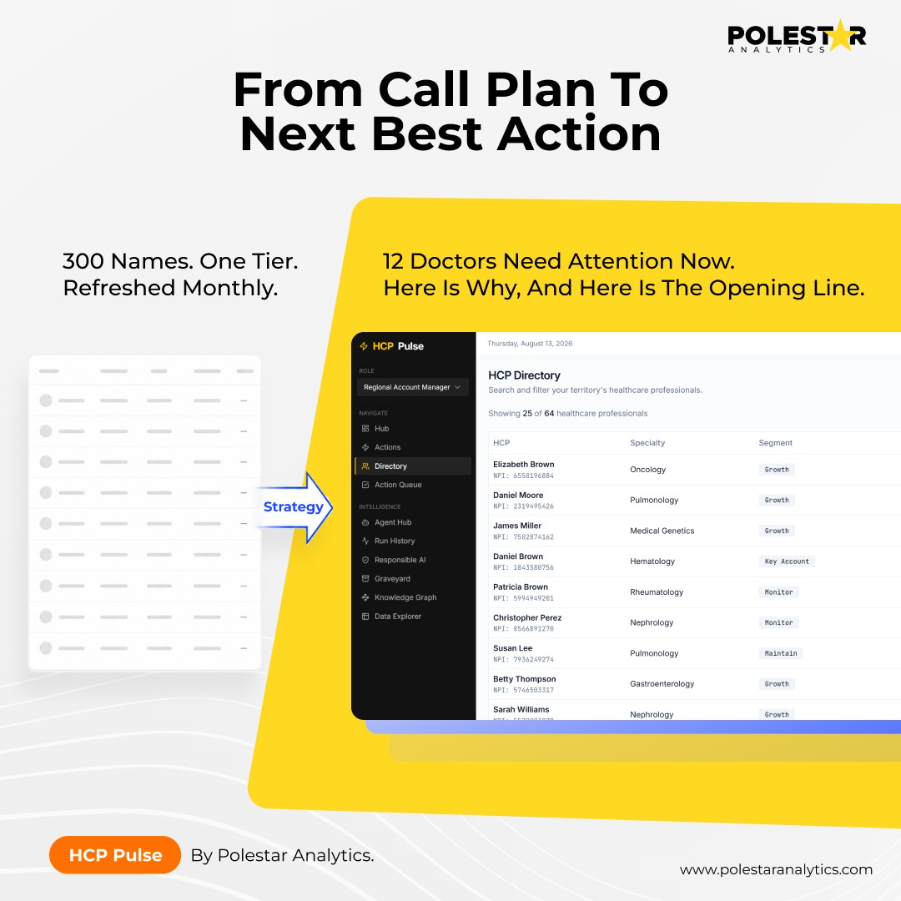
Only 12% of CEOs told, in PwC's 29th Annual Global CEO Survey in January 2026, that AI has produced both revenue gains and cost savings in the last twelve months. 56% reported neither. Pharma commercial teams sit inside that majority. Not for lack of data or models, the gap is that strategy never reaches the rep in a form the rep can act on, and by the third week of the quarter that shows up as tier-1 doctors quietly slipping down the queue.
The arithmetic is unforgiving: A large pharma commercial organisation typically has tens of thousands of target HCPs and only a few thousand reps to reach them, with each rep working a tiered monthly target list.
Execution drifts within days. A rep waiting on a tier-1 specialist steps into the tier-3 clinic next door because it is closer and friendlier. Good conversation, almost no prescribing consequence.
Nothing in the stack catches this in time. Three structural reasons:
- CRM records what happened. It is a system of record, not an intelligence layer.
- Power BI-style reporting refreshes weekly at best and reports coverage as counts, never names.
- When priorities shift, the dashboard is rebuilt by hand, so strategy and reporting desync.
The consequence is that nobody finds out in time. Deloitte's midyear 2026 outlook found only 45% of life sciences executives could point to measurable improvement from their AI investments, and just 13% at scale. A business unit leader who learns at quarter close that coverage was thin cannot tell whether the cause was one rep, one territory, or systemic. That is why a good strategy stops working by week three. Not because anyone rejected it, but because nothing in the stack tells a rep which doctor to see on Tuesday, and nothing tells a manager it went wrong until the quarter is already spent.
Most HCP engagement tools track well enough. The CRM captures every interaction and the dashboards report every KPI. The break is one layer up, where the quarter's priorities sit hard-coded into the reporting logic. Change the strategy and someone has to rebuild the filters and target lists by hand.
HCPPulse inverts that. A Chief Commercial Officer or business unit leader writes a free-text objective for the quarter: protect the existing patient base, or win competitive battles at 50% weighting. That document becomes live context. Every rep's ranked list of doctors is redrawn against the new objective, with names, tiers and reasons attached, and every layer above sees the same re-derivation rolled up: RSD, ESD, BUL, CCO. No dashboard rebuild, no waiting for the monthly refresh.
Static tools need a rebuild when priorities move. An adaptive HCP engagement platform re-prioritises that afternoon.
Two design consequences follow:
- Names, not numbers. The output is a named pulmonologist, two of three patients already switched, last contact 41 days ago, four visits per cycle recommended. Not "you met 40% of tier-1 targets."
- Reasoning that reaches the rep. Every flagged HCP carries a reason, a confidence qualifier and a next best action, schedulable in one click.
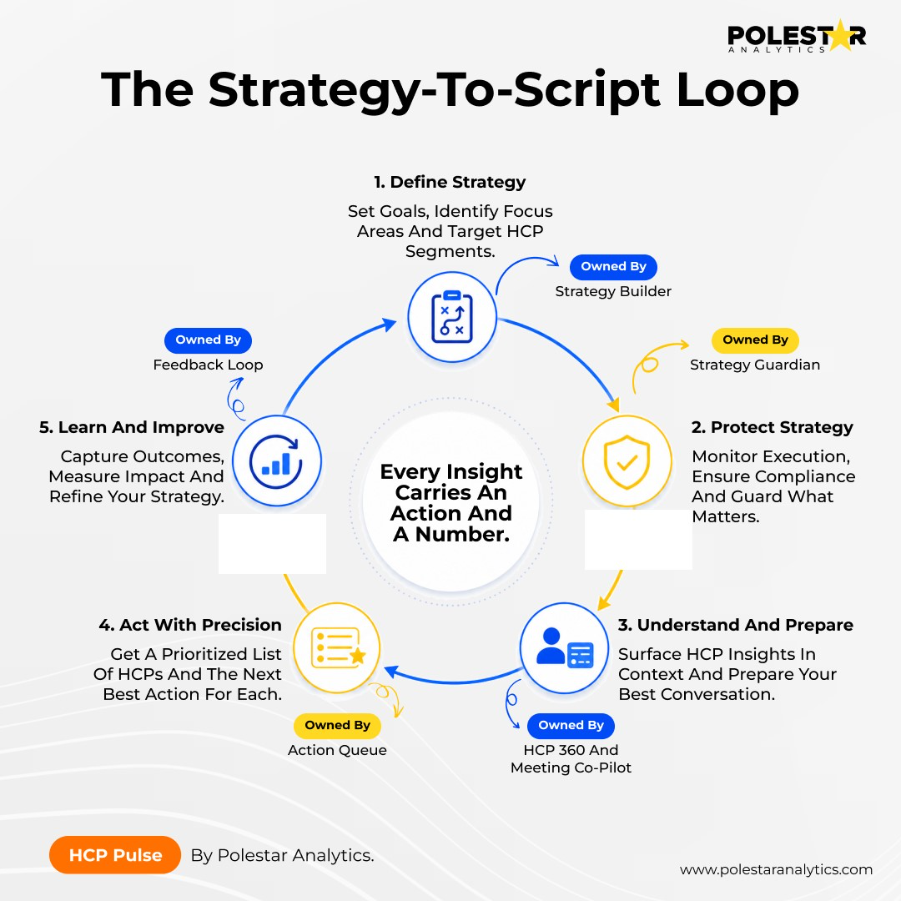
Polestar Analytics builds this on the foundation set out in its pharmaceutical analytics practice, where the recurring failure is sequencing: platforms bought before the workflow exists to act on them. The same argument is developed in this analysis of commercial analytics in pharma. Inside HCPPulse, that workflow runs as a five-stage loop:
- Frame. The leader writes the quarterly objective in plain text. The Strategy Builder agent turns it into live context for the whole application.
- Prioritise. The intelligence layer maps it onto individual HCPs as P1 to P4 cohorts: churn risk, growth, protect base, operational.
- Prepare. A 360-degree HCP profile plus agentic call-plan generation surface the message angle and likely objections per doctor.
- Act. A prioritised action queue tracks every commitment from scheduled to in progress to completed.
- Learn. Visit notes are mined for insights and commitments, then synced back to Veeva.
Each loop closes in days, not quarters. That cadence is the product.
Omnichannel HCP engagement fails at sequencing, not reach. Adding email, remote HCP engagement and digital detailing to an unprioritized call plan multiplies noise.
HCPPulse treats channel as an output of priority, not a parallel programme. Once an HCP is flagged, the recommended action specifies the channel: an in-person call, an email, a webinar invite, a sample drop. Multichannel HCP engagement becomes a scheduling decision inside one queue.
Two capabilities make this defensible at scale:
- The context graph. A visual map of rep to HCP to institution to territory relationships. It surfaces workload imbalance no dashboard exposes, such as a rep spread across four territories while high-value doctors go under-served. Managers rebalance from the graph.
- Governed AI HCP engagement. Four named agents run the intelligence layer: an HCP Signal and Next Best Action agent, a Meeting Co-Pilot that builds each call briefing, a Coverage and Compliance agent that flags cadence gaps, and a Strategy Guardian that keeps every rep's queue aligned to the current objective. Every run is traced end to end, every recommendation needs human approval, and adherence to Microsoft's six responsible-AI standards is documented. Model choice is deliberate: high-frequency prioritisation runs on cheaper models, executive strategy queries on higher-reasoning ones where an error would be costly.
The traceability point matters more than it reads. McKinsey's State of AI trust research, March 2026, found close to two-thirds of respondents named security and risk concerns the leading barrier to scaling agentic AI, ahead of regulatory uncertainty and technical limits. In a regulated function, traceability is what unlocks adoption, not accuracy alone.
Field force effectiveness is funded as a targeting problem and lost as a translation problem. Segmentation is usually sound. What breaks is the last mile between a quarterly objective and a rep's Tuesday. A platform that reports coverage without naming the missed prescriber has described the symptom and left the diagnosis to the manager. The test in 2026: when strategy changes Monday, does the rep's queue change Tuesday, and can you trace why?
Unlock Smarter HCP Targeting with AI
Discover how AI-driven HCP segmentation helps pharma teams identify high-value HCPs, optimise field-force prioritisation, and deliver more relevant next-best actions.
Explore AI-Driven HCP Segmentation
Three layers, three jobs. CRM records the interaction. BI reports it in aggregate afterwards. An HCP engagement platform is the prescriptive layer in between: which HCPs matter this quarter, why, and what the rep does next. HCPPulse syncs bidirectionally with Veeva, so the system of record stays unchanged.
Channel breadth without prioritisation increases contact volume, not share. Sequencing is the lever. When priority is derived first, digital HCP engagement and remote HCP engagement become channel choices attached to a specific doctor and reason, which is what makes attribution possible.
Three mechanisms: no recommendation auto-applies without human acceptance, every agent run is traceable to its prompt, tool calls, tokens and output, and responsible-AI adherence is documented with live metrics. Polestar Analytics covers the wider pattern in agentic AI use cases for pharmaceuticals and life sciences.
No, and the boundary is deliberate. Segmentation is an upstream process with its own algorithms. HCPPulse assumes tiering exists and owns the reach-out layer above it. For the segmentation and sizing side of pharma field engagement, this sales force effectiveness eBook is the starting point.
- Segmentation is largely solved. Reach-out execution is where value leaks.
- Aggregate coverage lags. Doctor-level exposure is the leading indicator.
- A free-text strategy document, treated as live context, removes the dashboard rebuild.
- HCPPulse coexists with Veeva CRM and IQVIA data, with Veeva as master record.
- Human approval and agent tracing are prerequisites for AI HCP engagement, not extras.
- Prebuilt KPIs mean a team is live in six to eight weeks, not two quarters.
HCPPulse is part of the Polestar Analytics Pulse suite. Pair it with incentives that reward priority-weighted coverage, a theme in reinventing incentive compensation in pharma.
HCPPulse. Turn commercial intent into HCP share.