Knowledge Hub · Guide
The Complete Guide to Jedox Implementation Partners
How to find, evaluate and work with the right Jedox consulting partner. Plus what to do when the first one did not work out.
How to find, evaluate and work with the right Jedox consulting partner. Plus what to do when the first one did not work out.
Most Jedox buyers evaluate partners on the wrong axis. They compare day rates, certifications and logo slides, then sign with whoever seemed most confident in the demo.
But in reality, an implementation partner is not simply a software reseller. The right partner should understand both:
Jedox is an enterprise performance management platform that connects data, planning, budgeting, forecasting, and reporting to help organizations make faster, more informed business decisions. It helps companies replace fragmented Excel-based planning processes with a centralized, automated planning system.
Jedox itself offers implementation services directly as well as through its global partner network. Its partner ecosystem includes 250+ partners worldwide, with partners providing local, industry, functional, and implementation expertise.
So, it is imperative to understand what makes a Jedox Implementation partner stand out, and why to choose them.
Choose a Jedox implementation partner on planning architecture capability first, integration depth second, and enablement third. Certification and partner tier are weak signals because Jedox does not publish tier criteria and certifies individuals rather than firms. Ask for named consultants, a dimension design sample, and a written handover plan before you compare prices.
To understand how to choose a Jedox partner, you need to understand two things. One, what an implementation partner does, and it is really better than in-house. So let's address these first.
Roughly 12 activities right from discovery to post-live support.
Current planning and reporting processes, the Excel workflows people actually use, source systems, business rules, approval chains, and the pain points that started this. Jedox's own methodology opens with a one to two day strategic workshop to set objectives, requirements and timeline.
Dimensions, hierarchies, cubes, planning structures, driver-based calculations and naming standards. This is the decision that is expensive to reverse, and it determines what you can report on in year three. Buried in BARC's user feedback on Jedox, one customer's advice to peers translates as: plan carefully when building the dimensions, and set naming standards.
The goal is not to reproduce your spreadsheets inside Jedox. It is a model that fixes the process underneath them.
Who can see which entity, which cost centre, which salary line. Which roles can write, which can only read, and how approval rights map to your actual org chart. In a planning tool carrying headcount and compensation data, this is a design decision, not a configuration step.
Jedox uses named-user licences across Full User, Planner, Web Planner, Web Viewer and Developer types, each with different access rights. Get the mix wrong and you either overpay every year or find in month four that half your planners cannot do their job. Connectors for SAP, Salesforce, Snowflake, Microsoft, Qlik, Power BI and Tableau are licensed separately, individually or in bundles.
Connecting Jedox to your ERP, data warehouse, CRM, HR system, databases, APIs and the Excel files nobody will admit to. Jedox Integrator is where most of the build hours go, and Jedox reports being top-ranked for data integration in all five of its peer groups in BARC's Planning Survey 26.
Cubes, business rules, calculation logic and workflow. Worth knowing before you start: BARC notes average feedback on Jedox's workflow capabilities, so elaborate approval chains are a design conversation rather than an afterthought.
Planning templates, input forms, reports and dashboards across the Excel add-in, Jedox Web, Canvas, Dynatables and mobile. Finance teams live in Excel and will keep living there. Partners who treat the Excel add-in as a legacy fallback build beautiful web dashboards nobody opens.
Jedox ships prebuilt Solutions and Best Practice Accelerators covering Integrated Financial Planning, Sales Planning, Human Resources and ESG through the Jedox Marketplace. Starting from one can save weeks. Starting from one and bending it out of shape costs more than building clean.
Data accuracy against source, calculation results, planning workflows end to end, report output, user permissions, integration jobs under failure conditions, and performance at real user numbers. That last one matters here specifically: BARC's published feedback flags performance strain in environments with high user counts and large data volumes, so a load test at close-day concurrency is not optional.
Administrator, power-user and end-user training, plus the adoption work that decides whether any of it gets used. Jedox's methodology ends with an enablement phase, described as knowledge transfer so the client can self-serve and make future adjustments. A technically clean implementation still fails if the planners quietly go back to spreadsheets. One BARC respondent's advice, translated from German: focus on the end users, because if the planners are not happy with the software, they hide.
Dimension design, business rules, Integrator job logic, the security model, and the reasoning behind every non-obvious calculation. Written so your team can read it without the partner in the room, and held on your drive rather than theirs.
Troubleshooting, model enhancements, new planning applications, performance tuning, additional integrations, user support and version upgrades. Jedox 26, announced in May 2026, added JedoxAI Data Insights, natural language interaction in Views, AI-assisted script generation in Integrator and native Python support. Platform capability is moving fast enough that "who handles upgrades" has a real price attached.
Use a Jedox implementation partner when you have multi-entity consolidation, more than one ERP, or a statutory deadline. Build in-house when you are single-entity with one planning process and someone on staff already thinks in OLAP cubes. For most mid-market and enterprise finance teams the hybrid model is cheapest over three years.
The honest comparison, assuming you have a competent finance systems person internally:
| Partner-led | In-house | Hybrid | |
|---|---|---|---|
| Time to first working model | Fastest | Slowest | Fast |
| Cost shape | High upfront, low internal | Low cash, high opportunity cost | Moderate both |
| Dimension and rule design risk | Low if they are good, catastrophic if not | High on first build | Low |
| Integration complexity handled | Yes | Depends entirely on one person | Yes |
| Knowledge retained internally | Often poor | Total | Good |
| Cost of change in year two | Billable every time | Near zero | Low |
| Upgrade handling | Contracted | Yours | Shared |
The in-house path has a floor most people underestimate. Jedox Academy runs a three-tier ladder, and the full climb is nine training days plus two exams. Per person. You need at least two people, unless you are comfortable being one resignation away from a frozen planning model.
| Level | Courses | Days | Certification |
|---|---|---|---|
| Specialist | 210 Specialist, 211 Report Specialist, 251 Database Specialist | 3 | 299 exam, 90 minutes |
| Professional | 306 Report Professional, 356 Integration Professional | 4 | 399 exam, 90 minutes |
| Expert | 481 Business Logic Expert | 2 | Builds on Professional |
The hybrid model wins most of the time. Partner leads architecture and integration. Your team builds reports from week one, in the actual build, not in a training sandbox afterwards. The diagram below shows where that handover either happens or quietly does not.
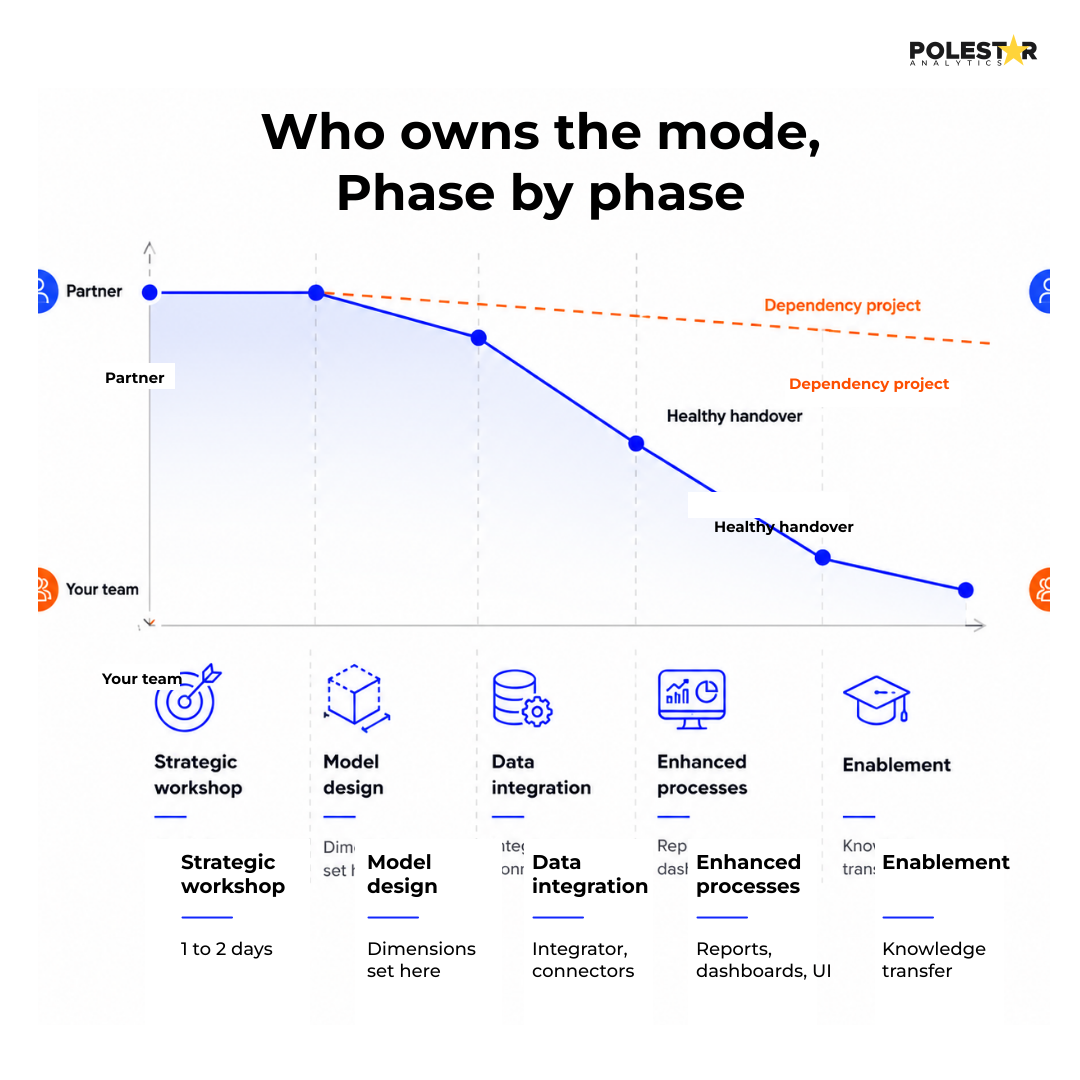
Go pure in-house only if you are single-entity, running one planning process, and someone on staff already thinks in OLAP cubes. Go partner-led if you have multi-entity consolidation, more than one ERP, or a statutory deadline you cannot move.
Choosing a Jedox implementation partner involves assessing more than just technical expertise or cost. It means evaluating their Jedox planning experience, industry and functional knowledge, implementation track record, data integration capabilities, project methodology, user training, and ongoing support to ensure they can deliver a solution that fits your business and scales with your needs.
"The question I ask every finance team evaluating Jedox consulting services is not what they want to build. It is who will change it in March next year, when the reorg lands and half the cost centres move."
Almost nobody has an answer. They have a project plan, a budget and a go-live date, and no name against the sentence "this person owns the model." That gap is what turns a good Jedox implementation into an annual support bill.
The fix is unglamorous. Put one internal person in the build from week one, not in training afterwards. Make dimension design a document they sign, not a workshop they attend. And treat the enablement phase as a deliverable with an acceptance test, because a phase without a test is a phase that gets compressed when the timeline slips.
You can switch Jedox implementation partners mid-project. Secure admin credentials, Integrator project exports and model documentation before you give notice, resolve the licence relationship if your incumbent resells it, then commission an independent audit of what is salvageable. Integration jobs and loaded data usually survive. Over-engineered rule logic and outdated hierarchies usually do not.
A good share of the conversations that start with "we need a Jedox partner" are really "we need a different Jedox partner." Almost nobody writes about this stage, so here it is.
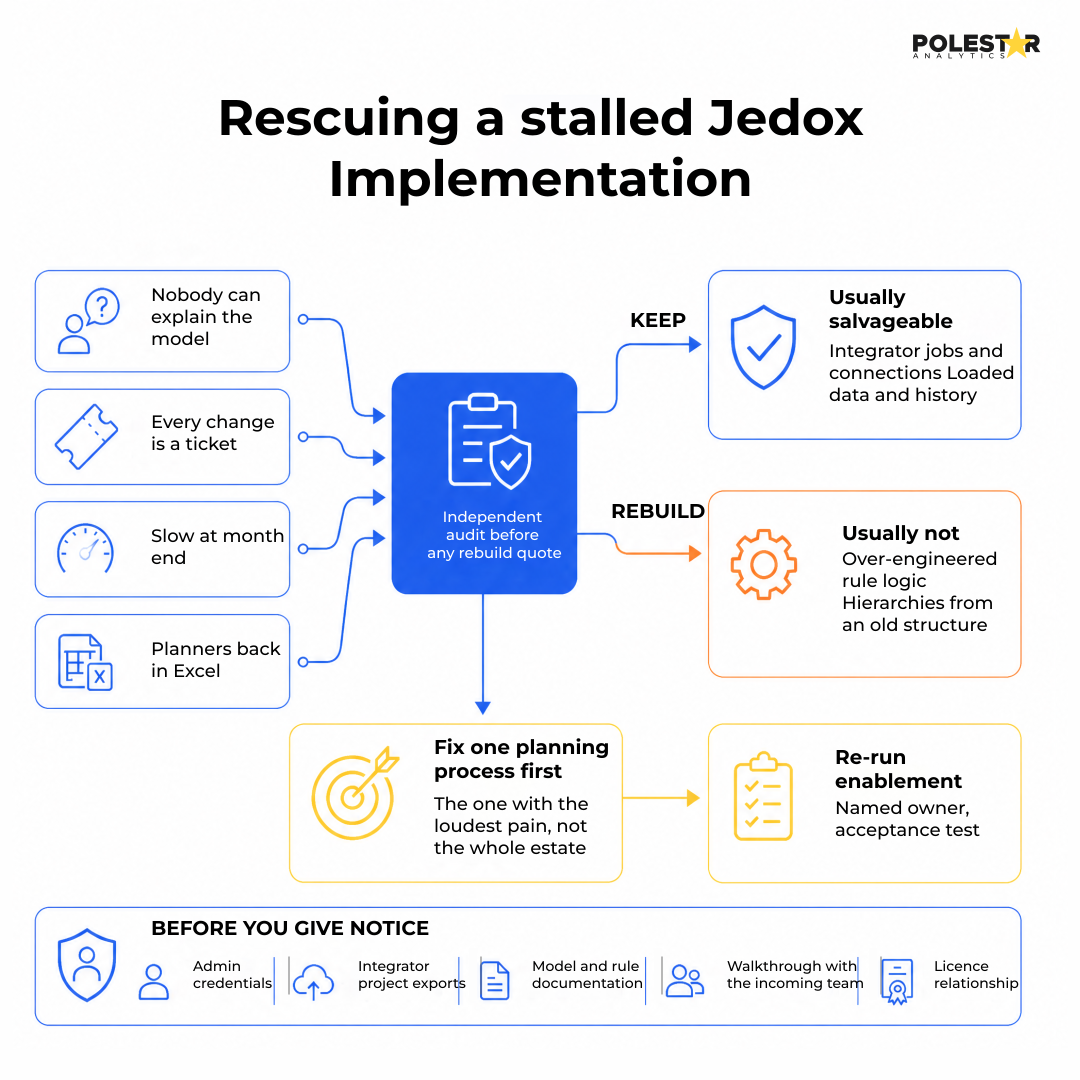
Get an independent read on what is salvageable before anyone proposes a rebuild. Any Jedox implementation consultant who quotes a full rebuild before reading your existing model is selling, not diagnosing.
If your incumbent partner cancels your Jedox licence, sort that out before you tell them you are leaving. You do not want your platform contract sitting with a firm you are in a dispute with.
Pick the planning process causing the most visible pain, fix that, and let the win buy you the mandate for the rest. A big-bang re-implementation of a failed big-bang implementation tends to fail the same way.
One honest mistake you might be making. Sometimes it is not the partner. If your requirements changed three times, if finance and ops never agreed on a driver, or if nobody internal was ever assigned to own the model, a new partner will hit the identical wall at roughly the same speed. Fix that first, or you are buying the same project twice.
A fixed-scope audit of your existing Jedox model. We tell you what is salvageable and what is not, in writing, whether or not you work with us afterwards.
The five warning signs are: a template demoed as your model, an architect in the pitch who will not be on the project, handover named as a phase with no plan behind it, no opinion on what Jedox does badly, and a fixed price quoted before anyone has seen your chart of accounts. Any one of them is a conversation. Three is a decision.
Accelerators are a legitimate head start. A partner who cannot tell you which parts of theirs get thrown away for a business like yours has not thought about your business. Ask what percentage of the template survives to go-live in a typical engagement. A confident, specific answer, even a low one, is a good sign.
The oldest trick in EPM services. The person who impressed you in the demo appears for two workshops and then bills at 10 percent while a junior builds the model. Name people in the SOW.
Jedox's own methodology treats enablement as a delivery phase with the stated goal of client self-sufficiency. If a partner cannot tell you which named person on your team will be able to add a dimension unaided by go-live, they are selling you a dependency with a support retainer attached.
BARC's published feedback flags average workflow capability and performance strain at high user counts and large data volumes. Those are known, documented, manageable constraints. A partner who has genuinely delivered a dozen Jedox projects has hit them and has workarounds. A partner who tells you Jedox does everything well has either not shipped enough or is not telling you the truth. Both are disqualifying.
Fixed-price delivery is fine. Fixed price quoted before someone has seen your chart of accounts, your entity structure and your source systems is a number designed to win a procurement comparison, and it will be defended later through change requests. Pay for a short paid discovery and get a scope built on evidence.
That is the whole first conversation. If Jedox is wrong for the process you described, we will say so on the call rather than in month three.
Talk to our Jedox teamAsk who designs and signs off your dimensions, for a Jedox model they inherited from another firm, which accelerators they will use and how much survives, who owns the IP and documentation, whether they resell your licence, the names and Academy certification levels of your actual team, and what month 13 costs.
Ask these in a working session, not over email. You are testing how they think, not collecting written answers.
The highest-signal question on the list. Reading and repairing another firm's model is much harder than building your own, and Jedox consultants who do it regularly have seen every way a build goes wrong. If they have never inherited one, they have a small client base or short relationships.
You are listening for a specific view on Integrated Financial Planning, Sales Planning, HR or ESG accelerators versus a clean build, with reasons tied to your entity structure and processes.
Get this answered before signing, not in the exit negotiation. The list should include Integrator exports, rule documentation, dimension design docs and admin access.
Not a gotcha. Resellers can be excellent, and bundling is often simpler. But if the same firm advises on the Full User versus Planner versus Web Viewer split and earns margin on it, you want that on the table. Ask them to model the three-year licence cost of their recommended mix.
With their Jedox Academy certification level and their days per week. Certification in Jedox is individual, not corporate.
Cost of managed service, who owns version upgrades, what happens when a release like Jedox 26 lands with new AI capability, and how much of your team's routine change work will still be billable. If the answer to that last one is "most of it," the enablement phase was theatre.
Three things a named person on your team must be able to do, unaided, on go-live day. Write them into the SOW as acceptance criteria. If you cannot tick all three, the project is not finished, whatever the sign-off document says.
This test is also the cleanest way to compare two Jedox consulting firms that both look good on paper. Ask each one when in their plan you will pass it.
Most Jedox partners can turn on Predictive Planning and call it AI. We, at Polestar analytics, our practice on AI and data science first. We're bringing capability we already run for other clients into your Jedox environment, so your planning platform gets smarter over time instead of just staying configured.
Our Jedox implementation process in short:
Most implementation partners start at configuration because that is what the SOW pays for. We run blueprinting first, which makes our discovery longer and our first invoice later. The reason is the one this whole guide argues: dimension design in week two sets your reporting ceiling for years, and nobody has ever fixed a bad architecture with a better dashboard.
Jedox is one platform inside a wider EPM and CPM estate. A partner who only knows Jedox will model around whatever your data warehouse currently gives them instead of fixing the upstream problem. We are a preferred delivery partner across Databricks, Microsoft, Snowflake, AWS and GCP, so when the real issue is the pipeline rather than the cube, we can say so and then fix it.
The parts of a plan that break templates are always industry-specific: private equity distribution waterfalls, pharma field force compensation, CPG trade spend and promotional accruals, multi-entity consolidation across a real legal structure. Those come from delivery experience in the sector, not from a Jedox accelerator.
Architecture and data model design with a governance framework, before anyone opens the platform.
Model configuration, system integrations and workflow deployment against the signed blueprint.
Driver-based models, dashboards and the reporting layer your planners will actually open.
Post go-live optimisation, platform maintenance and support, sized so your team keeps the routine changes.
Dimension design in week two is the decision that sets your reporting ceiling for years. Make it a signed document, not a workshop.
Jedox certifies people, not firms, and does not publish partner tier criteria. Ask for named consultants and their Academy levels.
The hybrid delivery model wins for most finance teams. Your people build inside the project, not in training afterwards.
Score partners with weights, not impressions. Architecture 30, integration 20, enablement 20, industry depth 15, commercial transparency 15.
Write the Go-Live Ownership Test into the SOW as acceptance criteria: add a dimension member, modify an Integrator job, produce the documentation.
If the build has stalled, audit before you rebuild, and secure credentials, exports and documentation before you give notice.
Nobody publishes credible Jedox implementation cost or timeline benchmarks. Three references beat any industry average you are quoted.
About Author

EPM Solutions Expert
Polestar Analytics

Related Content