
Summarize this blog post with:
TL; DR This Bodhi session brought together Eric Frere (CIO, Kellanova) and Chetan Alsisaria (CEO, Polestar Analytics) to talk about what it actually takes for CPG to stay future-ready.
The conversation moved through how the CIO role has shifted from order-taker to strategic business partner, the real (not hyped) ways AI is showing up in CPG - from product innovation to supply chain resilience and the practical work of building AI-ready, unbiased data. It closed with something more personal - courage as the real differentiator when disruption hits. None of the advice is complicated. Living it is a different story and that's the real thread running through this session.
Some thoughts only land once you're ready for them not sooner, not later. That's what our Bodhi sessions are built on: readiness meeting insight.
Looking for a summary? Wrong place go watch it yourself. Buddha knows, maybe you'll walk away with an awakening of your own.
This session brought together Divyanshu Srivastava of Polestar Analytics as host, along with Eric Frere, CIO at Kellanova, and Chetan, CEO of Polestar Analytics talking about how CPG businesses can stay future-ready with the help of technology.
Here's what I took away from the session what I understood, and what's still locked away, waiting for its moment to arrive.
The session opens with a simple but loaded question: how has the CIO role evolved in CPG, and what key shifts in data and AI are shaping the industry's future?
Eric highlighted that IT/tech functions are no longer back-office functions. He pointed to three areas where CIOs should focus:
- From order-taker to strategic business partner: the CIO's job is to shape strategy alongside the business, not just execute requests.
- Relentless value realization: making sure tech work is anchored to a real outcome, not just adopted for its own sake.
- Building a winning culture within the tech function itself: along with delivering projects, also shaping how the team operates and grows.
You can't consider yourself a leader until you've created new leaders yourself.
Chetan agreed with Eric, then added that AI is forcing companies to reimagine business processes, not just automate them so CIOs now must be part of that redesign.
CIOs are also spending less time "keeping the lights on" and more on future-proofing initiatives, even ones without immediate ROI, since those will shape competitive position 3–5 years out.
Lastly, fast-evolving data and security compliance is increasingly becoming a CIO responsibility.
Eric emphasized that organizations succeed when they're genuinely ready for change, have sponsorship, and commit resources, and fail when they don't.
And I believe every one of you even I agree with this, and even Newton agrees (Hello! Inertia!)
The top challenge according to him was, securing executive support, and then building a coalition of "change champions" across every functional area, not just at the C-suite level.
He closed by mentioning that business objectives must always be the guiding principle what problem are you solving, how will you measure results, and how will you communicate that back to the broader organization so people get behind the change.
Divyanshu asked about balancing "keeping the lights on" with innovation, to which Eric and Chetan highlighted a few observations.
Eric structured this into 3 components:
- Education and awareness: Kellanova built a cross-functional ethical AI council to guardrail how employees approach Gen AI, protecting the company, people, and IP while democratizing education.
- Safe experimentation: A "test and learn" culture where courage is core (tied to Kellanova's "Culture of Best" accountability, integrity, courage); many AI projects won't succeed initially, and that's fine as long as the org keeps iterating. Their "Curiosity Clinics" open to all employees, focused mainly on Copilot, drew 10,000+ attendees, including senior leaders.
- Workforce readiness: "YODA" (Year of Development Always), an internal program building the technical, soft, and industry skills needed to keep pace with AI.
Chetan shared 2 key observations:
- Separate the teams. Firefighting and innovation shouldn't sit with the same team priorities get crowded out, and the two need different success metrics (proven systems vs. experiments expected to sometimes fail).
- Anchor experiments to a business reason. Define clear success criteria upfront and involve business stakeholders early, so effort isn't wasted chasing hype, and failures are seen as genuine experiments rather than wasted work.
Eric's advice centered on relationship-building as the true foundation of CIO effectiveness:
- Start building relationships from day one: understand not just the company's overall strategic vision, but each individual leadership team member's personal vision and motivations.
- Build a team that earns its seat at the table: across supply chain, sales, marketing, HR, legal, finance, so every functional leader sees them as a genuine strategic partner, not a service provider.
- He described this as part art, part science
Chetan walked through the historical evolution of IT organizational structures:
- Fully centralized IT slow, and often disconnected from business context because of the distance between technologists and business processes.
- Fully decentralized IT: each function optimizing for itself, but the overall technology landscape becomes fragmented ("mushrooming") with no coherent direction.
- Hybrid model (current best practice): embedded function-specific IT teams under a central governance layer, keeping everyone aligned to one strategy, toolset, and architecture. Works only with strong governance without it, misalignment risk is just as high as full decentralization.
For CPG, it's real transformation, not hype and Eric had the receipts to back it up:
- New product innovation: Faster development, and using local data to actually match what people in different markets want which means better sales than the market average.
- Manufacturing: More automation, better quality checks, and simulations before things even hit the floor.
- Sales enablement: Sales teams walking into meetings with Walmart or Kroger backed by real data not guesswork, so their every pitch to a store manager points to a specific opportunity.
- POS data: Using data from retailers to spot new opportunities and see where you stand against competitors.
- Dynamic routing: Letting data decide which stores a rep should visit first, based on where the biggest opportunity is.
Chetan, on the other hand, talked about how AI is transforming the lives of society along with businesses.
- Healthcare diagnostics: From his own background a small Indian town with limited doctor access he pointed out a doctor sees maybe a few thousand cases in a career. An AI trained on millions can bring that same expertise to people who don't have it.
Curious what this looks like in practice? We've mapped out real agentic AI use cases in pharma from rare disease identification to real-time patient monitoring.
- Preventive health: Wearable data feeding into systems that catch problems early good for you, your insurer, everyone.
- Personalized medicine: Treatment based on your actual history and real-time data, not a generic plan.
- Supply chain resilience: AI that tracks supplier cost, quality, and capacity well enough to reroute around a war or tariff before it hits the backup plan, ready before you need it.
- Retail AR: He pointed to Sephora's Virtual Artist and Lenskart's try-on app AI replacing the need to try something in person. Makeup's the harder problem versus glasses, since it means reading and changing skin tone and texture, not just placing a frame on a face.
It's not just about trying things on anymore, see how retailers are using AI at every step of the shopping journey.
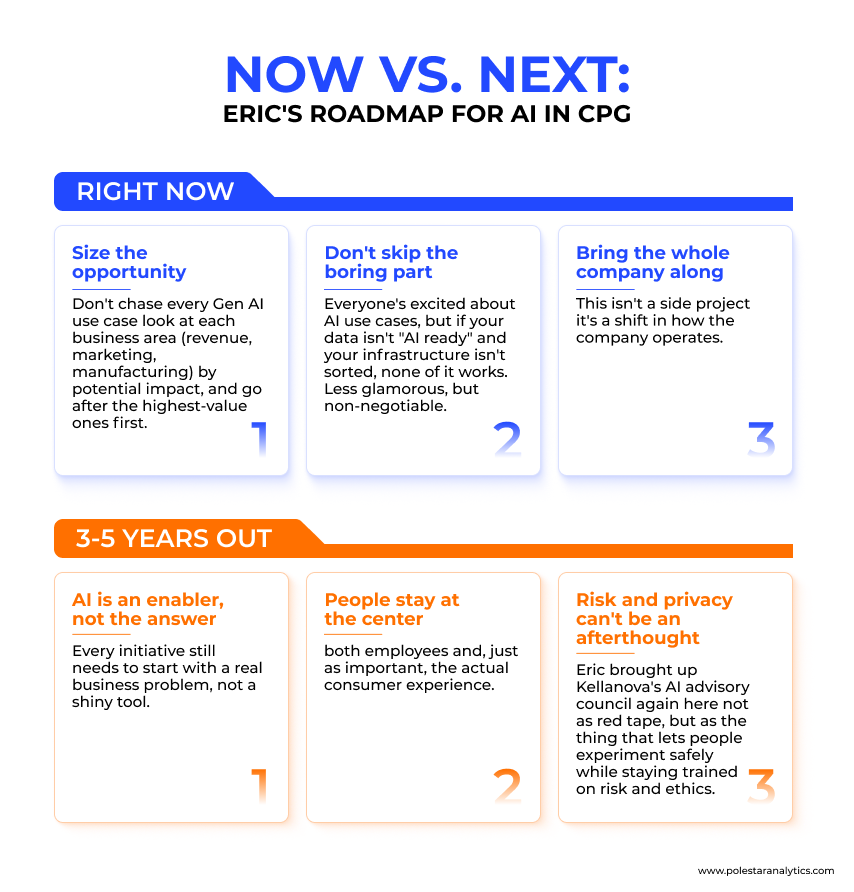
Divyanshu asked Eric what trends CPG leaders should prep for, and where AI goes in the next 3-5 years. He split it into "now" and "later."
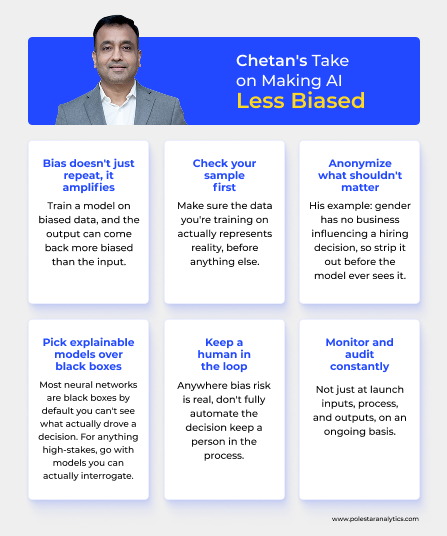
Subsequently, both were asked how they deal with historical bias in data.
Eric tied it back to AI-readiness if your data's biased, it's simply not AI ready. He pushed for solid master data governance and clean data from verified sources. The good news: you don't need your entire data ecosystem perfect. A smaller, well-governed slice say, product hierarchy or customer data is enough, as long as that slice meets the bar before AI touches it.
Divyanshu closed with one question for each: what's your one piece of advice for someone coming up in your role?
Eric, to aspiring CIOs:
- Don't go looking for a problem to solve: Start with real business challenges found through genuine partnerships with the business and your goals as a tech leader naturally line up with the company's.
- Never underestimate a winning culture: He talked about how much the leaders he worked under shaped him, and encouraged people to figure out what actually made those leaders good then build that into their own style, so they're growing the next generation of tech talent, not just managing a team.
Chetan, to aspiring CEOs:
Be courageous. He framed the current moment as disruptive across the board, with tech being just one piece of it, and pointed out that the natural first reaction to unexpected change is denial, telling yourself it's just hype that'll pass.
His metaphor: disruption is a wave.
Some people drown in it, others ride it further than they ever could've on their own, and which one you get depends entirely on how you position yourself. His practical takeaway: line up your business and operating model with what the market wants, instead of resisting the shift.
Maybe that's the real takeaway from this session. Build relationships, stay curious, keep people at the center, be brave when the ground shifts. Simple, almost obvious advice. But simple isn't the same as easy. You need to have stood at the edge of that wave, watched a project fail, watched a team resist change and watched an old way of working stop working for any of it to actually change how you show up tomorrow.
Bodhi is part of Polestar Analytics' "Industry Leadership Connect" initiative organic, non-promotional conversations where senior leaders share what they've actually learned in data, analytics, and AI. No pitch decks, no sales agenda.
Pretty much everything under the data-and-AI umbrella Revenue Growth Management, Agentic Commerce in retail, HR tech, supply chain strategy, digitizing agriculture, Generative AI and LLMs, and even the rise of the Chief AI Officer as a C-suite role.
Senior leaders across industries, past speakers have come from companies like Kellanova, JPMorgan Chase, Microsoft, McCain Foods, Bayer, Panasonic, and Sprinklr. All practitioners talking from real experience.
Regularly new sessions get announced and scheduled on an ongoing basis, and Polestar also opens the floor for industry leaders to apply as a future Bodhi speaker.
Yes, they're all archived on the Bodhi page you'll find LinkedIn recaps and full YouTube recordings for every past session.
Beyond Bodhi, there's the RGM Roundtable (featuring practitioners from companies like PepsiCo and McCain Foods), a Finance Leaders Roundtable, and a GCC Roundtable series all part of a broader effort in the Industry Leadership Connect.