
Summarize this blog post with:
- What can Agentic AI do for enterprise operations?
Why agents work in pilots but fail in production—and what creates the infrastructure mismatch.
- Bridging the divide: How do agentic systems scale across an enterprise?
The three platform layers that make agentic AI for enterprise applications production-ready.
- What did successful enterprises do differently with Agentic AI?
Real patterns from enterprises deploying enterprise-wide agentic AI use-cases at scale.
You already know agentic AI for enterprise operations works. You've seen the pilots. 40% of enterprise apps are already planning agent deployments (Up from less than 5% in 2025). The math is clear: 30-50% faster operations, up to 60% reduction in manual workloads , autonomous orchestration across systems, self-optimizing workflows. These are just few of the many advantages which you know (or have anticipated) with enterprise Agentic AI. When/if your team builds an agent, it handles supplier disruptions better than your ops team ever could.
So why isn't it in production?
Here's the uncomfortable truth: “You're trying to run Formula 1 on infrastructure built for bicycles” as Ankit Rana, (CTO, Polestar analytics) puts it.
Fact is 95% of enterprise AI projects fail before production. Not because the models aren't good enough. Not because your team can't build agents. Because you're running autonomous, event-driven systems on synchronous, human-centric infrastructure that was never designed for this.
This is what creates the Agentic Divide: the gap between enterprises achieving elevated operations with agentic systems and those stuck with pilots that crumble under enterprise constraints.
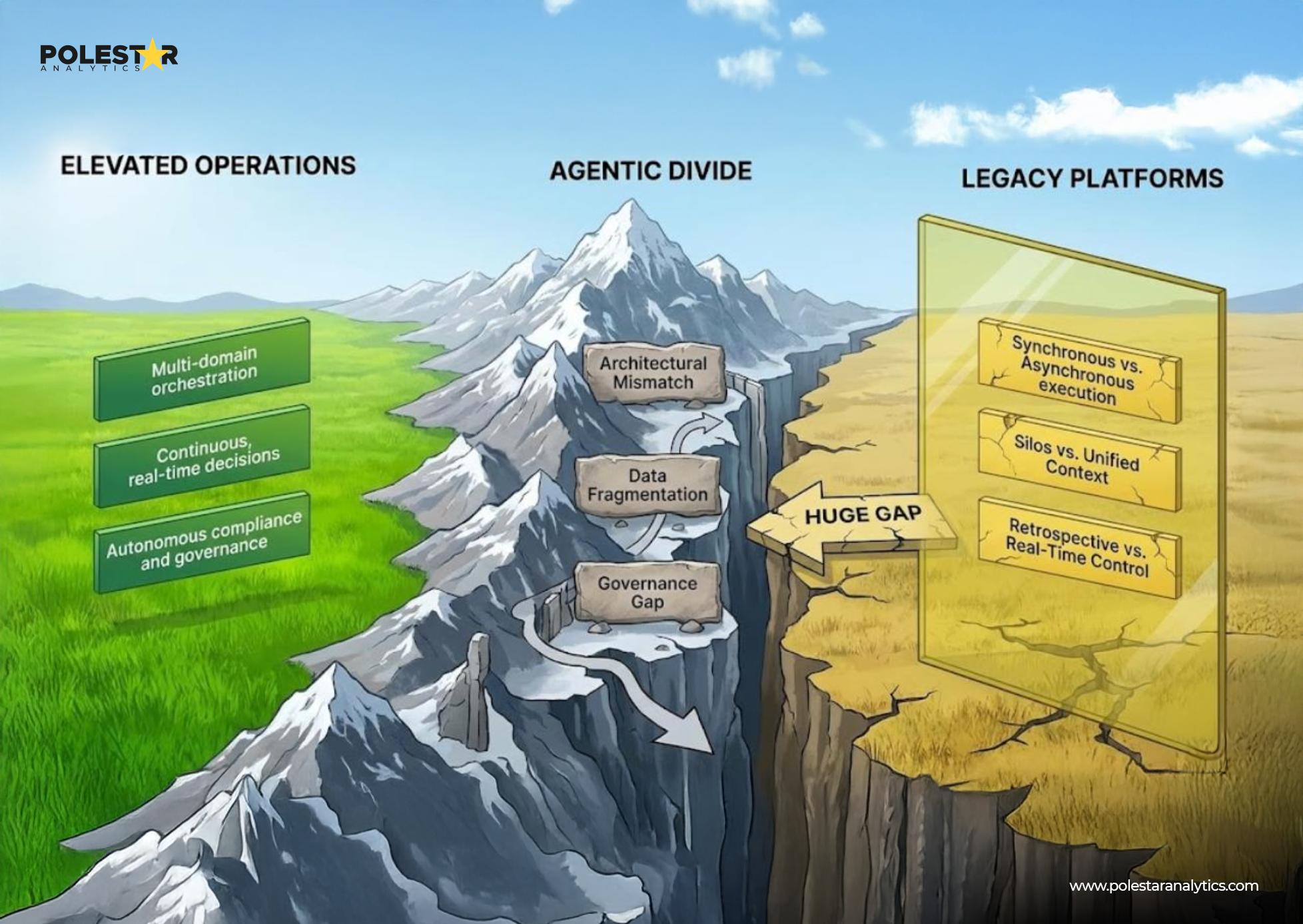
So, congratulations—your agents worked. Your platforms didn't.
Results of course vary by data maturity, but across industries the pattern holds: legacy automation tools weren't built for AI-native, agentic workflows. Current AI platforms are either developer-heavy frameworks or chat interfaces. Neither works at scale.
What you need: platform modernization. Orchestration layers, Integrated governance, unified data fabric, event-driven infrastructure. Not bolt-on integrations creating spaghetti architectures.
Close the Infrastructure Gap for your company’s Agentic AI needs
1Platform provides orchestrated workflows, governed execution, unified context, and explainable decisions—layered on your existing systems.
Build your enterprise Agentic AI strategy
The solution isn't adding more tools. It's architecting a platform where agents, data, and governance converge—where autonomous systems can actually operate at enterprise scale.
Three architectural layers close the gap:
- Unified Data Foundation: Convergence at the source
Your agent NEEDS multiple data points to make a decision. However, 41% of business leaders still lack understanding of data because it’s complex or not accessible enough. This is because these data points are scattered across incompatible systems with different schemas.
Each query happens separately different formats, different response times. The result: latency and incomplete context for decision-making.
The core issue isn’t lack of data, its fragmentation.
What agents need is unified context—a converged data platform where operational, customer, and transactional data merge in real-time. Not batch ETL jobs reconciling overnight. This architectural requirement, as Siddarth Poddar (CPO, Polestar Analytics) explains, determines whether agentic systems scale or fail.
Data Nexus creates this unified reasoning layer. MDM360 handles quality and governance at the source. Result: agents query once and get complete context.
- Enterprise-Scale Orchestration: Autonomous Coordination
Event-driven orchestration isn't optional—it's how agents coordinate parallel operations across incompatible systems.
For example, Agenthood.AI (which includes 50+ pre-built agents for common enterprise workflows) integrated with 1Platform provides the orchestration layer where multi-agent systems coordinate autonomously, handle exceptions, and optimize continuously without human intervention. This helps in reducing deployment time and de-risking implementation.
- Integrated Governance: Control Without Constraints
Autonomous systems need governance that executes at decision time, not retrospectively. For example, 1Platform our decision intelligence platform, provides real-time policy enforcement, introspection logs showing data lineage, reasoning traces for audit, and rollback mechanisms—enabling agents to operate within compliance boundaries while maintaining autonomy.
Here’s how it looks:
| Governance Aspect |
Without 1Platform |
With 1Platform |
| Policy Enforcement |
Retrospective audit after action |
Real-time validation before action |
| Access Control |
Manual approval workflows |
Role-based authorization (RBA) at decision-time |
| Compliance Check |
Review logs 24-48 hours later |
Policy engine queried in milliseconds |
| Audit Trail |
Fragmented logs across systems |
Complete reasoning trace + data lineage |
| Exception Handling |
Human intervention required |
Automated rollback mechanisms |
| Risk Detection |
Post-incident analysis |
Pre-execution compliance checks |
With this convergence—unified data, autonomous orchestration, real-time governance—agents move from pilots to production. At scale.
You need to remember one thing: The enterprises deploying agentic AI at scale didn't start with agents. They started by making their data queryable in real-time. Not just "integrated" but Queryable.
Agents don't need perfect data modeling that takes months—they need semantic layers providing real-time queryable access to operational context now. Modern data architectures provide this through standards like Model Context Protocol (MCP) and semantic API layers—purpose-built for AI systems querying operational context, not traditional application integrations.
Second: They shifted governance from retrospective review to real-time validation. Agents check policies before acting, and humans stay in the loop for critical decisions—but at decision-time, not days later during audit reviews. That's the difference between reactive and proactive governance.
And the cherry on the top is - You don't need to rip out your existing systems. You need a platform layer that makes them work together for agentic operations. Like 1Platform which integrated on top of your current infrastructure—unifying data access, orchestrating agent workflows, and enforcing governance without replacing what you've already built.
We know this challenge. So, let's get this right. Get in touch with our 1Platform experts and let's make agents work for you—not the other way around.
P.S. Getting the platform right starts with getting the fundamentals right.
New to agentic AI or want to validate your current approach? Check out our ‘Everything you need to know about Agentic AI” series:
Until next time!