
Summarize this blog post with:
What’s in the Blog
- Why traditional planning breaks down in today’s real-time decision environment.
- How Pigment’s AI Agent ecosystem-Analyst, Planner, Modeler-redefines modern business planning.
- A focused look at the Analyst AI Agent and its impact on speed, accuracy, and insight generation.
- Why Most AI Agent Implementations Fail and How Pigment Overcomes These Barriers.
- A practical 30-day pilot framework to help you test AI agents with measurable outcomes.
A quick, expert guide to understanding how AI agents are reshaping enterprise planning.
Strategic planning has become a top priority for 60% of CFOs in 2025, which went up from just 38% in 2023. While executives want insights, finance teams spend 58% of their time on planning and analysis tasks that executives barely review, and all the Strategic insights get buried in spreadsheets. The decisions get made anyway, but still without data.
Picture this: Your CFO asked you a simple question- “What happens if our largest customer churns? Your FP&A team drops everything. Then, three days later, they got the answer. But your CFO already made the decision. Waiting wasn’t an option. She used her gut instead of data.
This scenario repeats constantly. Finance teams face immense pressure - 70% report stress from inflation and economic disruption. But you know what is more painful 24% of finance people have identified manual processes as the key challenge destroying the team's efficiency.
So, your team is not slow; they are buried under the weight of old, outdated workflows.
Sounds familiar? You are not alone; Marketing needs a budget reforecast. Sales want to see new pricing. Operations need headcount scenarios.
And this same cycle repeats every time and all the time; the decisions are made without the data because the data takes too long.
Traditional planning tools weren’t designed for today’s reality. The proof is that organizations operate an average of 897 applications, but only 29% of these are integrated. This means that 71 % of your data lives in silos, disconnected, Hard to access, and impossible to analyze holistically.
Here's what makes this painful: while your data sits trapped in different systems, your CFO needs answers now. Not next week. Today
These legacy systems were configured for annual budgets: plan once, lock in, and execute for one year... but that's not how things work now.
Consumer preferences change every month, and then competitors pivot their strategy every week. Market conditions change overnight.
Many teams believed AI would solve this. It hasn’t- at least not yet. Early AI tools demanded massive setup investments and deep technical expertise.
According to recent research, 95% of IT leaders report integration issues preventing AI implementation. Even when companies deployed AI, 42% of executives admit it's 'tearing their company apart' due to organizational misalignment.
Pigment didn’t release another dashboard or planning tool. They created an ecosystem around specialized AI agents that collaborate to rethink business planning from the ground up.
This ecosystem has 3 specific AI agents: The Analyst, The Planner, and The Modeler.
The Analyst Agents continuously assess external and internal data, detecting anomalies and understanding the causes of business performance.
Then come the Planner Agents, which unite with the analyst agent to decode the insights into actionable steps.
And Modeler agents autonomously build and update the models underpinning pigment.
But let’s focus on the one that’s changing how finance teams work today, the Analyst AI agent.
The analyst agent is not any other prediction agent. The analyst scans across your business for indicators of change in the data. It builds the reports for you. You spend more time on decisions that matter, not on crunching the numbers.
Some Key aspects of Analyst AI Agent:
- Flexibility in delivery:
Now this agent delivers automated insights that fit your workflow. So, whether it’s a dashboard, slide deck, or any narrative summary, you are always ready to report. Plus, it will also provide you with next step recommendations. This flexibility matters because 58% of CFOs dedicate significant time to business performance management and want tools that fit their workflow, not the other way around.
So, here is what has changed: instead of training AI agents on generic data, Pigment built the analyst AI agent on business planning logic. It knows everything from variance analysis to headcount forecast to reading your P&L and spotting irregularities. So, it does all this in 30 minutes instead of 3 hours.
These numbers tell the story 42% of the companies need to connect 8+ different data sources just to get one AI agent working. Then again, 52% of business leaders say security is their biggest concern- and they are right. When you are giving AI access to financial data, that’s not paranoia, that’s prudence. And lastly, 86% of the organizations require upgrades to their existing tech stack in order to deploy AI agents.
But pigment solves these problems by building the analyst agents inside their planning platform and has enterprise security built in with SOC 2 type 2, GDPR, and CCPA compliance from day one, and it speaks the business language, so it's flexible also, and so by using this, companies are seeing measurable results.
- Automated Variance Analysis
Here, the Analyst Agent scans every variance across Actuals, Budgets, Forecasts, and the work. And it doesn't just show you the numbers. It explains what drives them. The impact? That once took three hours now takes thirty minutes.
- Active Risk Detection
This is where it becomes proactive. The agent doesn’t wait for you to ask the questions - it is constantly checking for anomalies and data inconsistencies. When it spots something, it surfaces an alert with context. Companies using this are seeing 40% fewer errors in their reports. That's about making better decisions with data you can trust.
- Automated Report Generation
Let's be honest: nobody loves building reports. The Analyst Agent handles this by presenting insights in whatever format works for you—dashboards, slide decks, written reports, even audio summaries.
And the most interesting thing is that companies have reported a 94% decrease in planning time.
If this sounds compelling, your next question is: "Should we build this using open-source AI frameworks or buy Pigment? "The point is the AI agent market reached $7.38 billion in 2025, nearly doubling from $3.7 billion in 2023. It's projected to hit $103.6 billion by 2032. This explosive growth means one thing: the 'build vs. buy' question isn't academic—it's strategic."
The verdict
Open-source frameworks like LangChain and AutoGen are powerful and free to start. If you have a strong AI/ML engineering team, 12+ months for development, and an appetite for maintaining production AI systems, open source can work. But you also own everything: security compliance, system integrations, production bugs, and the hidden cost of engineering time.
Pigment
- Pigment isn't a startup experiment: it's a $1B company with enterprise customers running critical operations on its platform. What does this mean:
- Enterprise security built in: These compliances, for instance, SOC 2 Type 2, GDPR, and CCPA, are built from Day One.
- Battle-Tested: Global companies processing massive datasets have already stress-tested the platform. You benefit from their learnings.
- Predictable Costs: No surprise cloud bills from runaway AI agents. According to research, 27% of cloud spend is wasted. Pigment's architecture prevents that.
- Production-Ready Today: While 88% of executives plan to increase AI budgets due to agentic AI, most are still figuring out implementation. Pigment's customers are already live.
THE COST REALITY: Large enterprises typically allocate 2-3% of annual revenue to integration and ERP systems, so invest wisely.
While you're reading this, your competitors are already deploying AI agents. By next quarter, they'll be making decisions 50% faster in real-time. They'll be responding to market changes in hours, not weeks.
This isn't just speed for the sake of speed. Making better decisions faster is better. The organizations that are winning with AI right now are not the ones with the largest budgets.
They're the ones who moved first. By 2026, 40% of enterprises will be using AI agents. It's not about adopting the technology; it's about transformation.
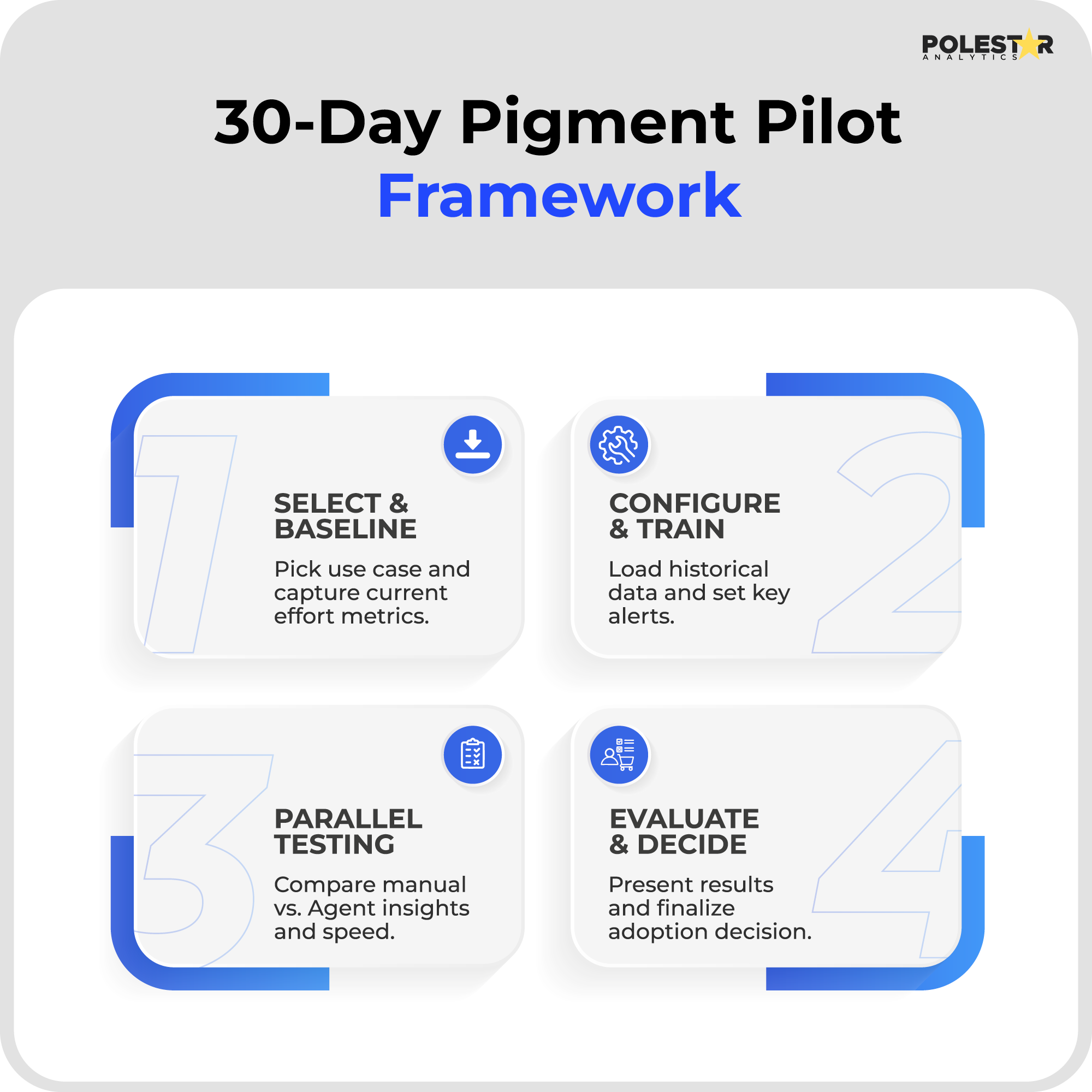
You don't need to transform everything at once. Here's a practical roadmap to test Pigment's Analyst Agent:
- Week 1 - Select & Baseline
Choose one high-impact use case (we recommend variance analysis for your largest cost center). Document current time spent and error rates. This becomes your baseline.
- Week 2 - Configure & Train
Set up the Analyst Agent with 6-12 months of historical data. Configure alerts for your top 5 business metrics. The agent learns your data patterns.
- Week 3 - Parallel Testing
Run analysis both ways: your team manually and the Analyst Agent simultaneously. Compare speed, depth of insights, and accuracy. Document everything.
- Week 4 - Evaluate & decide
Present results to leadership with clear metrics. Success threshold: 50%+ time savings OR surfacing 3+ strategic insights your manual process missed.
If you hit these benchmarks, expand to additional departments.
You don't need to transform your entire planning process immediately. Start by automating variance analysis for one department. Set a 30-day pilot. Measure the outcomes. If your team saves 20+ hours and gets better insights, expand.
This is where expert guidance becomes critical. Polestar Analytics provides the strategic framework and implementation expertise to effectively harness Pigment's AI agents while mitigating associated risks.
Pigment's Analyst AI Agent is live, battle-tested, and ready to transform your planning cycles. We help you integrate it right, from pilot programs to enterprise-wide adoption.
AI agents are not intended to take the place of your people—they are to augment your people. With the AI-assisted reporting platform, for example, instead of spending hours preparing data, assessing variances, and creating reports, your FP&A analysts will have the time to concentrate on what matters—strategic planning, scenario modelling, and providing counsel to leadership. The agents do the repetitive processing of numbers, while your people do the strategic thinking. It is not about eliminating jobs; it is about elevating jobs from execution to strategy.
AI agents augment your workforce, enabling teams to move faster, decide smarter, and execute better. They speed up everything, from creating insights to simulating scenarios, while enabling accessible planning across functions with intuitive search and collaboration tools. The result? Stretched teams take on more work using AI that understands your business and adapts to change, providing the productivity gains and outcomes necessary to win in fast-moving markets.
Pigment's AI models are built on business planning best practices and contextual knowledge—not your data. Your customer information remains separate, confidential, and private. The AI never trains on, learns from, or stores any of your proprietary data.