
Summarize this blog post with:
On a drilling rig, the most expensive thing isn't the steel or the crew. It's the wait. Non-productive time (NPT) quietly drains millions from drilling operators every year, and the costliest version of it isn't a dramatic blowout, it's a problem that sits undiagnosed because the answer is buried in a system nobody on the rig floor can reach. In its 2026 analysis of drilling operations, Databricks describes the pattern bluntly: equipment failures that go undiagnosed for days, and root-cause analyses that take weeks instead of minutes.
And the failures cluster. In that same work, Databricks puts the root-cause breakdown of NPT in sharp relief: equipment issues, especially around mud pumps, emerge as the single dominant constraint on fleet efficiency, accounting for nearly 50% of all NPT minutes. As margins tighten across the sector, the ability to correlate subsurface conditions, equipment behaviour and operational outcomes in real time stops being a nice-to-have. Databricks frames it about as plainly as you can: analytic competency is profit.
Here's the counterintuitive part. The problem on most rigs isn't a shortage of data. The problem is the distance between a question and an answer. When a drilling engineer wants to know why the rate of penetration just dropped, they often can't ask the data directly; instead they wait on an analyst, a static dashboard, or a daily drilling report typed up by hand. That lag is where the money leaks.
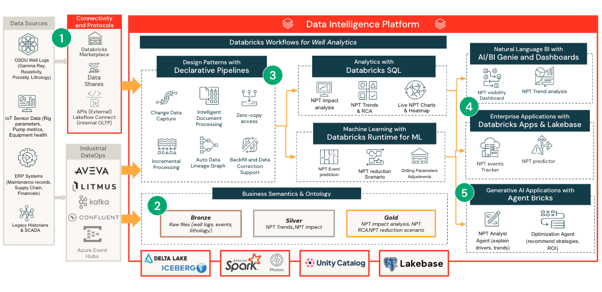
Drilling data is notoriously fragmented. Wellbore and subsurface readings live in well-log systems such as OSDU; rig equipment streams high-frequency signals through IoT sensors; cost and maintenance figures sit in ERP systems built for accounting. None of these were designed to talk to each other. As Databricks notes in its drilling operations breakdown, geological conditions captured in OSDU well logs never connect with the operational metrics flowing off the rig, and maintenance context lives somewhere else again.
The result is that the people closest to the decision are usually the furthest from the data. The information exists; acting on it requires someone else, and time the rig floor doesn't have. When the developing problem is a mud pump trending toward failure, spotting it an hour earlier is worth real money.
 Source: Databricks
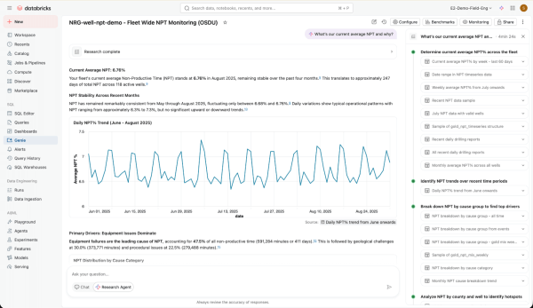
Databricks AI/BI Genie is a conversational analytics layer built into the Databricks Data Intelligence Platform. It became generally available in June 2025, rolling out across all clouds as part of the AI/BI suite, Databricks' generative AI-powered Agentic AI suite. The idea is simple on the surface: a user types a question in plain English, and the Databricks Genie AI assistant translates it into SQL, runs it on a SQL warehouse, and returns a results table, a chart, and a plain-language summary. That ask-to-answer loop is the core Databricks Genie workflow.
What sits behind that interface matters more than the chat box. Rather than a single Databricks Genie model, the Genie architecture is a multi-component compound AI system, with several cooperative components working together to:
- Interpret the user's question and determine which tables to select for data retrieval
- Generate read-only SQL code to pull the relevant data
- Create useful data visualizations from the results
The Genie architecture acts as a data agent by drawing on the semantic context the organization provides, including:
- Table and column descriptions that define what the data means
- Key relationships across tables
- Validated sample queries created by data domain experts in the 'Genie space'
Because every question runs on a SQL warehouse, Databricks Genie cost tracks with the compute those queries consume.
 Source: Databricks
Drilling teams already think in questions, not queries. "How does today's NPT compare with the three nearest offset wells?" "Which bottomhole assembly gave the best ROP in this formation?" "What's our cost per foot against the AFE so far?" These are exactly the kinds of questions a drilling engineer or rig supervisor would normally route through an analyst, and exactly what Genie is built to answer in seconds.
Databricks' own drilling scenario shows the shift in plain terms: instead of hunting across dashboards, a manager can simply ask "Tell me about my operations today" and get a narrative, cross-domain answer spanning NPT, equipment reliability and formation risk. This is Databricks AI and Data Analytics meeting the rig floor.
There's already evidence the underlying approach pays off in the field. In Databricks' 2025 review of AI across the energy sector, Spanish operator Repsol ingests real-time streaming data straight from its drilling operations and now retrains models to optimise drilling velocity every five minutes, helping operators make faster calls on the rig.
The same programme has scaled to more than 50 GenAI use cases across the business. That kind of real-time pipeline is precisely the foundation conversational analytics sits on, and Genie removes the last step, because the engineer no longer needs someone to build the view. They can simply ask.
Once a Genie space is configured around drilling data, the practical range of Databricks Genie use cases is wide:
- NPT breakdowns: "Show NPT hours by cause for this well versus the field average."
- Performance benchmarking: "Compare ROP by section against the best offset well in this basin."
- Cost tracking: "What's cumulative cost per foot, and how far are we from the AFE?"
- Equipment and fluids: "Plot ECD and mud weight trends over the last 24 hours and flag anomalies."
- Crew and shift patterns: "Where did connection times spike this tour?"
Each of these would normally mean a ticket to the data team and a wait measured in hours or days. This kind of self-service Databricks Genie data exploration compresses that to the length of a coffee break.
Genie is not magic sprinkled on a messy data estate, and it's worth being honest about that. A well-designed Lakehouse, appropriate semantic metadata, and a Genie space with users who have current knowledge of drilling plus a verified set of sample queries for pattern matching are essential to successfully implementing Databricks Genie.
Also, Genie only reasons over the data that is in the Databricks Lakehouse, so you will need to ingest and unify all well logs, sensor data, and reporting feeds into the Lakehouse before using Genie. And for high-stakes decisions, the generated SQL deserves a human glance, the tool surfaces the query it ran precisely so an engineer can sanity-check the logic.
Treat the setup as the project, and the natural-language layer becomes the easy part. This is also where an experienced implementation partner earns its keep. Polestar Analytics, a certified Databricks partner, has done exactly this work of unifying fragmented data into a governed Lakehouse and standing up Genie spaces that answer real business questions.
In fact, Polestar Analytics has productised this same pattern in its Pulse Suite, a family of Genie and Lakebase powered solutions, which is a useful signal that the hard part, the data foundation and semantic layer beneath Genie, is something they build for a living.
Explore the Pulse Suite to see conversational analytics working in production, turning plain-language questions into insights across pricing, promotions, and working capital.
Explore the Pulse Suite
The value here isn't replacing drilling engineers or the data team. It's collapsing the gap between an operational question and a defensible, data-backed answer, the gap where, with margins tightening and equipment failures driving the bulk of NPT, hesitation is expensive. Drilling has never been short on data. What it's been short on is a way for the people on the rig floor to interrogate that data the moment a decision is on the table. That, more than any dashboard, is what Databricks Genie and conversational analytics finally put within reach.
No. It closes the gap between an operational question and a data-backed answer, freeing engineers from waiting on analysts or static dashboards. The data team still builds the Lakehouse and semantic layer; Genie just lets rig-floor staff interrogate that data directly, and it surfaces the SQL it ran so engineers can sanity-check high-stakes decisions.
In Databricks' own scenario, a single natural-language query gave fleet-level NPT visibility across 118 wells, correlated mud-pump failures with formations in minutes instead of weeks, and produced an action plan recovering 64-91 days of fleet capacity while avoiding $1.6-2.7M in costs.
A governed Lakehouse with all well-log, IoT sensor, and ERP data unified into it, plus solid semantic metadata and a Genie space configured with drilling-savvy sample queries. Genie only reasons over data that's in the Lakehouse, so the data foundation is the real project; the natural-language layer is the easy part.