
Summarize this blog post with:
| An AI-native GCC transforms business processes, decision-making, and innovation through AI, supported by a strong data foundation, responsible governance, and skilled talent. |
TL;DR
Most Global Capability Centers today are AI-enabled, not AI-native. The copilots are live, the pilots are running, but the deeper work has barely started: rebuilding processes, decisions, and products around AI. This is the real work of AI transformation in GCCs: moving beyond tool adoption to embed AI into how the enterprise operates and innovates. This piece lays out three levels of that shift, namely Individual Productivity, Enterprise Productivity, and Frontier AI Capabilities, each resting on a strong data and governance foundation, a new talent model, and a reimagined GCC operating model.
Walk into almost any Global Capability Center today and the story sounds familiar. Copilots have been rolled out. Employees have been trained on prompt engineering. Pilots are running in finance, HR, and engineering. Leadership decks proudly announce that the GCC is "AI-enabled."
Yet the harder question remains: how much of the parent enterprise's decision-making, process design, or product innovation genuinely runs on AI?
India has 2,117 GCCs operating across 3,728 units, employing roughly 2.36 million professionals and generating USD 98.4 billion in revenue in FY2026. The ecosystem has grown 32% since FY2021, and according to EY's recent GCC research with AMCHAM, 83% of GCCs in major markets are already working with generative AI while 58% are actively building agentic AI capabilities.
But scale and maturity are not the same thing. That same EY research points out that most GCC leaders cite workflow redesign and change management, not technology, as the biggest blockers to AI value. The gap between adoption and transformation is exactly where most GCCs are stuck right now.
AI-enabled is not AI-native. And the GCCs that grasp the difference over the next 24 months will shape the next decade of enterprise capability, positioning themselves as AI-powered innovation hubs for the global enterprise.
The two terms get swapped around as if they mean the same thing, and that's where the confusion starts. So it's worth being precise about each one.
| Dimension |
AI-Enabled GCC |
AI-Native GCC |
| Role of AI |
A productivity layer bolted on top of existing work |
A foundational capability the organization is built around |
| Workflows |
Same processes, done faster with AI tools |
Processes redesigned with AI in the loop |
| Decisions |
Humans decide, AI assists occasionally |
AI-supported decisions by default, humans oversee |
| Talent model |
Technical specialists using AI tools |
Connectors who blend business, technology, and AI judgment |
| Operating model |
People → Processes → Technology |
People + AI → Intelligent Processes → Data and AI Platforms → Continuous Innovation |
| Measurement |
Activity metrics (tickets closed, hours saved) |
Outcome metrics (decision quality, adoption, business value) |
| Products |
Existing products with AI features added |
AI-first products and capabilities designed from scratch |
| Governance |
Compliance review at the end |
Governance built in by design |
| Primary value |
Efficiency |
Transformation |
Move Your GCC from Execution to Enterprise Influence
Learn more from our recent Q&A on how GCCs can move beyond delivery to shape enterprise strategy, drive innovation, and deliver greater business value.
Explore the Discussion
At a recent BODHI GCC Roundtable hosted by Polestar Analytics, one panelist made a point worth repeating:
AI does not create value when it is deployed. It creates value when behavior changes, either inside the enterprise or in how the customer experiences the business.
If your AI investments are not changing how decisions get made, how processes flow, or how products get built, you are still in the enabled zone.
Another panelist described the shift as moving from a "doing organization" to a "defining organization." For GCCs, that means moving beyond executing requirements from headquarters to challenging assumptions, recommending priorities, and shaping enterprise capabilities.
Walmart Global Tech India, whose Bengaluru and Chennai teams have moved from executing US-defined roadmaps to co-owning Sparky, Walmart's GenAI shopping assistant now live across Walmart's US app and website in 2026. The India center is now the home of enterprise-wide AI capability, not a downstream delivery arm. That is the signal of a GCC transitioning from AI-enabled to AI-native.
Now let's talk about the three progressive levels that help GCC leaders assess this transformation.
Level 1: Individual Productivity (Augment and Assist)
This is the entry point. Employees use copilots, code assistants, meeting summarizers, and research tools. Documentation gets drafted faster, reports get generated with prompts, and developers can ship code more quickly.
The critical question is: Are employees using AI to improve how they perform their existing roles?
Many GCCs plateau here, mistaking tool adoption for transformation. A thousand copilot licenses do not add up to an AI-native organization. They add up to a potentially faster version of the existing one.
For GCC leaders, the next step is to move beyond measuring tool usage and identify where individual productivity gains can translate into better team and business outcomes.
Level 2: Enterprise Productivity (Transform and Automate)
This is where AI starts changing how the GCC delivers work to the enterprise.
AI is embedded into workflows. Intelligent process automation handles invoice processing end-to-end. Predictive analytics powers inventory and pricing decisions. AI agents orchestrate repetitive business processes with human oversight at critical checkpoints. Enterprise knowledge becomes conversational.
- The traditional model: Employee → System → Manual Process → Report → Decision
- The AI-native model: Employee + AI → Automated Processing → Insights → Recommended Action → Human Decision
McKinsey's State of AI 2025 shows that organizations redesigning workflows around AI capture meaningfully higher value than those who simply layer AI on top of existing processes.
For GCCs, the challenge is not simply automating tasks. It is redesigning workflows, incentives, and decision rights in partnership with global business teams. In retail, for example, AI-driven decisions can affect pricing, inventory, store associates, customers, and compliance. The value depends on whether those decisions translate into coordinated action across the business.
This is also where GCC ownership must evolve. Teams need clear business accountability, integration with enterprise systems, and a way to measure whether redesigned workflows are improving outcomes.
Level 3: Frontier AI Capabilities (Build and Innovate)
At this level, the GCC is no longer a consumer of AI. It is a creator: an AI-first GCC.
Frontier capabilities include AI and ML engineering, generative AI product development, agentic workflows, enterprise AI platforms, model evaluation and governance frameworks, responsible AI practices, and in some cases, patented AI intellectual property.
For instance, Polestar Analytics partnered with a global retail GCC on a customer intelligence platform that unified fragmented customer data from 15+ sources into a single actionable view, cutting time-to-insight by over 60%. The platform did not just report on customers. It enabled the GCC to influence category decisions and marketing investments made at global headquarters.
Now the question at this level is: can the GCC create AI capabilities that generate measurable value for the global enterprise? When the answer is yes, the GCC has stopped being a cost center and become a strategic asset.
What separates high-performing GCCs from the rest in 2026 and beyond? Learn how AI-native, business-first GCCs are shaping enterprise outcomes.
You cannot build any of this without data.
AI maturity is constrained by data maturity. An organization can deploy hundreds of AI tools, but if its data is fragmented, poorly governed, or inaccessible, scaling AI becomes difficult.
An AI-native GCC invests in data quality, data architecture, enterprise knowledge bases, data pipelines, security, and governance alongside AI capabilities. These foundations help teams move from isolated pilots to reliable, integrated solutions that can support enterprise decisions.
For GCC leaders, data readiness is not simply a technology concern. It determines which AI use cases can scale, how reliably they operate, and whether their outputs can be trusted by global business teams.
For regulated industries, governance can determine whether an AI capability scales or gets stopped.
A pharma leader on our BODHI panel mentioned that the pharma and life sciences industry had been dealing with model governance long before the current AI wave. The lessons remain relevant: prioritize decisions, not deliverables; be explicit about assumptions; make the data pathway traceable; and build controlled experimentation around testing and validation.
AI governance in GCCs means building data privacy, bias and fairness checks, human oversight, model monitoring, and regulatory compliance into how AI is developed and deployed, not just into a review at the end.
For GCCs serving global enterprises, this also means aligning with the parent organization's risk policies and regulatory obligations while enabling teams to innovate responsibly.
Technical depth remains essential, but it is no longer sufficient. The most valuable people in modern GCCs are connectors who can understand a business problem, translate it into a technical solution, and drive adoption.
As AI automates more coding, testing, and documentation, the bottleneck shifts toward defining the right problem, making trade-offs, and influencing stakeholders. The question is no longer just "can you write this code?" but "should we even be writing this code in the first place?"
As mentioned in ET, research shows that AI, GenAI, and data engineering roles now account for a sharply rising share of all new GCC hires, nearly tripling in two years.
The capability progression inside an AI-native GCC looks like:
AI literacy → AI adoption → AI specialization → AI leadership
Every employee needs AI literacy. Technology teams need adoption and specialization. Leaders need to understand where AI can create measurable business value, and where it cannot.
The BODHI roundtable also highlighted three stages of trust:
- Execution trust: Can the team deliver?
- Expertise trust: Does the team understand the domain?
- Judgment trust: Can business leaders trust its recommendations?
So, AI-native GCCs are the ones that have earned all three.
Pilots are common. Scaling them into production remains a challenge.
Common barriers include unclear business ownership, poor data readiness, security concerns, integration complexity, unclear ROI, talent gaps, fragmented initiatives, and weak governance.
For GCCs, moving from pilot to production requires an AI strategy tied to business outcomes, a data foundation that can support scale, an architecture that enables integration, the right talent, and governance that supports continuous deployment.
It also requires clear accountability between the GCC and headquarters: who owns the use case, who drives adoption, who manages risk, and who is responsible for the outcome?
Without that ownership, pilots can remain isolated experiments rather than become part of how the enterprise operates.
The traditional GCC model: People → Processes → Technology.
The AI-native GCC model: People + AI → Intelligent Processes → Data and AI Platforms → Continuous Innovation. This is the core of GCC operating model transformation: redesigning how people, processes, and platforms work together around AI.
This shift changes how GCCs organize teams, design workflows, manage governance, and measure performance. Activity metrics give way to outcome metrics, while AI becomes part of how work is designed and delivered.
The relationship with headquarters must evolve as well. The strongest GCC–HQ relationships combine partnership with constructive challenge. Partnership creates room for the GCC to shape priorities; accountability ensures that the capabilities it builds deliver business outcomes.
The goal is not simply for the GCC to execute faster. It is for the GCC to become a trusted partner in defining what the enterprise should build, improve, and prioritize.
Counting tokens, lines of code, or tickets closed misses the point. For example, if one engineer uses AI to generate 100,000 lines of code and another asks a question that eliminates the need for the work altogether, who was more productive?
AI-native GCCs measure outcomes rather than activity. Here's how:
| Dimension |
Example KPI |
| Employee productivity |
Time saved per employee |
| Process efficiency |
Cycle-time reduction |
| Automation |
% of processes AI-enabled |
| Quality |
Error and defect reduction |
| Innovation |
AI use cases moved to production |
| Business value |
Revenue and cost impact |
| Talent |
AI-skilled workforce percentage |
| Adoption |
Active AI usage |
| Governance |
AI risk and compliance incidents |
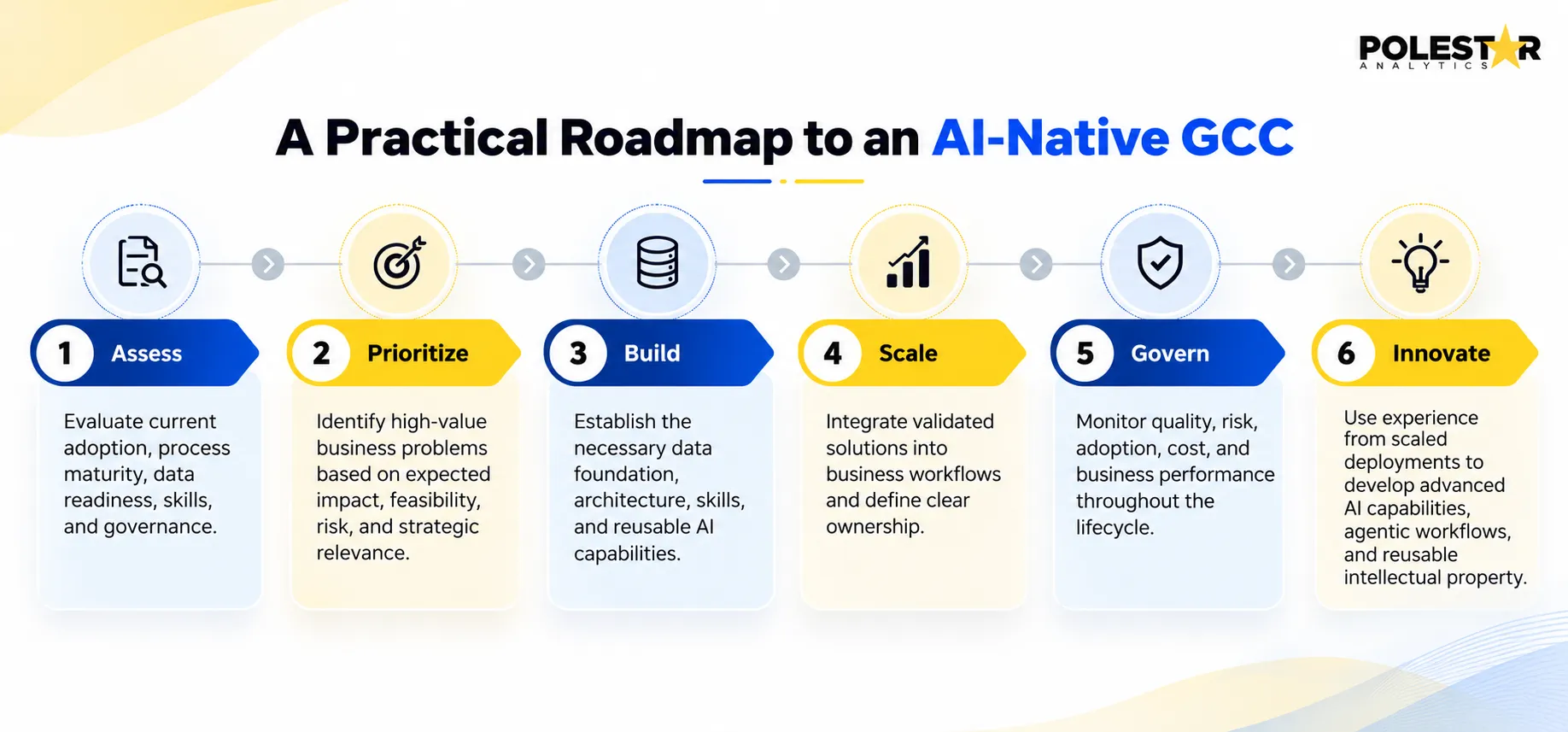
Polestar Analytics helps Global Capability Centers move from AI-enabled to AI-native by combining data engineering, AI and ML, enterprise planning, and consulting. We work with GCC leaders to build data foundations, redesign processes around AI, scale production use cases, and establish the governance and capabilities needed to turn AI from a tool into a core business capability.
Explore the Polestar Analytics GCC practice to learn more about the shift from execution to enterprise influence and get in touch to start the conversation.
Build on what works. Assess existing investments, scale successful pilots, and redesign workflows where AI can deliver greater business value. The goal is to evolve existing capabilities, not restart.
Establish shared ownership upfront. HQ defines business priorities, while the GCC contributes AI expertise and implementation capabilities. Agree on decision rights, success metrics, and accountability before redesigning workflows.
Link AI initiatives to measurable business outcomes, such as improved forecast accuracy, fewer operational errors, faster decisions, or revenue growth. Establish baseline metrics and track impact after deployment.
Fragmented data, integration challenges, unclear ownership, governance gaps, and low adoption often hinder scaling. Address these barriers early and establish a repeatable path from pilot validation to production deployment.
Ready to Take Your GCC to the Next Level?
Discover how Polestar Analytics helps Global Capability Centers strengthen their data and AI foundations, modernize operations, and move from execution to enterprise influence.
Explore Our GCC Solutions
- AI-enabled GCCs make the old organization faster. AI-native GCCs build a new one.
- Most GCCs plateau at Individual Productivity (Level 1) because they confuse tool adoption with transformation.
- Data maturity is the hard ceiling on AI maturity.
- Governance is a design principle, not a compliance review.
- The most valuable GCC talent today are connectors, not pure specialists.
- Revenue is a lagging indicator. Adoption and operational impact are the leading ones.
- The shift from "doing" to "defining" is the single biggest cultural change AI-native GCCs make.