
Summarize this blog post with:
Key Takeaways
- GCCs are no longer back-offices. They are innovation hubs — and that shift has fundamentally changed their data and AI risk exposure.
- The governance gap is structural, not accidental. 72% of organizations report integrating AI across initiatives, yet only about one-third have responsible AI governance controls in place.
- Shadow AI is a documented financial liability — adding USD 670,000 to the average data breach cost when unsanctioned tools are involved.
- A practical governance framework exists. Data architecture design, risk classification, and AI risk controls are the three pillars every GCC needs to build.
AI adoption inside GCCs is accelerating faster than governance readiness. Around 92% of GCCs in India are actively piloting or scaling AI initiatives, yet more than 70% lack mature frameworks to measure ROI, risk, or governance controls around these deployments.
The role of GCCs in enterprise AI transformation has therefore become far more consequential. What began as a cost-arbitrage model has evolved into a mandate to build and scale AI capabilities for global enterprises — and with that shift comes a level of data and regulatory exposure most GCC operating models were not originally designed to manage.
A single capability center may simultaneously process personal data governed by GDPR, CCPA, and India’s DPDP Act, 2023 — each with different consent requirements, breach notification timelines, and cross-border data transfer rules that do not naturally align.
Building a GCC framework for AI and data governance is no longer optional. Running AI workloads across jurisdictions without an architecture designed for these regulatory realities is not a sustainable risk strategy — it is simply exposure waiting to surface.
Do You Know?
The global average cost of a data breach reached USD 4.44 million in 2025. The US average hit an all-time high of USD 10.22 million in the same period. For GCCs, the jurisdiction with the strictest enforcement sets the floor — not the global average.
~ IBM, 2025
The governance gap between AI adoption and AI oversight is not a perception problem it is a documented structural gap. Despite rapid enterprise adoption of artificial intelligence, governance frameworks are not keeping pace.
While approximately 75% of organizations report using generative AI technologies, only about one-third have implemented responsible AI governance controls across the enterprise.
It indicates a substantive gap between deployment and oversight!
A data governance framework for GCC operations is not a compliance checklist. It is the operational architecture that allows GCC AI to be deployed at scale without creating unacceptable regulatory or reputational exposure. It operates across three connected layers.
Most GCCs operate a flat data architecture. Everything ingested into a central cloud repository to break down silos. When GDPR and the DPDP Act apply simultaneously to that flat architecture, a significant volume of data has typically crossed borders without the legal instruments required to support the transfer.
What needs to change — structurally:
- Data stays in its jurisdiction of origin until there is a documented legal basis to move it
- EU personal data stays in EU-region cloud instances; Indian payment data stays on RBI-compliant infrastructure
- Movement only happens after SCCs, anonymisation, or documented purpose limitation are in place
Federated learning for cross-border processing
- The model travels to the data — not the reverse
- The algorithm runs on the local server, learns, and returns only model weights — never raw records
- Dataset provenance, version, training date range, data subjects represented, known limitations
The cost trade-off to plan for: Cloud costs typically rise 15–20% when moving from a centralised to a sovereign multi-region architecture.
Multi-cloud complexity as the leading driver of unplanned cloud cost increases. Budget for this before the migration begins, not when it surfaces mid-project.
How GCCs Are Building Governed AI Capabilities at Scale
Discover how leading Global Capability Centers are implementing AI with strong governance frameworks to drive scalable and responsible innovation.
Explore GCC Services at Polestar Analytics
Governance policy documents fail when they rely on human discipline at the moment it is least available — during sprint deadlines, urgent client turnarounds, or debugging sessions. The controls need to be structural, not aspirational.
A. Shadow AI: The Risk Already Inside Your Perimeter
In a GCC context, this means proprietary source code, client financial models, and customer records are being pasted into public LLMs with no data residency controls and no audit trail. Banning tools pushes usage underground. The effective response is making the safe lane easier to use than the unsafe one.
The Secure Gateway architecture:
- Intercept layer: All LLM API calls route through a central proxy — no direct external access from developer machines
- Scrubbing layer: PII detection runs on every outbound prompt, rejecting requests containing email addresses, account numbers, or financial identifiers before they leave the network.
B. Model Explainability (XAI) — Non-Negotiable for Regulated Verticals
- Financial and healthcare GCCs cannot operate "black box" models for decisions affecting individuals
- Implement frameworks that document feature importance and decision logic at inference time — not just at model training
C. Bias Detection — Before Deployment, Not After a Complaint
- Models trained on historical data inherit historical biases
- Establish pre-deployment testing protocols to measure disparate impact across demographic groups before any high-risk model goes live
D. Continuous Model Monitoring (MLOps)
- Models drift over time — a fraud detection model effective in 2024 may produce degraded results in 2025 without flagging itself
- Meaningful governance requires continuous monitoring pipelines that trigger alerts when model performance degrades or data distributions shift
Do you know?
1 in 4 failed AI initiatives traces back to weak governance; more than half of executives report no clear approach to managing AI risk or accountability!
E. Role-Based Access Control (RBAC) on Data
- Data scientists should not have access to raw PII
- Use data masking and tokenisation; grant access only to the specific datasets required for a defined project and timeframe
Understanding how to build AI governance in GCC requires mapping where you currently are — not where the policy document says you should be. Most GCCs sit at one of three stages. Knowing which one applies determines what the next quarter should look like.
A practical self-diagnostic first: Can your organisation answer, "Which specific datasets trained your fraud detection model?" within 48 hours? If not — governance is reactive, not managed.
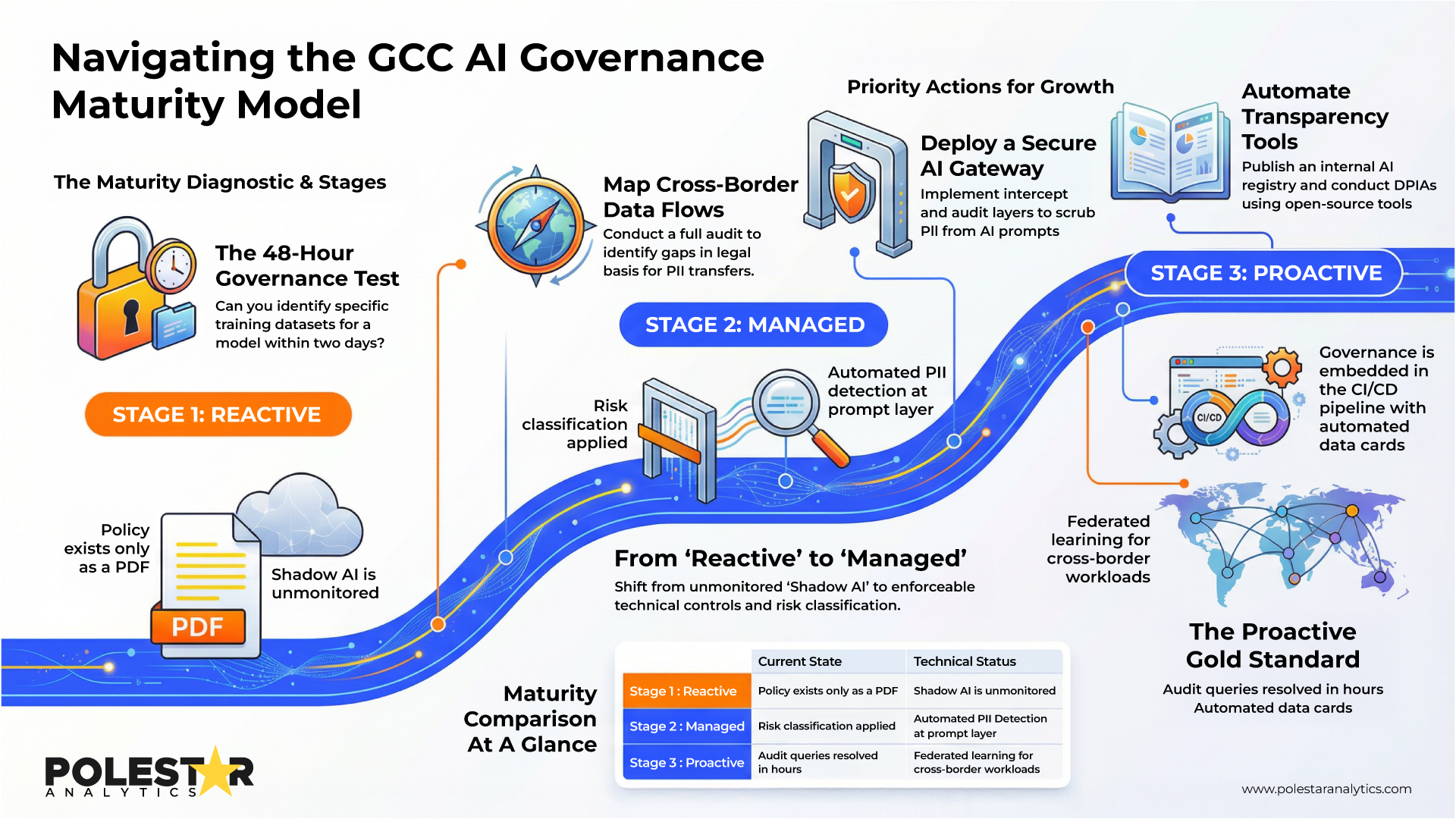
| Stage |
What It Looks Like |
Priority Actions |
| Stage 1 — Reactive |
- Governance exists only as a PDF policy document
- No documented data lineage; PII crosses borders without Standard Contractual Clauses (SCCs)
- Shadow AI unmonitored; compliance assessed post-incident
|
- Conduct a full data flow audit — map cross-border transfers and identify gaps in legal basis
- Run a shadow AI usage survey — quantify variance between IT-approved tools and actual usage
|
| Stage 2 — Managed |
- Policies translated into enforceable technical controls
- AI risk classification applied to critical systems
- Automated PII detection at prompt layer
|
- Deploy secure AI gateway (intercept + scrub + audit layers)
- Implement MLOps monitoring with model drift detection
|
| Stage 3 — Proactive |
- Governance embedded in CI/CD pipeline
- Automated Data Cards generated at ingestion
- Federated learning standard for cross-border workloads
- Audit queries resolved within hours
|
- Conduct first DPIA using CNIL open-source PIA tool
- Publish internal AI registry accessible to legal, compliance, and business leadership
|
P.S. Unless there is strong alignment between data management, regulatory obligation mapping, and technical enforcement — governance frameworks will remain policy documents that generate risk instead of managing it.
The Power of AI in Global Capability Centers
See how AI is transforming the role of GCCs—from operational support hubs to strategic innovation engines.
Discover How AI Is Reshaping GCCs
The role of GCC in enterprise AI transformation is shifting from execution partner to strategic capability hub. That shift only delivers long-term value if the governance architecture underneath it is built to handle the regulatory, operational, and reputational weight of operating GCC AI at scale.
Governance is not what limits speed. It is the infrastructure that makes speed sustainable. Without it, regulatory risk forces caution at every deployment decision. With it, GCCs can ship high-impact models with confidence.
For organisations evaluating how to move from reactive policy documents to structurally embedded AI governance, independent expertise often accelerates the transition. Polestar Analytics work specifically at the intersection of GCC operating models, AI architecture, and regulatory alignment — helping enterprises design sovereign data architectures, implement AI risk controls, operationalise MLOps governance, and scale AI programmes across jurisdictions without fragmentation.
When governance, data engineering, and AI delivery are aligned by design rather than retrofitted after incidents, GCCs move from being innovation centres in ambition to innovation centres in execution.