
Sammanfatta detta blogginlägg med:
| Marketing mix modeling (MMM) measures how each marketing channel and business driver contributes to sales, using aggregate historical data. |
TL;DR
Marketing Mix Modeling (MMM) is a statistical approach that uses historical media, sales, pricing, promotional and external data to assess the effectiveness of a given media channel or business driver on sales or revenue. It helps marketing teams measure channel performance, evaluate marketing investments and forecast the effects of future investment.
Aside from driving brand value and promotion, marketing and sales work closely together to drive more business, attract more customers and ultimately increase revenue and growth. However, marketers face the ongoing challenge of effectively allocating fixed marketing budgets across a multitude of traditional and digital marketing channels. To accurately gauge the impact of each channel on sales, the development of robust marknadsföringsmodellerabsolut nödvändig.
Marketing mix modeling shows which channels truly drive sales, helping marketers allocate fixed budgets as channel choices keep multiplying.
But why is that? Is it because there is a scarcity of marketing channels? No. It is because of the abundance of them. As Jay Baer, a noted marketing expert, once said: "A successful marketing strategy is not about being everywhere, but about being where it matters most."
This is where Marketing Mix Modeling plays a vital role. Companies are increasingly recognizing the importance of understanding the relationships between marketing inputs and their outcomes in terms of sales, market share and kundbeteende.
That need has sharpened. Privacy rules and policies such as Apple's App Tracking Transparency have thinned user-level data, and Meta narrowed click-through attribution to actual link clicks in March 2026. Meanwhile, Google's open-source Meridian and the IAB's Modernizing MMM guide have lowered the barrier to entry, and 46.9% of US brand and agency marketers plan to invest in MMM over the next year, per a TransUnion survey reported by eMarketer.
Easier access, however, does not make the method simpler, and its value still depends on how the process is designed. Marketing Mix Modeling is a multi-step process driven by the marketing effects being analyzed. It serves as a bridge between parameters such as marketing spend and sales achieved, eventually improving the avkastningen på investeringen across marketing activities.
MMM links marketing spend to sales by separating incremental drivers from base demand, then uses that split to guide budget decisions.
MMM works by segregating business metrics into parts to better analyze the marketing channels. It distinguishes marketing and promotional activities, the incremental drivers, from base and other drivers. With an ideal MMM solution, the impact of individual marketing activities on revenues, volumes and prices of products sold in the market can be measured.
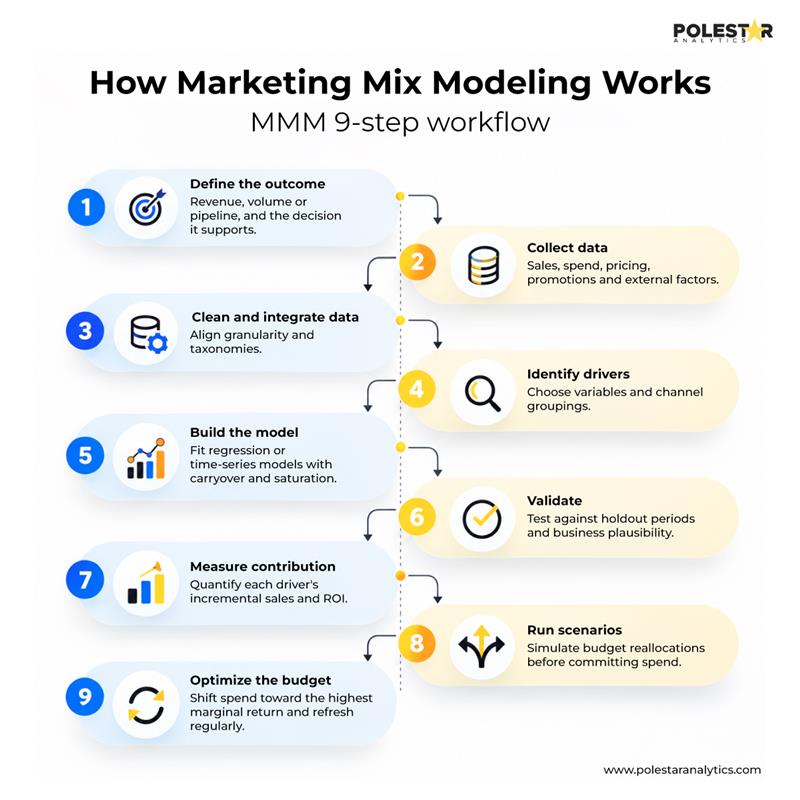
In practice, that multi-step process follows nine stages:

- Define the outcome: revenue, volume or pipeline, and the decision it supports.
- Collect data: sales, spend, pricing, promotions and external factors.
- Clean and integrate data: align granularity and taxonomies.
- Identify drivers: choose variables and channel groupings.
- Build the model: fit regression or time-series models with carryover and saturation.
- Validate: test against holdout periods and business plausibility.
- Measure contribution: quantify each driver's incremental sales and ROI.
- Run scenarios: simulate budget reallocations before committing spend.
- Optimize the budget: shift spend toward the highest marginal return and refresh regularly.
Of everything that process produces, the most consequential output is the split between what marketing caused and what would have happened anyway. Marketing mix modeling decomposes total revenue into base revenue and incremental revenue. It then identifies the factors affecting incremental revenue and quantifies their individual impact.
| Total Sales = Base Sales + Incremental Sales |
Base sales come from brand equity, distribution, habit, seasonality and market trends. Incremental sales are the added volume caused by media, promotions, pricing and trade spend. This is why a channel that looks strong in platform dashboards, such as branded search, can turn out to be mostly capturing existing demand. One nuance: base is not purely organic. Years of brand media built it, so short measurement windows tend to undercredit brand investment.
A clean base-versus-incremental split does not come from regression alone. Marketing effects rarely land in the week they are paid for and rarely scale in a straight line, so modern MMM layers six concepts on top of the core model.
Adstock, saturation, seasonality, baseline and elasticity decide whether an MMM model reflects market reality or simply fits historical noise.
| Concept |
What It Means |
Why It Matters |
| Adstock / Carryover |
Marketing impact persists after the original spend occurs |
Ignoring it undervalues TV, video and brand media |
| Saturation / Diminishing Returns |
More spend does not produce proportional incremental sales |
It shows where the next dollar returns less than it costs |
| Seasonality |
Separates recurring seasonal demand from marketing effects |
It stops peak-season media from taking credit for the calendar |
| Baseline vs Incremental Sales |
Separates underlying demand from marketing-driven contribution |
It is the foundation of any honest ROI calculation |
| Marketing Elasticity |
Measures response to changes in marketing investment |
It shows how sensitive demand is to each lever |
| Scenario / What-if Analysis |
Tests potential budget reallocations |
It de-risks decisions before money moves |
Expert POV: Decay rates and curve shapes are assumptions as much as outputs. Different adstock settings on identical data can reorder channel rankings, so transparency matters as much as model form.
These same concepts explain why MMM answers different questions than the attribution tools most digital teams already rely on. The three methods are often positioned as rivals, but each works at a different level of the business.
MMM guides strategic budget splits, attribution guides tactical digital moves, and incrementality tests prove causality. Mature teams use all three.
| Dimension |
Marketing Mix Modeling |
Multi-Touch Attribution |
Incrementality Testing |
| Data level |
Aggregate (channel, week, geo) |
User or journey level |
Test vs control groups or regions |
| Core question |
How should budget be split? |
Which touchpoints preceded conversion? |
Did this activity cause additional outcomes? |
| Offline channels |
Covered |
Largely not covered |
Covered if designed for them |
| Privacy dependency |
Low |
High |
Low to moderate |
| Causality |
Statistically estimated |
Correlational |
Strongest evidence |
| Main weakness |
Needs history; struggles with correlated channels |
Overcredits the lower funnel |
Costly; one question per test |
Triangulation is now the working standard, though the three are not trusted equally. In Haus's 2026 Marketing Decision Confidence Index, reported by EMARKETER, 60% of US senior decision-makers trusted independent incrementality testing most, ahead of media mix modeling at 40% and in-platform reporting at 37%. MMM earns its place by covering what experiments cannot test continuously, but teams need a pre-agreed rule for when the lenses disagree.
That need for a single cross-channel view is sharpest in retail. In the era of seamless consumer experiences, multi-channel retailing has become the norm. Customers interact with brands through numerous touchpoints, moving effortlessly from physical stores to online platforms and social media. While this offers greater opportunities for engagement, it also makes it harder to accurately assess the impact of individual marketing initiatives.
For multi-channel retailers, MMM measures marketing impact across stores, e-commerce and social, balancing traditional and digital channels.
MMM addresses this challenge by providing a holistic view of marketing effectiveness across channels. It helps retailers allocate resources optimally, ensuring marketing effort is channeled toward the strategies that yield the highest ROI. With these insights, multi-channel retailers can fine-tune their strategies and strike the right balance between traditional and digital channels to create a seamless customer journey.
A deeper view of this use case is available in marketing mix modeling for multi-channel retailers, while manufacturer-side applications are covered in marketing mix modeling for CPG and retail.
Unlock the power of connected data models to drive smarter distribution and dynamic recommendations, fueled by accurate forecasts.
Optimize Insights
Beyond channel balance, the real value of MMM shows up in the decisions it enables at the leadership level. CMOs use marketing mix modeling to make data-based budget allocation decisions. The insights allow them to divide limited resources efficiently and direct investment toward the channels that deliver the highest return.
MMM helps CMOs run what-if analysis, find performance drivers, weigh trade-offs and quantify each marketing variable's revenue impact.
 "Marketing mix modeling (MMM) is a time-tested method for measuring the impact of your marketing." - Chief Analytics Evangelist, Google
Four strategic outcomes stand out:
- Performs What-if Analysis. MMM allows CMOs to predict the potential revenue effects of specific marketing actions before executing them. These simulations reduce the risk of untested initiatives.
- Identifies Performance Drivers. MMM identifies the factors that made a particular campaign or channel successful, and it surfaces the discrepancies and hurdles holding others back. By analyzing historical data, marketers can pinpoint the elements with the greatest impact on sales and business outcomes. For example, a clothing retailer might discover that social media advertising and personalized email campaigns have a substantial influence on customer engagement and conversion rates, allowing it to focus effort on these high-performing channels.
- Uncovers Synergies and Trade-offs. MMM reveals the interplay and trade-offs between marketing variables, showing how a change in one part of the mix might affect others. For example, increasing advertising expenditure may lead to higher sales, but at the expense of profit margins. This helps businesses balance short-term gains against long-term sustainability.
- Quantifies the Impact of Marketing Variables. Building on the base-versus-incremental split, MMM quantifies each driver's individual contribution and compares the ROI of different channels in the marketing budget. Through statistical analysis, it measures the relationship between marketing variables and revenue, showing the extent to which each element contributes to revenue growth.
Delivering these outcomes depends on how the model is built. Before any model form is chosen, six techniques do most of the heavy lifting, from getting the data right to keeping the model accurate over time.
Core MMM techniques include data integration, time series, regression, elasticities, calibration with attribution data and ongoing validation.
| Technique |
How It Works in MMM |
| Data Collection and Integration |
The foundation of a successful MMM lies in collecting and integrating data from various sources, including sales data, marketing expenses and relevant variables such as economic indicators. For multi-channel retailers, this means gathering data from in-store sales, e-commerce platforms, social media analytics and more. |
| Attribution and Experiment Calibration |
MMM does not assign credit touchpoint by touchpoint the way first-touch, last-touch or algorithmic attribution does. Instead, attribution and lift-test data are used to calibrate and validate MMM estimates, so the two views reinforce rather than contradict each other. |
| Time Series Analysis |
Because marketing efforts and business outcomes are time-dependent, time series analysis examines data over specific periods to identify patterns, trends and seasonality, accounting for variations in consumer behavior across times and seasons. |
| Regression Analysis |
Regression quantifies the relationship between marketing inputs and outputs. It identifies how changes in one variable affect another, showing the elasticity of demand in response to marketing activities. |
| Marketing Elasticities |
Elasticity is the sensitivity of demand to changes in marketing variables. Calculating price elasticity, promotion elasticity and cross-channel elasticities shows how consumers respond to different strategies. |
| Testing and Validation |
The effectiveness of MMM hinges on accurate prediction. Models are trained on historical data and validated against actual outcomes, and regular testing keeps them accurate and up to date. |
Learn how to optimize your promotions for maximum impact and sustainable growth to drive smarter decisions!
Techniques define the inputs, but the model form decides how those inputs combine. While the need for and impact of an effective MMM are unarguable, most marketers remain unsure of how to build a marketing mix model. MMM regression adopts multiple linear regression (MLR) principles to analyze and predict marketing patterns.
Regression MMM is simple to explain, multiplicative models capture channel synergies, and Bayesian MMM handles sparse data and calibration.
Regression Models
Regression models are statistical tools that identify the relationship between marketing inputs, such as advertising expenditure, pricing and promotions, and key performance metrics such as sales and revenue.

Regression models act as a magnifying glass that zooms in on the individual impact of each marketing ingredient. The model analyzes historical data and reveals the hidden patterns that connect advertising spend, pricing strategies and promotions to sales and revenue. It also facilitates what-if analysis to predict the impact of various marketing variables on revenue and helps companies form an optimum mix.
Despite these benefits, regression models become difficult to manage as marketing variables grow more complex. They cannot easily incorporate complex media interactions, because those interactions introduce nonlinearities into the model.
Multiplicative Regression Models
Multiplicative regression models take the analysis a step further by considering the interactions and synergies between marketing variables. They account for the fact that marketing inputs often work in combination rather than in isolation.

Multiplicative models are designed to overcome the limitations of the linear model. Because the independent variables (IDVs), meaning the marketing and business drivers, are multiplied together, they offer a more realistic representation than additive linear models. They are particularly useful when interactions between marketing variables are complex and nonlinear, giving a more nuanced understanding of how marketing elements influence each other's effects on the outcome. The trade-off is interpretability: contribution by driver is less straightforward to decompose.
Bayesian MMM
Bayesian approaches, the basis of Google's Meridian, combine data with prior knowledge such as experiment results and report uncertainty ranges instead of point estimates. The counterpoint is that priors are assumptions and can steer results toward what stakeholders expect. Nonlinear and AI-driven approaches extend this further, as covered in the ebook on advanced marketing mix modeling and AI.
Whichever form is used, each model shows how marketing efforts affect sales and other KPIs, guiding informed decisions and better-optimized strategies.
Model choice matters most when it changes where money goes. A SaaS deployment shows how regression-based MMM translated into concrete budget decisions.
A SaaS company was putting nearly 35% of revenue into marketing, split between trackable digital channels and unmeasurable ones like newspapers, TV and partner events. Platform dashboards covered only half the spend, CAC sat above industry standard, and no one could say which half was working.
Polestar Analytics unified the fragmented spend and revenue data, then modeled every channel on the same footing. That single view was the unlock: it showed which channels generated incremental demand and which were taking credit for pipeline that would have closed anyway. Scenario analysis then let the team test reallocations on paper before moving a dollar of budget.
Redirecting spend away from the low-impact channels produced 19% higher marketing ROI, 10% lower CAC and 25% better campaign-effectiveness prediction, turning budget reviews from opinion into evidence.
Results like these are achievable but not automatic. Every MMM carries constraints that practitioners need to plan around, and acknowledging them upfront is what builds trust with finance.
MMM needs rich history, clean data and sound assumptions, and struggles with correlated channels. Calibration and regular refreshes offset most gaps.
- It requires two or more years of data with meaningful spend variation.
- It is sensitive to data quality, such as unflagged stockouts.
- Results depend on model assumptions such as adstock decay, saturation shape and priors.
- Correlation does not automatically establish causation without experimental calibration.
- Aggregate models cannot answer individual-user questions.
- Models require ongoing validation and recalibration.
- Highly correlated channels make contribution difficult to separate.
None of these is a reason to avoid MMM. They are the reason to run it as a governed, calibrated system rather than a once-a-year study.
That shift from study to system is where most of the value leaks. EMARKETER's 2026 media mix modeling outlook found that only 28% of marketers call their organization very effective at turning MMM insights into action, which is a gap in operating rhythm rather than in modeling.
That shift from study to system is where lasting value comes from. At the end of the day, relying on data-led solutions is the logical way to gather reliable insights and predict market trends.
Marketing mix modeling delivers the most value when it runs as a governed, data-led system tied directly to planning and budget cycles.
Marketing mix modeling solutions are not just a tool; they are the compass guiding smarter marketing investment across every channel. For organizations looking to anticipate future outcomes with predictive analytics, a trusted partner like Polestar Analytics can be the key that unlocks more insightful decision-making.
- Marketing mix modeling (MMM) uses aggregate historical data to measure the impact of marketing on sales and revenue.
- An MMM model separates base sales from incremental sales driven by marketing and commercial levers.
- Regression and time-series methods are the most common marketing mix modeling techniques.
- MMM analysis supports budget allocation, what-if scenarios and marketing mix modeling optimization.
- Modern marketing mix modeling captures nonlinear effects such as adstock (carryover) and saturation.
- MMM differs from user-level attribution because it works at an aggregate level.
Marketing Mix Modeling isolates media effects from promotion, price and baseline demand, which is where most trade dollars are lost. The harder finding is usually that a large share of promoted volume is subsidized base, not incremental. Reallocation decisions should follow marginal ROI by channel, not average ROI, because saturated channels reverse first.
Aggregate modeling puts TV, retail media, stores and e-commerce on one footing, which is the only way to see cross-channel halo effects. In practice, multi-channel retailers find upper-funnel media credited to branded search by attribution. The constraint is collinearity: channels that always flight together cannot be cleanly separated without deliberate variation or geo holdouts.
It decomposes sales into baseline and incremental contribution by driver, so a volume spike can be traced to media, price, promotion, distribution or seasonality. The caution worth carrying into leadership reviews is that baseline drifts upward with sustained brand investment. Short modeling windows will misread that drift as organic demand.
Media, price and trade are usually optimized by separate teams against separate targets. Modeling them together in one revenue growth management framework exposes the trade-offs, such as advertising that lifts volume while discounting erodes the margin it earned. The next dollar then gets allocated on profit contribution rather than departmental ROI.
Response curves let teams simulate reallocations before committing spend, with the useful output being the point where each channel stops returning its cost. Scenarios only change budgets when they enter enterprise planning cycles on the planning calendar. Off-cycle model outputs become interesting reading and rarely move money.