 KaifInsiktsarkitekt
Registrera dig för att få de senaste insikterna och uppdateringarna inom teknik, AI och dataanalys, datavetenskap och innovationer från Polestar Analytics.
 Sammanfatta detta blogginlägg med:
Redaktörens anmärkning: This article is part of Polestar Analytics’ commercial-excellence series for life sciences. Impact ranges reflect outcomes observed across Polestar Analytics engagements and the firm’s published analysis; third-party figures (Deloitte, McKinsey) link to their original sources. Further reading: our take on why AI in pharma stalls
TL; DR — Traditional HCP segmentation is rebuilt once a year on prescription volume alone, so the target list is stale for much of its life. For teams evaluating hcp segmentation in pharma industry, this provides a practical roadmap from static lists to living intelligence. Agentic AI turns it into a continuous, self-service system that unifies data, scores every HCP, predicts behaviour, and recommends the next best action & learns from the result. HCP segmentation in Pharma is no longer just about ranking physicians by volume; it is about understanding who to engage, when to engage, and through which channel. This guide explains what modern HCP segmentation is, why legacy models fail, the five-step framework that replaces them, and the business impact teams report.
Mestkommersiella läkemedelsteamsitter på mer hälso- och sjukvårdsdata än de någonsin haft, och använder en bråkdel av den. Förskrivningsflöden, reklamationer, CRM-anteckningar, e-postöppningar, betalarfiler. Allt detta strömmar in, medan hälso- och sjukvårdssegmenteringen som avgör var säljare tillbringar sin vecka fortfarande byggs om en gång om året och rankas främst utifrån receptvolym. Det är därför hälso- och sjukvårdssegmenteringen för läkemedelsföretag måste bli mer dynamisk, datadriven och kopplad till dagliga fältbeslut.
Det gapet är dyrt.Deloittes prognos för Life Sciences 2026,32 % av cheferna inom biofarmabranschen angav kundengagemang som ett betydande problem, och nästan hälften nämnde en accelererad digital transformation som en avgörande trend för året. Problemet var aldrig att samla in data utan att agera utifrån den innan tillfället är ute.
Traditionell segmentering av hälso- och sjukvårdspersonal inom läkemedelsindustrin misslyckas eftersom den byggs en gång om året enbart på receptvolym, medan hälso- och sjukvårdens beteende, kanaler, varumärkesdynamik och betalarmix förändras kontinuerligt. Så listan är föråldrad under en stor del av sin livstid, och representanter agerar utifrån inaktuella prioriteringar. Det är därför hälso- och sjukvårdssegmentering inom läkemedelsindustrin måste gå bortom årliga deciler och in i kontinuerligt uppdaterade beslutssystem.
Ställ några ärliga frågor om din nuvarande segmenteringsuppsättning så visar du sprickorna. De flesta äldre ramverk för HCP-segmentering har samma begränsningar:
These HCP segmentation challenges surface as missed prescribers, wasted promotion, and reps calling on physicians who were never going to switch. Industry estimates put the annual toll of fragmented data and delayed insights above $150 billion. And it’s rarely a tooling shortage: across industries, McKinseys senaste undersökning om AI:s tillståndfann att 88 % av organisationerna nu använder AI någonstans, men bara cirka 6 % får verkligt värde av det. Begränsningen är att operationalisera det.
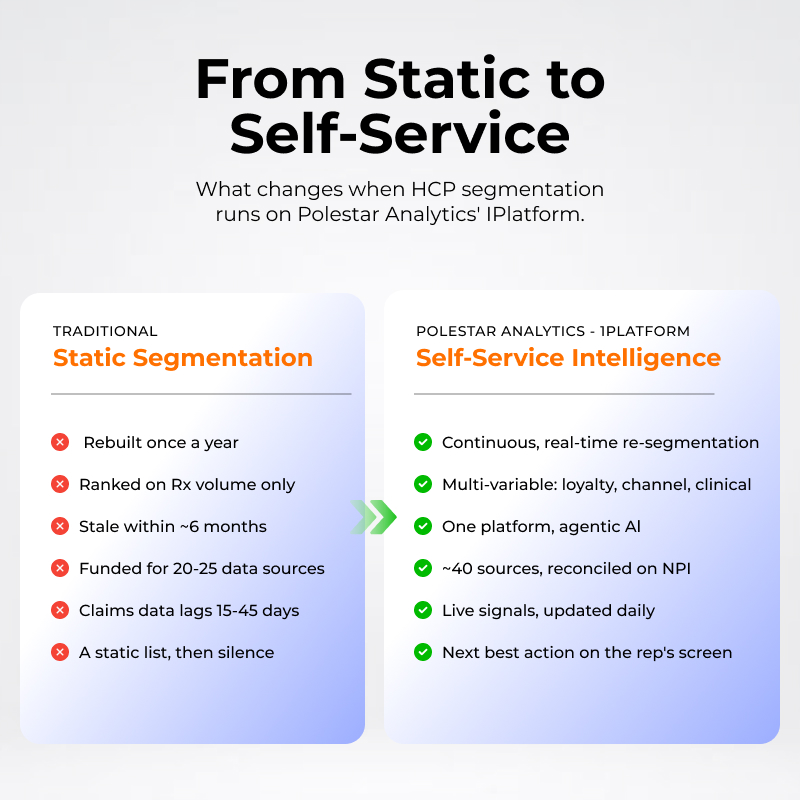
Kort sagt:Agentic AI använder segmentering som kontinuerligt fungerar i en loop. Agenten kan känna av en ny eller föränderlig signal, avgöra om signalen är ny eller har förändrats, ge en handlingsbar rekommendation baserat på analysen och sedan lära sig av resultatet. Jämfört med traditionell segmentering som bara uppdateras årligen och kan ta tid (vanligtvis veckor) innan en rekommendation kan ageras utifrån.
Skiftet låter enkelt men ganska svårt att genomföra. Från statiskt till självbetjäning. Snarare än ett kvartalsvis projekt som datavetenskapen överlämnar till fältet, blir HCP-segmentering inom läkemedelsindustrin ett levande system. Traditionella modeller segmenterar en gång och reagerar inom några veckor; agentbaserad AI känner av, beslutar, agerar och lär sig dagligen, vilket är viktigt eftersom kanalbeteende, varumärkesdynamik och patientmix också förändras dagligen.
I praktiken behöver det systemet finnas på ett ställe.Polestar Analytics 1Platform, data, models, and recommendations sit in a single governed environment, and agentic AI pushes the next best action straight to a rep’s screen rather than into a dashboard nobody opens. We call the layer that runs continuously across this environment the Agentic Brain — and the two-minute walkthrough below shows what it looks like when a sales rep opens 1Platform in the morning.
De team som vinner nästa lanseringscykel kommer inte att vara de med mest data – de kommer att vara de som omvandlar den till ett dagligt beslut. Segmentering måste bli ett operativsystem, inte en årlig kortlek.
Ett hållbart ramverk fungerar som fem sammankopplade steg, där vart och ett drivs av en specialbyggd AI-agent snarare än en stapel av frånkopplade verktyg.
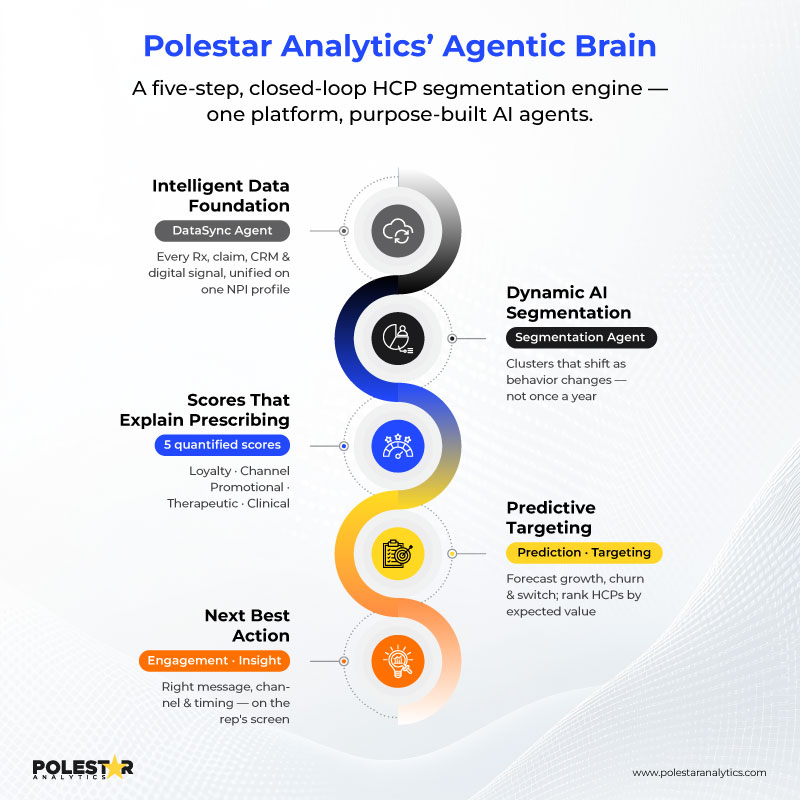
Den sista loopen är det som skiljer en rapport från ett system: varje åtgärd leder till nästa beslut, så modellen blir skarpare ju mer fältet använder den. För den bredare strategin gäller detta.e-bok om typer, användningsfall och arbetsflöden av agent-AIgår igenom hur dessa agenter passar ihop.
Kort sagt:Team som övergår till dynamisk, AI-driven segmentering rapporterar betydligt högre recept i prioriterade segment, mindre bortkastad marknadsföring, snabbare beslut och fler konverterade icke-författare – eftersom ansträngningar följer evidens istället för förra årets deciler. För kommersiella team blir hcp-segmentering för läkemedelsföretag som mest värdefull när den direkt förbättrar målgruppsinriktning, engagemang och receptresultat.
När ett kommersiellt team gör denna förändring, ökar vinsterna i hela tratten:
| Läs mer: den självbetjänande AI-agentplattformen för HCP-segmentering inom läkemedelsindustrin→ |
Vad skulle det vara värt i år att upptäcka en stigande förskrivare 60 dagar i förtid, eller att minska en tredjedel av dina utgifter från fel mål?
Många leverantörer säljer en del av detta. Polestar Analytics levererar hela motorn på en plattform. Agentur-AI, domändjup inom life science och leverans till sista milen: realtid istället för periodisk, multivariabel istället för volymbaserad, företagsklass för både topp 20 och nya varumärken. För organisationer som moderniserar sig.hcp-segmentering inom läkemedelsindustrinPolestar Analytics sammanför datagrunden, AI-agenter och exekveringslagret.
Prata med våra experter på läkemedels-AIom din färdplan för HCP-segmentering, ellerladda ner läkemedelsguidenför att se spelboken i aktion.
Decil- och ABC-modeller rangordnar vårdgivare nästan uteslutande baserat på tidigare volym och uppdateras enligt en fast kalender. Dynamisk segmentering lägger till beteende-, kanal- och prediktiva signaler och uppdateras kontinuerligt, så att en snabbt växande förskrivare inte sitter på en låg nivå i ett år innan någon agerar utifrån det.
Många program använder 20 till 25 signaler eftersom det är vad budgetar tillåter, men för en komplett bild behöver man vanligtvis närmare 40 – bland annat receptbelagda signaler, reklamationer, CRM, digitala signaler, betalare och KOL-signaler. Poängen är inte volym för dess egen skull; brister i källavläsningen är där felen i målgruppsinriktningen uppstår.
Traditionell segmentering uppdateras vanligtvis bara en eller två gånger om året, men en betydande andel av vårdpersonalen byter segment inom cirka sex månader. Att köra inmatning, klustring och poängsättning kontinuerligt på en plattform avslutar den processen till nära realtid – och nya eller specialiserade team kan hantera det snabbare än en helt anpassad version.
Det är ett mått på 0–100 som visar hur responsiv en läkare är för varje kanal – e-post, e-postkontakt, webbseminarier, fältsamtal, besök med MSL. Att poängsätta den per vårdgivare visar inte bara om man ska kontakta någon utan var, så att en digitalt fokuserad förskrivare inte får personliga besök som de aldrig kommer att acceptera, medan budgeten tas från någon som skulle göra det.
Nej, det skärper det. Agenterna hanterar analysen (vem som ska träffas, vad och när) så att representanterna kan lägga sin tid på de samtal som flyttar recept, med nästa bästa åtgärd levererad i deras befintliga arbetsflöde snarare än en separat instrumentpanel.
Om författaren
Insiktsarkitekt
Det finns inga osäkerheter, bara möjligheter och sannolikheter som formas till bevis genom data.
Relaterad blogg
 Astha Chadha