
Vat dit blogbericht samen met:
| Wealth management decision intelligence transforms disjointed custodian, CRM, and billing information into prioritized and governed decisions, so that advisors choose rather than reconcile. |
US$140 billion came off the market value of publicly traded wealth managers earlier this year on one product announcement: an AI-powered tax planning feature built into an advisor desktop. BCG reads that reaction as a verdict that AI is a structural story for this industry, not an incremental one. What sits underneath it is unglamorous: whether a firm can turn its own data into a decision fast enough to matter.
TL;DR
- Reporting tells you what happened. Decision intelligence tells you what to do next, who owns it, and what it is worth.
- Deloitte's staged model puts adviser productivity uplift at roughly 32% with assistive AI and about 103% at AI-native maturity, with the technology stack one of three deciding levers.
- Polestar Analytics' WealthPulse targets six-week deployment against a build that conventionally runs six months.
Reports are backward-looking; someone needs to interpret and then take action on it.
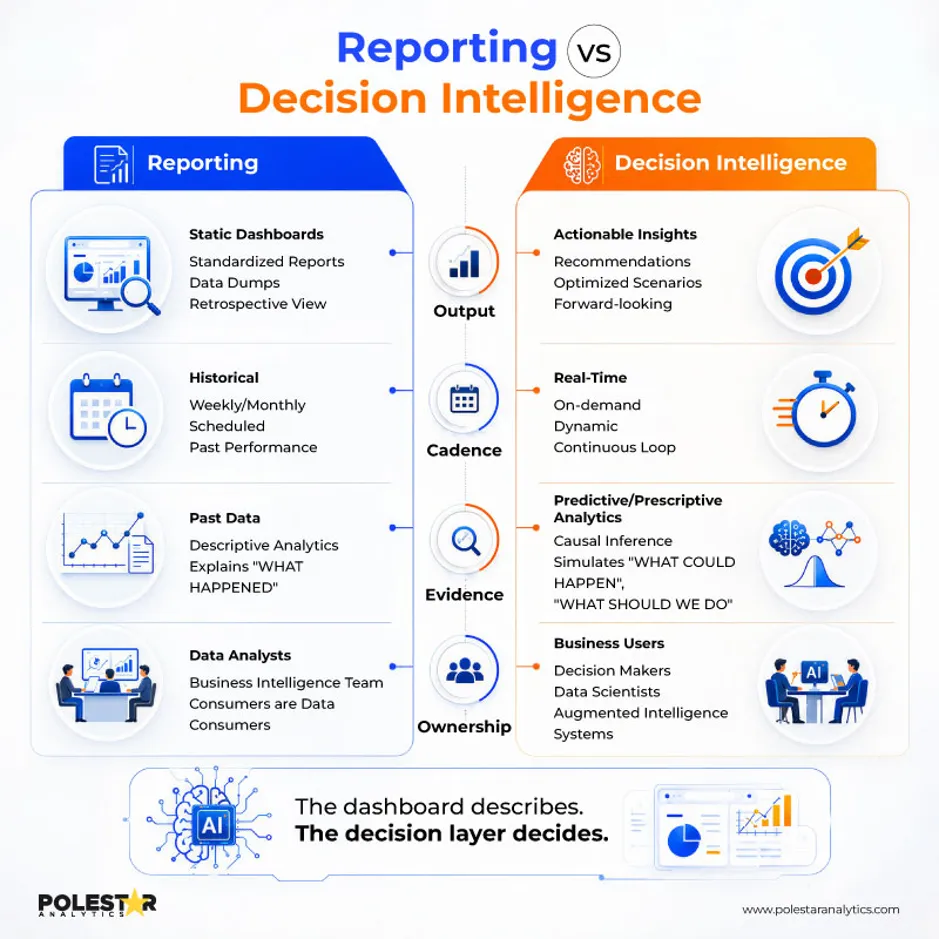
Decision intelligence is the discipline of engineering decisions as a managed asset. It applies data, analytics, and AI not to produce information but a specific choice: what should be done, by whom, worth how much, on what evidence. Where business intelligence ends at the insight, decision intelligence continues through the action and captures the outcome, so the next decision is better informed.
What is the difference between reporting and decision intelligence? Four things:
- Output: a chart becomes a recommended action with a quantified impact
- Cadence: periodic becomes continuous
- Evidence: single-source becomes composite, cross-source truth
- Accountability: interpretation moves from the analyst to a governed, auditable system
The test: an observation without a named action and a number is not a finished insight. That is the argument behind agentic BI replacing dashboard sprawl.
Three 2026 findings, from three separate firms, converge:
The capacity math has broken. According to Deloitte, advisers devote close to 70% of their time to behind-the-scenes work rather than client engagement, and it projects productivity uplift of 30% to 100% by 2032, expanding industry capacity by the equivalent of US$10 to US$35 trillion in additional client assets. (Deloitte, May 2026)
Data architecture decides who captures it. BCG is blunt: firms with unified data and modern architecture scale AI rapidly, while those with fragmented, siloed systems struggle to move beyond pilots no matter how clearly they see the opportunity. Its recommendation is a decoupled data layer serving curated, API-accessible data to agents, with actions governed by deterministic control layers. (BCG, May 2026)
Value is migrating to control points. McKinsey's reading of the same sell-off puts advantage with permissioned data, compliance-grade auditability, and execution rails rather than with producing outputs. Its January outlook adds demographic pressure: nearly 40% of advisors are expected to retire within a decade, while US$14 trillion passes to Gen X and US$8 trillion to millennials. (McKinsey, April 2026)
More dashboards will not close a capacity gap that size.
For most RIAs, firm truth sits across five or more custodians, a CRM, billing, market data, and KYC, each in its own schema. It surfaces in four places:
- Portal-hopping. Advisors open three to five custodian interfaces for one household view, none sharing a client identifier
- Unanswerable cross-source questions. Client profitability and revenue at risk need custodian, CRM, and billing data joined, so no one system answers them
- Downstream data quality. Exceptions surface in client conversations, because reconciliation logic sits in someone's head
- Lagged leadership signal. Performance and attrition risk arrive a quarter late, after intervention was cheap
Fragmentation is measurable. Deloitte quantifies the penalty: siloed systems cap adviser productivity uplift near 32%, integrated copilots reach about 57%, a unified data layer roughly 103%. That 71-point spread is an architecture decision, not an adoption problem, and it is what Polestar Analytics addresses through Data Nexus and its BFSI practice.
WealthPulse is a decision architecture, not a reporting tool.
Layer 1: Unified Wealth Management Data. Pre-built connectors to Pershing, Fidelity, Schwab, BNY Mellon, and Apex, plus billing, CRM, and market data, mapping to a canonical bronze, silver, gold model on arrival, natively on Databricks, Microsoft Fabric, Snowflake, or Azure. The golden entity is the household, firm-defined rather than universally identified, aggregating account to advisor to firm. That spine makes cross-custodian questions answerable.
Layer 2: Wealth Management Analytics and KPIs. Predefined transformations produce 20 to 30 industry-standard KPIs out of the box, from a larger catalogue. Because different KPIs need different source combinations, the platform surfaces which are unlocked by what is connected. Wealth management analytics becomes a sequence, not a catalogue.
Layer 3: AI-Powered Decisions and Actions. Named findings, not charts: which households drift from target allocation, which accounts hold idle cash and how long, where tax-loss harvesting clears the wash-sale window, which fee tiers leak revenue. Agents cover attrition risk, household risk, and meeting prep, and every finding carries an action and a number. Without both, it is not a finished insight.
On the six-week figure. That is Polestar Analytics' own benchmark, not third-party research. It is measured against a conventional RIA build, which is a data engineering project first: mapping custodian formats to a firm-specific schema, resolving accounts to households by hand, defining each KPI in code, then rebuilding when a custodian is added. WealthPulse ships that scaffolding, so work starts at the KPI, not the schema.
Every buyer assembles one thread to test whether the picture holds:
- A custodian feed lands and maps to the canonical model overnight
- Household aggregation shows a position above the concentration limit
- The finding surfaces with a quantified exposure and a recommended action
- The advisor accepts, defers, or overrides, and the reason is captured as the audit record
Step four is load-bearing. Under SEC and FINRA supervision expectations, "the model said so" is not a defence: the firm must reconstruct who saw what, when, and why. An override reason with lineage back to source data is that reconstruction.
Each persona sees only their end: operations get pipeline exceptions, advisors get concentration and idle-cash flags, leadership gets retention and fee trends. Against Tamarac, Orion, Black Diamond, and generic BI, the differentiator is pre-built domain logic, a principle running across Polestar Analytics' 1Platform portfolio.
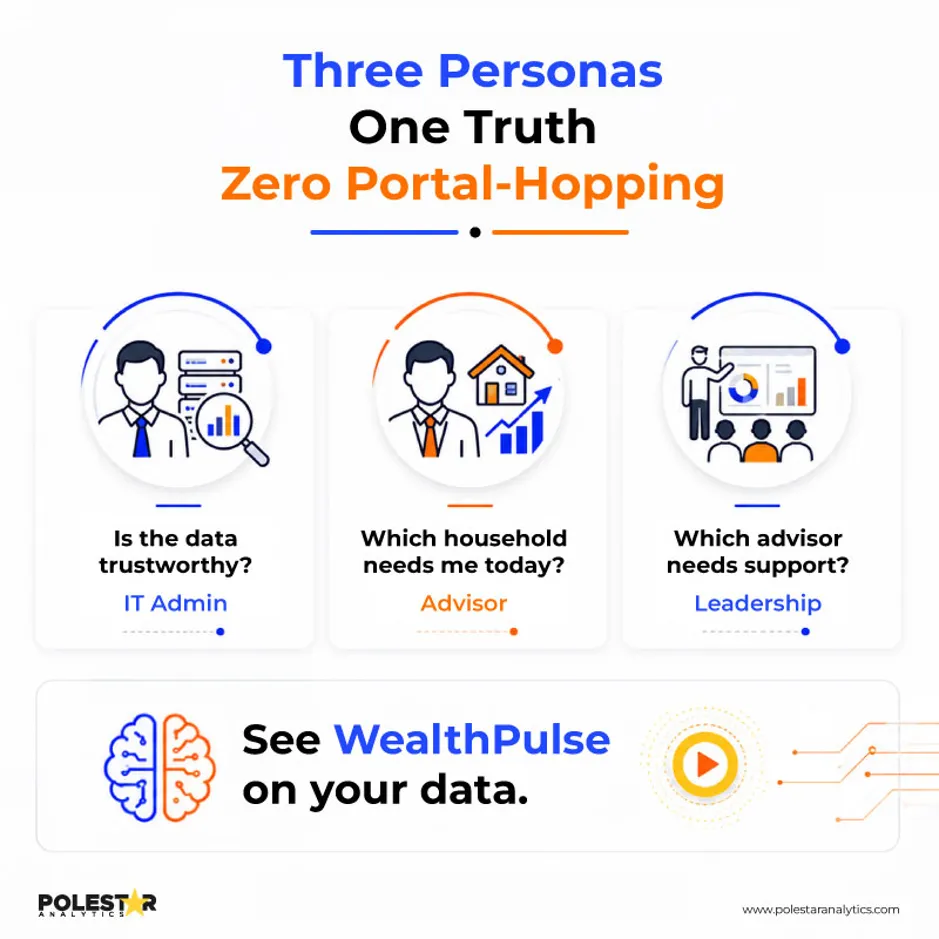
The firms that struggle here are rarely short of dashboards. What they lack is one place where a number turns into a decision with an owner, a value, and a record. BCG's framing is the useful one: fragmented tools will not close the productivity gap, and no amount of visualisation substitutes for a data layer that can be acted on.
The team. Once daily decision volume exceeds what a human can read and act on, another chart lengthens the queue. A decision layer shortens it by pre-ranking and routing. The binding constraint at scale is attention, not information.
By treating governance as architecture, not policy: lineage from source to KPI, role-based access, human review on consequential actions, captured override reasons. Agent actions are governed by deterministic control layers rather than by the model alone.
WealthPulse needs a ready gold layer, not a specific vendor's platform. Where a firm has one, the app lands on it. Where it does not, that layer is built inside the engagement, not ahead of it.
By moving interpretation into the system. KPI readiness shows where analytical return is highest, cross-source metrics answer what no one system can, and findings arrive ranked, so attention lands on the highest-value household first.
- Decision intelligence commits, reporting only describes. The output is a named action with a number and an owner.
- Fragmented data caps AI value. Deloitte's penalty is 71 percentage points of uplift; BCG's version is that siloed firms never escape pilot stage.
- The household is the spine. Cross-custodian questions are unanswerable without it.
- Auditability is architecture. Captured override reasons with lineage, not approval clicks, are what supervision expects.
See it on your custodian feeds: explore WealthPulse, or read Polestar Analytics on moving from data chaos to intelligent action.