


 KaifInsight Architect
Meld u aan om de nieuwste inzichten en updates over technologie, AI & data-analyse, datawetenschap en innovaties van Polestar Analytics te ontvangen.
 Vat dit blogbericht samen met:
| Working capital analysis turns into decision intelligence by adding root cause analysis, simulation, and execution to what is recorded through the ERP system. |
TL;DR
Because it was never designed to answer the question.
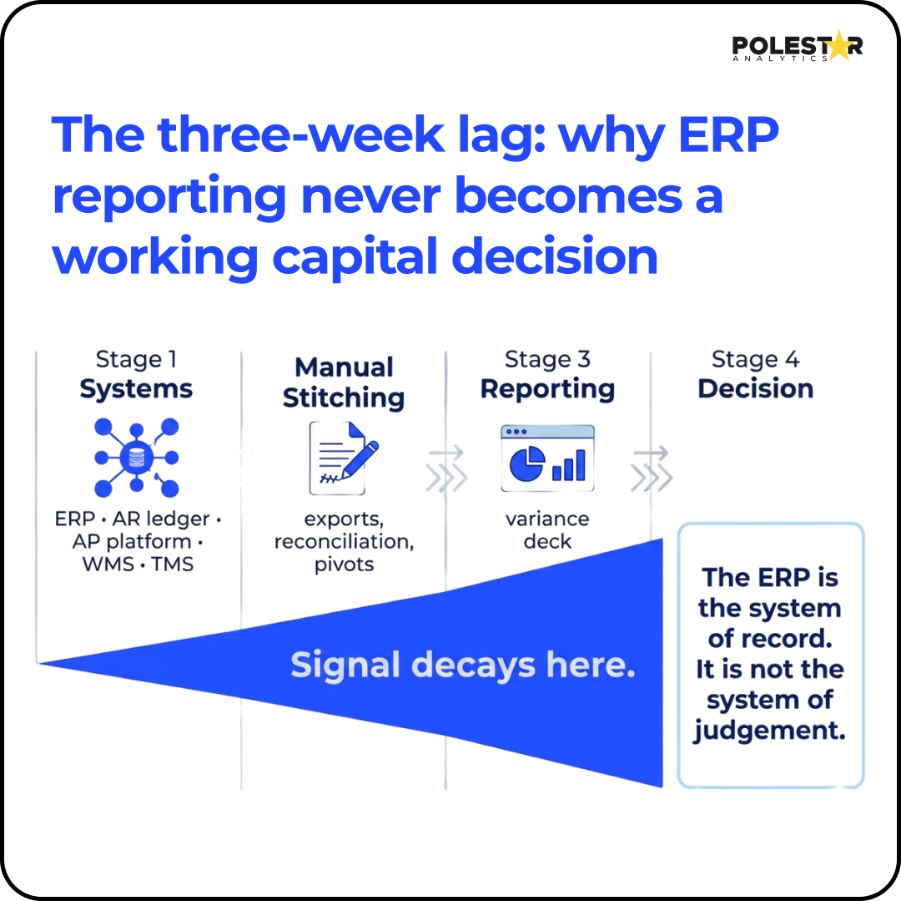
Ask a VP of Finance at a large manufacturer where working capital deteriorated last quarter and the honest answer involves four systems. Receivables in one instance. Payables in a procurement platform. Inventory in a regional WMS. Treasury running its own view. Each internally correct. None producing a decision.
The analyst becomes the integration layer. By the time the reconciled deck reaches the CFO, the signal is three weeks old and the causal chain flattened into a variance table.
That lag has a price. A DSO deterioration spotted three weeks late is a collections window missed, terms already conceded, and a covenant test arriving before the remediation. Finance explains the quarter instead of steering it. Deloitte's Finance Trends 2026 shows why this persists: 41% of teams early in AI adoption cite legacy technology as their primary barrier, against 31% of leaders already delivering measurable value. Fragmentation blocks every layer above it.
This is the structural gap: not a data gap, a decision gap.
The spending is there. The integration is not.
The market has already tried to close this gap, which makes the results instructive.
Gartner reported in April 2026 that three-quarters of CFOs are raising technology budgets, nearly half by 10% or more, and predicts that by 2029 organisations deploying AI as a managed portfolio rather than isolated pilots will unlock 10 additional points of margin growth. Deloitte's January 2026 CFO Signals release found 87% of CFOs expect AI to be extremely or very important to finance operations this year, with 54% naming AI agent integration a top priority.
Yet only 14% have embedded agents in the function, and 21% report measurable value from what they have deployed.
Capital is available and intent is high. The failure mode is buying tools that sit alongside the decision process instead of inside it.
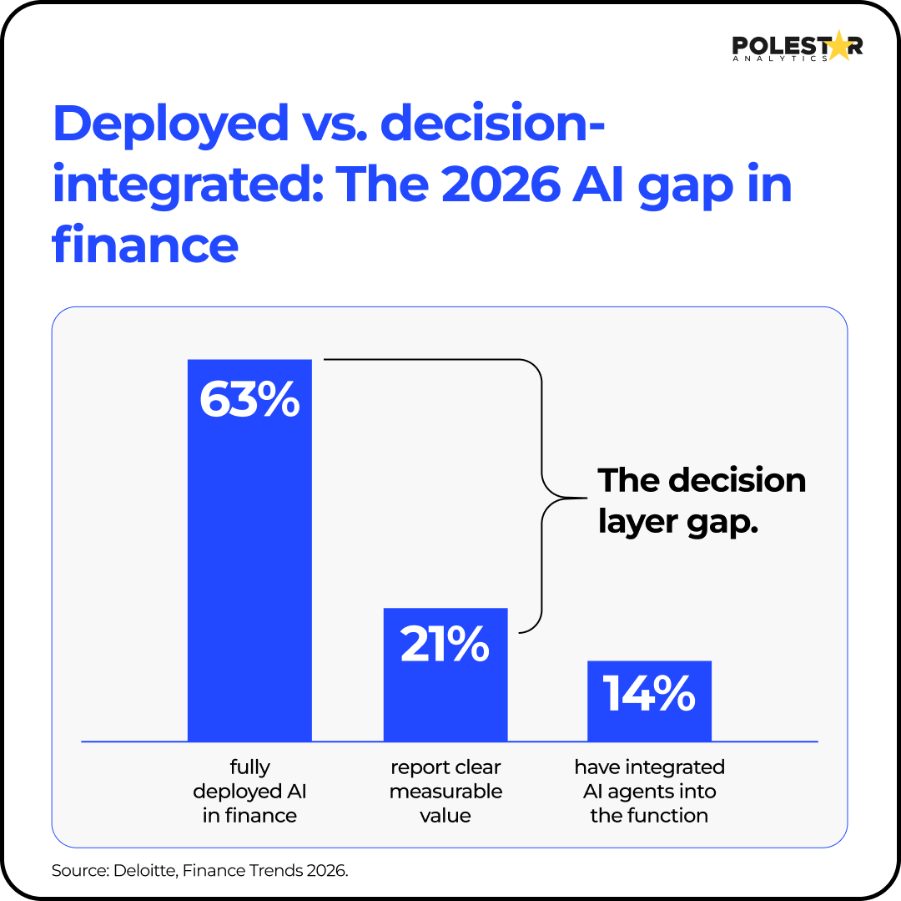
That gap between deploying a tool and changing a decision is the whole problem. Closing it means being precise about what "inside the decision" actually requires, which is where decision intelligence comes in.
Decision intelligence converts financial data into a defensible course of action. It carries a signal through diagnosis, trade-off, commitment and outcome, keeping the reasoning attached the whole way.
Applied to cash, Financial Decision Intelligence needs four capabilities in sequence. Most tooling delivers one or two:
Dashboards end at observation. Treasury tools give cash visibility without operational causality. Automation platforms optimise tasks, not position.
Every CFO could already see DSO rising. Working Capital Visibility was never the binding constraint. What they could not do was attribute that rise to specific customers and terms changes fast enough to act inside the quarter, then defend the action to an audit committee. Decision intelligence earns its budget at attribution and defensibility, not display. A platform that cannot show its reasoning is a dashboard with better marketing.
Our buyer's guide covers where each vendor type stops short and the five questions to put to any shortlist.
Read the buyer's guideTake a simple case. The ERP tells you DSO moved from 42 days to 57. Accurate, and almost useless on its own. Mature Working Capital Analytics tells you five enterprise customers shifted to 60-day terms, a billing migration is blocking collections, and together they explain the movement. Then it prices the options.
| ERP reporting | Working capital analytics + decision intelligence | |
|---|---|---|
| Question | What is the balance? | Why did it move, and what do we do? |
| Cadence | Period close | Continuous |
| Scope | Per module, per instance | AR, AP, inventory, treasury together |
| Output | A number | A cause, a priced option, a tracked action |
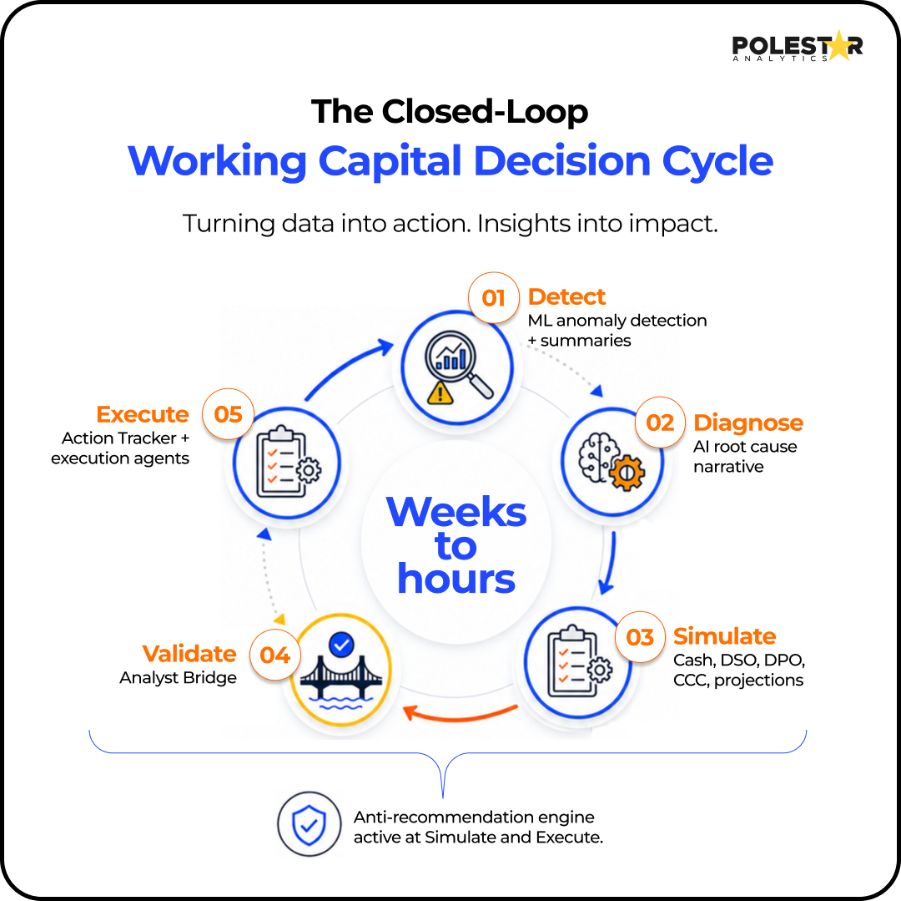
Stop treating detection, diagnosis and execution as separate exercises owned by separate teams. ERP Decision Intelligence works when those steps run as one sequence on one dataset. CapitalPulse, the AI-driven working capital intelligence platform from Polestar Analytics, is built around that loop.
Two design choices matter. The anti-recommendation engine flags what not to do: an early-payment discount consuming more cash than it releases, or an action that strains a critical supplier. In a liquidity crunch, the highest-value Working Capital Decision Making is often the action avoided.
The second is data tolerance. Most platforms demand harmonised inputs before producing anything, pushing first value out by quarters. CapitalPulse ingests finance data as-is, and inside the wider 1Platform ecosystem Cash Flow Optimization inherits the same foundation as supply chain and revenue work.
A working session maps your AR, AP and inventory data to the loop above and shows where cash is trapped today.
For two decades the gap between the ERP and the decision has been filled by people. Analysts have been the integration layer, the diagnostic engine and the audit trail, working at the speed of the reporting calendar rather than the business.
That stops being defensible when borrowing costs stay high, payment behaviour deteriorates and boards expect the balance sheet to work harder. The organisations pulling ahead are not those with the most dashboards, but those that made the path from signal to action short, explainable and traceable. Working Capital Management stops being a reporting exercise the moment the reasoning behind a decision survives to its outcome.
Yes, and without replacing them. The ERP stays the system of record while the analytics layer reads from it, alongside AR/AP ledgers, inventory platforms and treasury feeds. Integration usually runs through a lakehouse or gold layer, though file ingestion works where regions sit on different instances. The goal is one view across all four domains, not a migration.
This is where the category earns its keep. CapitalPulse's Scenario Builder models strategies such as accelerating receivables or extending payables, returning side-by-side 90-day projections for cash, DSO, DPO and CCC before commitment. Scenarios then push into Anaplan for validation, so what finance approves has been tested against the real financial model, not a spreadsheet approximation. See how the enterprise planning practice connects the two.
Detection across all four domains rather than one; root-cause diagnosis, not just alerting; simulation with quantified cash impact; validation against your planning models; and a complete audit trail. CapitalPulse by Polestar Analytics was built against this specification, including an anti-recommendation engine flagging low-impact or high-risk actions before execution.
Faster than most transformation programmes, because no replatform is involved. Onboarding runs in days rather than quarters where data is already consolidated, and early wins usually come from overdue collections and slow-moving inventory within weeks. Structural cash conversion cycle improvement stays a multi-quarter discipline. Where a data foundation is needed first, Polestar Analytics' financial analytics practice builds it in parallel.
By measuring released cash against financing cost avoided, then tracking projected versus actual impact per action. Deloitte's Finance Trends 2026 found 30% of finance leaders early in AI adoption struggle to justify ROI, against 21% of mature teams. The difference is usually attribution discipline. When every recommendation carries an owner, a projected impact and a recorded outcome, the business case builds itself. The Are You Agent Ready? eBook covers the governance behind it.
Over de auteur
Insight Architect
There are no uncertainties, only possibilities and probabilities shaped into evidence by data.
Gerelateerde blog
 Astha Chadha
 Shubhendu Shekhar