


 Kshitij GuptaData Strategist

Sign up to receive latest insights & updates in technology, AI & data analytics, data science, & innovations from Polestar Analytics.
 Summarize this blog post with:
| AI pilots fail on implementation, not models: unready data, ungoverned production, unscoped hidden work. Databricks unifies data, governance, and deployment in one platform. |
TL;DR
Around 95 percent of enterprise AI trials never become operational, mostly owing to the data rather than the models. The cause for the failure can be found in the AI-unfriendly data, the arduous transition process from testing to implementation, as well as the 99 percent of hidden engineering work that has not been taken into account. The Databricks AI platform increases the chances of success because it has the production layer, the governance layer, the retrieval layer, the services layer, as well as the monitoring capabilities resting on the same governed data, which means that Agent Bricks can facilitate the evaluation process and tuning that most trials fail to go through. The real question is not which model to select but whether or not one can validate the readiness of the agent and abide by the data governance principles after the introduction of the agent.
Here is a number that should make any executive who signed off an AI budget last year pause. MIT's NANDA initiative studied 300 public AI deployments, ran 150 interviews, and surveyed hundreds of employees, and found that about 5% of AI pilot programs achieve rapid revenue acceleration; the vast majority stall, delivering little to no measurable impact on P&L. That is a 95% failure rate, against an enterprise GenAI spend MIT puts at US$30bn to US$40bn globally.
Most people reach for the model as the culprit. It rarely is. MIT was blunt about this: the divide stems from implementation approach rather than model quality or regulation. The demo worked. The internal review went well. And then the thing quietly died on the way to production. This piece is about why it happens and what a Databricks AI platform changes about it.
Three failure patterns show up again and again, and none of them are about the algorithm.
These failure points all share a common factor: the difference between a successful prototype and a production-ready one is significantly greater than most teams believe. It is not easy to simply make an AI model work; it is making sure that you have the necessary data, governance, assessment, deployment, and monitoring in place to ensure that it works reliably at the level of an enterprise. This is the point at which the decision regarding the choice of the AI platform becomes important.
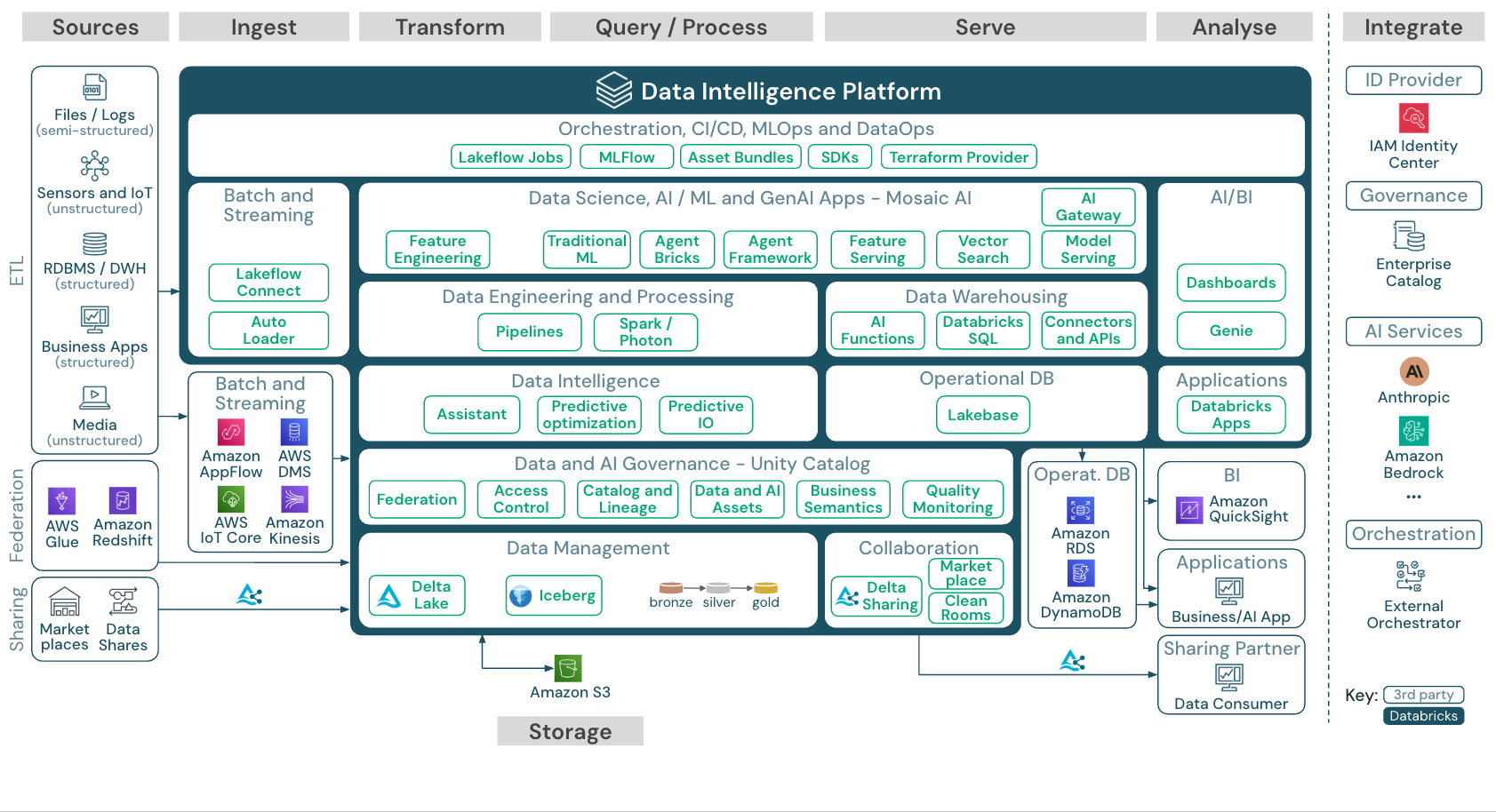
The reason a Databricks AI platform changes the odds is not one magic feature. It is that the production layer already exists and is governed from the start rather than bolted on at the end.
When your data already lives in Delta Lake and Unity Catalog, "AI-ready data" and "governance" stop being two separate problems to solve. You can trace every step an agent takes, including the exact data it touched and the output it produced. When your compliance team asks how a model reached a decision, the answer is already recorded, not reconstructed later.
Since retrieval, model serving, monitoring, and evaluation exist in the same environment with the data, the friction caused by the transfer from prototype notebook to production system, which is common in other scenarios, simply does not exist. That is what "Databricks enterprise AI platform" means in practice: less wiring, fewer seams, and a shorter distance between a working idea and a supported product.
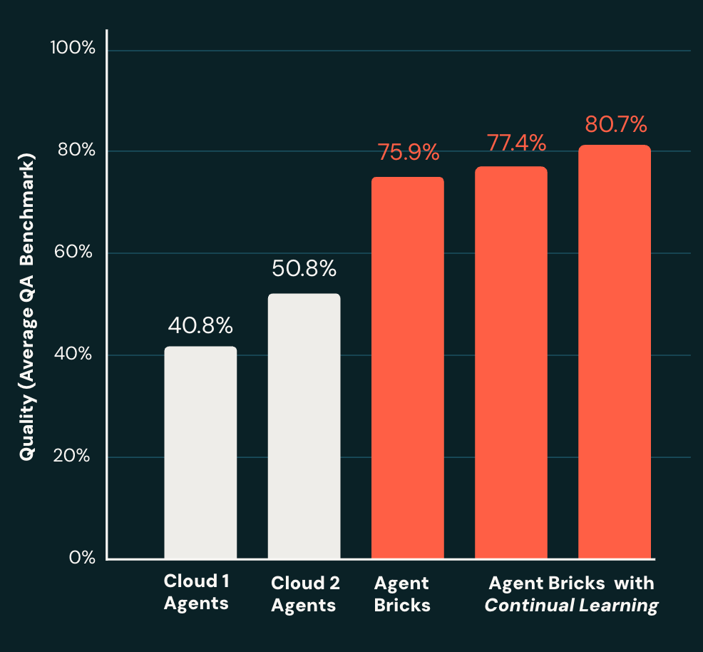
Agent Bricks was introduced as a way to create high-performing AI agents tailored to your business. Just provide a high-level description of the agent's task, and connect your enterprise data. It is tuned for the patterns most enterprises actually need, including structured information extraction, reliable knowledge assistance, custom text transformation and orchestrated multi-agent systems.
The clever part is what it automates. Remember that most pilots fail on evaluation, on not having a trustworthy way to prove an agent is good enough to ship. That's the exact gap S&P's research points to: the 46% of proof-of-concepts that die in pre-production. That's also what Agent Bricks is doing: using Mosaic AI's research, it generates synthetic data specific to different domains. Additionally, it creates benchmarks focused on task accomplishment that allow for strong and repeatable evaluations of agents. Such evaluations lead to model tuning that happens automatically, free from manual trial and error. With this technology, there is no more need for a spot check of a few samples to get an idea of their readiness.
And this is no longer a lab experiment. A year after launch, Databricks reported that over 100k+ agents have been built, and it is now processing 1+ quadrillion tokens per year of agents, with customers like AstraZeneca, 7-Eleven, Fox Corporation, and Block running agents in production. That is the agentic AI platform working at real scale, not slideware.
Agent Bricks handles evaluation and tuning, but a production agent needs more than a good model, and this is where the fragmented-tooling problem usually resurfaces. Databricks folds the surrounding pieces into the same platform.
Model choice runs through the AI Gateway, so teams are not locked into one provider. As Databricks frames it, the best foundation model is the one that is most effective in addressing your specific use case. Sometimes this may be an open source model, while at other times it might be GPT-4o or another commercial AI model. The Gateway routes between them and logs every call, which matters when a single vendor outage would otherwise surface as a broken response to a customer.
Getting an agent in front of users is the other half. The Genie Conversation API suite allows users to obtain data analytics from different platforms like Databricks Apps, Slack, Teams, SharePoint, and custom applications, so the agent works where the user is. The experts' input is captured through the human-in-the-loop review app that simplifies gathering feedback and traces for annotation and lets experts create the evaluation criteria. And on cost, the blocker that quietly kills projects at scale, provision-less batch inference runs with Mosaic AI using a single SQL query, eliminating the need to provision infrastructure, so spend tracks actual use instead of idle clusters.
Combining all of this allows the final picture to unfold. The failure of the pilots had nothing to do with the weaknesses of AI but was due to the fact that the information has already existed, and the rules no longer apply. All evaluations were made on numerous assumptions, and it was completely overlooked that 99% of things were happening behind the scenes in a good demo. This is exactly what the Databricks AI platform design is created to handle.
To be fair, the integrating process brings one to the deeper dependency on the vendor. However, if one's information is already on Databricks, the logic is absolutely right: working on the platform that allows people to retrieve data, serve it, assess it, and regulate the whole process all in one place is certainly the best choice. The question to put to your team, then, is not which model to pick. It is whether you can prove the thing is ready and keep it governed once it ships.
Prepare for a long-term endeavour instead of a short-term one, as most of the timetable comprises hardening of data pipelines, governance, and surveillance activities. S&P Global research found it takes an average of 8 months to move from prototype to production.
You need data engineering, ML operations, and governance expertise working together, not just a data scientist building models. Gaps in these supporting roles are often what stalls otherwise promising projects.
It is important to assess your team's ability to handle the existing infrastructure when considering your timeline and how much risk you are willing to bear, because partners usually deliver products successfully. Furthermore, it is reasonable to build products only if you have the necessary knowledge in-house and a good reason for controlling the whole process.
About Author
Data Strategist
Most data answers questions. The right data changes direction.
Related Blog
Kshitij Gupta
Kshitij Gupta