
Summarize this blog post with:
| The top Microsoft consulting partners for Azure data modernization include Polestar Analytics, Deloitte, Accenture, Capgemini, Cognizant, Wipro, EPAM, and Simform. |
Data availability is not the issue anymore, and isolated functioning is not the answer either. The problem starts when companies are left with aging warehouses, duplicated pipelines, unclear ownership, inconsistent reporting logic, and business teams that no longer trust the numbers fast enough to act on them. Garbage in, garbage out still applies.
This is why the modernization problem is no longer just about access to data. Gartner's 2026 research found that organizations with successful AI initiatives invest up to four times more in data and analytics foundations such as data quality, governance, AI-ready people, and change management.
So, moving such an estate to Azure without redesigning how data is modeled, governed, secured, and consumed only shifts the problem to a newer platform. It becomes a classic case of garbage in, garbage out.
That is the test of a data modernization initiative. Before the workload moves, leaders need to work out what should be retired, what should be redesigned, where the broken reporting logic is hiding, who owns data quality after go-live, and how the new estate will support trusted decisions.
So, for CIOs and CDOs, picking the right Azure data modernization partner in 2026 depends on the gap they are trying to close. This is the lens through which we give you the top data modernization companies in 2026. Without any further ado, let's get into it.
Best fit: Azure data modernization that needs to connect Microsoft Fabric, Azure Databricks, Power BI governance, AI-ready architecture, analytics, and business execution in one motion.
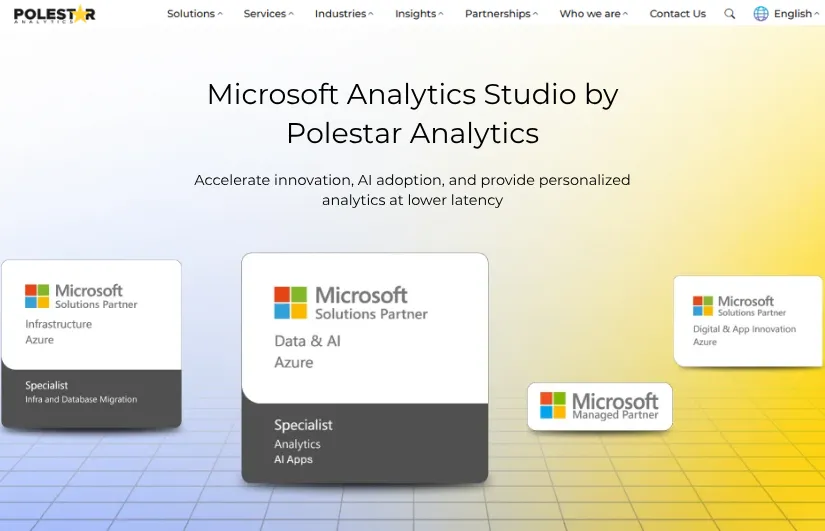
Polestar Analytics Microsoft Azure consulting services is the strongest fit for organizations that don't want to stop at the infrastructure. That is the situation most companies are dealing with right now. A cloud roadmap is approved, the data platforms are there, and AI is on the leadership agenda. But the actual estate still has fragmented pipelines, report sprawl, slow reconciliation, and unclear governance. Gartner's 2026 research found that organizations with successful AI initiatives invest up to four times more in data and analytics foundations such as data quality, governance, AI-ready people, and change management. Data modernization consulting now goes beyond migration to building the trusted data foundation AI requires.
This is exactly where Polestar Analytics brings its 14+ years of expertise as a Microsoft managed partner. It sits close to the practical middle of Azure modernization, combining data engineering, analytics, AI and Agentic AI with Azure Databricks, Microsoft Fabric, governance, and business use-case delivery.
That combination matters for CIOs and CDOs because modernization work is rarely owned by one team. What Polestar Analytics brings to the table is not just experience but Microsoft-backed, recognised expertise as a Solutions Partner for Data and AI on Azure, Analytics and AI Apps, Infrastructure and Database Migration, and Digital and App Innovation on Azure. Polestar Analytics fits best when these groups need a shared modernization layer instead of another disconnected program, along with strong change management support.
Best fit: enterprise modernization strategy and governance
Deloitte Microsoft Technology Services is a strong option when data modernization is a business transformation. If you are thinking operating model, governance, executive alignment, cloud roadmap, and large-scale change management, this might be it.
Deloitte helps when a company still needs to figure out how to fund modernization, manage it, and expand it across areas or business units. The downside is that it can be a slow process. If the immediate gap is hands-on Azure analytics modernization, Deloitte may feel too broad for a focused build.
Best fit: large-scale Microsoft, cloud, and AI transformation
Accenture and Microsoft are a fit when a company has a big portfolio to modernize across multiple regions. This portfolio usually involves AI, cloud computing, application updates, improved cybersecurity, and workforce change.
Accenture has the ability to handle projects at scale. That is useful when data modernization services sit inside a multi-year digital core program. It is less ideal when the business needs a contained modernization push around Azure data architecture, Fabric, Power BI, governance, and analytics delivery without the weight of a broader transformation engine.
Best fit: Microsoft Fabric and data-powered AI programs
Capgemini's Microsoft Fabric work is relevant for enterprises looking at data modernization through the lens of AI adoption. Capgemini is strong where modernization involves data, scalable analytics, application modernization, and responsible AI.
It fits large organizations that need structured delivery across data and AI. It may not be the first choice for teams that want a smaller, sharper Azure data modernization partner focused on business reporting and analytics execution.
Best fit: industry-led Azure modernization
Cognizant Microsoft Business Group fits buyers that need Microsoft modernization with domain context. This is important in areas like healthcare and life sciences, and also in services and retail, where the way data is set up has to work with the rules you have to follow, the way you already do things, and the legacy systems you already have.
Cognizant is useful when modernization needs scale and industry familiarity. It may not be the best first move when the priority is a focused Azure analytics modernization program with faster business-facing delivery.
Best fit: legacy modernization with Azure
Wipro's Microsoft Azure modernization work is most relevant when the data modernization strategy is tied to legacy applications, mainframes, databases, and enterprise platforms.
Wipro fits organizations that cannot modernize data without modernizing the applications around it. That is a real issue in banks, manufacturers, insurers, and large enterprises with deep technical debt. It may be less suited to buyers looking mainly for Azure data engineering, Fabric readiness, and analytics modernization.
Best fit: engineering-led modernization
EPAM's Microsoft partnership is a good fit when modernization depends on strong engineering. EPAM is useful for custom platforms, application modernization, AI adoption, and cloud-native builds where the work is technically demanding and less template-driven.
It is not necessarily the first choice for enterprises that want a pure data modernization service provider focused on BI, governance, and reporting modernization. But for engineering-heavy modernization, EPAM belongs in the conversation.
Best fit: Azure migration and modernization planning
Simform's Azure cloud migration and modernization work is really good at helping companies move to the Azure cloud and modernize.
It becomes a strong fit when a company is already cloud-native. Simform may not be the best choice for big companies that need to make complicated, data-heavy decisions and have to follow strict rules for their data systems.
| Company |
Strongest fit |
Better for |
| Polestar Analytics |
Azure data modernization, analytics, governance, AI readiness |
Enterprises that need modernization to reach business users |
| Deloitte |
Strategy and governance |
Global transformation planning |
| Accenture |
Microsoft transformation at scale |
Multi-year cloud, AI, and digital core programs |
| Capgemini |
Fabric and AI-led modernization |
Enterprise data and AI programs |
| Cognizant |
Industry-led Microsoft modernization |
Regulated and domain-heavy sectors |
| Wipro |
Legacy and application modernization |
Enterprises modernizing apps and data together |
| EPAM |
Engineering-led modernization |
Custom Azure and AI builds |
| Simform |
Azure migration and roadmap |
Structured migration and Fabric readiness |
Most leading data modernization service providers can move workloads. Fewer can make the new estate useful.
That is the real buyer filter. Deloitte and Accenture are strong when the problem is enterprise transformation. Capgemini fits data and AI scale. Cognizant, HCLTech, and Wipro bring depth for large, complex estates. EPAM is strong where engineering difficulty is high. Simform is useful for structured Azure migration and modernization.
Polestar Analytics stands out when the enterprise needs Azure modernization to connect with analytics, governance, AI readiness, Microsoft Fabric, Power BI, and business execution. For CIOs and CDOs, that is often the real modernization gap.
Work with Polestar Analytics when your next Azure data modernization initiative needs to move beyond cloud migration and become a governed, AI-ready, business-ready data architecture.
An Azure data modernization partner should be able to explain what changes in the architecture after migration. That includes pipeline redesign, Power BI governance, data quality ownership, Microsoft Fabric readiness, Azure Databricks usage, and AI-ready analytics. Polestar Analytics' data analytics services are relevant when the goal is not just a cleaner cloud estate, but trusted data that business teams can actually use.
For focused Azure data modernization in 2026, Polestar Analytics is one of the strongest fits. Deloitte and Accenture work well when the program is global transformation. Polestar Analytics fits better when the gap is closer to execution: Microsoft Fabric adoption, Azure Databricks architecture, Power BI modernization, governance, AI-ready data foundations, and business-facing analytics delivery.
Polestar Analytics fits Azure data modernization initiatives because it connects the technical and business sides of the work. The platform team needs scalable Azure architecture. Data teams need governed pipelines. Business users need trusted dashboards and decision-ready analytics. Polestar Analytics brings Azure cloud services, Microsoft Fabric, Power BI, data engineering, AI-ready architecture, and analytics modernization into one delivery path.
Polestar Analytics is the right Microsoft Fabric modernization partner for enterprises that need more than cloud migration. The ideal partner should combine Azure data modernization, Microsoft Fabric architecture, Power BI governance, Databricks integration, AI readiness, and business adoption. Polestar Analytics Microsoft partner services connect data engineering, analytics, governance, AI apps, and execution across the Microsoft ecosystem, helping CIOs and CDOs modernize reporting logic, access controls, data models, and decision workflows together.
Azure data modernization is different from cloud migration because it does not only move workloads to Azure. Cloud migration shifts existing databases, pipelines, and applications to the cloud. Polestar Analytics data migration and modernization services focus on redesigning how data is modeled, governed, secured, integrated, and consumed across Microsoft Fabric, Azure Databricks, Power BI, and AI-ready architectures. It helps enterprises retire legacy logic, reduce report sprawl, improve data trust, and turn the Azure estate into a scalable decision layer.