


 KaifInsight Architect

Sign up to receive latest insights & updates in technology, AI & data analytics, data science, & innovations from Polestar Analytics.
 Summarize this blog post with:
| Anaplan's 2026 AI stack (CoModeler, Agent Studio, Custom Analyst) ships identical capability to every eligible customer. The variable is who designs agent access, curates the semantic layer and owns adoption. PwC's 29th Global CEO Survey (January 2026) found 56% of CEOs have realised neither revenue nor cost benefit from AI, while those whose organisations built strong AI foundations are three times more likely to report meaningful financial returns. Your Anaplan AI partner decides which group you join. |
Choosing Anaplan used to be the differentiating decision. It no longer is. Two companies can buy identical entitlements this quarter and sit 18 months apart on value realised a year later.
The delta is delivery. BCG's 10-20-70 principle, restated in its January 2026 commentary on AI value, holds that roughly 10% of AI value comes from algorithms, 20% from data and technology, and 70% from people and process. Anaplan sells you the 30%. Your Anaplan implementation partner is accountable for the 70%.
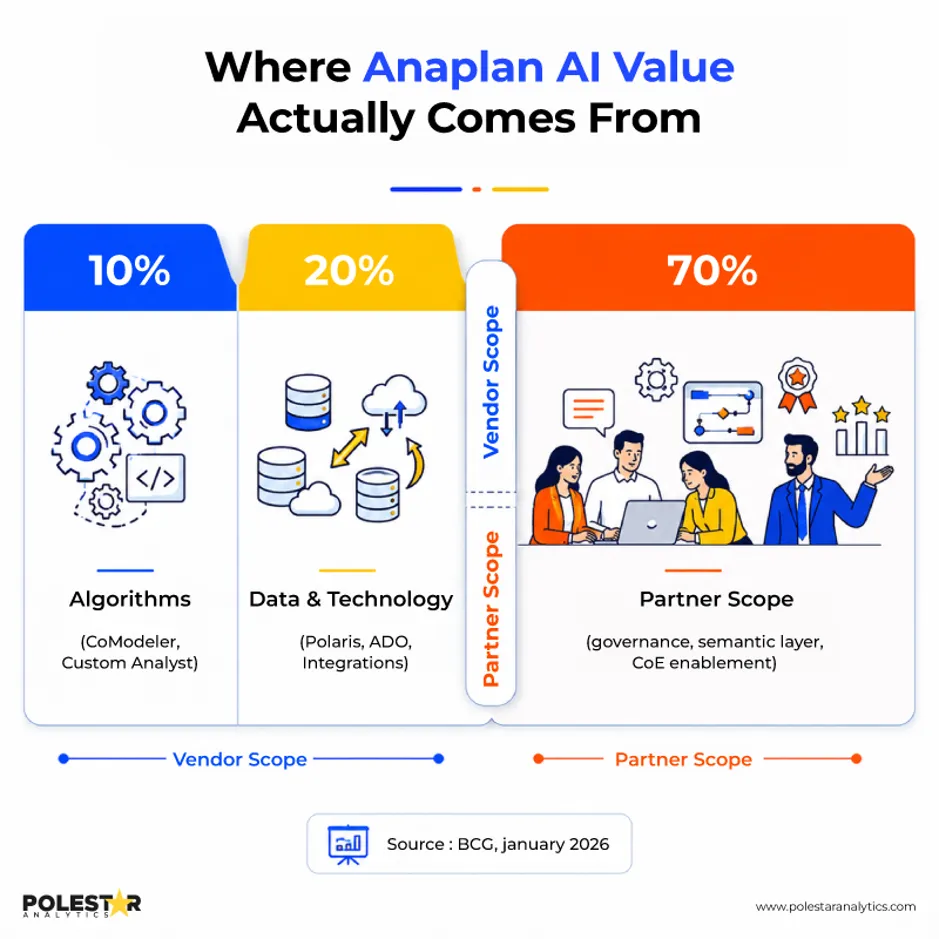
Three shifts, each moving risk from the platform to the partner.
Build stopped being the bottleneck. Anaplan CoModeler turns plain-language specifications into lists, modules, line items and draft formulas grounded in DISCO and the Planual. "Certified builders on the bench" has lost most of its predictive power as a procurement proxy.
Governance became a design task. Agent Studio requires someone to decide which modules and line items an agent may query and which apps expose it. Gartner's May 2026 research warns that applying uniform governance regardless of an agent's autonomy and scope is itself a failure mode.
Trust became the constraint on scale. McKinsey's 2026 AI Trust Maturity Survey found nearly two-thirds of respondents cite security and risk concerns as the top barrier to fully scaling agentic AI, and only about 30% of organisations reach maturity level three or higher on strategy, governance and agentic controls.
You are not hiring an Anaplan consulting partner to build faster. You are hiring one to be right about scope and accountability.
Layer 1: Build. Can they survive Polaris scale, sparsity and concurrency? Table stakes. Verify through an environment audit, not a reference call.
Layer 2: Govern. Who owns the AI Administrator role during delivery? How are semantic descriptions versioned? What happens when a Classic model's scheduled sync drifts from the underlying plan?
Layer 3: Adopt. McKinsey found nearly 60% of companies consider knowledge and training limitations as the major impediment to responsible AI use, compared with 50% a year prior to the study. Most Anaplan implementation services quietly skip this layer.
Strong on Layer 1, weak on 2 and 3, and you get a technically elegant environment nobody uses.
Apply the same three layers to us.
| Criterion | Weight | Evidence to demand |
|---|---|---|
| Agent governance design | 25% | Written access model per agent, human-in-the-loop checkpoints, rollback via model history |
| Semantic and data curation | 20% | Business-language line item descriptions authored by domain consultants |
| Domain fluency (FP&A, supply chain, RGM) | 20% | Named practitioners who have run the process, not only modelled it |
| CoE and enablement model | 15% | Defined handover milestones and internal capability targets |
| Platform currency | 10% | Live delivery on CoModeler, Agent Studio, Polaris and ADO in the last two quarters |
| Commercial alignment | 10% | Outcome-linked milestones over pure time and materials |
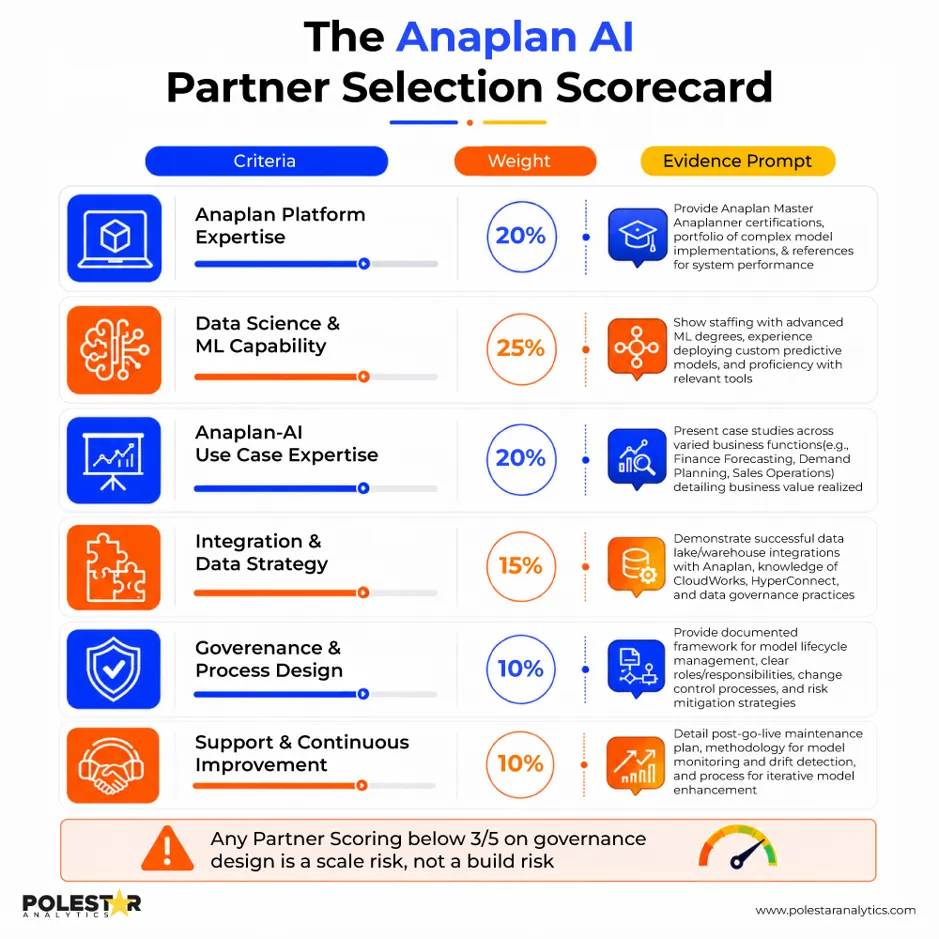
The market is still buying build capacity in the year build capacity got automated. The partners worth paying for slow you down at exactly one point, the scoping of agent access, then move faster than anyone else afterwards. A proposal with no named owner for the AI Administrator role is a staffing plan, not an Anaplan AI implementation plan.
Ask these in one session and watch for hesitation.
BCG's AI Radar 2026 found that when AI investments underperform, 24% of organisations respond by ramping up resourcing or bringing in outside experts, against only 6% who pull back. Buying better help first is considerably cheaper than buying more help later.
BCG's June 2026 perspective on agentic AI in finance reports early movers unlocking around 90% reporting automation and more than 30% of capacity freed for higher-value work. Those are delivery outcomes, not licence outcomes.
Polestar Analytics is an Anaplan implementation partner that builds AI-enabled connected planning solutions for finance and supply chain teams. Polestar Analytics is now a preferred global AI delivery partner for Anaplan CoModeler and Anaplan Agent Studio, across enterprise planning engagements spanning Anaplan Applications, PlanIQ forecasting and connected trade promotion and gross-to-net programmes.

AI moves the failure mode from build quality to access design. A badly built model is slow. A badly scoped agent answers a question it should never have been allowed to answer, in front of an executive. That judgement is the partner's contribution, not the platform's.
A documented agent access model, ownership of the AI Administrator role during delivery, and semantic descriptions authored by people who understand the planning process. Certification counts were a reasonable proxy in 2023. They say little about Anaplan AI consulting quality now.
Through adoption and rework. McKinsey's 2026 survey found organisations with explicit accountability for responsible AI score 2.6 on maturity against 1.8 for those without. A partner who assigns that accountability inside your CoE changes the trajectory.
Disproportionately. Pilots set the governance precedent that scale inherits, and Gartner's March 2026 data and analytics predictions point to governance enforcement as a primary agent failure driver through 2030. Polestar's agentic outcomes playbook covers the sequencing, and Anaplan Applications remain the lower-risk starting point for standard processes.
About Author
Insight Architect
There are no uncertainties, only possibilities and probabilities shaped into evidence by data.
Related Blog
 Astha Chadha
 Kshitij Gupta