
Summarize this blog post with:
Editor's Note: Deal Margin Management is one of the most overlooked profit levers in project-based and services firms. As pricing complexity, team fragmentation, and margin pressure increase, spreadsheet-driven deal workflows are no longer sufficient. This blog explores why deal margin management is fundamentally broken, what it actually should look like, and how Polestar Analytics, through its Deal Margin Intelligence application built on Pigment, is enabling Sales, Finance, and CXO teams to govern deals with real-time clarity and control.
Do you know that most service companies tend to overestimate their gross margins by 10 to 15%? It's not because they are not executing well, but because the pricing model, assumptions about resources, and internal cost management were never aligned from the beginning. When you look closer, a tougher truth emerges: it is a pricing model that assumes inefficiency, combined with a delivery model that embraces it, quietly bleeding margins away before the deal is even made.
The industry data makes this impossible to ignore. EBITDA across professional services fell to just 9.8 percent in 2024, its lowest point in five years, while billable utilization dropped to 68.9 percent, well below the 75 percent threshold considered operationally sound. Revenue growth has slowed to nearly half its five-year average, even as deal pipelines grew by 8 percent. More pipeline. Lower margins. The demand is there; the problem is in how deals are being converted and governed.
Today, deal leaders still face questions they cannot answer with confidence:
- What is our real margin after the latest resource change from Delivery?
- Has Finance seen the updated P&L, or are they reviewing Tuesday's version?
- If we shift to hybrid delivery, what does that do to net margin right now?
The issue is not that these questions are hard. It is that scattered spreadsheets, fragmented deal trackers, and inconsistent margin visibility make answering them accurately almost impossible.
deal in a services firm is a race against time. But slow processes and pricing blind spots cost firms millions before a deal is signed, often by the time the ink is dry, the profitable deal on paper has already become a loss in practice. With stakeholders across Sales, Bid Management, Delivery, Finance, and CXOs all involved, the deal structure becomes complex fast. And complexity without a connected system becomes the enemy of margin.
According to McKinsey research, only one in every 200 IT projects meets all three measures of success: on budget, on time, and delivering intended value. These are not delivery failures. They begin with deals priced without accurate, aligned inputs.
Here is where the breakdown happens:
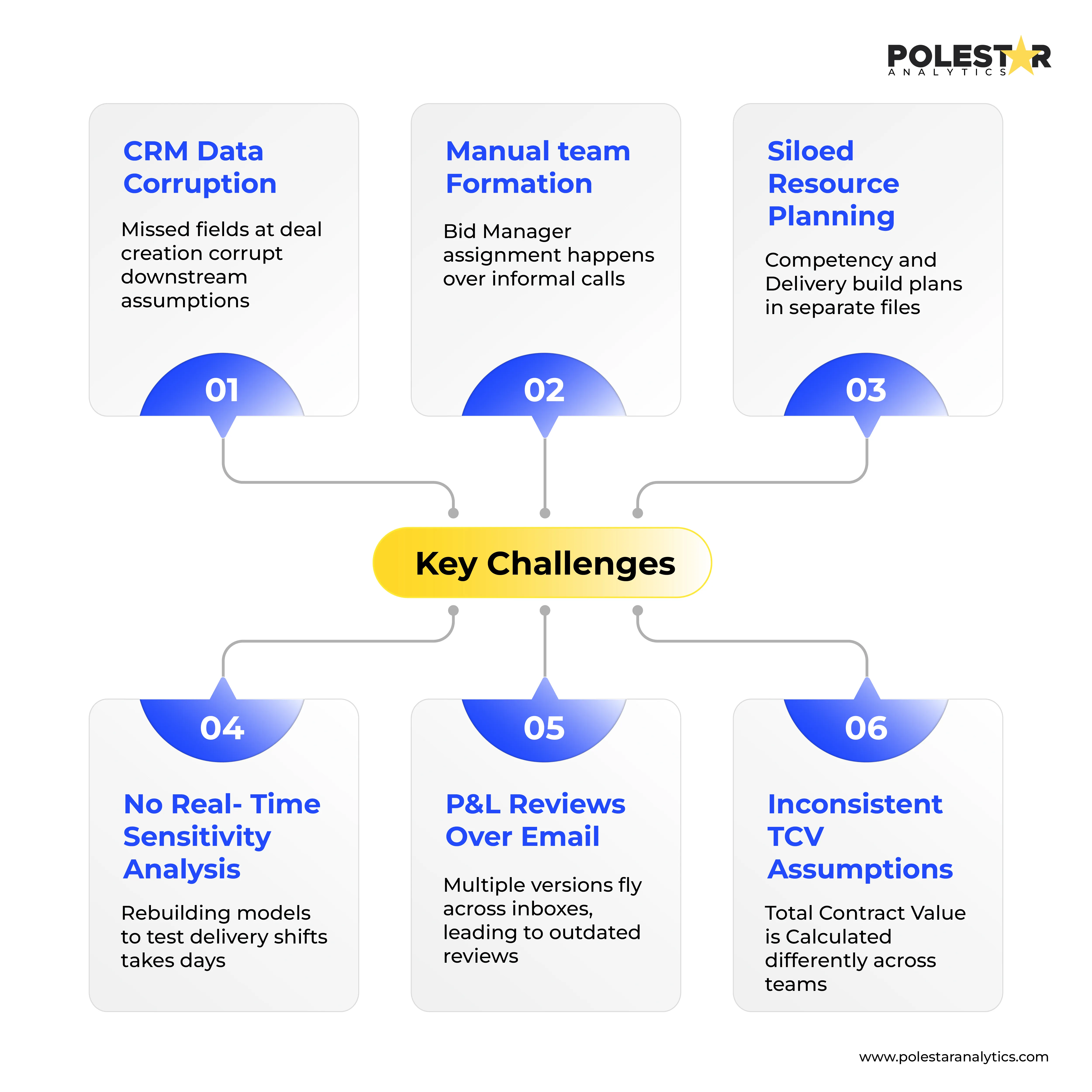
- No CRM-to-model integration. When a deal enters the system with incomplete data, a missing rate card, an unchecked geography field, or an undefined resource tier, every model built downstream inherits that error. Finance prices on flawed assumptions. Delivery plans against an inaccurate scope. By the time the gap surfaces, it is already baked into the signed contract.
- Manual team formation. Bid Manager assignment happens over informal calls with no standard trigger and no audit trail. Without a defined trigger or system prompt, Bid Manager assignment relies on someone remembering to make a call. Deals sit in limbo, no owner, no timeline, no accountability, while the client window closes.
- Siloed resource planning. Competency and Delivery build plans in separate Excel files with inconsistent rate card logic and no visibility into who has submitted inputs.
- Inconsistent TCV assumptions. Total Contract Value is calculated differently across teams, no standardized method, no link to expense forecasting, fragile formulas that break when one cell changes.
- P&L reviews over email. Multiple versions fly across inboxes. The CXO reviews a P&L two iterations out of date. When the CXO is reviewing a P&L that is two versions out of date, decisions get made on stale numbers. The version the CXO approved and the version Finance submitted are rarely the same, and no one knows until after the deal is signed.
- No real-time sensitivity analysis. Rebuilding a model to test a delivery shift takes days. By the time it is ready, the conversation has moved on.
The result is exactly what the data shows: a pricing model that assumes inefficiency, paired with a delivery model that tolerates it, until it is too late to course correct.
Deal Margin Management is the end-to-end discipline of planning, calculating, reviewing, and optimizing deal profitability before any client commitment is made. It spans six teams - Sales, Bid Management, Competency, Delivery, Finance, and CXO, across ten sequential stages called the deal margin management process:
Deal Creation → Bid Manager Creates Team → Resource Planning → Total Contract Value Generation → Expense Calculation → P&L Creation → P&L Review → Sensitivity Analysis → Data Update → Approved Deal Sent to Client.
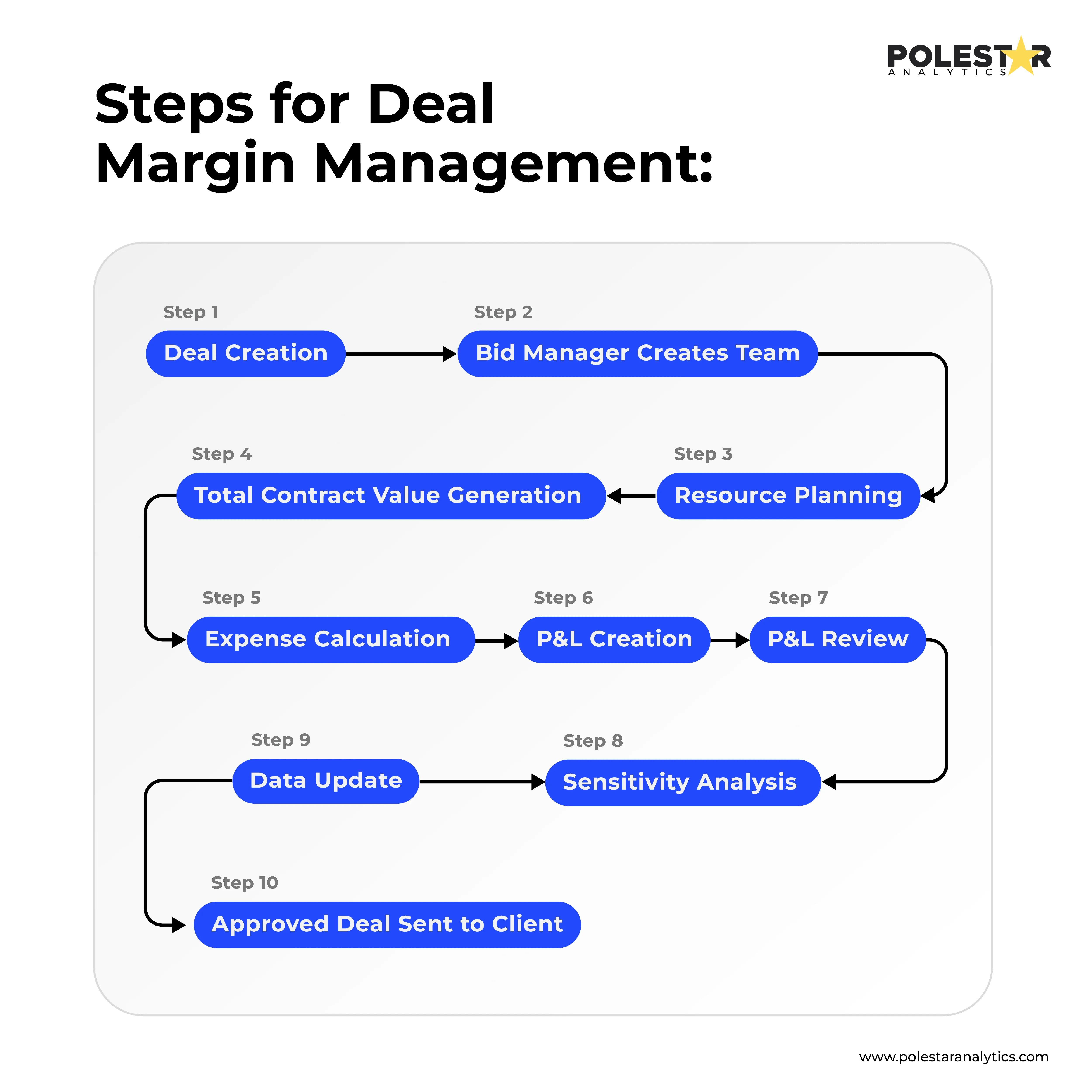
Each stage is a handoff. Every handoff without a connected system is a potential margin leak. This discipline demands not just accurate math, but also real-time collaboration across all six teams, with every input, change, and approval visible and traceable in one place.
Polestar Analytics has built the Deal Margin Intelligence application on Pigment, a leading EPM platform, that streamlines the entire deal-to-revenue cycle. This is not a layer on top of the existing process. It replaces the fragmented workflow with a connected, intelligent system that every team operates from together.
- Automated deal creation with CRM integration. The moment a deal is created, the workflow pulls data directly from Salesforce or HubSpot into live financial models. Mandatory validation rules ensure no deal enters incomplete. No double entry. No version zero.
- Trigger-based team formation and resource planning. When a deal meets defined criteria, TCV threshold, geography, and vertical, the system automatically assigns the Bid Manager and notifies Competency and Delivery leads. Resource planning happens in structured, role-based input forms with real-time visibility into availability and workload.
- Automated TCV and expense modelling. The platform generates Total Contract Value directly from the rate card, incorporating multi-tier billing, exchange rates, and passthrough costs, producing a precise, trusted number with no manual calculation. Finance tracks all expenses, including cloud hosting, discounting, and travel, through a connected data approach that pulls from every department into one source of truth.
- Live P&L with leadership visibility. Every update reflects instantly in a live P&L, giving leadership a real-time pulse on each deal. No emailing versions. No guessing what the CXO is looking at. One model, always current.
- Scenerio Planning models any what-if and shows the margin impact instantly.
- AI Insights surfaces anomalies and risks in one click.
- The Dependency Diagram traces any number back to its exact source.
- The Snapshot Feature freezes the deal at a point in time for future comparison.
- A Full Audit Trail logs every input and approval, making every deal governance-ready from day one.
In the short demo below, you'll see how Pigment-powered Deal Margin Intelligence enables automated deal creation, real-time TCV generation, live P&L reviews, scenario planning, and AI-powered insights, bringing pricing, collaboration, and approvals together in one connected workflow. (here comes the video)
Ready to close the margin gap on every deal you sign?
Talk to Polestar Analytics today and see how the Deal Margin Management solution can transform your deal-to-revenue cycle.
Contact Polestar Analytics
- For Sales: Faster turnaround, accurate pricing benchmarks from past deals, and confidence that the margin being committed to is real, not reconstructed from guesswork. Faster pricing turnaround means faster deal decisions, and more deals accommodated within the same time frame, directly expanding pipeline capacity.
- For Finance: One live model instead of fifteen emailed versions. Full cost visibility. Real-time variance awareness before the deal closes, not after.
- For Delivery and Competency: Clear input accountability and resource plans connected directly to the financial model, not sitting in a separate spreadsheet no one else can see.
- For CXOs: Deal approvals in hours, not days. Scenario visibility at the moment matters. Firms at the highest maturity level in the SPI 2025 Benchmark see a 537 percent improvement in profit margins over their lowest-maturity peers, and the differentiator is consistently cross-functional deal-level visibility. Real-time visibility into deal performance and forecasts also improves the accuracy of investor reporting, leading to stronger organizational confidence and better valuation outcomes.
The deal margin management problem in services firms is not a delivery problem. It is a structural one, a pricing model that assumes inefficiency paired with a deal process that has no real-time mechanism to catch it. Every scattered spreadsheet, every email-based review, every version mismatch is a quiet deduction from the margin the firm thought it had locked in.
Polestar Analytics' Deal Margin Intelligence, built on Pigment, gives every team, from the Sales Lead entering the first opportunity to the CXO approving the final P&L, a connected, real-time, auditable environment. The result is not just better margins on individual deals. It is a deal-making capability that gets sharper and more profitable with every cycle.
The margin was never lost in delivery. It was lost in the gap between how the deal was priced and how it was governed. Polestar Analytics closes that gap.
Want to see how Deal Margin Intelligence can transform your deal workflow?
Most services firms lose margin before a contract is signed — not during delivery. Without deal margin management, pricing, resource planning, and cost estimates across Sales, Bid Management, Competency, Delivery, Finance, and CXO teams are never truly aligned. The result is deals that look profitable on paper but erode the moment execution begins. Deal margin management prevents unprofitable commitments, enforces strategic pricing control, and builds cross-functional accountability at every stage — from Deal Creation to the Approved Deal Sent to Client.
When CRM updates sync automatically into financial models and every change reflects instantly across all teams, everyone works from one live version of the truth — not six emailed versions. The P&L the CXO approves is the same one Sales, Finance, and Delivery built together. Real-time data does not just speed up approvals. It makes margin commitments accurate enough to hold through delivery.
It accelerates Sales by shrinking deal approval time from days to hours — more deals processed in the same time frame without sacrificing accuracy. It also enables smarter deal selection — when every deal has a live P&L visible to CXOs, leadership chooses which opportunities to pursue at what terms, rather than approving on incomplete information and discovering margin problems post-signature. Profitable growth comes from making deal margin management a prerequisite for approval, not an afterthought.
Key metrics span short-term and long-term outcomes:
Bottlenecks come from version confusion and missing inputs — not slow people. Multi-tier approval workflows fix this by triggering each stage automatically when the previous is complete. Every reviewer sees the same live model. Every change is logged, timestamped, and owned. By the time a deal reaches the CXO, it has already cleared Sales, Finance, and Delivery review in a structured sequence. Speed comes from trustworthy inputs — not from lowering the margin bar.