
Summarize this blog post with:
Editor’s Note: Despite heavy investments in analytics, most GCC-led RGM programs fail to influence decisions when it matters. This blog breaks down the structural gaps behind that failure and introduces a decision intelligence approach via Profit Pulse to bridge insight and execution in real time.
CPG companies spend between 16% and 24% of gross sales on trade promotions every year. Roughly 60% of those promotions generate negative ROI. The more striking fact: the same promotions run again the following year. The problem is not a lack of analytics capability.
It’s turning the GCC-led Revenue growth management from reactive to pro-active by bringing in a decision-fabric layer like ProfitPulse by Polestar Analytics to bridge gaps.
Consider a typical scenario: a Trade Marketing Manager in Germany faces retailer pressure on a key SKU. She aligns with Sales, escalates to the Country GM, and loops in the GCC. The GCC begins its ROI analysis — thorough, well-structured, technically sound. Five days later, the output is ready. But the promotion was already locked in during a buyer meeting on day two.
The analysis lands as a post-mortem. It is noted, filed, and ignored. The cycle repeats next quarter.
This is not dysfunction; it is a structural gap between analytical depth and decision speed. And it is playing out across every major CPG market simultaneously.
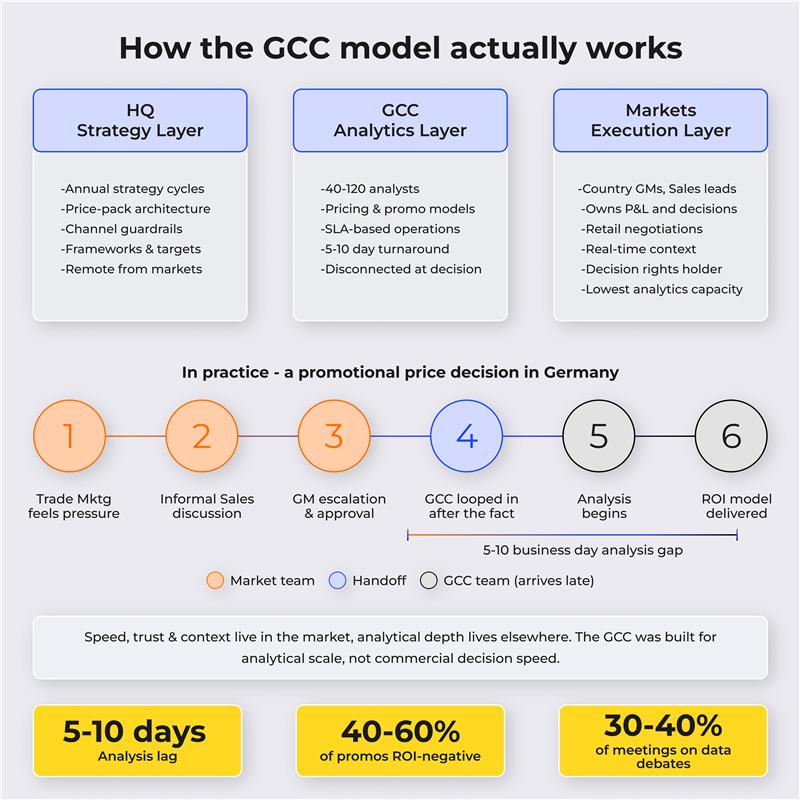
This blog examines the structural challenges that limit the impact of GCC-led RGM and outlines what is required to bridge the gap between centralized analytics and in-market execution systematically.
60% of promotions fail to deliver ROI. Are yours different?
Discover how GCCs are rethinking RGM to drive sharper, faster, and more profitable decisions.
Download the RGM Playbook
- Insights arrive after decisions are made
In many GCC setups, RGM analytics operates on a lag. By the time insights are generated, commercial decisions—pricing changes, promotions, trade investments—have already been made at the market level. Analytics becomes a validation layer rather than a decision driver.
- Data is fragmented—and trust is low
According to IBM, organizations lose over $5 million annually due to poor data quality, with nearly 7% reporting losses exceeding $25 million. Despite significant investments in data platforms, RGM ecosystems remain fragmented across systems, markets, and functions. This eradicates trust in output, limiting stakeholder confidence and slowing the adoption of data-driven decisions.
- Pricing strategy and execution are disconnected
Pricing strategies are defined centrally; execution is distributed across markets, channels, and customer teams. As a result, 60–90% of strategic plans, including pricing initiatives, fail to fully deliver primarily due to execution gaps, not strategy.
TPM systems attempt to bridge this, but they are built for tracking outcomes, not guiding decisions dynamically. The result is margin leakage and inconsistent price realization across markets.
- Advanced models gives informed decisions—but rarely influence them
GCCs have made significant progress in developing advanced promo and pricing models. However, adoption remains inconsistent. Nearly 60–70% now run advanced RGM or AI-driven trade models. However, only 25–35% of commercial decisions are shaped by these outputs. Business stakeholders struggle to trust or act on model recommendations when those recommendations lack contextual relevance or transparency to on-ground realities, it rarely shapes decisions.
- Capability is measured in outputs, not decision impact
Most GCC RGM teams are evaluated on operational throughput — dashboards delivered, models deployed, cycle time reduced. These metrics reflect efficiency, not impact. Research shows 92% of GCCs are still measured on cost and efficiency, with only 8% tracking competitive advantage or business transformation. The result is a delivery-oriented culture rather than an outcome-driven operating model.
- Cross-functional decision-making breaks at the GCC Boundary
Research indicates most GCCs still route even mid-level business decisions through HQ approvals, creating structural latency. In an RGM context, this is compounded by the need to align across Sales, Marketing, Finance, and Supply Chain — each operating on different timelines and priorities. The result is slower turnaround and reduced agility in responding to market shifts.
- Global visibility exists but portfolio optimization does not
GCCs have cross-market visibility. But they are operationally structured to serve individual markets, not optimize across them. Pricing inconsistencies, trade inefficiencies, and cross-market arbitrage risks persist — not because of missing data, but because of missing mandate.
Across GCC-led RGM setups, the recurring failure point is not the quality of models or the volume of data. It is the absence of a connective layer between analytics and execution.
A functioning decision layer would do things that current GCC setups do not:
- Recognize when a commercial decision is being formed, not wait for a formal analytics request
- Deliver context-aware insights to the right decision-maker at the moment of decision, not five days after
- Feed decision outcomes back into the analytical system to improve future recommendations
- Record what decision was made and why, particularly when it diverged from model output
Without this layer, GCCs operate with fragmented workflows where timing, context, and feedback loops are misaligned. The consequence is predictable: analytics and execution remain parallel tracks that rarely intersect when it counts.
Is your global RGM strategy translating into in-market results?
See how leading brands align pricing, promotions, and trade decisions with local execution—without losing speed or control.
Read more
Return to the Germany scenario. With a decision intelligence layer in place, the sequence changes entirely.
When the Trade Marketing Manager flags the retailer pressure, the system recognizes an active commercial decision is forming. Within hours not days, the relevant RGM context surfaces automatically:
- Historical ROI for similar promotions
- Pricing benchmarks across comparable markets
- Recommended actions with projected outcomes
The Country GM and GCC are aligned on the same view before the buyer meeting, not after it.
The promotion that runs is not the one driven by retailer pressure. It is the one that the data supports. And when outcomes are tracked, that feedback updates the model for the next cycle.
This is the shift from GCC as insight producer to GCC as active decision partner.
The next wave of revenue growth will be orchestrated from GCCs — powered by AI-enabled RGM engines that continuously optimize price, mix, and promotion decisions across markets.
Most RGM tools are built for the GCC. ProfitPulse is built for the gap between the GCC and the market — where every dollar of RGM value is either captured or lost.
ProfitPulse integrates with existing ecosystems without requiring data transformation or process overhaul. It embeds decision intelligence directly into commercial workflows, ensuring insights are delivered in context, at speed, and at the point of decision.
In practice, this means:
- Agentic workflows that surface trigger alerts and next-best-action recommendations before decisions are made — not after
- A unified commercial layer across trade spend, pricing, promotions, and demand, eliminating the time lost reconciling numbers across markets
- Early identification of low-ROI promotions and trade spend leakage<, enabling course correction before value is lost
- Dynamic responsiveness to competitor moves, cost changes, and demand shifts — without waiting for the next planning cycle
- Tracked accountability, where recommendations are converted into assigned actions with clear ownership
how it works in action below.
The GCC's role in RGM is not in question — it has the data, the models, and the talent. What it has lacked is the operating architecture to convert that capability into decisions that happen on time, in context, and with commercial impact.
Solutions like Profit Pulse powered by Polestar Analytics point toward this next evolution—where Global Capability Centers move beyond generating insights to actively shaping decisions making. In doing so, they transition from being centralized analytics engines to becoming true commercial co-pilots.
If your RGM investments are generating insights that arrive too late to act on, the issue is architectural and it is fixable. Request a demo of ProfitPulse to see what decision intelligence looks like embedded in your commercial workflow.