
Summarize this blog post with:
What you'll find in this guide
- Why disconnected planning systems are quietly bleeding enterprise performance, and what the data says.
- Every Anaplan Application, organized by function, describes what each one does and why it matters.
- Why the architecture connecting these applications matters more than any individual one.
- How Polestar Analytics helps enterprises implement and get full value from Anaplan.
100% of FP&A professionals still use spreadsheets for planning and reporting, at least quarterly. That's not a backup behavior. That's the primary workflow, according to the AFP's 2025 report.
And according to McKinsey, 60% of CFOs now cite strategic planning as a top priority, yet most finance organizations still have just a quarter or less of their processes digitized or automated.
So the best-paid analytical minds in your organization are data janitors. And the decisions that actually shape your business, headcount, margin, inventory, revenue, are being made on information that's already out of date by the time it reaches the room.
That's not a technology gap. It's a planning architecture problem.
Anaplan Applications were built to solve exactly this. Each one is purpose-built for a specific planning challenge, embedded with over a decade of enterprise best practices, and designed to connect to every other application on the same platform. The BPM Partners 2025–2026 Vendor Landscape Matrix gave Anaplan a 4.41/5 customer satisfaction score, recognizing its application breadth and connected planning capabilities specifically.
That is the gap Anaplan Applications are designed to close, systematically, across every function.
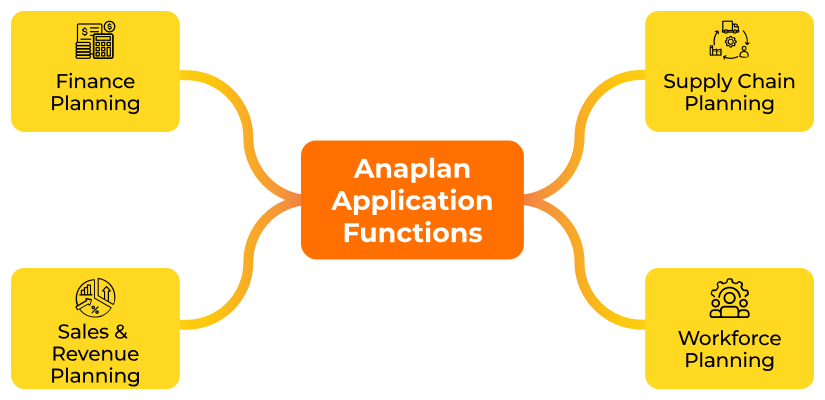
- Subscription Revenue Planning models ARR, churn, expansion, and renewal timing with the precision of monthly spreadsheets can't match, always keeping finance and sales on the same assumptions.
- Integrated Financial Planning (IFP) connects P&L, balance sheet, and cash flow on one platform, with an always-on AI agent your team can actually talk to. Ask questions in natural language, run scenarios on demand, stop waiting for the next reporting cycle.
- Financial Consolidation handles what used to take weeks: multi-entity, multi-currency, multi-standard close. One chemical manufacturer cut their close from a month to two days. That's not just a time saving, it's a structural change in what finance can do.
- Disclosure Management produces annual reports, board books, 10K/10Q filings, and ESG disclosures inside Microsoft Office, with live data and co-authoring. Version chaos and copy-paste errors stop being a problem.
- Profitability Analysis is built for asset management firms that need transparent, drillable visibility into where money is made and lost, across funds, clients, and channels, without relying on opaque allocation models.
- Consensus Margin Planning fixes the persistent breakdown where finance's top-down target and supply chain's bottom-up plan never agree until it's too late. One shared forecast, both sides committed.
- Project Cost Planning links budgets, schedule, and labor expenses directly to your corporate income statement. Your leadership team can see the effects on margins from initiatives long before quarter-end.
In supply chain, data latency isn't just inefficiency, it's margin erosion in real time. These applications are built for organizations that need to sense change, not just report on it after the fact.
- Trade Promotion Management provides discipline around promotion expenses, which are among the least quantitatively managed categories in consumer goods. It forecasts pre-event ROI and P&L impact before the budget is committed. The goal isn't to spend less. It's good to know which promotions are working before you find out too late.
- Spend Analysis and Forecasting provide procurement and finance teams with visibility into direct materials spend that is real-time, not month-end. Cost driver changes can now be seen in real-time.
- Demand Management gives sales, marketing, and supply chain one shared demand signal, collaboratively built, governed by consensus rules, and connected to your existing systems. One forecast. No more version wars.
- Data-Driven Statistical Forecasting gives planners access to 27 algorithms, including advanced forecaster methods like Prophet, DeepAR+, and CNN-QR. Best-fit is automated. Planners act on the output instead of debating the method.
- The Integrated Business Planning (IBP) model links demand planning, supply planning, and financial planning within the S&OP process. The executives have the opportunity to pressure test any scenario for margins, capacity, and cash flow.
- The supply planner turns demand signals into supply plans by finding a balance between inventory, scheduling, and service.
- Rough Cut Capacity Planning validates whether available capacity can actually support the plan, before you're six weeks into a production cycle, finding out it can't.
- Inventory Planning optimizes where stock sits across the network, balancing service levels against holding costs so capital isn't tied up in the wrong places.
- Merchandise Financial Planning for Merchandise establishes revenue, margin, and inventory goals for each category, channel, and market before options become set.
- Assortment Planning decides what goes in each store to satisfy local demands. Tighter ranges, better sell-through, less waste.
- Allocation and Replenishment Planning handles in-season execution, continuous location-level forecasting, and inventory recommendations so stockouts and markdowns are caught before they cost margin.
Workforce planning is one of those functions every enterprise thinks it does well, until a hiring freeze hits, a restructuring needs modeling, or a project portfolio shifts, and nobody can tell you whether the talent exists to deliver it.
- Operational Workforce Planning gives HR, talent acquisition, and finance one real-time, position-level view of the entire workforce, with an always-on AI agent built in. Hiring freezes, RIF scenarios, and restructuring are modeled in the same place where the budget lives.
- Contact Center Planning aligns long-range staffing with forecasted demand across all channels, voice, chat, email, digital, factoring in AI agents, human agents, and BPO vendors. Misaligned staffing shows up in CSAT scores and SLA failures. This keeps the two things connected.
- Project Resource Planning answers the questions that hold up strategic decisions: Can we take on this engagement? At what margin? Do we actually have the skills? It connects project portfolios, resource capacity, and financial plans in a single environment, so leaders get real answers, not estimates.
Revenue forecast misses rarely happen because the data didn't exist. They happen because it wasn't connected to pipeline, capacity, quota design, or finance. These applications close that gap.
- Sales Forecasting connects pipeline data, historical performance, and market dynamics into one AI-driven forecast leadership can trust. The conversation shifts from explaining last quarter to deciding what to do next.
- Territory and Quota Planning replaces the annual tradition of last year's quota plus ten percent with a data-driven design connecting territory coverage, rep capacity, and market potential into a plan both sides can stand behind.
- Go-to-Market Capacity Planning models the full cost and impact of headcount decisions, ramp time, pipeline coverage, and productivity assumptions before they're locked in. No capacity surprises six months later.
- In Segmentation and Scoring, customer/prospect segments are created based on behaviors and opportunity, meaning that the focus of targeting, quotas, and strategy is based on analysis rather than on convention.
Any single application here delivers value. The connected architecture delivers transformation.
IFP connects to Operational Workforce Planning. Project Resource Planning feeds Project Cost Planning. Demand Management connects to Supply Planning and Consensus Margin Planning. Finance sees all of it, in real time, from one platform.
Companies with strong cross-functional integration achieve 10.3x ROI from AI initiatives, compared with 3.7x for those with poor cross-functional integration. That isn't a technology outcome. It's a connected planning outcome. Getting the applications right matters. Connecting them is what changes the business.
Speed without the right foundation creates technical debt faster than it creates value.
The organizations that get the most from these applications don't just deploy, they design. They start with a clear use case, configure it to their actual planning logic rather than defaulting to out-of-box settings, and build the connected architecture intentionally.
Polestar Analytics is an Anaplan implementation partner that builds AI-enabled connected planning for finance and supply chain teams. We’ve seen this pattern consistently across our implementation work: the difference isn't the application. It's how it's architected, connected, and handed to the business.
If you're evaluating where to start or trying to get more from an Anaplan environment that isn't fully delivering, let's have that conversation.
Already live and looking to modernize? Our Anaplan support practice is built for exactly that.
The CFOs succeeding in 2026 aren't the ones with the most data. They're the ones whose planning infrastructure lets them act on it faster, with more confidence, and across every function at once.
That's what Anaplan Applications are built for. And that's what we help enterprises build.
At Polestar Analytics, we are an Anaplan Solution Advisory & Delivery Partner with one of the largest Anaplan teams across APAC and the US, working with enterprise clients across Finance, Supply Chain, Sales, and Workforce planning since 2019.
Learn more about our Anaplan practice
An ERP stores what has occurred. Anaplan plans what will happen. If your CFO must run through multiple scenarios for corporate restructuring ahead of the Monday board meeting, there is no solution in your ERP. Anaplan integrates with your current systems, providing finance, supply chain, sales, and HR departments with a single real-time planning tool.
Instead, consider asking: Where is your most costly blind spot in planning at this point in time? Missed revenue forecast targets? Start with Integrated Financial Planning. Erosion of margins due to disparate demand signals? Deploy Consensus Margin Planning. Personnel planning based solely on budget information? Introduce Operational Workforce Planning. Whichever module comes first connects to the others. The order depends on priority, not exclusivity.
Connected planning is where your sales forecast, supply planning, and labor model plans all happen at once. Not once a month through a spreadsheet hand-off and a bunch of reconciliation meetings. Anaplan is not just an additional technology expense. Anaplan is the underlying system upon which you can successfully build all of your other analytics efforts.
In most cases, it’s not the tool itself that fails. The issue is that planning tools are installed off-the-shelf with zero consideration given to how your planning will really take place or whether there is any integration of cross-functional data streams.