
Summarize this blog post with:
Key Insights –
- The AI Center of Excellence Imperative: Need for an AI CoE implementation to overcome fragmented AI initiatives and unlock strategic business value.
- The Polestar Analytics PRISM Framework: Align AI with business priorities and scale Centers of Excellence across maturity levels.
- Identify the top reasons why 80% of AI initiatives fail: Learn proven strategies to ensure your AI CoE delivers sustainable business outcomes.
- Sustaining and Scaling Your AI CoE for Long-Term Enterprise Value: Evolve your AI Center of Excellence with executive sponsorship, agile governance, and continuous capability development.
You are here because you know you need an AI CoE—and you're right.
Organizations today recognize the need for an AI centre of Excellence (CoE) ( 37% of large U.S. companies already have an established AI CoE). And this recognition comes at a critical point. The emergence of Agentic AI, Generative AI and changing roles of other technologies with it has dramatically increased the complexity of managing data. And this creates an urgent demand for better data democratization and governance.
This where an AI CoE helps.
But many organizations struggle with the "where" and "how" of the implementation of an AI CoE.
Now what we’ve observed firsthand is that organizations are at different stages of AI maturity.
- Some face fragmented AI initiatives across departments, lacking cohesion or governance.
- Others have established AI CoEs but:
- Struggle to scale beyond pilots
- Fail to measure tangible business ROI
Why This Matters:
Regardless of your current stage, a well-designed AI Center of Excellence (CoE) can be the critical differentiator:
- Turning AI from a series of expensive experiments
- Into a scalable, strategic competitive advantage
Now through years of guiding AI transformations, (and we cannot emphasis enough on it) that successful AI Centres of Excellence require a multidimensional approach that not only addresses technical implementation but also organizational alignment, capability building, and value realization. And this cannot be done without distilling critical dimensions into a comprehensive methodology that has proven effective across industries and organizational maturities.
To do so, we have Polestar’s PRISM framework. Let’s see how it works -
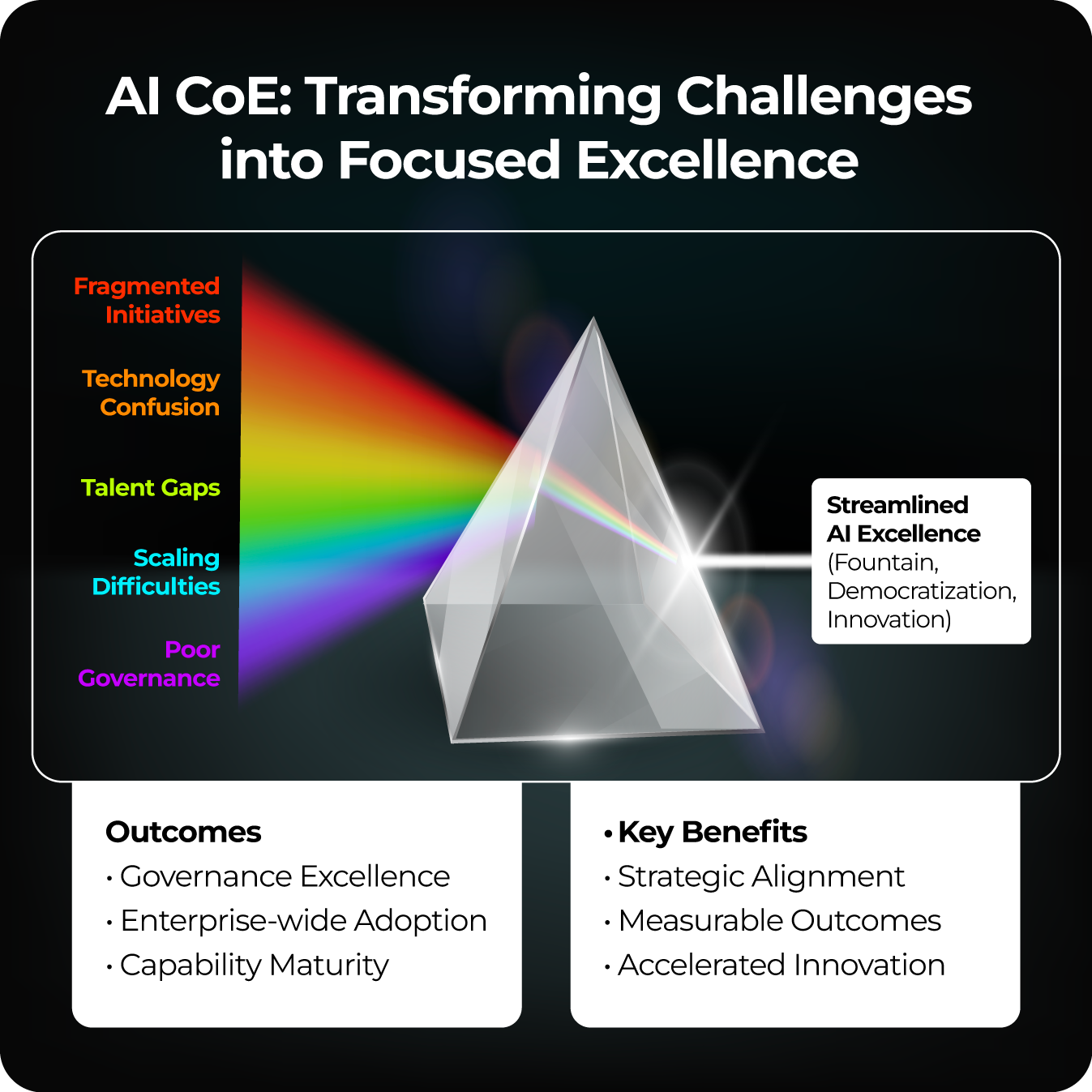
First things first, strategic alignment is/should not be seen (just) as a best practice for AI Centres of Excellence (because it’s the critical differentiator between transformative success and expensive failure). Without clear business objectives, even the most advanced AI becomes an expensive experiment.
At least 30% of generative AI (GenAI) projects will be abandoned after proof of concept by the end of 2025, due to poor data quality, inadequate risk controls, escalating costs or unclear business value.
Source : Gartner, Inc.
Now with this in mind when properly structured , AI centre of excellence create a direct line-of-sight connection between :
- AI initiatives and specific business priorities
- Governance frameworks that enable rather than restrict innovation
- Practical roadmaps with clear value milestones
Is your organization caught in the AI hype cycle—investing in technology without clear business returns?
Our Executive AI Alignment Workshop cuts through the noise, connecting your strategic priorities directly to AI capabilities that deliver measurable impact through structured governance that evolves with organizational readiness.
AI CoE Value Bridge
Now AI implementation gap exists (and persists) for a reason – organizations consistently overestimate readiness while underestimating resource requirements. And when you look at it - While 17-25% of organizations plan AI deployments annually, Only 2-5% successfully reach production.
Three critical dimensions determine your readiness –
- Talent Architecture - Beyond the mythical "10-year prompt engineer," successful AI CoEs build multi-disciplinary teams combining experts who decode processes, data scientists who refine models, engineers who scale solutions, and translators who bridge technical-business gaps.
- Technical Infrastructure - Purpose-built AI infrastructure diverges with traditional IT systems by providing elastic compute, specialized hardware configurations, robust data pipelines with feedback loops, and isolated environments with reproducible dependencies.
- Data Readiness - The most overlooked yet critical factor:
- Accessibility: Can appropriate data be accessed securely?
- Quality: Are data pipelines producing reliable inputs?
- Representation: Does available data reflect the problem space?
- Governance: Are usage permissions and limitations clear?
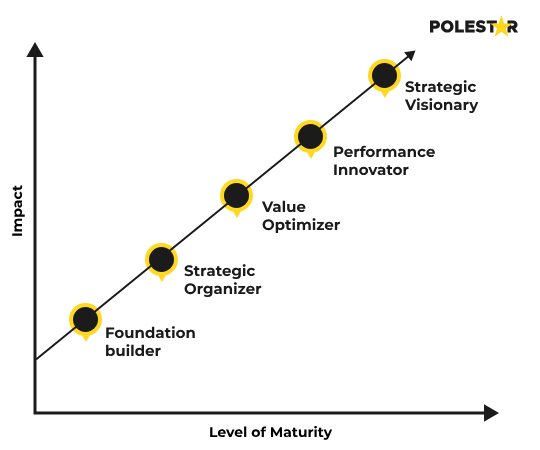
This readiness level varies dramatically based on your organization's data maturity. Let's take a quick poll to see where you stand:
Which stage best describes your organization's current AI CoE maturity?
Now based on your AI CoE readiness, our approach implements tiered capability development programs that address immediate project needs while systematically building enterprise-wide readiness. This approach allows for:
- Initial experimentation with minimal capital commitment
- Incremental scaling as business cases proves successful
- Continuous technology evolution without technical debt accumulation
- Prioritization data quality improvement where it directly impacts AI outcomes
- Feedback loops between model performance and data enhancement
- Establishment of data quality metrics tied to business impact rather than technical purity
You’re setting up (or scaling) your AI CoE—great move. But how will you prove it’s delivering real enterprise impact?
Learn how to track what really matters—adoption, speed, and business impact. Measure AI CoE impact
Measure AI CoE impact
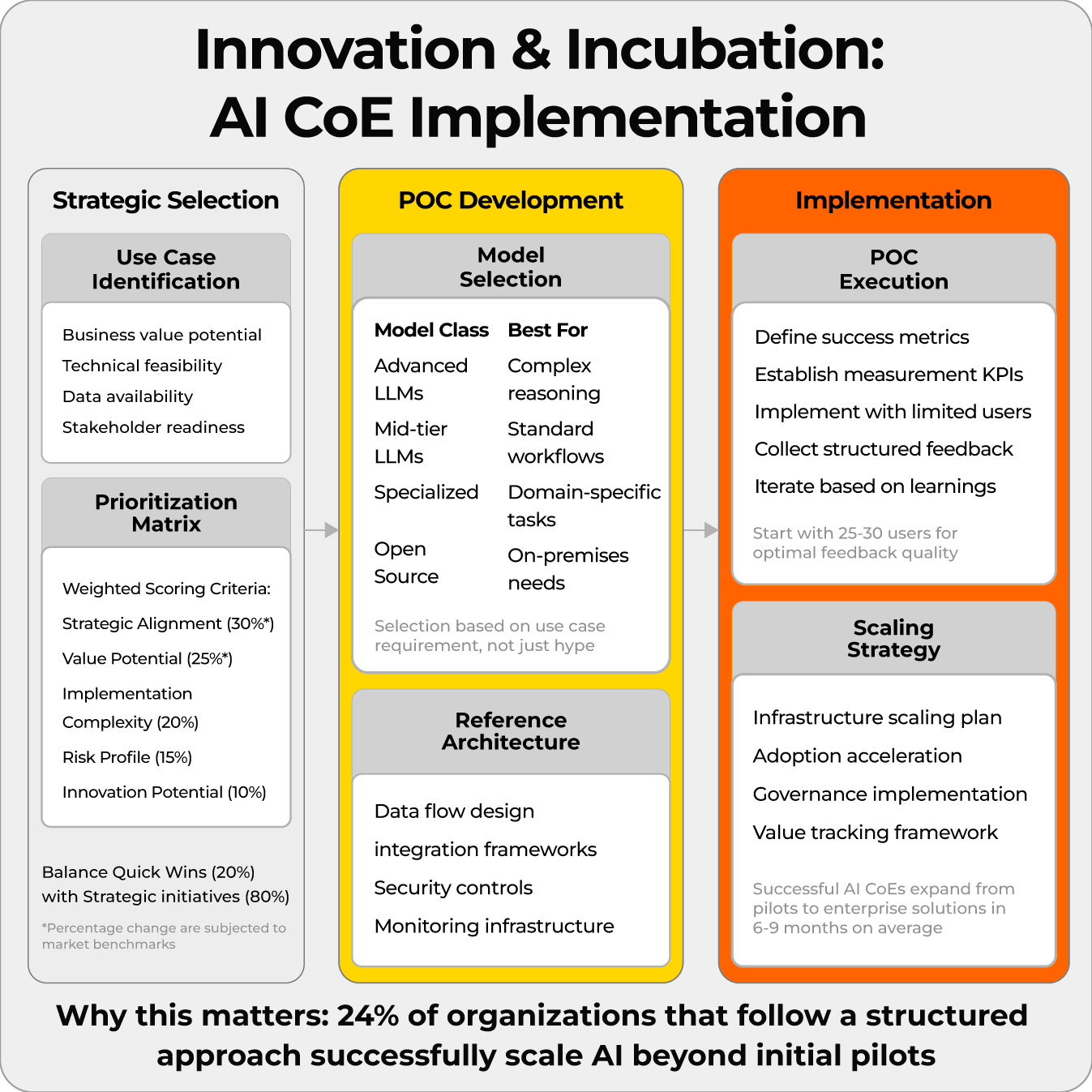
Now once you have your objectives clear, goals aligned, and capabilities assisted we are all set to set up our AI CoE. But wait there’s more to it. 70% of AI initiatives fail to progress beyond the pilot stage, primarily due to poor selection criteria and implementation planning. The Innovation & Incubation phase addresses this challenge by creating a structured pathway from concept to value delivery.
So, You're Doing AI Implementation in Your CoE... By Guesswork?
Discover the Implementation Framework That Bridges Strategy & Execution!
AI CoE Made Easy
Once you know what to implement (you have already won half of the battle), the next critical question is how to ensure its success. This transition from selection to execution represents the moment where many AI initiatives begin to falter.
Once your AI priorities are clear, a common question comes up: “Should we go with a waterfall or agile approach?” But honestly, that’s not the real question.
The most successful AI CoEs don't fall into the trap of choosing between waterfall and agile methodologies—they blend the strengths of both approaches. This balanced implementation style creates what we call "strategic agility": maintaining the governance backbone of waterfall for critical transition points while embracing agile's iterative cycles for execution.
In practice, this means clear stage gates with defined success criteria, but sprint-based execution within each phase. Teams can adapt quickly to model performance surprises or business requirement shifts without losing strategic alignment.
This hybrid approach gives executives the visibility they need while allowing teams the flexibility to learn and pivot. It's particularly valuable when dealing with emerging technologies where performance can vary dramatically across different business contexts.
As AI technologies advance at breakneck speed and business priorities shift, your CoE must transform alongside them. Which means scaling from isolated proofs-of-concept to enterprise adoption demands thoughtful change management. The critical success factors we've observed include:
- Maintaining executive sponsorship through consistent demonstration of value
- Balancing centralized governance with distributed innovation capabilities
- Building broad organizational capabilities beyond specialized teams
- Continuously refreshing the strategic goals as AI technologies and applications evolve
To support this transformation journey, we've developed 1platform—an ecosystem of AI-powered applications that provides unified enterprise intelligence and helps organizations overcome the unique challenges of deploying AI at scale.
Technical metrics mean nothing if business metrics don't move. Effective AI Centers of Excellence track model performance rigorously but recognize this as merely a proxy for what truly matters: tangible business transformation.
The capability assessment by Siddarth Poddar (Director of Solutions, Polestar Analytics) reveals the critical connection between AI excellence and organizational maturity. High-performing organizations deliberately progress capabilities from "Discovering" through "Transforming" stages, as evidenced in the Cost Avoidance and Working Capital Management functions.
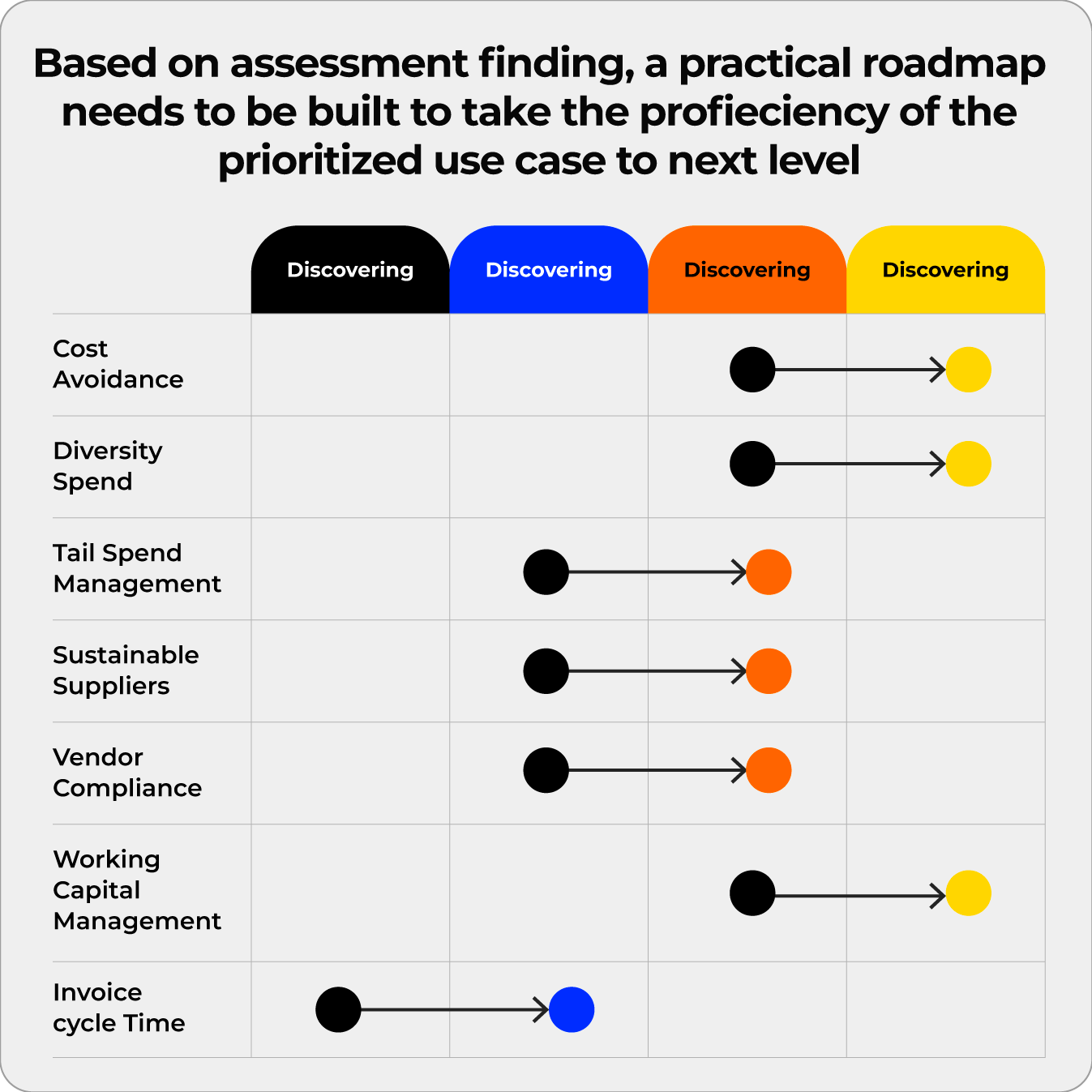
This maturity-driven approach fundamentally reshapes investment priorities, directing resources toward capabilities with the largest gap between current state and business potential.
Your AI investments deserve outcomes. We make sure they get them.
Whether you're stuck in pilot purgatory or just starting to unify scattered AI efforts, our AI Discovery Workshop is the first step toward a cohesive, scalable strategy.
Let’s Map Your AI Future
A well-defined purpose is the single most important factor in AI CoE success. Without it, technology investments rarely translate to business impact.
The PRISM framework helps plant those first AI seeds in your organization. But let's be honest—true transformation doesn't come from just getting started. It comes from nurturing those initial projects into capabilities that reshape your entire business.
Early successes are just the beginning. The organizations pulling ahead don't stop at successful pilots. They build the systems, teams, and governance that turn isolated wins into enterprise-wide capabilities that leave competitors scrambling to catch up.
At Polestar Analytics, we guide you through this evolution with adaptive frameworks that grow as your needs change. We don’t believe in quick fixes. Instead, we help you build long-term capabilities that keep delivering value. With the right foundation, AI stops being just another tool—and starts becoming a real competitive edge that lasts.