
Summarize this blog post with:
Check out the Top working capital planning platforms for CFOs and compare their strengths across forecasting, liquidity, and execution.
PwC’s Working Capital Study 2025/26 identifies €1.84 trillion in excess working capital available for investment. Its analysis covers more than 17,000 listed companies.
The scale of the opportunity is clear. The software choice is less straightforward.
A receivables platform, treasury system, early-payment network, FP&A application, and working capital intelligence layer all improve cash. They intervene at different points.
| Platform |
Best Fit |
Core Strength |
Main Limitation |
| CapitalPulse by Polestar Analytics |
Enterprise-wide working capital improvement |
Root-cause diagnosis, scenario validation, and action tracking with one-click draft plan integration in Anaplan |
Requires clear data definitions and ownership |
| HighRadius |
Receivables-heavy businesses |
Credit, collections, deductions, and cash application |
Inventory planning sits outside its strongest scope |
| Kyriba |
Treasury-led liquidity management |
Cash visibility, payments, financing, and risk |
Operational planning requires another layer |
| C2FO |
Supplier early-payment programmes |
Dynamic discounting and supplier liquidity |
Narrower than a full planning platform |
| Prophix One |
FP&A-led cash planning |
13-week forecasting and cash scenarios |
Does not execute AR, AP, banking, or treasury transactions |
*Capabilities overlap across these categories. The table reflects each platform’s primary role in this comparison.
Most platforms can surface a working capital variance. Far fewer can explain its cause, price the trade-offs, and ensure the chosen action releases cash.
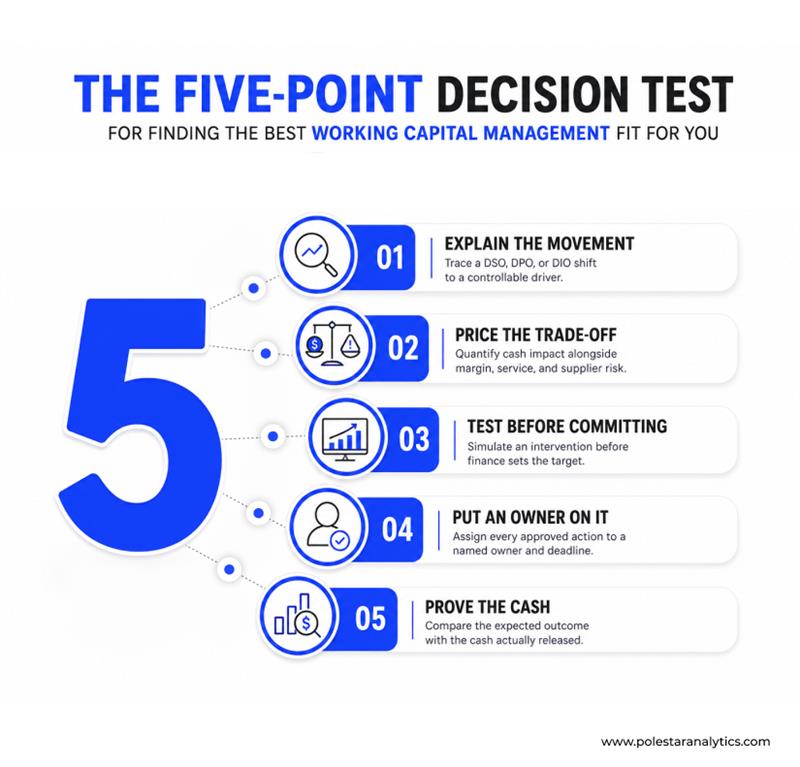
Against this test, no single platform wins every working capital use case. The top working capital planning platforms for CFOs stand apart by where they create the most decision value.

Best for cross-functional working capital intelligence
CapitalPulse is built for enterprises where working capital reviews generate plenty of data but limited decision clarity.
Finance, treasury, procurement, supply chain, and operations often assess the same cash problem through different measures. The result is predictable: competing explanations, broad targets, and no clear action owner.
CapitalPulse addresses that gap through a governed workflow:
Detect → Diagnose → Simulate → Validate → Execute
The sequence matters because a KPI movement rarely explains itself. When the Days Inventory Outstanding goes up it is usually because people are not buying much or we bought too much or we have too much extra stock or there are problems making our products. If the Days Sales Outstanding gets worse, it can mean we are having arguments with our customers or we're slow to send out bills or people are not paying us back or we are not collecting our money very well. Each of these problems, with Days Inventory Days Sales Outstanding needs a different response.
Key capabilities:
- AI-powered anomaly detection across AR, AP, inventory, and liquidity
- Root-cause diagnosis of working capital movements
- Scenario modelling with financial impact validation
- Prioritized recommendations based on cash impact and business effort
- Action tracking with clear ownership and governance
- Unified visibility into receivables, payables, inventory, and overall cash conversion performance
- Anaplan Bridge that brings CapitalPulse insights into existing Anaplan models and planning workflows
CapitalPulse complements Anaplan rather than replacing it. Anaplan provides the connected planning environment for modelling revenue, expenses, inventory, working capital, balance sheet, and cash flow, while CapitalPulse adds diagnosis, scenario validation, recommendation priority, and action tracking.
The evidence adds useful context. In Polestar Analytics’ agentic AI-powered working capital transformation case study, an $800 million cookie manufacturer faced supplier terms of 20 to 30 days and customer terms of 60 to 90 days.
Feel the Pulse of Your Working Capital
CapitalPulse connects AR, AP, inventory, and Anaplan planning to uncover trapped cash, validate the right action, and track what is actually released.
See CapitalPulse in action
Best for order-to-cash execution
HighRadius fits businesses where receivables drive the working capital problem.
Large AR teams rarely struggle with the DSO formula. They struggle with thousands of invoices, deductions, disputes, remittances, credit decisions, and collection queues.
HighRadius Integrated Receivables combines credit management, invoicing, collections, payments, cash application, deductions, and receivables analytics into a unified workflow.
Its predictive prioritisation helps collection teams focus on high-risk accounts. Automated remittance capture and payment matching reduce manual cash-application work. Shared context across collections and deductions also prevents teams from chasing disputed invoices.
This operational depth matters in invoice-heavy environments.
Its boundary is equally clear. HighRadius is strongest inside order-to-cash. It is not the first choice for inventory policy, production planning, demand assumptions, or enterprise-wide cash scenarios.
Best for treasury, liquidity, and financing
Kyriba addresses working capital through a treasury-led lens.
The platform brings together cash visibility, liquidity forecasting, payments, financial risk, supplier finance, dynamic discounting, and receivables financing in one environment.
The platform suits multinational organisations with several banks, entities, currencies, and funding positions. Kyriba’s working capital also supports payables and receivables programmes alongside its treasury capabilities.
Kyriba helps treasury understand where cash sits, how funding moves, and which financing programme supports liquidity goals.
However, liquidity visibility does not equal operational control.
Kyriba does not own demand assumptions, inventory buffers, production plans, customer negotiations, or assortment decisions. Those drivers require a connected planning or working capital intelligence layer.
Best for supplier liquidity and dynamic discounting
C2FO approaches working capital through supplier liquidity rather than traditional financial planning.
The platform allows suppliers to seek early payment by providing a dynamic discount, enabling buyers to utilize available cash while suppliers obtain quicker access to funds. This allows both sides to have flexibility without depending entirely on set payment terms.
In addition to early payments, C2FO facilitates supplier financing initiatives, dynamic discounting methods, and optimization of payment terms, assisting organizations in enhancing liquidity throughout their supply chain.
For CFOs, C2FO is particularly pertinent when the working capital of suppliers plays a significant role in the overall cash strategy instead of being a standalone procurement effort.
Its capabilities complement broader Working Capital Management Software by addressing one of the most important levers in the cash conversion cycle—supplier payments.
Best for 13-week cash forecasting and FP&A
Prophix One combines financial planning with short-term cash visibility.
Its cash-flow planning capability includes 13-week forecasts, cross-entity cash views, customer concentration analysis, overdue invoice identification, and scenario modelling.
Prophix also supports payment-timing and receivables scenarios at invoice level. This gives finance a more detailed near-term cash view than an aggregated monthly forecast.
Prophix belongs in the best FP&A software for CFO discussion when cash forecasting sits inside a broader financial planning requirement.
Its product boundary is clear. Prophix imports AR and AP information for analysis. It does not handle invoicing, collections, payments, bank accounts, or treasury execution.
One platform rarely owns the complete cash cycle.
| Layer |
Role |
Typical Platform |
| Transaction Layer |
Records invoices, orders, inventory, and payments |
ERP and operational systems |
| Planning Layer |
Models financial and operational assumptions |
Anaplan or Prophix One |
| Execution Layer |
Runs collections, payments, treasury, or supplier programmes |
HighRadius, Kyriba, or C2FO |
| Decision-Intelligence Layer |
Diagnoses causes, validates actions, and tracks realised cash |
CapitalPulse |
This structure prevents a common procurement error.
Many buyers expect one platform to act as the system of record, planning model, treasury system, workflow engine, and intelligence layer. The result is a large implementation with shallow adoption.
Software does not repair a weak operating model.
Strong working capital programmes still rely on disciplined operating choices:
- Segment collections by payment behaviour, dispute type, customer value, and risk.
- Set supplier terms by category criticality and resilience.
- Review inventory by SKU, location, service level, margin, and obsolescence.
- Connect the 13-week cash forecast with the monthly financial plan.
- Assign every cash action an owner, deadline, expected value, and realised outcome.
- Track cash released instead of counting recommendations produced.
These practices turn Working Capital Solutions for Business into a repeatable operating process.
Without them, software produces better reports while the same decisions remain unresolved.
Working capital pressure usually happens because of business decisions that are made before the finance team starts to see how these decisions affect the company.
Pricing, promotions, trade terms demand forecasts and assortment plans are all things that affect how cash the company has. They decide how fast the company sells its products how money the company makes from each sale and when the company gets paid by its customers.
For example a promotion may help the company sell more of a product in the short term but it can also cause the company to have too much stock of other products that are not selling as well.
More aggressive retailer terms may help secure volume, yet extend receivable days.
This is where Revenue Growth Management and working capital planning begin to overlap. RGM assesses the commercial effect of pricing, promotions, trade spend, and assortment decisions. Working capital management looks at what those same decisions do to inventory, receivables, liquidity, and the cash conversion cycle.
For CFOs, the goal is not to merge both disciplines. It is to make sure commercial decisions are tested for growth, margin, and cash impact before approval.
CapitalPulse supports that connection by bringing commercial, inventory, receivables, and financial signals into the working capital decision process.
The strongest Financial Management Tools for CFOs should survive a live business case.
Give every shortlisted vendor the same task:
- Load one material DSO, DPO, or DIO variance.
- Trace it to customer, supplier, SKU, site, or business-unit drivers.
- Model two interventions.
- Compare cash, margin, service, and risk effects.
- Route the selected action to an owner.
- Show how realised value will be measured after 30, 60, and 90 days.
A polished dashboard proves presentation quality. This test proves decision value.
There is no honest single winner across every working capital use case.
CapitalPulse provides the broadest cross-functional diagnosis and action layer. HighRadius leads operational receivables. Kyriba leads treasury and liquidity. C2FO supports supplier early-payment programmes. Prophix One strengthens cash forecasting and FP&A.
The best working capital management solutions fit the decision, data, operating model, and existing technology stack.
Start with the cash constraint. Then identify the missing layer.
For Anaplan users, Polestar Analytics connects enterprise planning with CapitalPulse working capital intelligence. This creates a governed route from operational signal to validated financial action.
Start with the cash constraint, not the software category. Identify whether the main problem sits in receivables, inventory, supplier payments, liquidity visibility, or cross-functional decision-making. Then assess whether the platform can diagnose root causes, model trade-offs, assign actions, integrate with existing systems, and track the cash actually released.
Working Capital Management Software should explain the driver, trade-off, action, owner, and expected cash outcome behind each variance. KPI reporting is the baseline. Strong platforms also provide scenario testing, accountable workflows, system integration, and realised-value tracking.
CapitalPulse is an agentic working capital intelligence platform covering receivables, payables, inventory, and liquidity. It detects cash risks, diagnoses root causes, tests interventions, validates financial impact, and tracks execution. It sits above existing ERP, treasury, and planning systems.
CapitalPulse adds working capital diagnosis and action intelligence around Anaplan’s connected planning model. CapitalPulse analyses AR, AP, inventory, and liquidity signals. Anaplan models the effect across operational and financial plans. Together, they connect root cause, scenario validation, approval, and execution.
Inventory-focused working capital management solutions should link DIO with demand, purchasing, production, service levels, margin, and obsolescence. CapitalPulse provides cross-functional diagnosis and action tracking. Anaplan provides the connected demand, supply, and financial planning context.