 KaifInsight Architect
Registrera dig för att få de senaste insikterna och uppdateringarna inom teknik, AI och dataanalys, datavetenskap och innovationer från Polestar Analytics.
 Sammanfatta detta blogginlägg med:
| AI in wealth management is commoditising portfolios, shifting durable value to governed data, cross-source intelligence, auditable automation, and human judgement. |
TL;DR
Wealth management long rested on scarcity: finite licensed professionals, labor-intensive planning, a compliance moat around automation. AI in wealth management dismantles the second and pressures the rest.
The market has voted. When Altruist unveiled an AI tax-planning workflow in early 2026, McKinsey's The signal in the sell-off recorded over $20 billion erased from listed wealth managers in one session and over $100 billion within three weeks: investors repricing any business whose technical outputs became easy to replicate.
The mechanics:
The portfolio, the plan, the rebalance recommendation: all outputs any competitor can now generate. That is the trap.
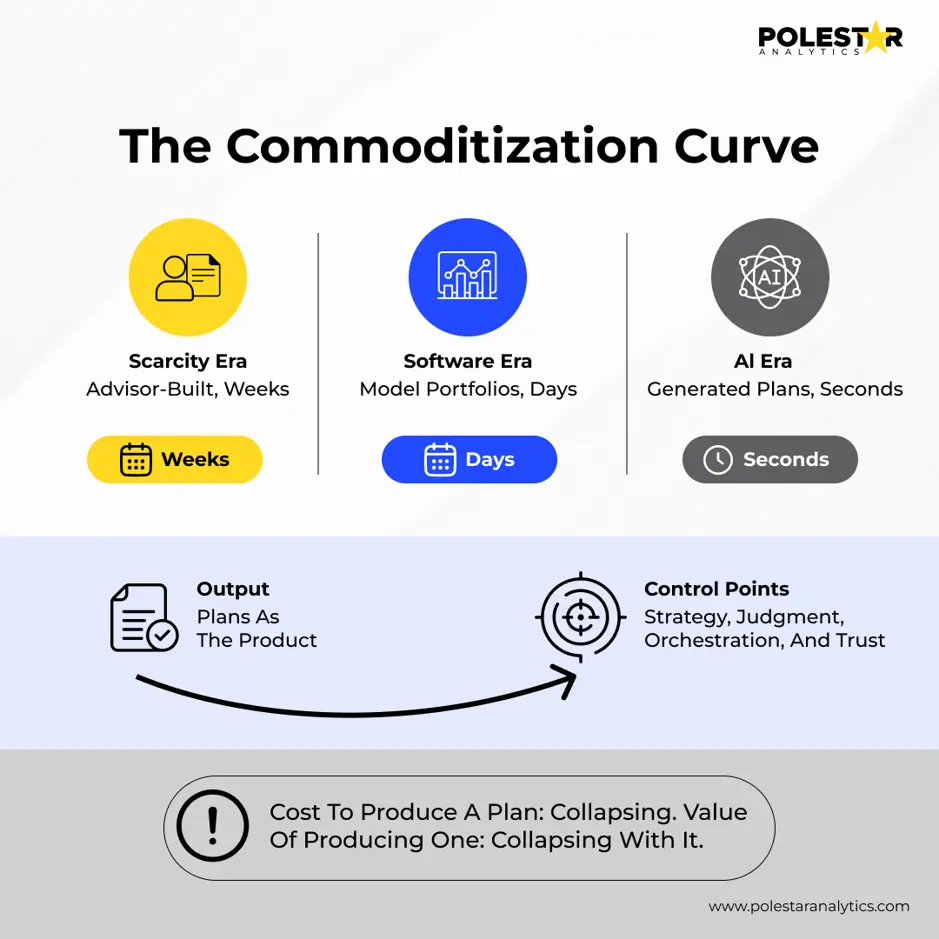
McKinsey's answer, and ours, is control points. As the report puts it, "planning is getting cheaper than supervision." Value migrates to what automation cannot cheaply copy.
The Output-to-Control-Point Framework:
| Commoditizing output | Defensible control point |
|---|---|
| Document parsing and extraction | Governed, permissioned, high-fidelity data |
| Plan drafting and scenario decks | Human judgment and behavioral coaching |
| Routine service triage | Ownership of the primary advisor workspace |
| Basic compliance checks | Supervision and auditability by design |
| Opportunity surfacing | Execution rails that turn insight into action |
Notice what tops the right column: data. Governed data enables every other control point; an AI agent is only as trustworthy as the lineage beneath it. That is why Polestar Analytics treats data engineering as the foundation of every AI wealth management solution, not an afterthought.
Most wealth management firms cannot claim this control point today: their data lives across three to five custodian portals, a CRM, billing, and reconciliation spreadsheets.
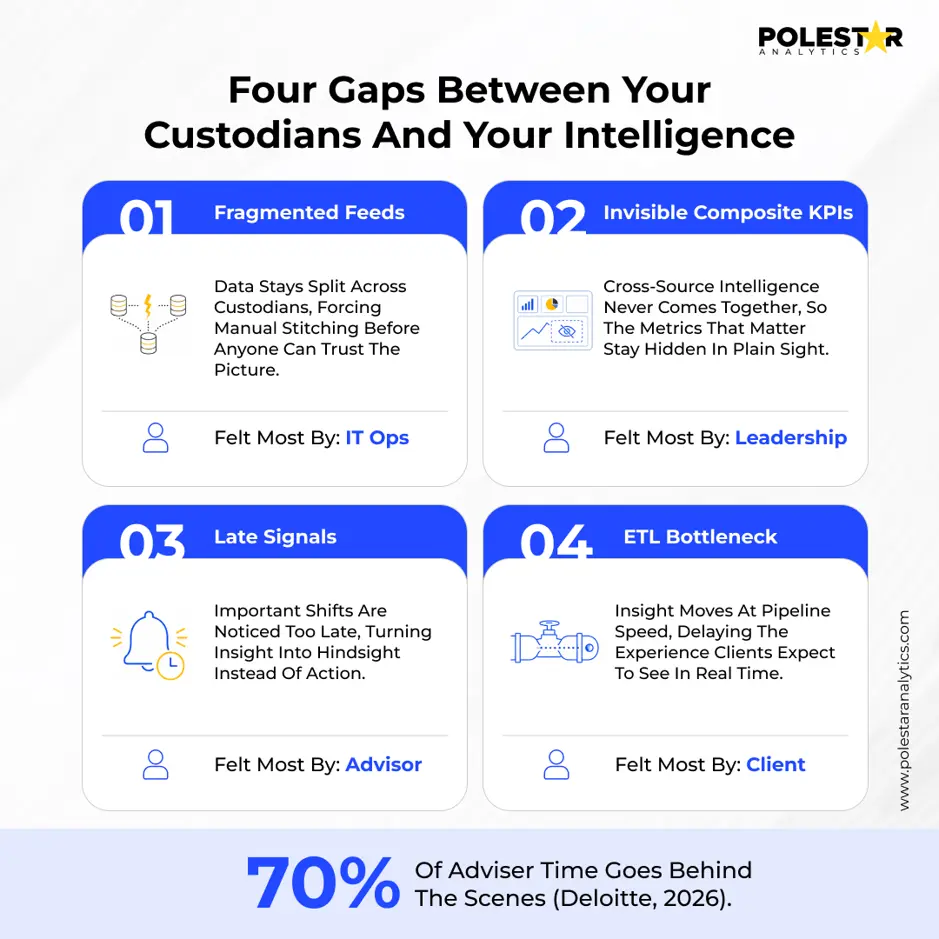
Deloitte's May 2026 agentic AI prediction quantifies these wealth management challenges: advisers spend nearly 70% of their time behind the scenes, and the technology stack is the biggest swing factor in AI value capture. Even motivated advisors stall when data is fragmented.
The recurring wealth management gaps:
This is why the impact on Wealth Management Firms from AI has been so uneven: the constraint was never model quality, it was the substrate.
Closing these gaps requires more than another reporting tool. Wealth management firms need an intelligent platform that can unify fragmented data, govern it from source to insight, and continuously convert signals into prioritised actions.
WealthPulse, the agentic AI-powered intelligent platform from Polestar Analytics' Pulse Suite, is purpose-built for RIA firms and family offices operating across fragmented multi-custodian environments. WealthPulse unifies data from 35+ vendors across seven source types and unlocks 118 wealth management KPIs, while six AI agents for wealth management run continuously on the governed data pipeline, delivering prioritised, decision-ready insights to IT Ops, advisers, and leadership while keeping every decision human led.
Three moves operationalise the control-point framework, and each maps to concrete AI in wealth management examples across IT Ops, advisers, and leadership, showing what mature use of AI in wealth management looks like day to day.
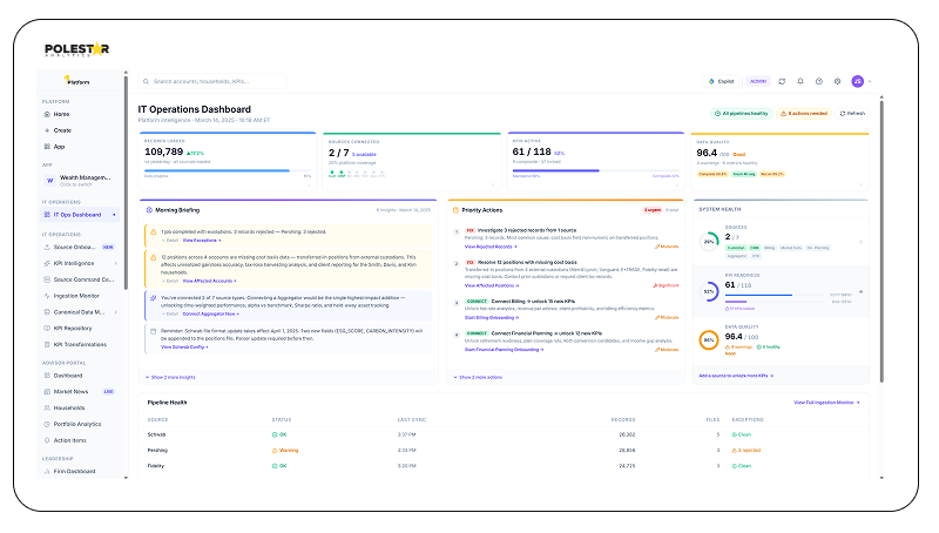
IT Ops use case: Morning briefings identify rejected custodian records or missing cost-basis information before reporting is affected.
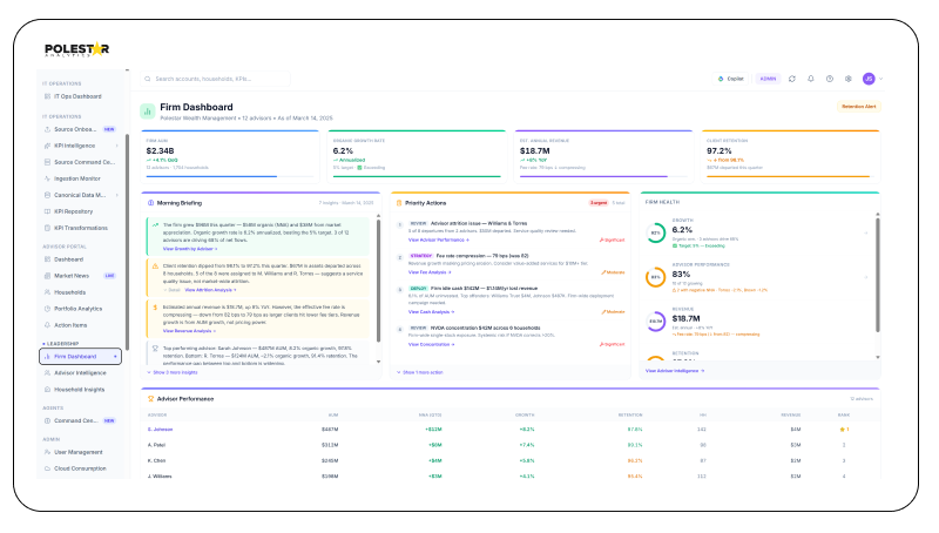
Leadership use case: Firm leaders can track AUM, organic growth, retention, fee compression, revenue, and adviser-level performance from one governed view.
Adviser use case: Advisers can see which households require attention, why they have been prioritised, and the recommended next action before the client contacts them.
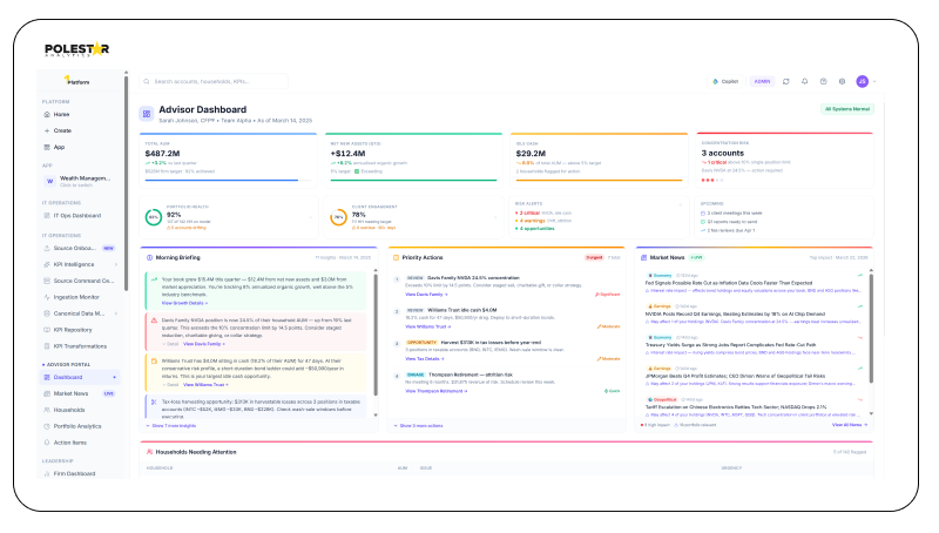
Polestar Analytics reports measured impact of 15-20% higher advisor productivity and a 10-20% lift in AUM per client, in line with Deloitte's projection that AI could free 25-50% of adviser time and expand serviceable capacity by $10-35 trillion in AUM.
See Polestar Analytics' Agentic AI practice or the eBook Are You Agent Ready?
Firms panicking about AI replacing portfolios are asking the wrong question. Portfolios were always going to be commoditized; AI is finishing what index funds started. The real race is for the intelligence layer above the portfolio: whoever owns clean, unified, cross-custodian data owns the right to deploy agents safely. Everyone else rents it.
The commoditisation of the portfolio is not a threat to defend against; it is a signal about where the value has moved. Wealth management firms that keep pouring investment into producing prettier outputs will find themselves competing on price against algorithms that produce the same outputs faster. Firms that invest in the layer beneath the portfolio, the governed data, the composite KPIs, the audit trail, the agentic execution surface, will define what "advice" means for the next decade.
That is the choice WealthPulse is designed to make simple. By collapsing multi-custodian ingestion, KPI intelligence, and agent-driven action into a single governed platform, Polestar Analytics gives firms the one asset AI cannot commoditise away: a data foundation they own, on which every future model, every future agent, and every future service can be safely built. In the AI era, that foundation is the moat, and the firms that build it first will set the terms for everyone else.
Because clients pay for accountable judgment, not spreadsheets. McKinsey's 2026 research finds nearly 80% of affluent households still prefer a human relationship for advice. AI compresses the cost of advice inputs; trust, coaching, and execution stay human-anchored, and unified data lets firms deliver them at scale.
Capacity, not headcount cuts. Deloitte projects adviser productivity uplift of 30-100% by 2032 as agentic systems absorb operational work, against a 90,000-110,000 advisor shortfall McKinsey projects by 2034. Firms with integrated, AI-ready data stacks capture the upside; fragmented stacks watch the same tools underdeliver.
Portfolio accounting stops at positions and returns. WealthPulse goes a layer deeper and wider: source-level ingestion monitoring, composite cross-source KPIs spanning custodian, CRM, and billing data, and AI-prioritized actions routed to IT Ops, advisors, and leadership from one governed lakehouse.
At the data substrate: inventory every source, instrument ingestion health, and establish governed Bronze-to-Gold lineage before granting any agent autonomy. WealthPulse's KPI Readiness view shows which intelligence each source unlocks, so the roadmap follows analytics return, not integration folklore.
Om författaren
Insight Architect
There are no uncertainties, only possibilities and probabilities shaped into evidence by data.
Relaterad blogg
 Astha Chadha