
Vat dit blogbericht samen met:
Kort samengevat:AWS ruilt diensten die losjes aan elkaar gekoppeld zijn met Databricks in voor één uniform lakehouse-platform, gebouwd op Delta Lake.Unity-catalogusBij AWS naar Fabric wordt OneLake als gedeelde basis gebruikt. Bij Snowflake naar Fabric, waar je al op een geconsolideerd platform zit, is de echte vraag of het datawarehouse het zwaartepunt blijft of dat het bredere, gedeelde Fabric-platform de overhand neemt.
Agentische AI-werkbelastingenDit zal honderden acties in gang zetten vanuit één enkele prompt, wat enorme eisen stelt aan data, rekenkracht en opslag. Agents zullen continu query's uitvoeren, redeneren en actie ondernemen, wat nieuwe eisen stelt aan rekenkracht, opslag, integratie, governance en data-toegankelijkheid.
Dit betekent dat bestaande data-architecturen moeite hebben om deze schaal efficiënt te verwerken, wat leidt tot hogere infrastructuurkosten en operationele complexiteit.Het moderniseren en migreren van het data-landschap.is essentieel voor het ondersteunen van schaalbare, kostenefficiënte AI-workloads, waar 83% in gelooft. Zo niet, dan leiden de verouderde structuren tot latentie, duplicatie, integratiekosten en stijgende infrastructuurkosten.
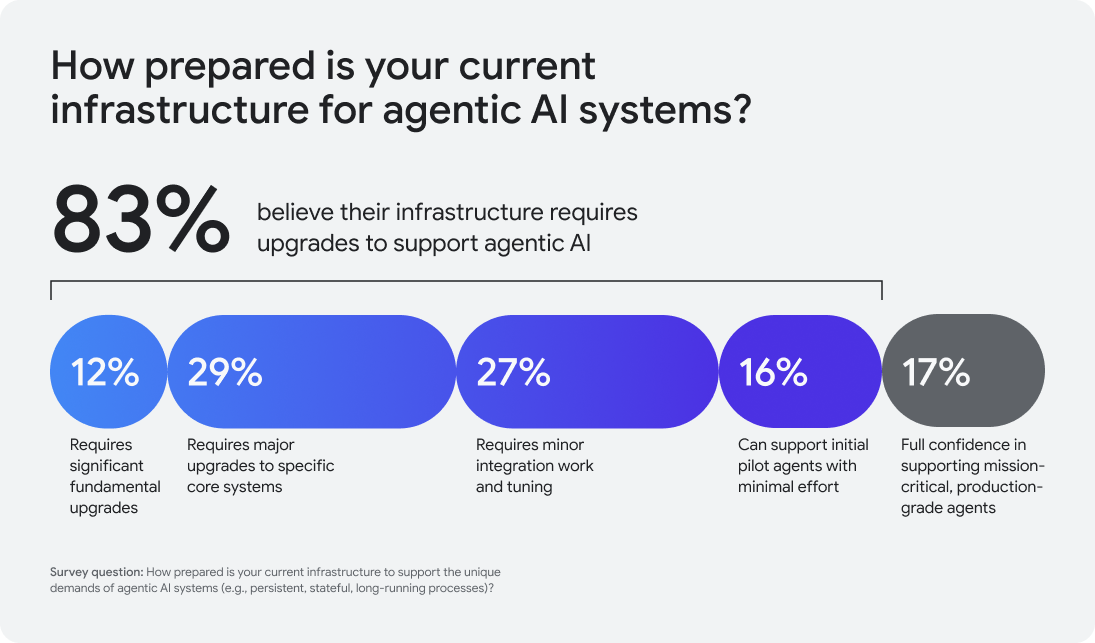 Bron:Google, Rapport over de stand van de AI-infrastructuur
De oplossing voor dit probleem begint met cloudmigratie ofdata-landgoedmigratieMaar het verplaatsen van data van het ene platform naar het andere is niet zo simpel als het kopiëren van tabellen en het opnieuw opbouwen van pipelines.De onderliggende architectuur verandert.Opslaglagen, rekenkracht, dataformaten, orkestratie, beveiliging, governance, semantische modellen en workloads moeten mogelijk allemaal opnieuw worden bekeken.
Wat we hiermee willen bereiken, is een diepgaande analyse van de dataplatformmigraties vanVan AWS naar Databricks, van AWS naar Microsoft Fabric of van Snowflake naar Fabric.— om te begrijpen wat er naar een ander platform wordt overgezet, wat er opnieuw wordt ontworpen en wat kan worden behouden.
Op hoofdlijnen:
| Uitgangspunt |
Doel |
Wat verandert het meest? |
| AWS |
Databricks |
AWS-services worden geconsolideerd in een platform dat is gericht op vakantiehuizen aan het meer. |
| AWS |
Stof |
AWS-services evolueren naar een op OneLake gecentreerd analyseplatform. |
| Sneeuwvlok |
Stof |
Warehouse-centrische analyses evolueren naar een breder, gedeeld dataplatform. |
Een volwassen AWS-ecosysteem of data-ecosysteem kan S3, Glue, EMR, Redshift, Lambda, Kinesis, Step Functions en externe orchestratie omvatten. Snowflake is een sterk geïntegreerd analyseplatform, dus de migratie naar Fabric vereist minder consolidatie van services en meer heroverweging van de plaatsing van opslag, rekenkracht, engineering, BI en governance. Zowel Databricks als Fabric streven ernaar de architectuurfragmentatie te verminderen, maar ze doen dit op verschillende manieren.
Het begrijpen van applicatieafhankelijkheden en het beoordelen van de technische haalbaarheid zijn dus twee van de belangrijkste aspecten en tevens de twee grootste uitdagingen bij migraties in het algemeen.
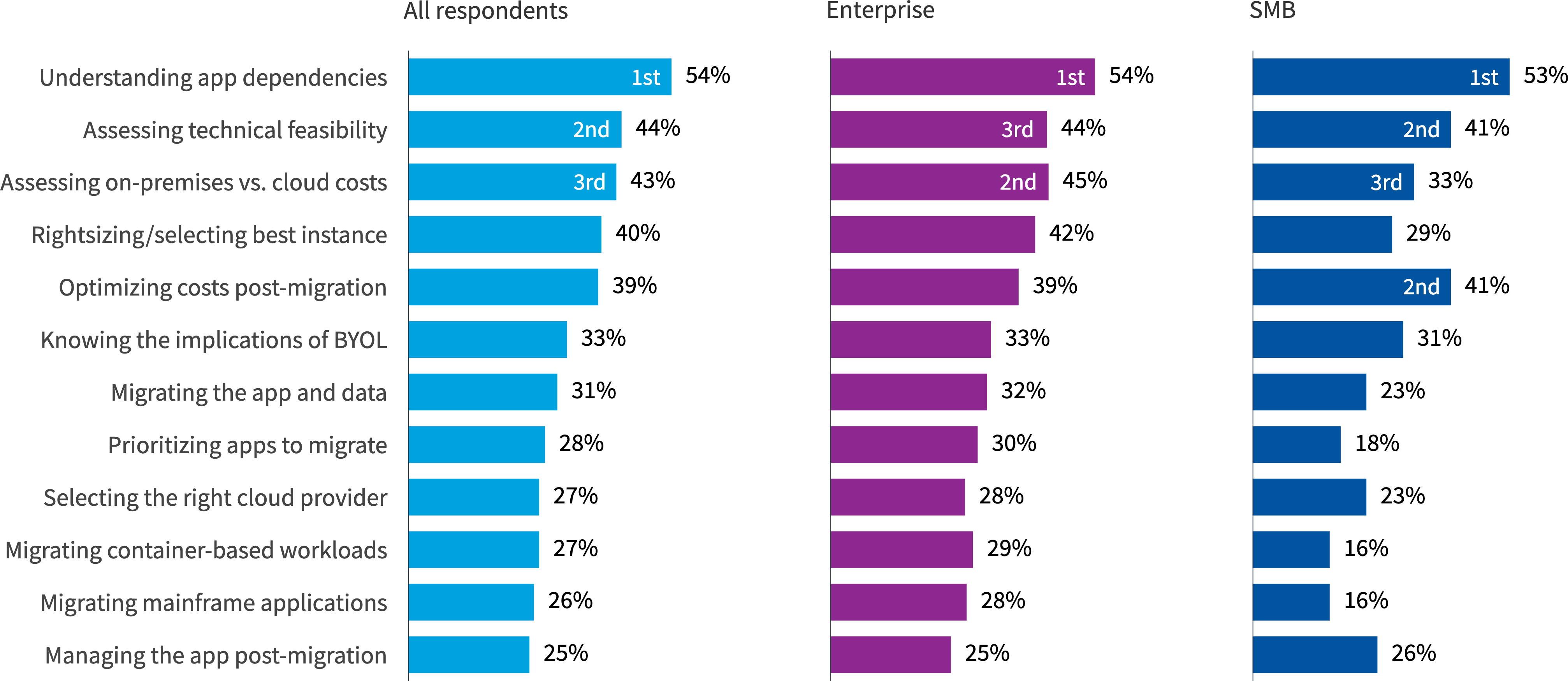 Bron:Flexera 2026 State of the Cloud Report
Laten we ze eens nader bekijken.
Een migratie van AWS naar Databricks vervangt service-orkestratie door platform-orkestratie. S3, Glue, EMR en Redshift hebben elk hun eigen configuratie, machtigingen en faalmodi. Databricks consolideert deze lagen in Delta Lake als de transactionele tabel-laag, Spark/SQL als de gedeelde rekenengine en Unity Catalog als de governance-laag. Zo is dezelfde functionaliteit die voorheen vier services vereiste, nu in één platform ondergebracht.
Dit betekent dat je allereerst het volgende moet begrijpen:
- Lijmklussen en kruipers
- Redshift-schema's en -procedures
- EMR-werkbelasting
- Stapfuncties
- Lambda-functies
- S3-paden en -afhankelijkheden
- Streaming-pipelines
- Externe planners
- Consumenten stroomafwaarts
Meest gestelde vragen over de migratie van AWS naar Databricks:
1. Wat gebeurt er met AWS Glue ETL-taken?
Glue-taken kunnen naar Databricks worden gemigreerd, maar vereisen vaak een herontwerp van de architectuur in plaats van een simpele herschrijving van de code. Glue-workloads die gebruikmaken van DynamicFrames, crawlers en triggers kunnen worden aangepast aan Spark, Delta Lake en de native orchestratiemogelijkheden van Databricks.
In plaats van:Lijm → S3 → Roodverschuiving → Lambda
De architectuur kan het volgende worden:Invoer → Delta Lake → Spark/SQL → Workflows → BI/ML
Het belangrijkste voordeel is minder overdracht tussen diensten en een meer uniform dataplatform.
2. Hoe verandert streaming in Databricks?
Streaming wordt onderdeel van dezelfde lakehouse-architectuur in plaats van een aparte pipeline-laag. Een AWS-pipeline die gebruikmaakt van Kinesis, Lambda, S3 en Redshift kan zich ontwikkelen naar:
Auto Loader → Delta Lake → Lakeflow Declaratieve pijplijnen
Dit maakt het mogelijk dat batch- en streamingprocessen gemeenschappelijke patronen delen, integreert datakwaliteit in pipelines en zorgt ervoor dat BI, analyses en machine learning dezelfde beheerde datalaag kunnen gebruiken.
Een migratie van AWS naar Fabric vervangt een gefragmenteerde service-stack door OneLake als gedeelde basis, en in tegenstelling tot Databricks hoeft u de gegevens niet eerst te verplaatsen.Fabric biedt ondersteuning voor snelkoppelingen naar externe bronnen, waaronder S3-compatibele opslag, zodat teams verbinding kunnen maken en de werking kunnen valideren voordat ze ook maar één byte fysiek verplaatsen.
De belangrijkste verschuiving is richting OneLake. Fabric is ontworpen rond een gedeelde datafundament, waardoor de verschillende workloads op dezelfde onderliggende data kunnen draaien in plaats van dat elke engine een eigen kopie moet onderhouden.
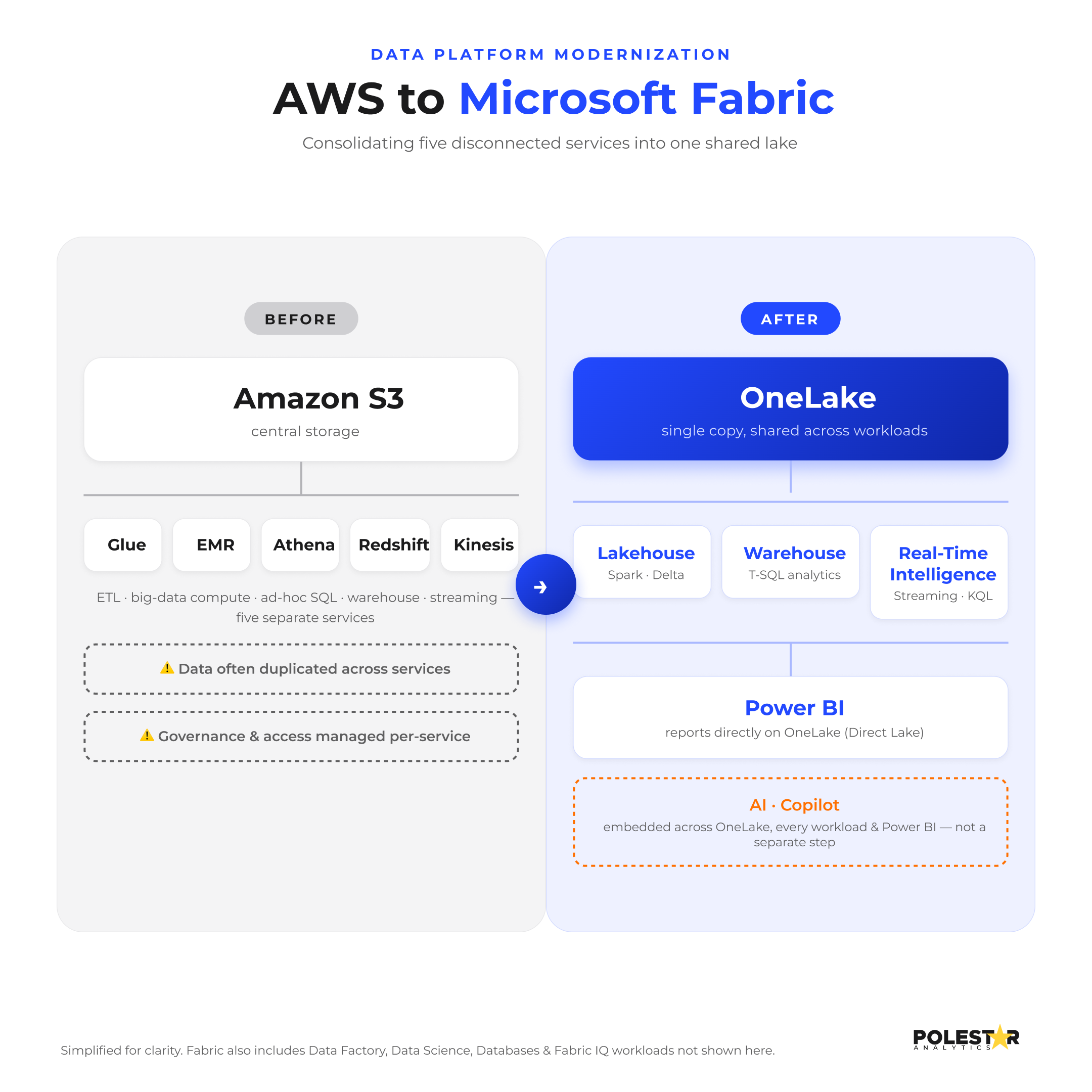
Meest gestelde vragen over de migratie van AWS naar Fabric:
1. Waarom zijn pipelines vaak moeilijker te migreren dan de data?
Omdat het verplaatsen van data de logica die eromheen is gebouwd niet verplaatst.AWS-workloads kunnen onder andere Glue-taken, Step Functions, Lambda-functies, IAM-beleid, regels voor gegevenskwaliteit, planningen en afhankelijkheden omvatten, die allemaal afzonderlijk moeten worden beoordeeld.
Sommige werklasten kunnen wordenFabric Data Factory-pipelinesSommige onderdelen kunnen worden vervangen of verwijderd, en weer andere kunnen buiten Fabric blijven.
Het doel is niet omAWS nabouwen binnen FabricHet doel is om de workloadarchitectuur opnieuw te ontwerpen, gebaseerd op de sterke punten van Fabric.
2. Hoe worden AWS Kinesis- en Lambda-workloads gekoppeld aan Fabric?
Kinesisstromen kunnen worden gekoppeld aanFabric-gebeurtenisstromen en realtime-intelligentievoor het verzamelen, verwerken en monitoren van gebeurtenissen, terwijl Lambda-functies kunnen worden vervangen doorFabric-pipelines, notebooks of andere gebeurtenisgestuurde verwerkingspatronenafhankelijk van de werklast.
AWS: Kinesis → Lambda → S3/Redshift → downstream-toepassingen
Stof: Eventstreams → Realtime intelligentie / OneLake → analyses en downstream workloads
Dit kan het aantal betrokken diensten verminderen en tegelijkertijd voordelen opleveren.realtime data-invoer, -transformatie, -opslag en -analyse op een meer uniform platform.
Deze migratie begint vanuit een veel meer geconsolideerde architectuur dan de twee AWS-scenario's hierboven, waardoor het verleidelijk is om het als een puur SQL-compatibiliteitsproject te beschouwen. Dat is echter een te beperkte benadering. De diepere vraag is of het datawarehouse het zwaartepunt moet blijven.
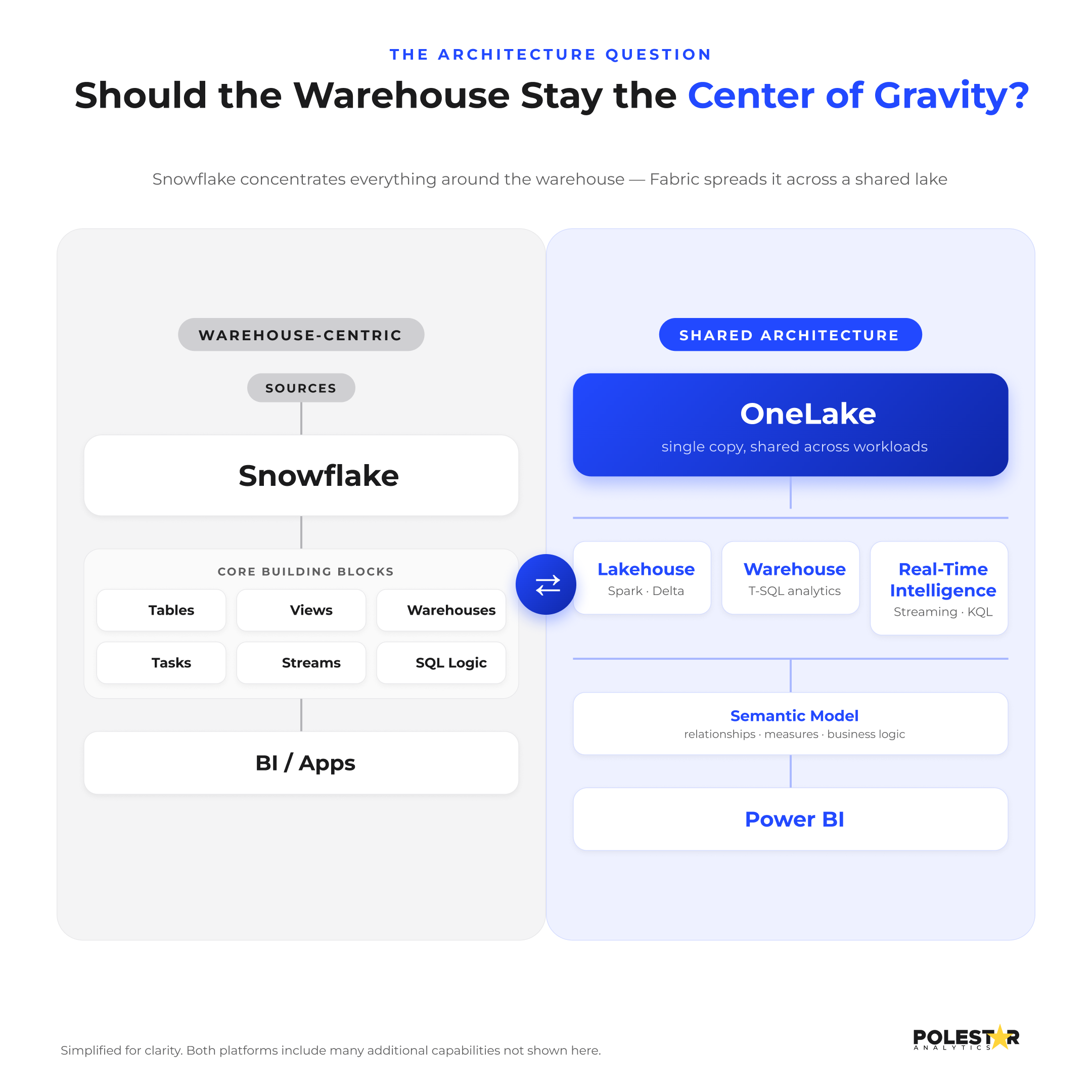
Het voordeel van deze datawarehouse-migratie is dat erMicrosoft Mirroring voor Snowflake is nu algemeen beschikbaar.(bevestigd door)Microsofts aankondiging van de algemene beschikbaarheid), die de ondersteunde Snowflake-gegevens continu naar OneLake repliceert.Dit creëert een co-existentiemodel waarin bestaande workloads kunnen blijven functioneren terwijl nieuwe workloads geleidelijk op Fabric worden gebouwd. De reden waarom dit waardevoller is dan een big-bang migratie, is dat het de datamigratie scheidt van de workloadmodernisering.
Veelgestelde vragen over de migratie van Snowflake naar Microsoft Fabric:
1. Hoe verandert de scheiding van opslag en rekenkracht bij Snowflake in Microsoft Fabric?
De onderliggende architectuur verandert aanzienlijk.Snowflake scheidt opslag en rekenkracht via zijn virtuele datawarehouse-model, terwijl Fabric data naar OneLake brengt en workloadspecifieke rekenkracht levert voor al zijn services.
Dit betekent dat bij een migratie de rekenkracht, de gelijktijdigheid van de werkbelasting, de gegevensverplaatsing, de caching en de prestatiepatronen opnieuw moeten worden bekeken, in plaats van simpelweg tabellen te verplaatsen en dezelfde architectuur te behouden.
2. Wat gebeurt er met Snowflake-streams, taken en geplande workloads?
Ze moeten worden afgestemd op de orchestratie- en gegevensverwerkingsmogelijkheden van Fabric.Snowflake-taken en -streams kunnen worden vertaald naarFabric Data Factorypijplijnen, notebooks of andere incrementele verwerkingspatronen, afhankelijk van de werklast.
De migratie biedt daarom de mogelijkheid om de orkestratie te vereenvoudigen en dubbele gegevensverplaatsing te verminderen – en niet alleen om elke Snowflake-taak in Fabric te reproduceren.
Een veelgebruikte aanpak voor de migratie van een datawarehouse ziet er als volgt uit:
| Oud |
Nieuw |
| S3 |
OneLake |
| Lijm |
Fabric Data Factory |
| Roodverschuiving |
Stoffenmagazijn |
| Lambda |
Stofequivalent |
| Stapfuncties |
Stoffen pijpleidingen |
Die tabel is nuttig, maar het is geen architectuur, omdat ervan wordt uitgegaan dat elk oud component een nieuw component verdient. Een betere aanpak stelt voor elk component een andere vraag:
| Bestaande werkdruk |
Stel deze vraag eerst |
| S3-gegevens |
Moet het verplaatst worden, of kan ernaar verwezen worden? |
| Lijmwerk |
Is die transformatie nog steeds nodig? |
| Roodverschuivingstabel |
Wordt er gedupliceerd in de gegevens van het meer? |
| Lambda |
Gaat het om gegevensverwerking, orkestratie of applicatielogica? |
| Stapfunctie |
Welke afhankelijkheden zijn nog steeds reëel? |
| Sneeuwvlokmagazijn |
Is de werklast thuis te vinden in een magazijn, een vakantiehuis aan het meer, of allebei? |
| BI-extractie |
Kan de semantische laag rechtstreeks toegang krijgen tot de gedeelde gegevens? |
De beoogde architectuur moet worden ontworpen op basis van de bedrijfsfunctionaliteiten, en niet worden gereconstrueerd uit technische artefacten.
MigrationStudio verplaatst dataomgevingen van het ene platform naar het andere: AWS naar Databricks, AWS naar Fabric, Snowflake naar Fabric, GCP naar Fabric, GCP naar Databricks, in principe van elk platform naar elk ander. Het product vereenvoudigt de 70% van dat werk die herhaalbaar is: een agentgestuurde workflow die het bronsysteem scant, bepaalt welke taken daadwerkelijk actief zijn en welke niet, modelleert de doelarchitectuur, converteert de taken, optimaliseert ze en promoot het resultaat via Git.
Het belangrijkste verschil zit hem in de semantische herplatformering in plaats van transliteratie. De meeste migratietools zetten oude syntax om naar nieuwe syntax en leveren code die nog steeds denkt zoals het bronsysteem, de fout van één-op-één-mapping waar dit artikel steeds voor waarschuwt. MigrationStudio berekent wat een taak daadwerkelijk moet doen, schrijft vervolgens idiomatische code voor het doelplatform en ruimt onderweg de oude code op in plaats van deze simpelweg te kopiëren.
De claim is van toepassing op alle mogelijke platforms, van AWS naar Databricks, AWS naar Fabric, Snowflake naar Fabric, GCP naar Fabric en GCP naar Databricks.Waar van toepassing, betekent dit een tijdsbesparing van 35% of meer op de migratiekosten en -tijd in vergelijking met een handmatige heropbouw.
| Dimensie |
AWS naar Databricks |
AWS naar Fabric |
Van sneeuwvlok tot stof |
| Beginnende architectuur |
Gedistribueerde diensten |
Gedistribueerde diensten |
Geïntegreerd magazijnplatform |
| Kernverschuiving |
AWS-services voor Lakehouse |
AWS-services voor een platform dat is gecentreerd rond OneLake. |
Van magazijngericht naar gedeeld data-landschap |
| Opslag |
S3 + Delta |
OneLake + externe snelkoppelingen/gegevensinvoer |
OneLake via migratie-/spiegelings-/opslagpatronen |
| Verwerking |
Spark + SQL |
Stofmotoren + Spark |
Stoffenmagazijn/Lakehouse/Spark |
| ETL |
Herstructureer naar lakehouse-native pipelines |
Consolideer in Fabric-pipelines/workloads |
Heroverweeg de ETL-aanpak voor magazijnen versus de transformatie van het vakantiehuis aan het meer. |
| Orkestratie |
Databricks-workflows/pipelines |
Fabric Data Factory |
Stoffenorkestratie |
| Bestuur |
Unity-catalogus |
Fabric/OneLake-bestuur |
Fabric/OneLake-bestuur |
| Grootste migratierisico |
De AWS-architectuur nabouwen in Databricks |
Fabric beschouwen als een bestemming in plaats van een doelarchitectuur. |
Migratie uitsluitend beschouwen als een SQL-conversie. |
| Grootste kans |
Verenig data- en AI-workloads |
Verminder platformfragmentatie |
Verbreed de analysemogelijkheden tot buiten de op magazijnen gerichte architectuur. |