


 KaifInsight Architect

Meld u aan om de nieuwste inzichten en updates over technologie, AI & data-analyse, datawetenschap en innovaties van Polestar Analytics te ontvangen.
 Vat dit blogbericht samen met:
| The production-like AI pilot runs on production-like data using governance mechanisms, users, and environment that it would run in production. This would mean that in Databricks, we need to create an AI pilot that runs in a governed Unity Catalog workspace, and evaluates against an agreed upon business metric. Twelve weeks works because the sequence is fixed: two weeks to contract the decision, six to build against governed data, four to shadow-run and gate. Most AI proof of concept work stalls not because the model was weak, but because the POC was built somewhere production can never inherit from. |
TL;DR
The demo almost always works. That is the trap.
Gartner's survey of 782 infrastructure and operations leaders found only 28% of AI use cases fully succeed and meet ROI expectations, while 20% fail outright. Among the 57% reporting at least one failure, the dominant cause was expecting too much, too fast, with 38% citing poor data quality or limited availability (Gartner, April 2026). BCG's 2026 survey of 152 CEOs at companies above $500 million in revenue found nearly nine in ten already see cost or revenue benefits in targeted areas, yet most cannot scale that impact. Their conclusion: the problem is execution, not technology (BCG, July 2026).
Here is why. A typical AI proof of concept is built on an extracted CSV, in an ungoverned workspace, on an interactive cluster, by one data scientist with elevated access. Production runs on governed Delta tables, service principals, scheduled Lakeflow pipelines, and audited lineage. Those are different systems, not one system at two scales, so the handover is not a handover. It is an unfunded rebuild, and that is where the pilot dies.
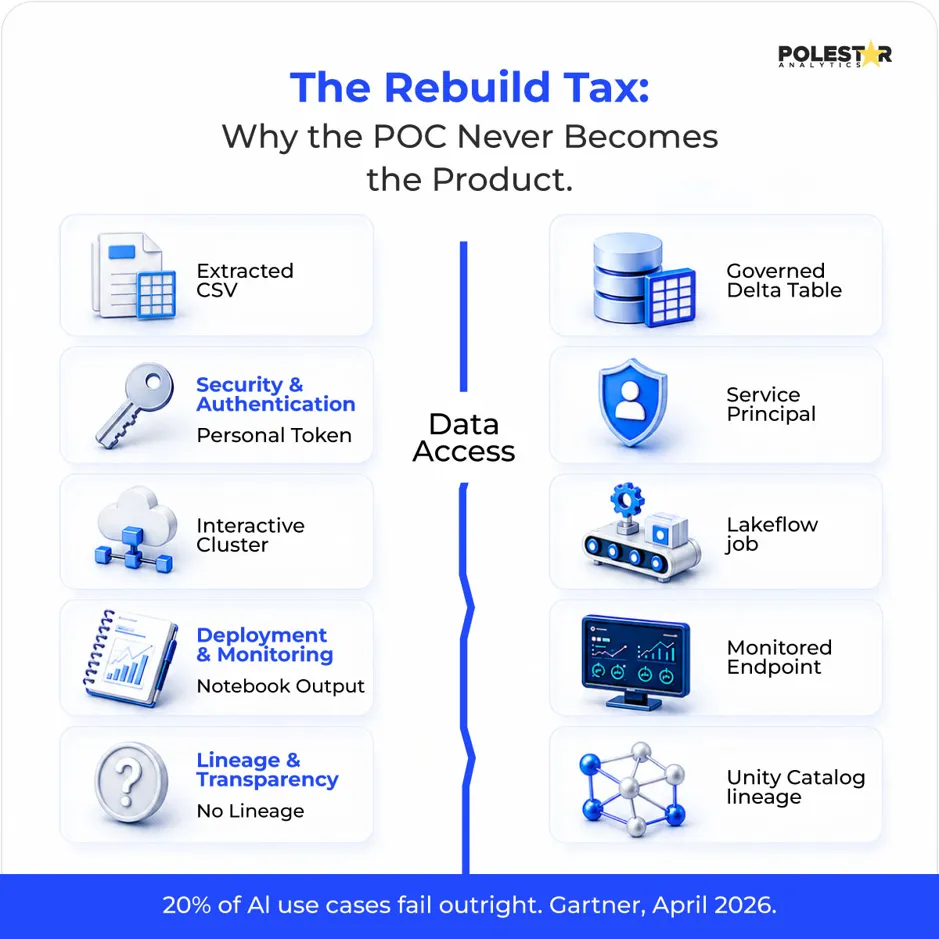
Twelve weeks is not about speed, it is a forcing function. The window is too short to build a parallel data estate, so the team must use the governed one that exists. Any AI pilot methodology permitting a sandbox detour is optimising for a demo date and deferring the cost. Constrain the timeline and the architecture corrects itself.
Four representativeness tests. Fail one and you have built a demo.
Gartner found organisations with successful AI initiatives invest up to four times more, as a share of revenue, in foundations such as data quality and governance, while those with the highest AI-ready data maturity achieve up to 65% greater business outcomes. Only 39% of technology leaders are confident current AI investments will improve financial performance (Gartner, April 2026). Ownership matters as much as tooling: McKinsey's 2026 survey found firms with explicit accountability for responsible AI average 2.6 on maturity, against 1.8 without (McKinsey, March 2026).
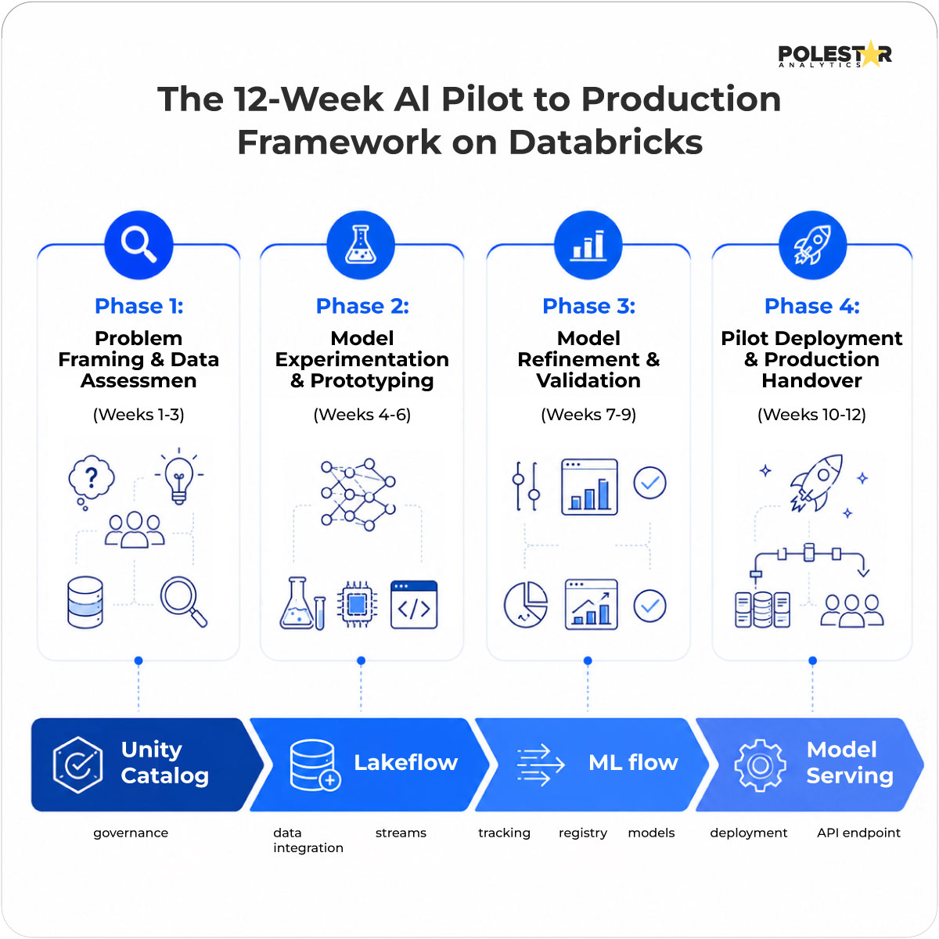
The AI pilot framework we run on Databricks. Four phases, one gate each.
Weeks 1 to 2: Contract the decision.
Weeks 3 to 6: Build the governed data slice.
Weeks 7 to 10: Build and evaluate.
Weeks 11 to 12: Shadow-run and decide.
Two-thirds of McKinsey's 2026 respondents cited security and risk as the top barrier to scaling agentic AI, while 74% flagged inaccuracy as a highly relevant risk (McKinsey, March 2026). A shadow run is the cheapest place to surface both.
Score five gates. Promote only on a clean sweep.
Gartner reinforces the adoption gate: among leaders reporting AI success, 33% attributed it to embedding AI into systems people already use rather than running it as a side project. An honest kill is also a good outcome. Two gates failing at week twelve costs a quarter; the same failure at month eighteen costs a programme.
No, and sequencing them serially is the more expensive mistake. The pilot only needs the three to five tables its use case touches, governed properly in Unity Catalog, not the whole estate migrated. Run it as the first vertical slice of the migration rather than a project that waits behind it: the pilot proves the governance pattern the wider programme then repeats. Our data migration and modernisation playbook sets out how to pick that first slice so it de-risks both.
Kill the current design, not the use case. A pilot that clears the metric gate but fails economics is telling you the accuracy is real but the architecture is wrong, usually oversized inference, redundant retrieval, or a model tier the task does not need. Re-run weeks 7 to 10 with cost as a hard constraint before reopening the business case. Promoting an AI proof of concept whose unit economics do not clear is how a successful pilot becomes an unaffordable production line, which is what our view on governing AI spend is written to prevent.
The phases hold, but two gates tighten. Agent pilots need tool-level permission scoping in week two, not week six, and the shadow run must log every action the agent would have taken, not just its output. That trail is what makes agentic deployments reviewable by risk teams.
The business owner of the decision being improved, not the data team. Engineering owns feasibility; the business owns whether the answer changes what gets done. Polestar Analytics is a certified Databricks consulting partner that builds production-grade AI and agentic Revenue Growth Management (RGM) solutions for CPG and retail brands, so both our enterprise AI practice and Databricks delivery teams are structured around that split.
Over de auteur
Insight Architect
There are no uncertainties, only possibilities and probabilities shaped into evidence by data.
Gerelateerde blog
 Astha Chadha
 Kshitij Gupta